

TL;DR
- Three back-to-back afternoon sessions shared one problem: the platforms don’t see enough of what customers actually do.
- Dave Alexander (Impression): if you can’t reach 30 conversions in 30 days, define a “high intent user” in GA4 and feed it to Google Ads as a secondary conversion. One industrial SaaS client went from 2.5 to 6 conversions a day.
- Dan Truman (Duga Digital): consent, Safari, iOS and ad blockers compound, so many accounts only measure around half of reality. Smart bidding optimises to that half. Server-side tagging, enhanced conversions, Data Manager and better consent rates rebuild the signal.
- Aleksei Rozhnov (Thrad): ads inside AI chats run on intent, not keywords. An AI query averages 60 words against 3.4 on Google, and most influence happens before any click.
- The shared message: check what the platform sees against what the business sees, and report one number everyone trusts.
About the Sessions
- Event: PPC.London 2026
- Date: 25 September 2026
- Venue: De Vere Grand Connaught Rooms, London
- 13:30 Dave Alexander, Senior Paid Media Strategist, Impression: “When the Conversion Is Not Enough: How to Make the Most of the Data You Have”
- 14:00 Dan Truman, Analytics Director, Duga Digital: “Winning Tracking, Winning Measurement, Winning Conversion: Fixing the Gaps Costing Your Paid Search”
- 14:30 Aleksei Rozhnov, Senior Engineer, Thrad: “From Search to Ask: What Running Paid Ads in LLMs Has Taught Us so Far”
Thrad’s CEO, Andrea Tortella, was originally on the agenda. He couldn’t attend, so Aleksei presented in his place.
Dave Alexander: When the Conversion Is Not Enough
The problem. Google recommends 30 or more conversions in a rolling 30-day period for conversion-based bid strategies. When data is thinner than that, the algorithm struggles, CPCs swing wildly, campaign learning stalls and traffic quality varies. Dave’s talk focused on lead gen, but he said the method works for ecommerce too.
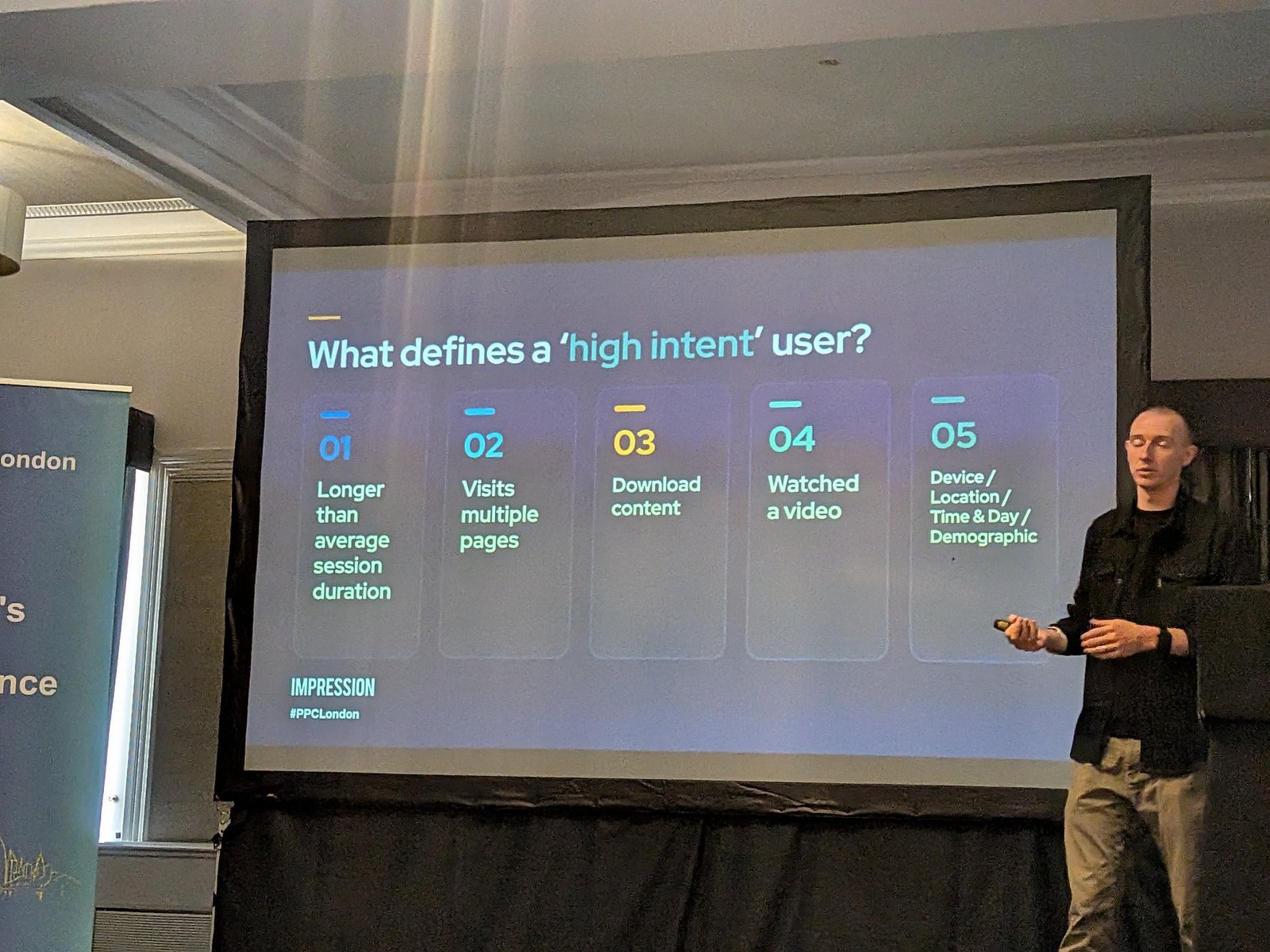
The fix. Move back up the funnel to find more high-intent users. A high-intent user, in his framework, shows some combination of:
- Longer than average session duration
- Visits to multiple pages, such as pricing or about pages, rather than bouncing from the landing page
- Content downloads, such as a white paper
- Watching a video, all the way through rather than the first few seconds
- Device, location, time and day, or demographic, depending on the business
Building it in GA4. He kept the example to the first two signals.
- In Explore, build a report with landing page as the dimension and average session duration, then views per active user, as the metrics. Analyse the pages you want high-intent users to land on, not the whole site, which can skew the average. Look at several date ranges to account for seasonality.
- Set thresholds. In his example: 2 minutes 30 seconds, and more than two pages.
- In Admin, under Data display, create a new custom audience with those conditions. Duration is entered in seconds, so 2 minutes 30 seconds is 150. He admitted he had got this wrong more than once.
- Set the membership duration to match the customer cycle: perhaps six to nine months for a wedding photographer, two years for warehouse management software.
- Create an audience trigger, so an event fires whenever someone joins the audience.
- Mark that event as a key event.
Into Google Ads. Create a new conversion action, import the GA4 key event under the Engagement category, and set it as a secondary action. No extra tag is needed, because GA4 handles the tracking. Secondary actions give the bid strategy context. Primary actions are what it optimises towards.
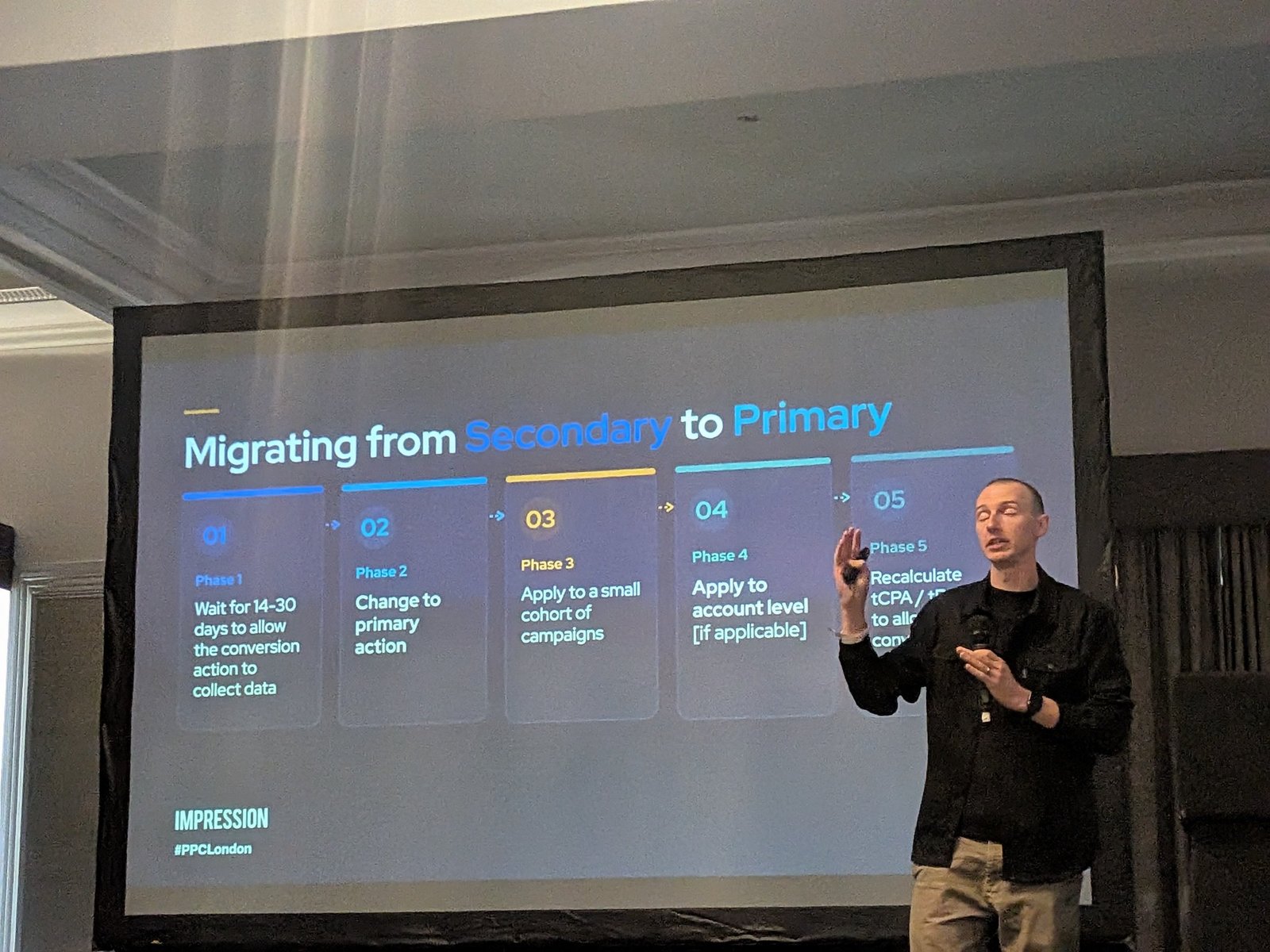
Migrating from secondary to primary, in five phases:
- Wait 14 to 30 days so the conversion action can collect data.
- Change it to a primary action.
- Apply it to a small cohort of campaigns first, so a sudden jump in conversions doesn’t destabilise the whole account.
- Apply it at account level, if it works.
- Recalculate tCPA or tROAS for the new conversion data. Going from a handful of conversions to fifty or more can move CPA from £200 to £10, and the targets need to reflect that.
Other options. A custom goal can combine “high intent user” and “contact form” into one action. Or use value-based bidding, which he recommended especially for lead gen: give contact forms and pipeline a high or dynamic value, and the high-intent user a low one, for example £100 against £10. The bid strategy then prioritises forms while still learning from the weaker signal.
Case study: industrial SaaS client. The historical baseline was 2.5 conversions a day. With the high-intent user action added, the account averaged 6 a day, which Dave reported as 328% more conversions. That gave smart bidding enough signal to support more campaigns, and the quality of submitted forms improved too.
Dan Truman: Fixing the Gaps Costing Your Paid Search
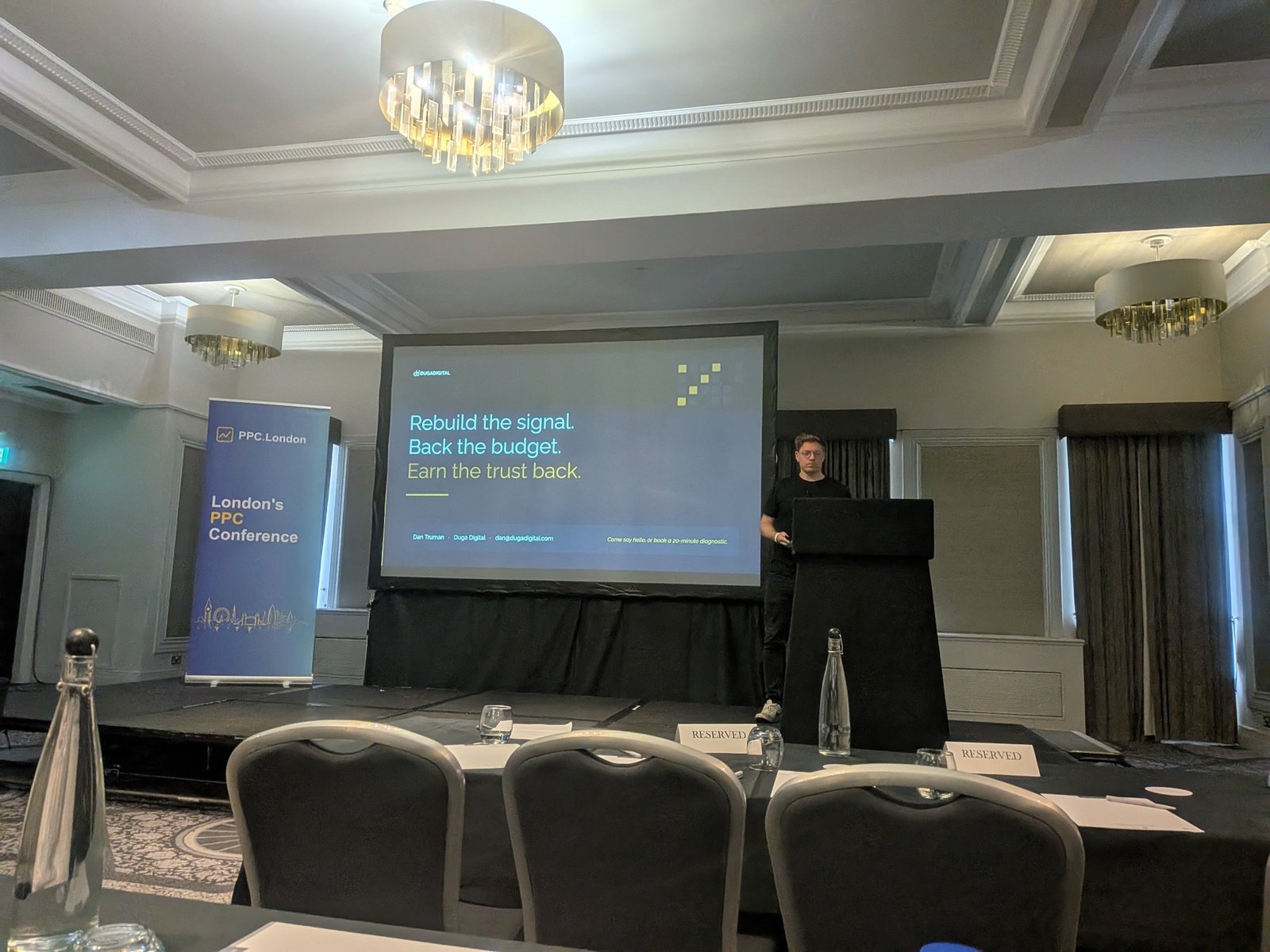
Dan opened bluntly: every other department thinks digital marketing is nonsense. Finance can’t see where the money goes, and sales sees spend going to Google and Meta without results they recognise. His view was that this is less a technical problem than a language problem. Marketing talks in CPAs. Sales talks in revenue. Finance talks in profit.
Why tracking broke. For around 15 years, a pixel fired, the platform counted it, and bids got smarter. Now several “villains” sit in the way:
- Safari’s Intelligent Tracking Prevention. Script-set cookies are capped at 7 days, sometimes 24 hours, so a returning customer looks new every week. Around 30% of UK web traffic is Safari, much of it mobile-first and higher intent.
- iOS App Tracking Transparency. Most people say no, so the journey from an in-app ad to a web conversion goes dark.
- Consent. When accept-or-reject banners went live, opt-in fell from roughly 85% to 65%, and further privacy changes pushed it lower. Many sites now track just over half of their real visitors.
- Ad blockers. 33% of tracking requests never arrive. Blockers are heaviest among the technical, affluent, privacy-aware audiences you most want to win.
- The rest: shrinking cookie lifetimes, referrer stripping, private browsing, VPNs. One client’s landing pages were stripping everything after the slash in the URL, so no identifiers survived.
These don’t add up, they compound. His illustration: of 100% of what actually happened, tracking reported 46%.
Nothing looks broken. Dashboards load, charts trend, the Monday report goes out. There is no error message for “this is only half the story”. In Dan’s words, tracking is not measurement. It is a biased output, sampled from the users who happened to let you watch.
Case study. For one online-only bathroom retailer, 54% of revenue was unattributed in the numbers the business ran on. After fixing consent and data collection, the gap narrowed to minus 3.5% and then 0.8%. In July, the client changed its consent setup again and the gap widened to 10 to 12%.
What the gap does to budget. Smart bidding learns from the signal it sees, and money flows to whatever that signal rewards. Feed it 50% and it optimises to 50%. A missing conversion doesn’t read as missing, it reads as failure, so budget moves away from what actually worked. The channels that suffer most are the ones you can measure least: upper funnel, mobile, Safari-heavy and privacy-conscious audiences. In insurance, for example, the largest purchases often happen by phone. Double the budget on a mis-measured account and you double the misallocation.
His worked illustration: on a modest £30k a month account with 40% of the conversion signal blind, if even a third of that lands on the wrong channel, that is around £48k a year. And the typical finance question: revenue is up 20%, so why is the marketing dashboard flat, and why should I approve more budget?
The rebuild.
- Server-side GTM. Sends events through your own first-party domain, so ad blockers can’t strip them, cookies keep their full lifetime, and Google, Meta, the warehouse and finance receive the same events. Across around 60 implementations, Dan sees roughly 15 to 20% more data. What it does not do: track people who said no, fix a broken data layer, prove incrementality, or make a bad campaign good. “Server-side is plumbing. Excellent plumbing. Still plumbing.”
- Enhanced conversions and user-provided data. Hashed emails or phone numbers recover conversions Google would otherwise miss, typically around 5 to 10% by his estimate, sometimes less.
- Data Manager and the Data Manager API. One connection that feeds first-party CRM and warehouse data into Google Ads, GA, Display & Video 360 and Campaign Manager, tying online clicks to offline outcomes. His example was a jewellery brand: not just the online appointment booking, but which appointments turned into in-store sales.
- Consent optimisation. The most important and ongoing piece. Raising opt-in rates is the easiest win for data coverage, and everything downstream depends on it.
He summarised the stack as five layers: consent, collection, server, IDs and activation. Mapping your percentage at each layer shows where the gaps are.
Selling it internally, in three moves:
- Reconcile to the system of record. Tie measured revenue to the finance system, not GA or the platform, and report the match rate in the same deck as the spend.
- Prove incrementality. Use causal impact and geo or holdout testing to isolate what a channel actually caused. Incrementality answers the question a CFO already asks: what if we stopped?
- Give every team the same number. Media, CRO, analytics and finance reading from one reconciled source, with the same events sent to Google, Meta, GA and TikTok. In his experience, this builds the most trust.
His results slide: traffic measurable rose from 60% to 95% once consent and server-side were done right, an accurate revenue match rate rose from 3.6% to 30% on a Shopify rebuild, and an automotive account recovered 37% of lost signal and held it for a full year.
Where to start. You don’t need a six-month programme. Pull one week of platform revenue against finance revenue, and treat the gap as your headline. Check your consent opt-in rate and your Safari share of traffic. Then run a proper diagnostic before you sign off next quarter’s budget.
Aleksei Rozhnov (Thrad): From Search to Ask
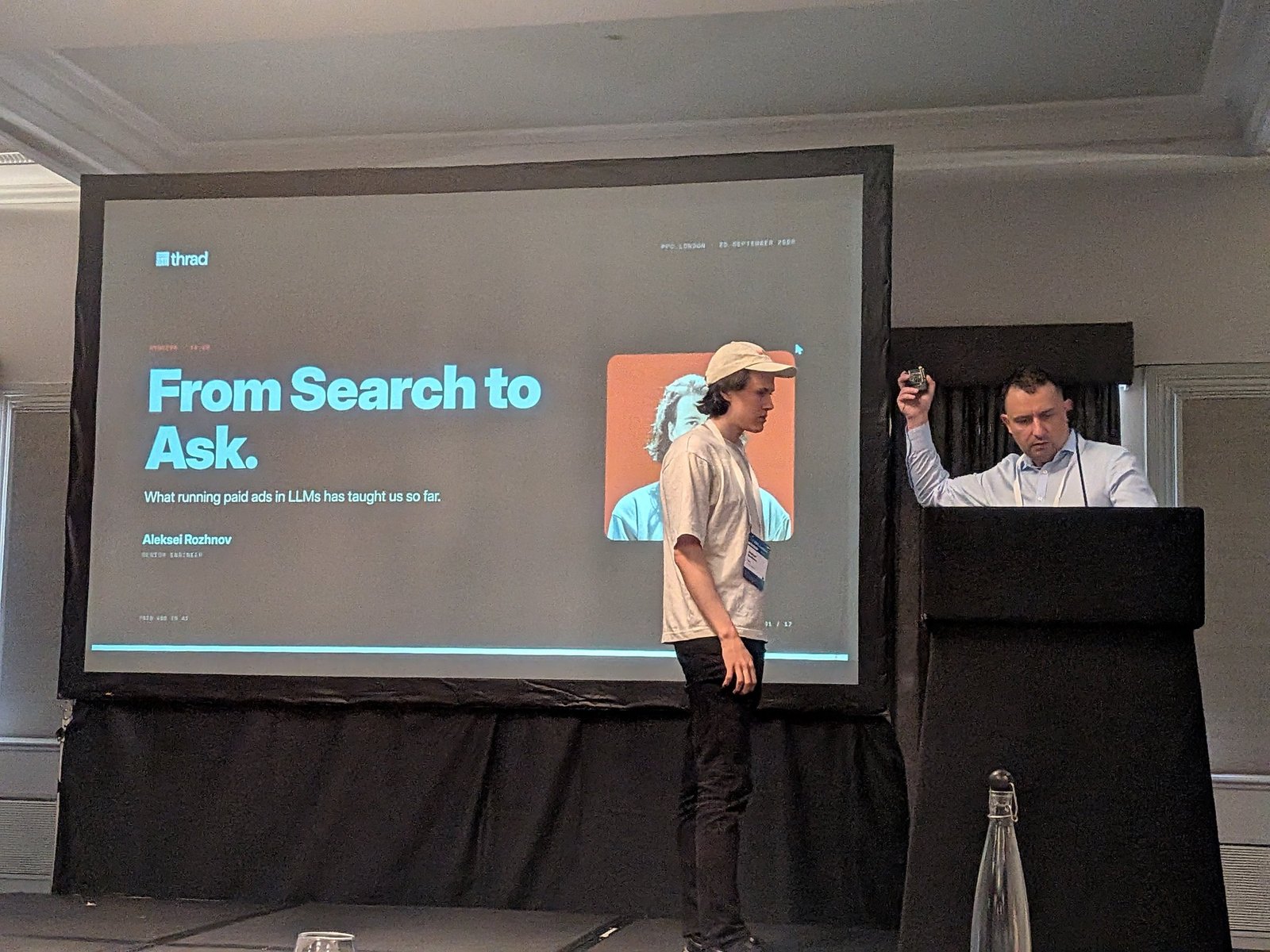
Thrad is an advertising platform for AI conversations, which describes itself as the DSP for ads in AI chats. Aleksei’s framing: search ran on three assumptions for twenty years, and “ask” breaks all three.
- Targeting used to start with a keyword. Now it starts with intent expressed in a sentence.
- Measurement used to end with a last-click conversion. Now it starts inside the conversation and still ends at the sale.
- Real estate used to be a page you own and rank. Now it is a surface you participate in.
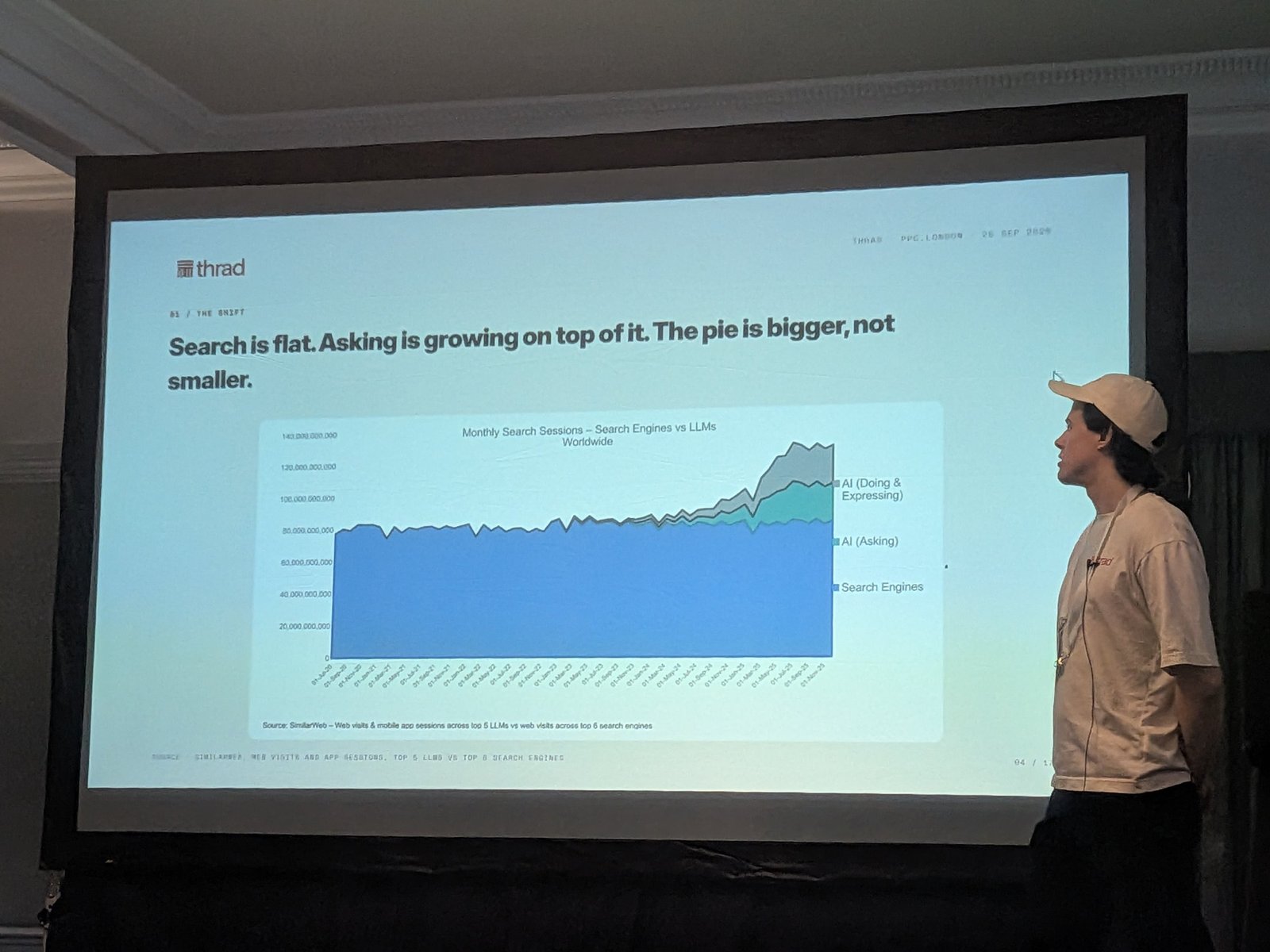
The market. Conversational AI is one of the fastest-growing ecosystems on the web, and it is plural: ChatGPT, Gemini, Claude, DeepSeek, Grok, Perplexity and Copilot together passed 10 billion monthly website visits by May 2026, according to Similarweb. Search engine sessions stayed roughly flat, and AI is growing on top of them. The pie is bigger, not smaller.
Targeting. “Keywords are ice cubes. Prompts are snowflakes.” With keywords, every brand fights over the same few. In conversations, every moment is its own auction. An AI query averages 60 words, against 3.4 on Google, so it reads like a brief: the need, the constraints, the budget and the stage of the decision, all in one turn. And one conversation can hold the whole funnel, from discovery to evaluation to purchase.
His table of what replaces the search toolkit:
- Keyword: intent read from the whole conversation, including the topic, the need and how far along the person is.
- Match type: a relevance threshold. The ad serves where the conversation is commercial enough.
- Negative list: topic and category exclusions applied to the thread, not to a word.
- Audience segment: optional, not required. The context on screen does the targeting.
What live campaigns taught them (anonymised, category-level):
- B2B software. The brief targeted senior engineering leaders. The conversations actually came from juniors asked by their boss to bring a plan, such as how to move off legacy code. Targeting flipped bottom-up, and the seniors followed.
- Mobile gaming. The winning conversations weren’t about games. They were about switching off after work, a commute with no signal, five quiet minutes.
- Travel. Search starts once dates and budget exist. In conversation it starts earlier, with how much a trip might cost or when somewhere is warm. A suggestion at that stage can still shape the trip.
Measurement. Most of the influence happens before the click, and last click can’t see it. Thrad is building a metric it calls “attention shift”: compare what the conversation is about before the ad with what it is about after. In his example, a runner asks what to eat before a marathon, sees an ad for a recovery magnesium product, and the next question becomes whether magnesium would help them sleep. No click, but a measurable shift. He was clear that clicks still count and are still reported, and that this metric is still in build.
Real estate. The page is no longer the atomic unit of the internet. The answer is. Brands appear either inside the model’s answer, which is organic and slow, or as a labelled sponsored unit after it. The surfaces are multiplying: general assistants, in-app chat, and retailers’ own assistants. Formats built for chat earn attention: they land after a genuinely helpful answer, are clearly labelled, match the topic, and give the user something to do. Banners under the chat window, interruptions before the answer, and keyword-stuffed search copy get ignored. Thrad runs six native formats: sponsored prompt, message, poll, carousel, product card and sponsored card.
Three things to take back on Monday:
- Targeting: take your top 20 keywords and write the sentence a real person would say instead. That list is your brief for conversational AI, and it often improves search copy too.
- Measurement: ask what happens in the conversation after the ad, not just whether it was clicked.
- Real estate: test across several surfaces, not one.
As a sponsor session, it closed with an introduction to Thrad’s network. The case studies were shared without figures, so they are best read as directional.
The Common Thread
Taken together, the three sessions describe one chain. Dave’s accounts don’t have enough conversions for the algorithm to learn from. Dan’s accounts measure only part of what happens, so the algorithm learns from a biased sample. And in Aleksei’s world, much of the decision happens inside a conversation, before any click that could be measured.
All three point the same way as Rob Evans and Sophie Logan earlier in the day: don’t trust the platform’s conversions at face value, check them against what the business actually sees, and agree on one number.
What Not to Do
- Don’t run conversion-based bidding on a handful of conversions. Add a high-intent signal first.
- Don’t switch a new conversion action straight to primary across the account. Test on a few campaigns, then recalculate targets.
- Don’t assume your tracking is complete because nothing looks broken. Compare platform revenue with finance revenue.
- Don’t treat server-side tagging as a cure-all. It doesn’t override consent or fix bad data design.
- Don’t paste search ads into AI chats. Formats need to fit the conversation.
- Don’t judge AI ads on last click alone. Much of the influence happens before the click.
Next Steps
- Count your conversions over the last 30 days. If you’re under 30, define a high-intent user from session duration and pages per landing page.
- Build the GA4 audience and import it as a secondary conversion. Remember that duration is in seconds.
- Pull one week of platform revenue against finance revenue. The gap is your headline.
- Check your consent opt-in rate and Safari share of traffic. Together they show how much you can’t see.
- List your conversion actions and where each one is sent. Make sure every platform receives the same events.
- Rewrite your top 20 keywords as sentences a real person would say. Use them to test AI placements and to refresh search copy.
Personal Takeaways
Back in April, I took Impression’s one-day content marketing training at brightonSEO. The best part was getting hands-on with real data, and it was a good reminder to go back to basics. Dave’s session had the same practical feel: a clear, step-by-step process you could follow in GA4 the very next day.
Dan’s talk reminded me how important it is to keep asking whether your measurement is actually right. When nothing looks broken, it’s easy to forget to question it.
Ads inside AI conversations are still very early days, and honestly, I’m not sure yet how useful they’ll be for most of my clients. That said, at brightonSEO San Diego, Ethan Smith showed that ChatGPT ad click-through rates in Japan and South Korea are roughly double those in English-speaking markets. For Japanese brands, it may be worth keeping an eye on.
Related Resources
- PPC.London 2026 agenda
- Speaker: Dave Alexander (PPC.London)
- Speaker: Dan Truman (PPC.London)
- Thrad
- Rob Evans’ session report: the morning session on why Google Ads conversions so often don’t match business value
- Sophie Logan’s session report: the morning B2B talk, including micro conversions and conversion windows
- Azeem Ahmad’s session report: the session before lunch, on why customers now arrive through four different paths
- Ethan Smith’s session report from brightonSEO San Diego: ChatGPT ads data, including click-through rates by market
Written by Ayaka Uchida
CEO, A-Digital Works
This report covers three afternoon sessions at PPC.London 2026, 25 September 2026: Dave Alexander’s “When the Conversion Is Not Enough”, Dan Truman’s “Winning Tracking, Winning Measurement, Winning Conversion” and Aleksei Rozhnov’s “From Search to Ask”.
