

TL;DR
- AI search traffic is at 8% of consumer search — and shopping queries on AI are exploding. AI chat engines now take ~8% of consumer search traffic (vs Google Search’s 82%). Within AI engines, ChatGPT dominates at 68%, Gemini holds 18%, others 14%. Shopping-related searches on AI chat engines grew +4,700% year-on-year (2025 vs 2024)
- Citation density is tight (2–7 sources/answer) and varies dramatically by LLM. ChatGPT in particular is shrinking — from 20–30 sources per answer toward ~15 since January 2026. Other engines sit at very different baselines: Perplexity is the most generous (~10, stable), DeepSeek averages just 0.5–0.7, Gemini holds ~2. There is no single “AI citation behaviour” to optimise for
- The source mix is industry-specific and LLM-specific. In UK apparel retail, the Top 10 cited sources differ dramatically across ChatGPT, Google AI Overview, Gemini, and Perplexity — Gemini’s apparel results are dominated by direct brand sites, ChatGPT leans on UGC/Social at the top before mixing in editorial and brand, and Google AI Overview is the most UGC-heavy of the four
- Brand-level visibility benchmarks. Across 5 AI chat engines in UK apparel, Marks & Spencer and H&M tied for the top average visibility score at 44% (appearing in ~5 of every 10 AI answers). M&S is climbing — driven by both brand-identity pages and listicle-style content getting indexed by LLMs. Visibility is becoming the North Star metric for AI search
- LLM selection matters by use case. B2C brands should monitor ChatGPT and Google’s LLMs (AI Overviews, Gemini) most closely; B2B brands need Claude, Perplexity, and Copilot in the tracking mix — Copilot in particular is under-tracked across the industry
- Position in answer is now its own KPI — distinct from rank. Answers are getting longer; users don’t scroll. The first few brands cited do disproportionate work
About the Session
Track: Skyline Stage — Retail
Date: Friday 1 May 2026, 09:30
Venue: Skyline Stage, Brighton Centre, Kings Road, Brighton and Hove, BN1 2GR, United Kingdom
About the Speaker
Gintarė Rimolaitytė — Chief Commercial Officer, Trendos
Gintarė leads commercial strategy at Trendos, an AI search visibility analytics platform that monitors how brands appear across major LLMs (ChatGPT, Google AI Overview, Gemini, Perplexity, and others) at industry and brand level. An experienced entrepreneur with prior ventures in marketing consulting, affiliate, and brand risk management, Gintarė has spent her career working closely with marketing teams — listening to pain points that frequently became the basis for new SaaS products. Trendos launched in March 2026 and is backed by Tesonet, the Lithuanian venture builder behind Nord Security, Surfshark, Hostinger, and Oxylabs — giving the platform an unusually strong data infrastructure foundation. The platform currently covers 13+ markets including the US, UK, Germany, France, Spain, Lithuania, the Netherlands, Australia, Israel, China, and Japan, with a database of over 2.5 million brands.
Her Day 2 morning session sat in the Skyline Stage retail track alongside Malte Landwehr and Wendi Sturgis — three different angles on the same underlying question of how AI engines decide what products to surface to consumers.
Where Malte’s research focused on the mechanics of ChatGPT’s fan-out and grounding, and Wendi’s focused on brand-vs-location visibility strategy, Gintarė anchored on the empirical state of source citation across industries in the UK market — apparel, confectionery, and consumer finance — using Trendos’s monitoring panel data from March 2026.
AI Search Traffic Is at 8% — But Shopping Queries Are Exploding
Gintarė opened with the baseline number every SEO leader needs to know: AI chat engines now account for around 8% of consumer search traffic as of March 2026, with Google Search still holding 82%. The 8% is small but the trajectory is what matters.
The composition of that AI slice:
- ChatGPT dominates at 68% of AI chat engine traffic, driven by the fastest early adoption
- Gemini holds 18%
- Other engines (Perplexity, DeepSeek, and others) make up the remaining 14%
The single most dramatic number in the session: shopping-related searches on AI chat engines grew +4,700% year-on-year (2025 vs 2024). This is the part of the AI shift with the most immediate revenue consequence for retail — consumers are now running transactional and commercial prompts (“best sneakers under £200”, “what laptop should I buy for video editing”) inside LLM interfaces instead of going to Google.
The discovery layer hasn’t disappeared — it’s moved, and for shopping specifically, it’s moved fast.
Citation Density Varies by LLM — and ChatGPT’s Is Shrinking
The most distinctive empirical finding of Gintarė’s session was the differential citation behaviour across major LLMs. There is no single number — each engine cites at a different baseline, and the trends diverge.
The numbers, combining Gintarė’s on-stage commentary with her published data:
- On her slides, the headline figure was 2–7 sources cited per answer across LLMs — already a tight set compared to a traditional SERP
- In her commentary, ChatGPT specifically used to surface 20–30 sources per answer and is now closer to 15 and trending down since January 2026 — the engine with the largest AI search share becoming structurally less generous
- From her published 4-month data (December 2025–April 2026, over 7 million responses): Perplexity is the most generous and consistent citer (~10 sources, stable monthly); Google AI Overview is volatile but trending up (peaked at 10.38 in February); Gemini holds steady at ~2; DeepSeek averages just 0.5–0.7 sources, often returning none at all
The strategic implication is that “AI visibility” is not one game. ChatGPT visibility, Perplexity visibility, Google AI Overview visibility, and Gemini visibility are five different problems with different success criteria. A brand that ranks well in Perplexity’s 10-citation list may be invisible in Gemini’s 2-citation list — and the optimisations for each are not the same.
Gintarė’s framing on the ChatGPT-specific shrinkage: brands that aren’t in ChatGPT’s shortlist of 15 today will be competing for a slot in a list of 8 or 10 tomorrow. The advantage compounds for whoever gets indexed and cited early. The window to establish “default cited” status in ChatGPT is closing fastest of the major engines.
Apparel Retail UK: The Source Mix by LLM
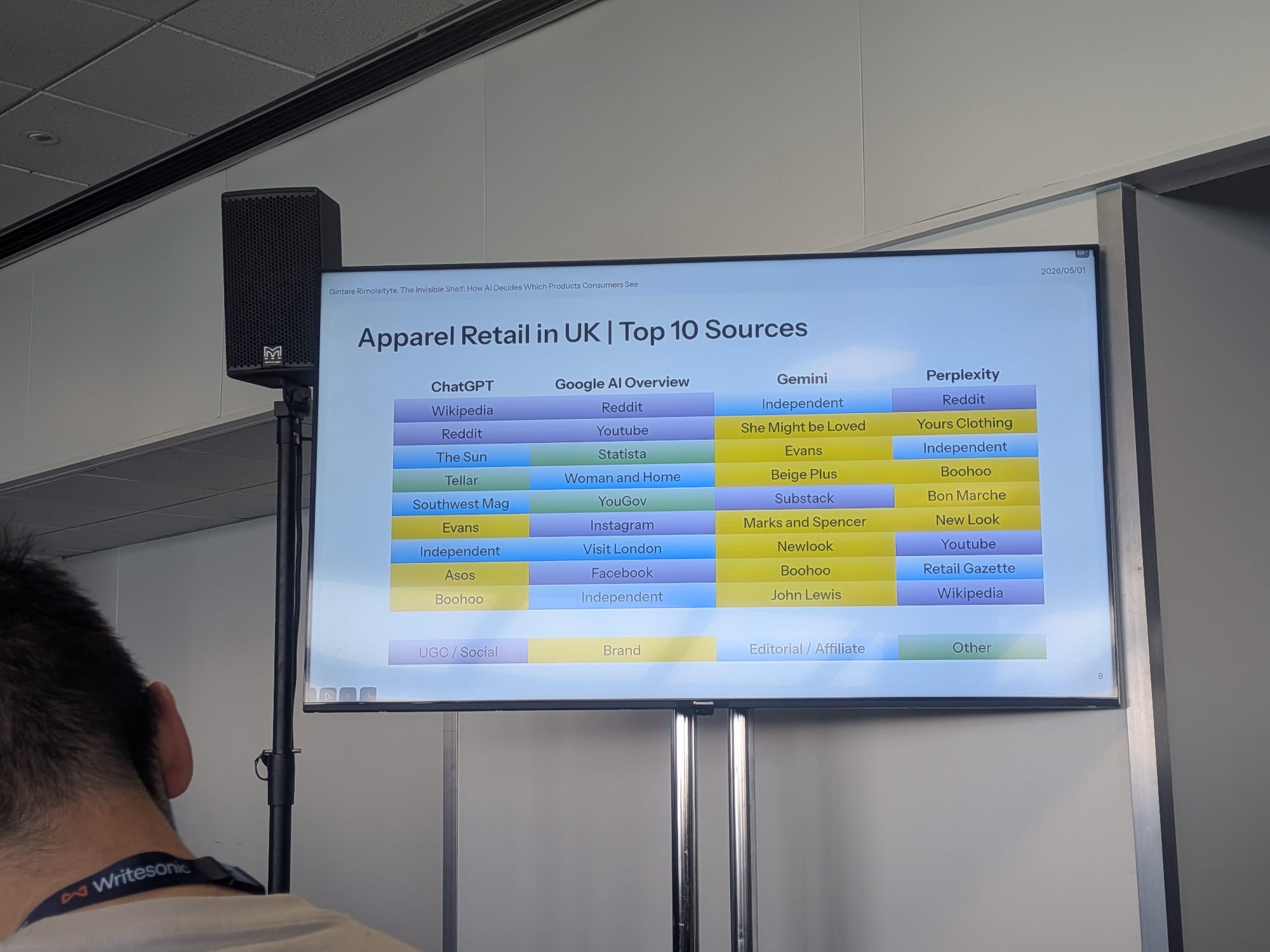
The most useful slide of the session was Gintarė’s Top 10 sources view across four LLMs (ChatGPT, Google AI Overview, Gemini, Perplexity) for UK apparel retail, colour-coded by source type:
- UGC / Social (Reddit, YouTube, Wikipedia, Instagram, Facebook)
- Brand (Asos, Boohoo, Evans, Marks and Spencer, John Lewis, New Look, etc.)
- Editorial / Affiliate (The Independent, The Sun, Retail Gazette, Woman and Home)
- Other (Statista, YouGov, Tellar, Southwest Mag)
The pattern is striking:
- ChatGPT leans on UGC/Social at the very top — Wikipedia and Reddit anchor the top of the top-10 — but quickly diversifies into editorial sources (The Sun, The Independent), other (Tellar), and brand sites (Evans, Asos, Boohoo) further down the list
- Google AI Overview is also UGC/Social-heavy at the top (Reddit, YouTube), but blends in editorial and statistical sources (Statista, YouGov, Woman and Home)
- Gemini is brand-dominated in apparel — the majority of its top sources are direct retailer sites (Evans, Beige Plus, Marks and Spencer, New Look, Boohoo, John Lewis)
- Perplexity sits between the others, with Reddit at the top but a strong brand presence (Yours Clothing, Boohoo, Bon Marche, New Look)
The strategic implication: there is no single AI-visibility playbook that works across all LLMs in retail. If your brand is invisible on Gemini, your problem is your direct site content not getting indexed. If you’re invisible on ChatGPT, your problem is more likely UGC and editorial coverage. Perplexity requires both — direct brand presence and UGC visibility.
This is the kind of empirical, industry-specific breakdown that’s hard to get from generic AI visibility tooling and is the strongest analytical contribution of the session.
Confectionery: Same Pattern, Different Brands
Gintarė walked through a parallel view for UK confectionery, where she flagged two observations:
- Gemini is dominated by branded content in confectionery responses. If you’re a confectionery brand with a reseller network (Tesco and other UK supermarket retailers), one of the highest-leverage activities is making sure resellers carry structured, well-organised content about your brand on their product pages. That reseller content is what Gemini picks up and re-cites when consumers ask LLMs about confectionery
- Cadbury’s visibility is declining in the 30-day trend, despite holding a top position in confectionery share-of-citation through most of 2025. Among the confectionery Top 5, Cadbury was the only one trending down — Haribo, Swizzels, Tesco, and ASDA were all broadly flat
The Cadbury observation isn’t just a competitive note — it’s a warning that incumbent visibility decays if a brand doesn’t actively feed the LLM-cited content layer. With the rest of the confectionery Top 5 holding flat, Cadbury’s decline stands out as the single moving piece — and not in the direction a category leader wants.
B2C vs B2B: Different LLMs Matter
A simple but consequential framework Gintarė offered for AI visibility monitoring:
- B2C brands: prioritise monitoring ChatGPT and Google’s LLMs (AI Overviews, AI Mode, Gemini). This is where consumer purchase journeys are happening
- B2B brands: prioritise Claude, Perplexity, and Copilot. These are the LLMs used by enterprise buyers, technical evaluators, and researchers — and they’re often forgotten in mainstream AI visibility tools that default to a B2C lens
She noted that Copilot specifically is under-tracked across the industry. Many platforms have stopped reporting on it or never started, partly because Microsoft’s product positioning is confusing and partly because it doesn’t have the consumer-mindshare of ChatGPT or Gemini. But for B2B brands sold into Microsoft-shop enterprises, Copilot is the LLM their buyers actually use.
Practical implication for tracking: if your AI visibility dashboard only monitors three or four LLMs, make sure they match your buyer’s actual usage patterns — not the industry’s default list.
Brand Visibility Benchmarks
The benchmark Gintarė anchored was her “Visibility Score” view — measured across 5 AI chat engines for the Top 10 brands in UK apparel retail (March 2026):
- Marks & Spencer led at 44% average visibility score (latest 54%, ranging 32–60%) — appearing in roughly 5 of every 10 AI answers
- H&M also at 44% average
- ASOS 42%, New Look 41%, Boohoo 37%, Next 33%, Uniqlo 31%, River Island 28%, ARKET 21%, Depop 18%
The spread is the point: even the category leader appears in only about half of relevant AI answers, and the gap between the leaders is narrow. This is a highly competitive visibility market where small content advantages compound.
Looking at the 30-day visibility trend, Marks & Spencer was climbing, H&M was declining slightly, and ASOS, River Island, and Boohoo were broadly flat.
The cause analysis Gintarė ran on M&S’s climb was instructive: it came from the brand’s own website content getting picked up by LLMs more aggressively over time — not just brand-identity pages, but the listicle and editorial-style content M&S produces.
This connects directly to Malte Landwehr’s earlier finding about listicles being one of the highest-leverage AI citation formats. Two independent panel-data analyses pointing at the same tactic in the same morning is one of the cleanest “this works” signals from the conference.
The Additional KPI Stack
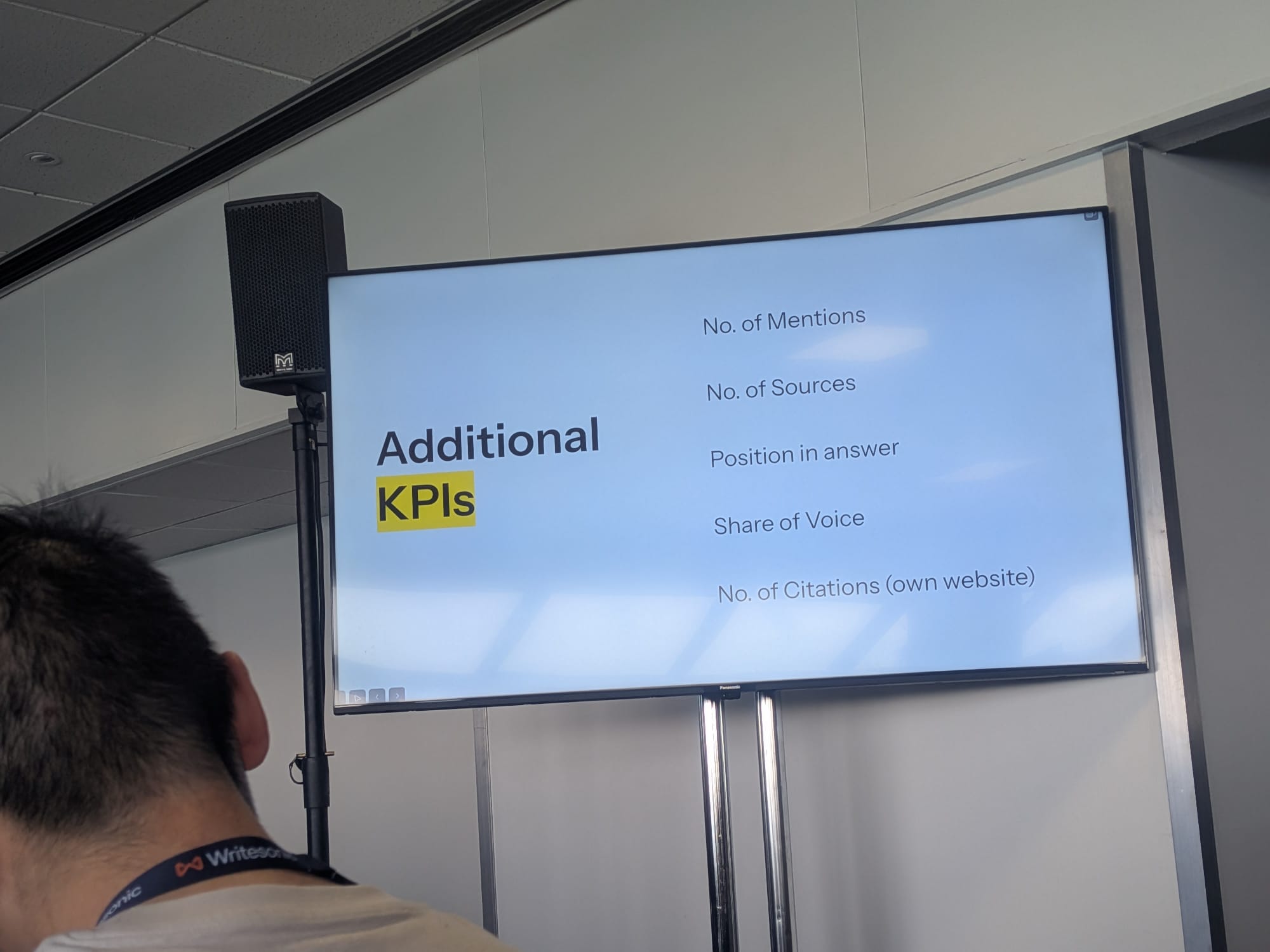
Gintarė closed with a five-metric KPI framework for AI visibility tracking that extends beyond the basic “do we appear or not” measurement:
- No. of Mentions — how often the brand appears across answers
- No. of Sources — how many distinct sources cite the brand
- Position in Answer — where in the response the brand sits (not the same as classic SERP rank; LLM answers are longer and the first few brands cited get disproportionate attention)
- Share of Voice — the brand’s citation share against its competitive set
- No. of Citations (own website) — how often the brand’s owned domain is cited as a source, vs being mentioned only via third parties
The Position in Answer metric is the most novel of the five and the one most under-tracked by current AI visibility platforms. As Gintarė pointed out, AI responses are getting longer and longer — users don’t read through to the end. The first three brands mentioned do most of the work; brand seven or eight is functionally invisible even if technically “mentioned.”
This complements Pete Meyers’s later keynote observation about brand bias in prompts: if your AI visibility platform reports you as “highly mentioned” but only tracks branded prompts, and only tracks raw mentions without position-in-answer, your dashboard is telling you a flattering lie.
Personal Takeaways
This is my third BrightonSEO (Brighton 2025, San Diego 2025, Brighton 2026), and Gintarė’s session was a useful counterweight to the more theoretical or mechanism-focused sessions of the morning. Where Malte gave us how ChatGPT does its shopping fan-out and Wendi gave us why location visibility behaves differently from brand visibility, Gintarė gave us what’s actually happening right now in three UK industries — apparel, confectionery, consumer finance — at the level of which specific brands and sources are getting cited where.
What I’m taking home:
- The ChatGPT-specific citation density shrinkage is the most operationally important finding for A-Digital Works clients. If ChatGPT is moving from 20–30 sources per answer toward 10 or fewer, the window to establish a brand in ChatGPT’s “default cited” set is closing fast — and given ChatGPT’s market share, that matters more than the same trend would in a smaller-share engine. This is the kind of trend that’s much easier to act on at month six than at month eighteen. Meanwhile, the lesson from the other engines is the opposite: Perplexity, Gemini, DeepSeek, and Google AI Overview each behave differently, and a brand strategy needs to treat them as five separate optimisation problems, not one.
- The Top-10 sources by LLM view is a workflow I can adopt immediately. For any client entering the UK or Japanese market, the question “where does AI find brands in this category” used to be answered with generic SEO research. Trendos’s approach — actual top-10 cited sources per LLM, colour-coded by source type — is a far more actionable framing. Trendos covers Japan as one of its 13+ markets, which makes it directly applicable to A-Digital Works’s UK–Japan corridor work. I’ll be applying this analysis pattern to A-Digital Works’s client onboarding, and exploring whether Trendos’s Japan data can replace some of the SEMrush-based research I currently lean on for Japanese market visibility audits.
- The B2C vs B2B LLM split is the kind of distinction that’s been collapsed in most AI visibility conversations, and it has real consequences. For A-Digital Works’s mix of consumer (Japanese language school, Nihon GO! World) and B2B (Descartes-style enterprise localisation) work, the right LLM mix to monitor is genuinely different. I had been treating it as one problem; it’s two.
- Position-in-answer as a metric is the operational refinement I was missing. Most of my AI visibility analysis to date has focused on whether the brand appears, not where it appears. The same point applies to client reporting — being mentioned ninth in a long answer is meaningfully different from being mentioned first.
- The M&S listicle uplift reinforces Malte’s listicle findings. Two independent panel datasets, two different analytical methodologies, same direction: brand-produced (and third-party) listicles continue to be one of the highest-leverage AI citation formats. The two findings aren’t identical — Malte’s data was about listicles generally as a citation source, Gintarė’s was about a single brand’s website content gaining traction — but they point at the same tactical pattern, which is much stronger as a signal than either finding alone.
Across the BrightonSEOs I’ve attended, the strongest sessions have been the ones that brought original panel data and analytical contributions to industry questions, rather than repackaging consensus. Gintarė’s session sat alongside the morning’s other two retail-track sessions (Malte’s ChatGPT carousel research and Wendi’s Yext panel data) in that bracket. Three retail-focused, data-grounded sessions in a single morning made Day 2’s Skyline opener arguably the strongest single track of the conference.
Related Resources
- Session: The Invisible Shelf: How AI Decides Which Products Consumers See (BrightonSEO)
- Speaker profile: Gintarė Rimolaitytė (BrightonSEO)
- Gintarė Rimolaitytė on LinkedIn
- Trendos — the AI search visibility analytics platform whose March 2026 panel data underpins this research; covers 13+ markets including the UK, US, Germany, and Japan
About the Author
Ayaka Uchida (打田彩夏) — Founder & CEO, A-Digital Works Ltd. Founder, Nihon GO! World (London Fitzrovia & Manchester). Over a decade of international business development across Japan, Singapore, the US, and the UK. Three-time BrightonSEO attendee (Brighton April 2025, San Diego September 2025, and Brighton April 2026 — the latter on scholarship). Aoyama Gakuin University Faculty of Law. Fluent in Japanese and English; studying Spanish, French, and German.
Connect: a-digitalworks.com | LinkedIn
About A-Digital Works
A-Digital Works Ltd is a London-based Japan–UK SEO and EN↔JA localisation consultancy supporting UK, EU, and US companies entering the Japanese market. Services span keyword research in Japanese, content localisation, technical SEO, and market entry strategy. Flagship case study: Descartes Systems Group (Canadian logistics technology) — full Japanese-market SEO programme covering 物流システム, EDIシステム, and 配車システム.
This report covers Gintarė Rimolaitytė’s session “The Invisible Shelf: How AI Decides Which Products Consumers See” on the Skyline Stage of BrightonSEO Brighton on Friday 1 May 2026.
