

TL;DR
- The SERP is now UGC-first and AI-cited; keywords alone are a losing game in a zero-click world.
- 73% of businesses already have Reddit threads ranking on page 1 for their branded searches — option A is zero click, option B is the user going to Reddit.
- Ainhoa’s framework: Landscape → Community → Market Deep Dives, applicable to any category.
- Her formula: SEO + Reddit = EEAT + Non-commodity — content that ranks, gets cited, and converts.
- In an automotive case study across G5 markets (UK / DE / FR / IT / ES), client EV sentiment swung 26 points between the UK (-9%) and Germany (+17%) — a single global content strategy cannot work.
- The operational shift: from one-time audits to a continuous MEUT loop (Monitor → Extract → Update → Track).
About the Session
Defining Your Content North Star in a Zero-Click World
Zero Click SEO track, Day 1, Auditorium 1 — Brighton Centre
Thursday 30 April 2026, afternoon track (third of four speakers: Jack Lingard → Tom Capper → Ainhoa Lizarralde → Jon Earnshaw)
About the Speaker
Ainhoa Lizarralde — International Head of SEO at Marketfully
Ainhoa is an SEO professional and marketer with over 15 years of experience. Originally from the Basque Country, she lived and worked in London for eight years and now operates internationally. She specialises in multilingual content, international and technical SEO, transcreation, and translation.
Branded Search Goes UGC-First
Ainhoa opened with the structural shift the talk was built around — global search has changed. The SERP is no longer a list of blue links pointing at brand-owned domains. It is increasingly a layered surface of AI Overviews, user-generated content, and platform-native answers that resolve the query before the user ever clicks. In her framing, every branded query now offers the user two options — option A is zero click, option B is going to Reddit.
Two related data points anchored the opening. First, brand conversations about businesses on Reddit are growing fast. Across a tracked brand set, Reddit mentions rose 23.7% period-on-period over 13 months, with H2 (October 2025 – April 2026) producing an additional 53,000 mentions compared to H1, sustaining roughly 1,408 daily mentions on average and 504,000 total conversations over the period. Second, Reddit’s overall content volume is staggering: 5.95 billion pieces of content created on Reddit in H1 2025 alone, including 1.93 billion comments and 3.50 billion chats. Around 80% of users surveyed believe some questions can only be answered by people, not AI-generated summaries — and Reddit itself frames its content as “essential for training” LLMs and AI search engines.
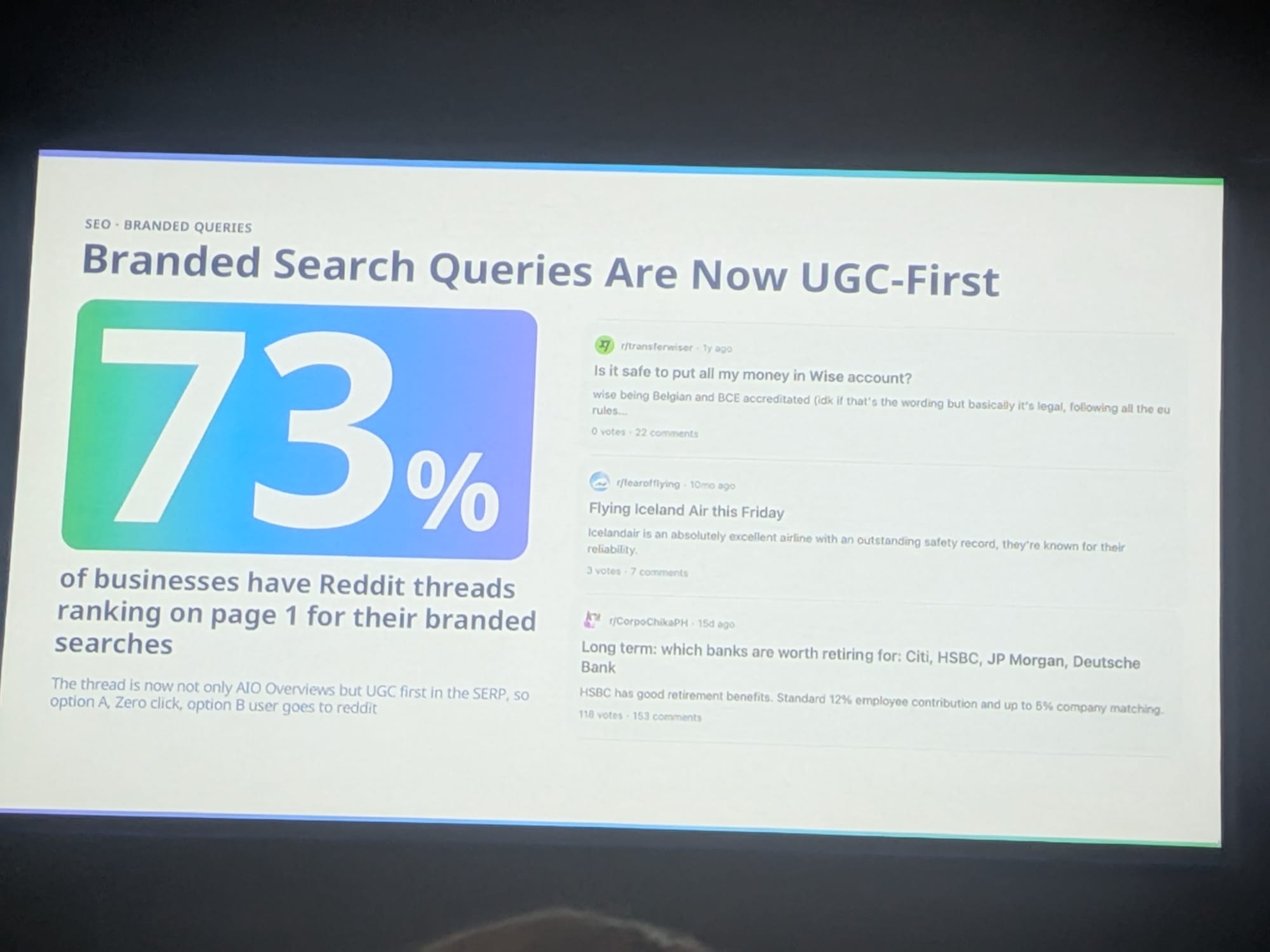
73% of businesses already have Reddit threads ranking on page 1 for their branded searches. The branded thread is not just an AI Overview source — it sits in the SERP itself, UGC-first. The path back to the brand’s own site is no longer the default.
Non-branded terms tell the same story. An Ahrefs snapshot for reddit.com in the UK, desktop, “review” filter, April 2026, showed Reddit ranking for 221,800 keywords generating roughly 1 million monthly organic visits with an estimated $1.0M traffic cost — and the trend has been climbing throughout the year.
The reframe Ainhoa argued for was this: it is not about Reddit. It is about content intelligence in a zero-click world. Two complementary data sources tell you what real user intent looks like. SEO data shows what users search privately — high-volume topics, intent clusters, gaps against competitors. Reddit data shows what users discuss openly — real questions, pain points, emerging themes across markets. In a zero-click environment, visibility is no longer just rankings. It is about understanding demand, sentiment, and gaps across platforms, which requires reading both signals at once.
The Three-Stage Methodology
To operationalise the SEO + Reddit reading, Marketfully developed a three-stage standardised approach powered by AI and text analytics. The methodology is the portable part of the talk — applicable to any category, not just automotive.
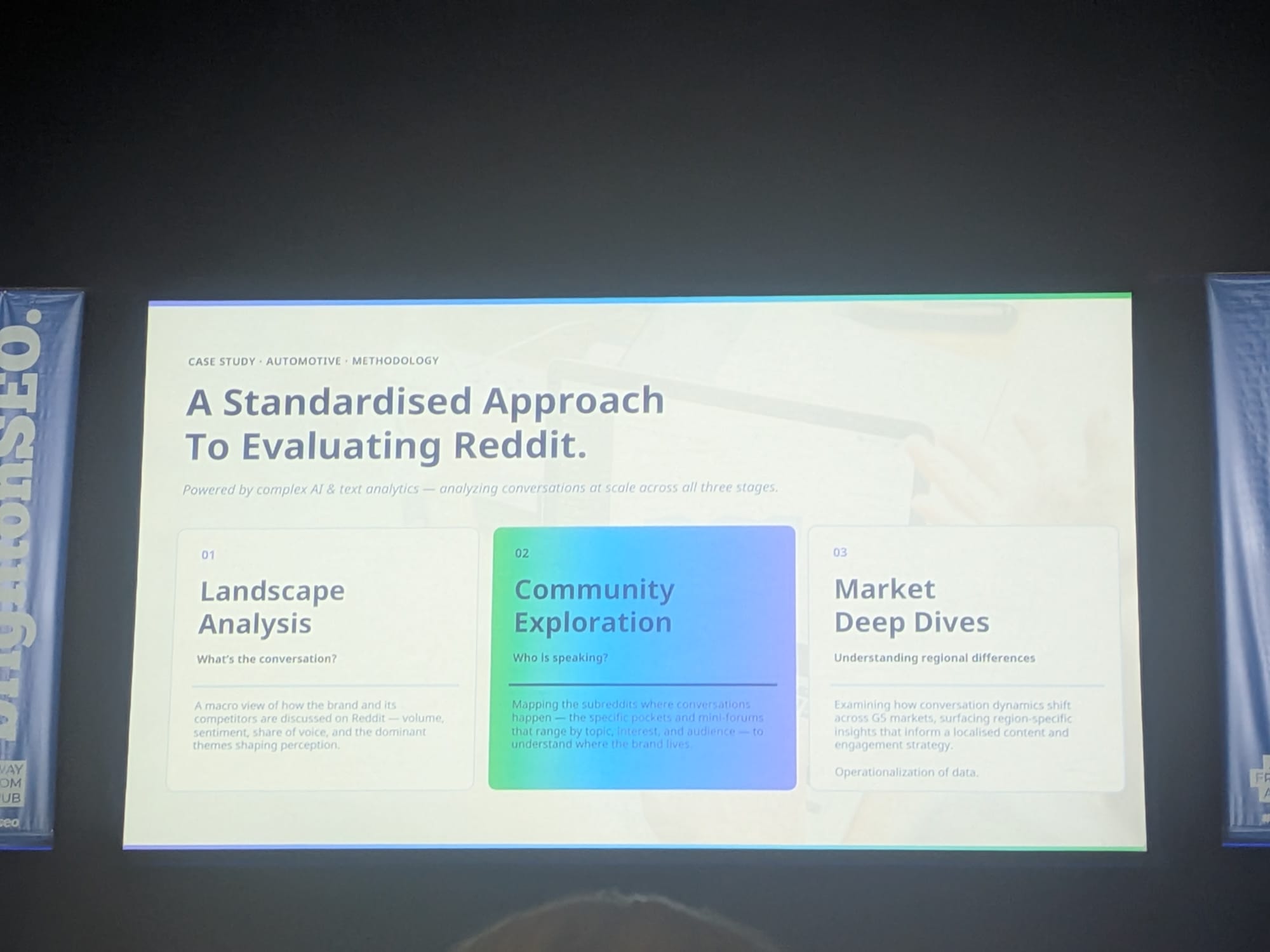
Stage 01 — Landscape Analysis: “What’s the conversation?” A macro view of how the brand and its competitors are discussed on Reddit — volume, sentiment, share of voice, and the dominant themes shaping perception.
Stage 02 — Community Exploration: “Who is speaking?” Mapping the subreddits where conversations actually happen — the specific pockets and mini-forums that vary by topic, interest, and audience — to understand where the brand lives in the Reddit ecosystem.
Stage 03 — Market Deep Dives: “Understanding regional differences.” Examining how conversation dynamics shift across markets, surfacing region-specific insights that inform a localised content and engagement strategy.
The Automotive Case Study Across G5 Markets
The middle of Ainhoa’s talk was a case study from Marketfully’s work with a global automotive brand evaluating its Reddit presence across the G5 markets — the UK, Germany, France, Italy, and Spain. The brief was straightforward: evaluate the brand’s Reddit presence and determine what active intervention is required. The approach was to analyse 12 months of Reddit data, examining mentions of the brand alongside 9 direct competitors to establish a clear benchmark. The central question framed everything: what are we missing from the conversation?
Landscape — a thriving, growing category. The automotive category on Reddit is massive — over 350,000 conversations across G5 markets, generating more than 2.7 million engagements in upvotes, comments, and shares. Year-on-year, category conversation volume is rising across all five markets. But the client’s visibility was uneven: a thriving, engaged category with significant pockets the client was not reaching.
Community — fragmented across 8,200 subreddits, client featured in 14%. Conversations clustered into three buckets — Brand (direct mentions, product discussion, owned content), Community (enthusiast spaces, peer advice, shared passion — the majority of conversation), and Multicultural Dynamics (broader automotive culture, trends, memes, lifestyle). Across 8,200 unique subreddits participating in automotive conversations, the client was featured in only 14% of those communities. Most conversation happens in shared spaces across all brands — and the client had not claimed its share.
Market — same topics, very different sentiment. This was the headline finding. Both the UK and Germany concentrate heavily on EV discussion — but client sentiment told two completely different stories. In the UK, the client had a net sentiment score of -9% (more negative than positive mentions). In Germany, the same client had a net sentiment score of +17% (significantly more positive than negative). That is a 26-point swing on the same topic between two markets in the same region. A single global content strategy would have been actively counterproductive in at least one of those two markets.
The theme maps confirmed the divergence. The UK map clustered around Toyota Yaris, Family Car Debates, EV Hunt, Driving Tips, Poor Drivers, Ford Engine Woes, Renault EVs, and Challenger Chinese Brands. The German map looked entirely different — German Auto Decline, Vehicle Issues, Reckless Driving, Used Cars, French Brands, Volkswagen, Reliability Issues, Kia, and a parallel EV Hunt thread. Same category, same competitors, different conversations, different sentiment.
The divergence was behavioural as well as thematic. In the UK, the brand had a deeper relationship with users — nostalgic conversations, lived experiences, peer-to-peer advice on driving tips, and discussion close to specific decision moments where users wanted to compare and validate. The funnel was mature; Reddit sat at the bottom of it. In Germany, the brand sat at an earlier stage of awareness and consideration. Conversations were more analytical and opinion-driven, focused on industry and brand perception rather than lifestyle, and noticeably less transactional. Same category, same competitors, but two markets sitting at different points in the buyer journey — which is why the same content strategy could not have worked for both.
Three things came out of the case study. On landscape: the conversation is rich, large, and growing, so listening is non-negotiable whether or not the brand decides to participate. On community: the most impactful conversations are concentrated in a few key spaces, especially where Google surfaces older Reddit results. On market deep dive: one topic like EVs can anchor a content strategy, but market-specific nuances allow the brand to dial in relevancy per market. One topic, five markets, tailored messaging.
From Commodity to Non-Commodity
The next question Ainhoa addressed was the one every SEO in the room was already asking: are we trying to outrank Reddit?
The answer was no. The goal is to move from keywords to themes and make the content conversational. From there, two paths open up depending on whether the brand can compete for the underlying query at all. If we can compete, we use the Reddit signal to write content that ranks for the queries we already chase. If we cannot compete, we build content that answers the question on our own site — even if it never ranks on Google — to get cited in AI answers and deepen the brand’s EEAT.
The bridge between data and content is what Ainhoa called the formula: SEO + Reddit = EEAT + Non-commodity. Content that ranks. Content that gets cited. Content that converts. The shift this formula enables — from generic, commoditised, descriptive content to specific, scenario-driven, decision-led content — is the operational core of the talk.
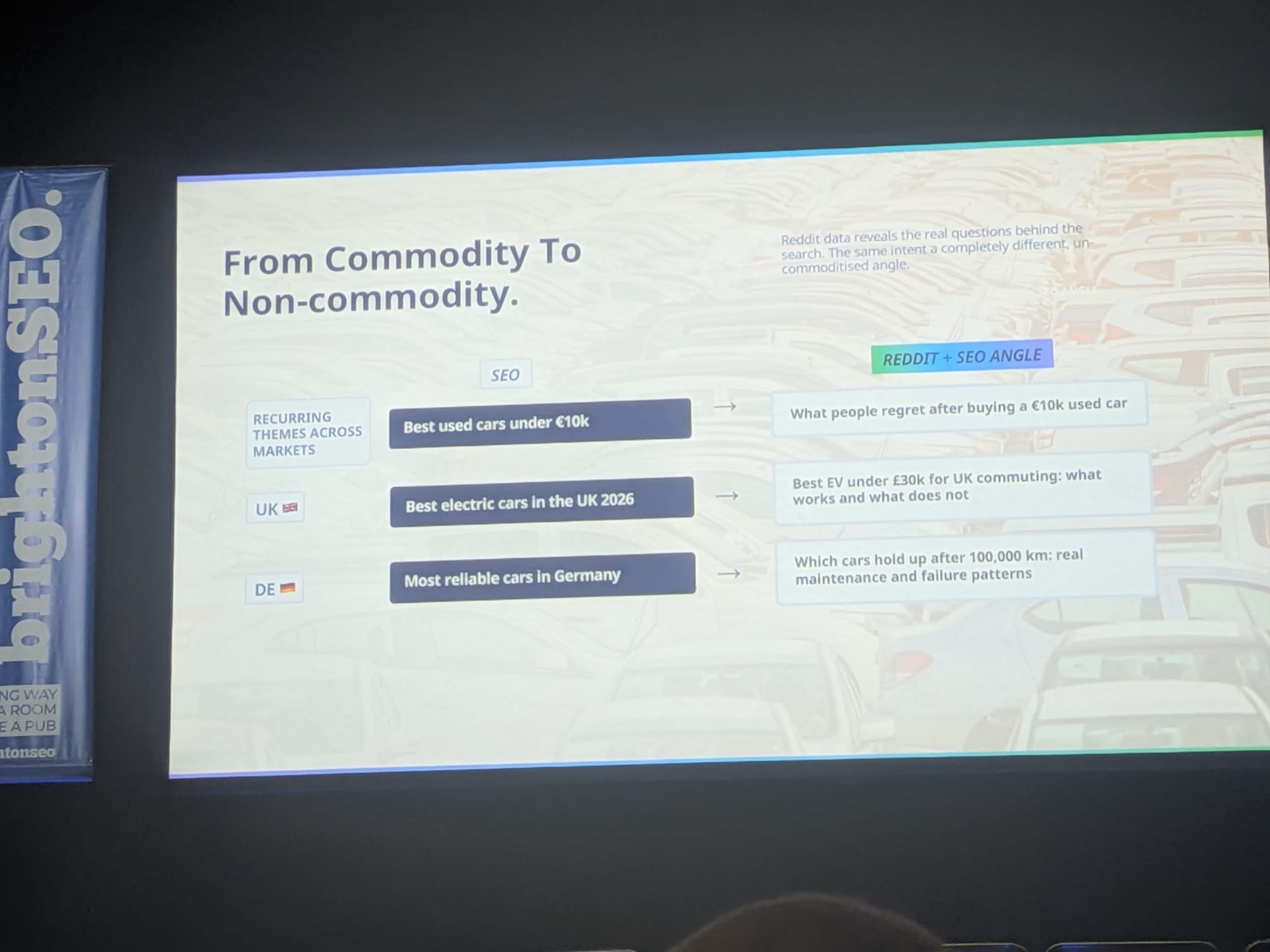
Three worked examples made the shift concrete:
- Recurring theme across markets: “Best used cars under €10k” → “What people regret after buying a €10k used car.”
- UK: “Best electric cars in the UK 2026” → “Best EV under £30k for UK commuting: what works and what does not.”
- Germany: “Most reliable cars in Germany” → “Which cars hold up after 100,000 km: real maintenance and failure patterns.”
Each rewritten title points at the same search demand as the original but answers a different — and more honest — question. The reframe turns a commodity comparison page into a piece of content with somewhere to go because it has a specific scenario, a constraint, and a decision behind it.
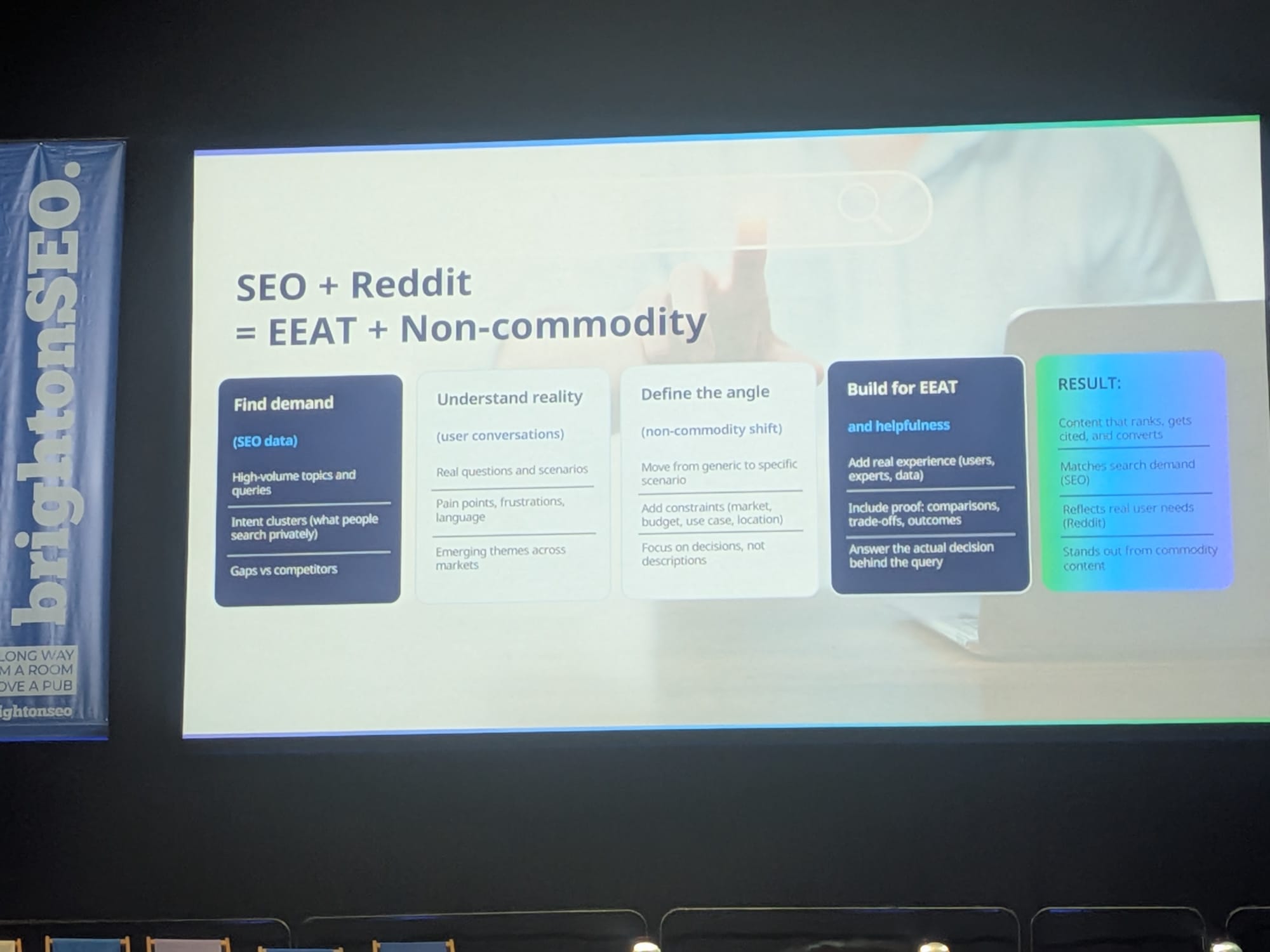
Find demand using SEO data — high-volume topics, intent clusters, gaps against competitors. Understand reality using user conversations — real questions and scenarios, pain points and language, emerging themes across markets. Define the angle by moving from generic to specific scenario, adding constraints around market, budget, use case, and location, and focusing on decisions rather than descriptions. Build for EEAT and helpfulness by adding real experience from users, experts, and data, including proof through comparisons, trade-offs, and outcomes, and answering the actual decision behind the query. The result, when the sequence is followed, is content that matches search demand, reflects real user needs, and stands out from commodity content — content that ranks, gets cited, and converts.
Building the MEUT Loop
Ainhoa’s closing argument was operational. None of the above works as a one-time audit. The formula has to run as an always-on system — a continuous feedback loop between social intelligence and content.
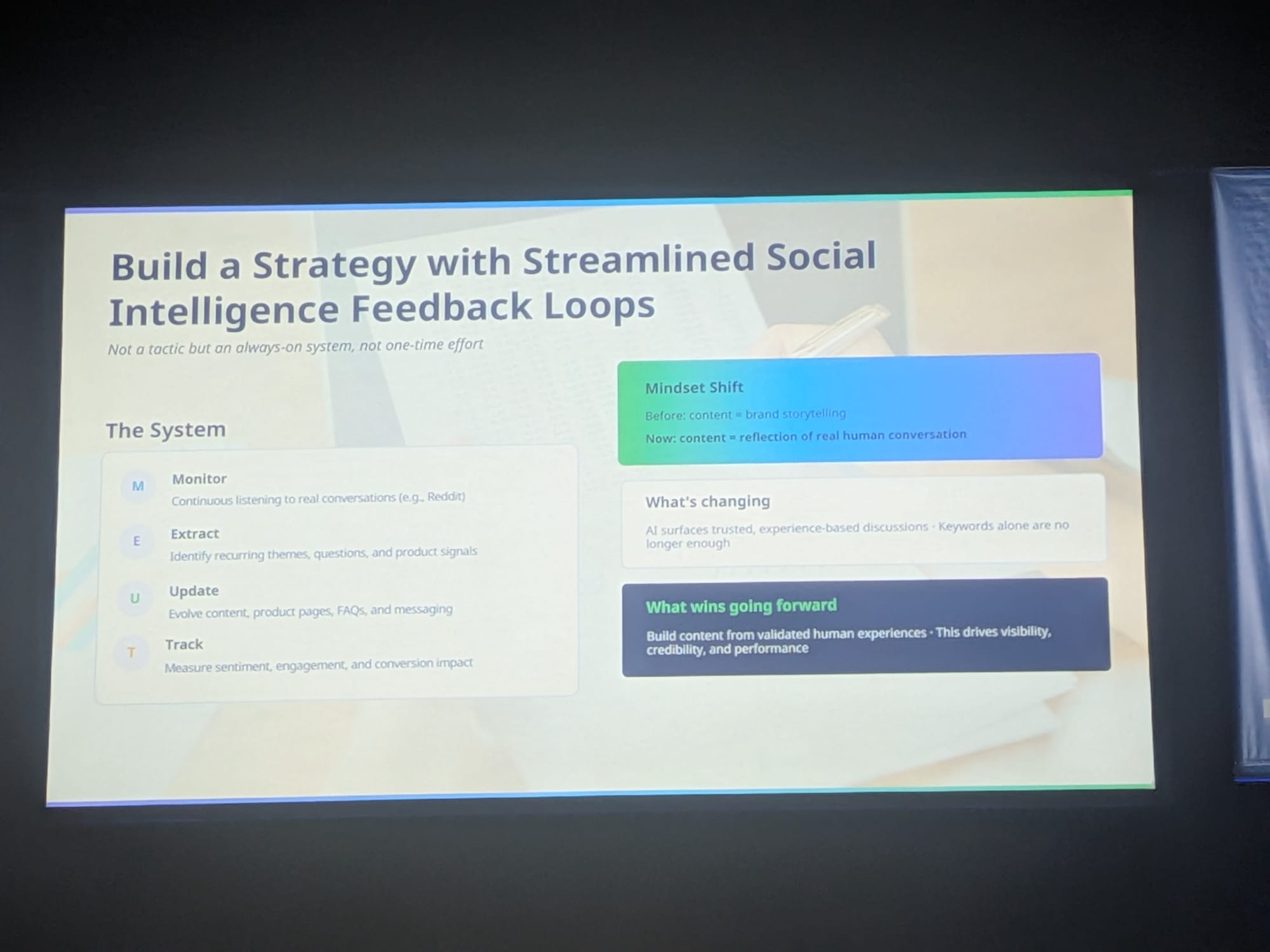
She named the loop MEUT. Monitor — continuous listening to real conversations on platforms like Reddit. Extract — identify recurring themes, questions, and product signals. Update — evolve content, product pages, FAQs, and messaging based on what the data reveals. Track — measure sentiment, engagement, and conversion impact, then feed those measurements back into the next monitoring cycle.
The mindset shift she paired with this loop is worth stating plainly. Before: content was brand storytelling. Now: content is a reflection of real human conversation. AI surfaces trusted, experience-based discussions; keywords alone are no longer enough. What wins going forward is content built from validated human experiences — that is what drives visibility, credibility, and performance simultaneously.
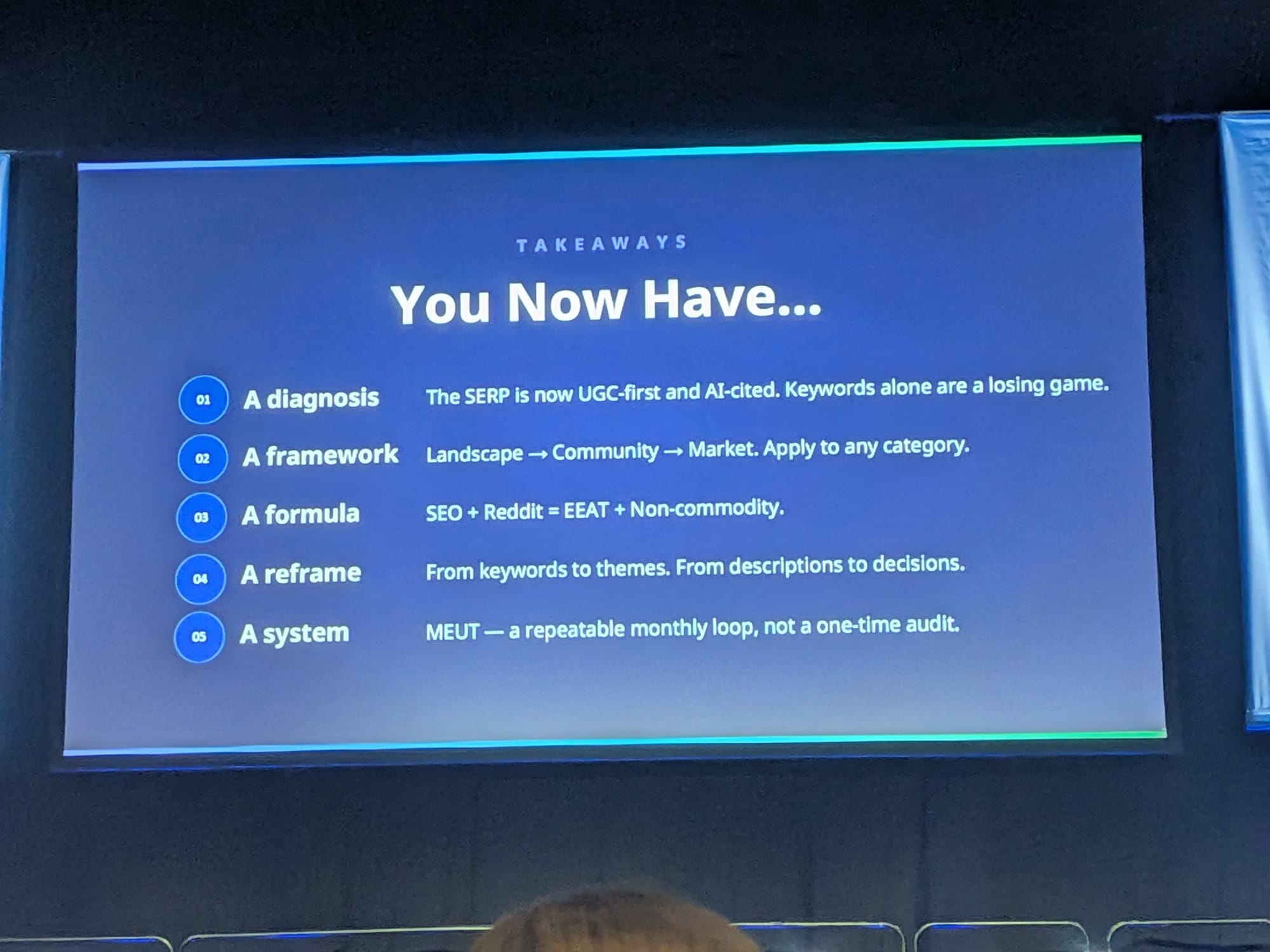
The closing summary slide consolidated the talk into five things to carry out of Auditorium 1: a diagnosis (the SERP is now UGC-first and AI-cited; keywords alone are a losing game), a framework (Landscape → Community → Market, applicable to any category), a formula (SEO + Reddit = EEAT + Non-commodity), a reframe (from keywords to themes, from descriptions to decisions), and a system (MEUT, a repeatable monthly loop, not a one-time audit).
Personal Takeaways
This was my third BrightonSEO — Brighton April 2025, San Diego September 2025, and Brighton April 2026 as a scholarship attendee. Across those three events, the zero-click theme has gone from “the thing everyone is worried about” to “the thing we are now operating inside.” Ainhoa’s session was a useful articulation of what an SEO content strategy looks like when you accept that as the starting condition rather than the problem.
The reframe I valued most was the “are we trying to outrank Reddit? No.” moment. A lot of zero-click commentary still implies that with enough EEAT signals and structured data, brand sites can win back the SERP positions UGC has taken. Ainhoa was direct that for a large share of branded and high-intent non-branded queries, that fight is over — and the question is no longer how to rank above Reddit but how to use Reddit as a signal source for content that gets cited in AI answers regardless of where it ranks.
Where the methodology becomes harder to apply directly is in Japanese-market content strategy. The “Reddit” of Japan is fragmented across several platforms — 5ch for anonymous community discussion, Yahoo!知恵袋 for question-and-answer intent, note for long-form personal experience writing, and X for real-time sentiment. None of these is a single, AI-citation-friendly source the way Reddit is for English. Japanese LLMs are also trained on different source weightings than Western models, so the AI citation layer behaves differently. The three-stage framework (Landscape → Community → Market) transfers cleanly; the platform layer needs a local equivalent map. For agencies running cross-border Japan–UK content strategy, building that mapping is the actual work — and it is not something Ainhoa’s Western data tooling would surface directly.
Related Resources
- Session page — Defining Your Content North Star in a Zero-Click World
- Speaker profile — Ainhoa Lizarralde at brightonSEO
- Slides — Defining Your Content North Star in a Zero-Click World
- LinkedIn — Ainhoa Lizarralde
- Marketfully
About the Author
Ayaka Uchida is the founder and CEO of A-Digital Works Ltd (Japan–UK SEO & EN↔JA localisation consultancy) and Nihon GO! World (Japanese language school operating in London Fitzrovia and Manchester). 10+ years of international business development across Japan, Singapore, the US, and the UK. Third BrightonSEO attendee (Brighton April 2025, San Diego September 2025, Brighton April 2026 — last as a scholarship recipient). Aoyama Gakuin University, Faculty of Law. Fluent in Japanese and English; studying Spanish, French, and German.
Connect: a-digitalworks.com | LinkedIn
About A-Digital Works
A-Digital Works Ltd is a London-based Japan–UK SEO and EN↔JA localisation consultancy supporting UK, EU, and US companies entering the Japanese market. Services span keyword research in Japanese, content localisation, technical SEO, and market entry strategy. Flagship case study: Descartes Systems Group (Canadian logistics technology) — full Japanese-market SEO programme covering 物流システム, EDIシステム, and 配車システム.
This report covers Ainhoa Lizarralde’s session “Defining Your Content North Star in a Zero-Click World” on the Zero Click SEO stage of BrightonSEO Brighton on Thursday 30 April 2026.
