

TL;DR
- Zero-click search is not a traffic problem — it’s an identity problem. When machines choose brands on our behalf, the brand collapses into a set of attributes (price, availability, returns, specs) and loses everything that makes it a brand
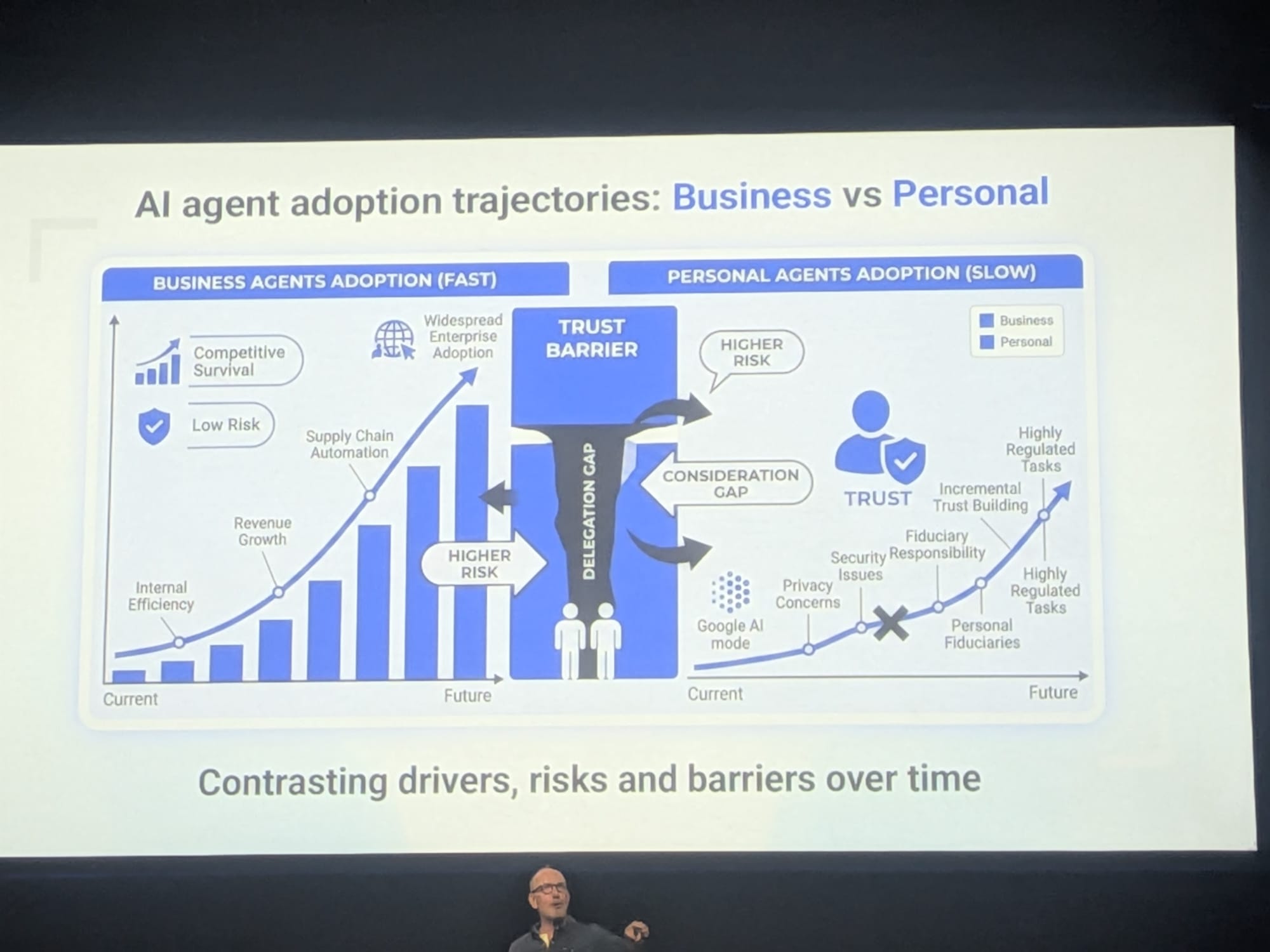
- Two waves of agents are arriving: business agents (already here, via Google Merchant Center) and personal agents (browsers, extensions — slower adoption but coming fast)
- Macy’s case study: shoppers who interacted with their business agent spent 4.25x as much on average as those who didn’t
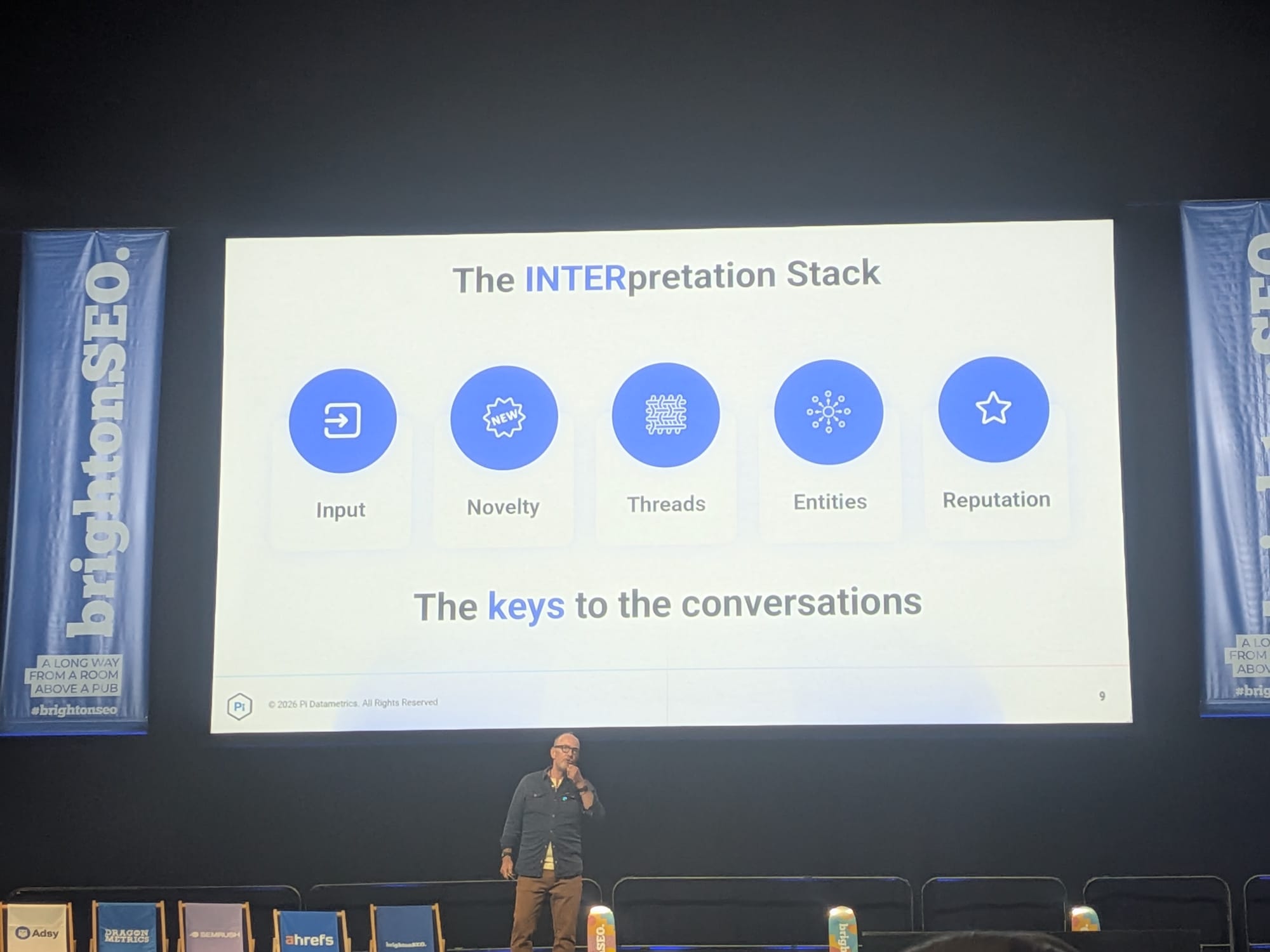
- Jon’s Interpretation Stack — five keys to staying visible in conversational search: Input, Novelty, Threads, Entities, and Reputation
- Stop optimising for prompts. Optimise for conversations — typical AI conversations are 4–6 turns deep, not a single query
- Weber barbecue case study: present in 5 of 8 relevant conversational spaces, with most citations coming from third-party content based in Malaysia, Canada, and Hong Kong — not Weber’s own site
About the Session
Track: Zero Click SEO
Date: Thursday 30 April 2026, 11:20 AM
Venue: Auditorium 1, Brighton Centre, Kings Road, Brighton and Hove, BN1 2GR, United Kingdom
About the Speaker
Jon Earnshaw — Pi Datametrics | Chief Product Evangelist
Jon is one of the longest-standing voices in UK enterprise SEO, having coined the term “keyword cannibalisation,” and a prominent thinker on conversational search and AI agent strategy. As Chief Product Evangelist and Co-Founder of Pi Datametrics, he drives innovation in search intelligence for global brands and agencies. He’s a regular BrightonSEO main-stage speaker known for his data-led, opinionated talks.
The Reframe: It’s an Identity Problem, Not a Traffic Problem
Jon opened with an observation that reframes the entire zero-click conversation: for 25 years, search engines helped us find stuff. In just the past 12 months, they’ve started doing the narrowing down — reading reviews, refining decisions, eliminating options. Soon, they’ll be doing the choosing.
Most of us are treating that shift as a traffic crisis. Jon’s argument: that’s the wrong frame.
The minute machines start choosing brands on behalf of humans — because humans have delegated that authority to agents — the brand stops getting to be the brand. There are no jazz hands. No tap-dancing. No 4K hero video, no immersive heritage story. The human delegating to the agent never sees any of it.
The brand collapses into a set of attributes: price, availability, returns, delivery options, specs, alternatives. That’s all the agent has to work with. That’s all it passes back.
So the question for the next 18 months isn’t “how do I rank in a world ruled by machines?” It’s: how will my brand be interpreted by machines that can only see my attributes?
The Future SERP Is a Conversation
Jon paused to make sure the room was aligned on something foundational: the future of e-commerce search is agentic, and the future SERP is a conversation.
It has to be a conversation, because there is no role for an AI agent inside ten blue links. The agent has to sit inside an exchange — a multi-turn back-and-forth — or in Google’s case, AI Mode.
If we accept that, then the operating reality changes: you cannot optimise for a single prompt. Real users — and real agents — turn through four to six exchanges before reaching a decision. Visibility for one prompt is meaningless if you drop out by turn three.
The Macy’s Story: Business Agents Are Already Here
Jon’s most concrete data point came from Macy’s in the US.
A few months ago, Macy’s set up a business agent through Google Merchant Center. They trained it. They gave it golden questions and answers. They put up the gateways. Crucially, they connected it to their site through MCP (Model Context Protocol) — what Jon calls “the AI USB.”
Then they rolled it out.
The result: shoppers who interacted with the Macy’s business agent spent 4.25x as much on average as shoppers who didn’t.
Not 25% more. Not double. Four-and-a-quarter times more.
Jon’s takeaway: business agents have already arrived, and there is no excuse not to secure yours the moment it becomes available in your market. The risk is zero. The upside is scale, margin, efficiency, and — increasingly — survival.
Two Agents, Two Adoption Curves
Jon split the agentic landscape into two distinct categories, each on a different adoption timeline.
Business agents — appearing in Google Merchant Center, ChatGPT business connectors, and similar surfaces. These solve a problem brands didn’t know they had: how do I get my customers to spend 4.25x more before they even reach my site? Adoption will be very fast because the upside is obvious and immediate.
Personal agents — arriving via browsers (Perplexity’s Comet browser is buildable into an agent in 15 minutes), extensions, and standalone apps. These face a harder adoption curve because handing over decisions about taste, style, fashion, what to wear at the next BrightonSEO — these decisions take real trust to delegate. Jon described his own experiment with a personal agent built in Comet: it was finding discount codes, negotiating, surfacing options. But the moment it suggested booking him a holiday to Aruba, the trust ceiling kicked in.
The gap between these two adoption curves is the strategic window. Business agents arrive first. Personal agents arrive over the next 18 months. In the middle, your brand will increasingly stop being experienced by humans and start being interpreted by machines.
The big consultancies are guiding clients to plan for that intersection point at roughly two years out. Jon’s view: it’ll be much sooner.
The Interpretation Stack: Five Keys to the Conversation
The core of Jon’s session was the framework his team uses for clients preparing for agent-driven search. He calls it the Interpretation Stack — or, more usefully, the Five Keys to the Conversation.
1. Input
The way users — and increasingly agents — feed information into the conversation. AI Mode users don’t iterate through short queries; they define the entire problem upfront. That changes what your content has to be ready to answer. The way the conversation enters your visibility window determines everything that follows.
2. Novelty
Everything in your ecosystem that’s lining itself up to get into the conversation. Without novelty, your content collapses into the generic average.
3. Threads
Conversations are not prompts. The whole industry obsession with prompt optimisation misses the point. Real users move through 4–6 turns. Your content has to last across those turns — appearing at the start is meaningless if you drop out by turn three.
This is why Jon’s team measures conversational visibility rather than prompt visibility. They use what he called a “synthetic protocol” — a methodology built on cosine similarity to simulate conversational spaces — to model what a realistic multi-turn conversation looks like for a given commercial intent.
4. Entities
Brands get collapsed into attributes. Attributes are what entities are made of. The actionable implication: use Merchant Center attributes aggressively. They were specifically designed to enable your content to last through a conversation, not just appear at the start. As personal agents start interrogating in depth — wanting more details about a product than human shoppers would ever type — the attribute layer becomes the layer your brand is interpreted through.
5. Reputation
Your reputation is not what you say it is. Agents — and the LLMs behind them — don’t see your brand. They see what your ecosystem says about your brand.
Jon’s strong opinion here: double down on first-hand, authentic content. Video shorts. Real users using your product. Rough and ready beats £50,000 production values, every time.
“We had slop before AI. Now we’ve got AI slop. Let’s not go back to that floor.”
A scrappy £50 short of a real customer talking about your product will outperform a polished agency-produced equivalent in citation outcomes — because the AI ecosystem actively favours authenticity over scaled-and-templated content.
The Visibility Paradox
Beyond the five-key Stack itself, Jon raised a related observation that has become central to how he thinks about conversational search. You can rank brilliantly for classic search — page 1 across all your priority terms — and still be completely absent from the conversation. The visibility paradox is the gap between traditional SERP rankings and conversational presence. They’re not the same metric, and increasingly they’re not even correlated. This is the reason the Interpretation Stack exists in the first place.
What Lily Ray Said (and Why It Matters)
Jon credited a recent Lily Ray observation: when people come to AI Mode (as opposed to AI Overviews), they define their entire problem upfront — everything they want, in one go. The behavioural pattern is fundamentally different from classic search, where users iterate through short queries.
Average prompt length last September: 23 words. Closer to 16 words now (Jon noted the slight pullback as users get more efficient).
The implication for content: AI Mode users hand over the entire job-to-be-done in their first message. Optimising for short keyword phrases misses what they’re actually saying.
Originality and the Generic Collapse
Jon shared a recent piece of research from his team: they were analysing running shoes. One particular site stood out, getting citation after citation across every conversation they monitored.
The reason: that site didn’t describe its products the way Nike, Adidas, On, Reebok and the rest did.
When everyone describes the same product the same way, the content becomes generic. Generic content collapses. Collapsed content loses identity. And without identity, you can’t even enter the conversation, let alone earn a citation.
“Originality is everything.”
It’s a familiar line. The new context is what makes it sharper: in classic SEO, generic content can still rank. In agentic search, generic content gets dissolved into the average and doesn’t surface at all.
The Weber Barbecue Case Study
Jon walked through a live analysis of Weber barbecues using his team’s conversational space methodology.
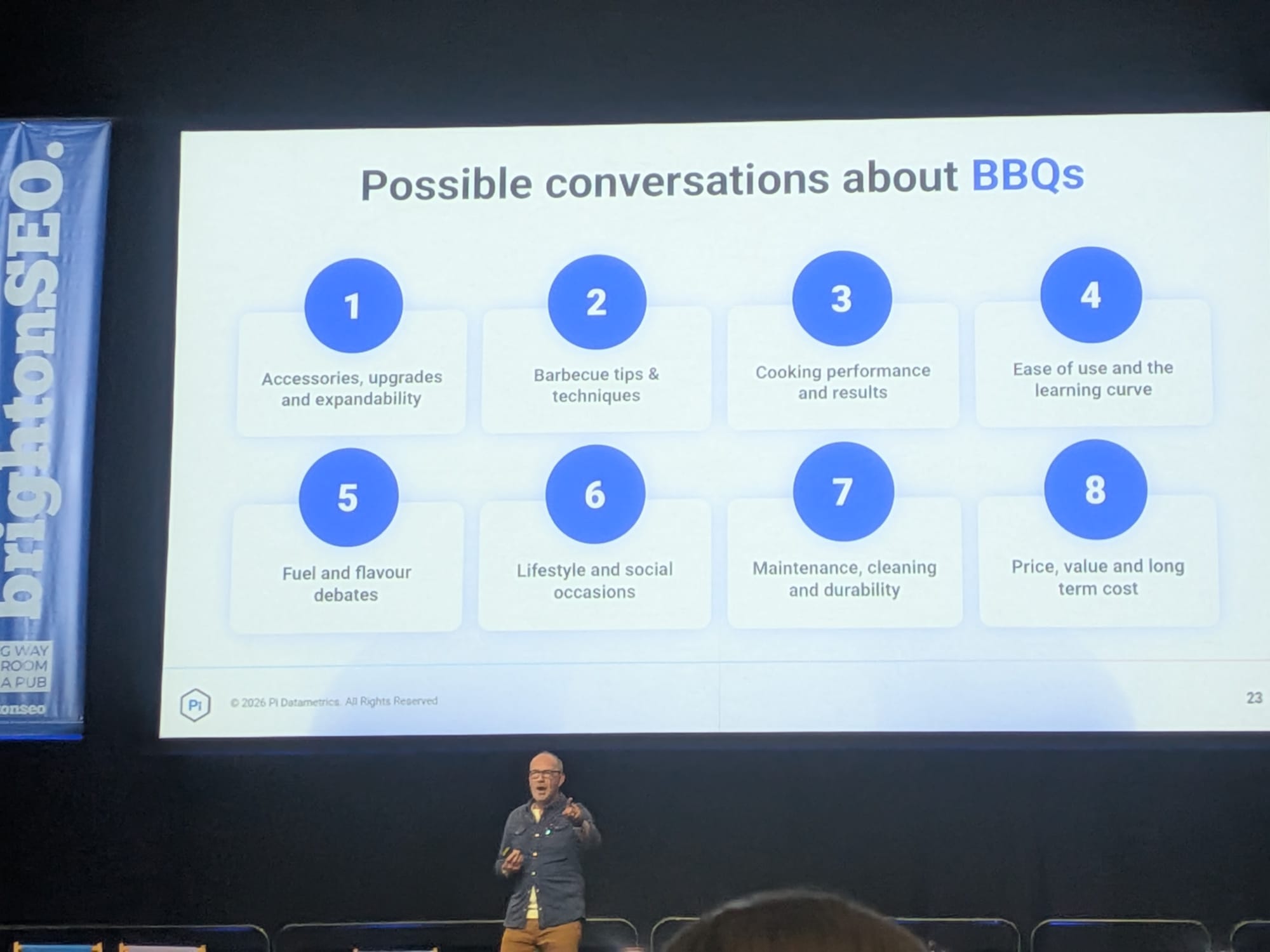
- Heading into summer, there are 8 conversational spaces Weber needs to be present in
- Weber is currently present in 5 of 8 — missing 3 entirely
- Weber gets some citations, but few — and the citations they do earn share one thing in common: the content goes deeper, talks more knowledgeably about specific food choices and grilling specifics
- Most strikingly: Weber’s top-cited direction in those conversations was third-party content from Malaysia, Canada, and Hong Kong — not Weber’s own UK or US sites
The point: Google’s AI Mode wants users to stay inside the conversation. Citations are earned, not given. And the brands earning them are often not the official manufacturer — they’re the third-party sites talking with more depth, specificity, and authenticity.
For a brand strategist, this is a wake-up call. If your brand is winning conversations through other people’s content, you have less control over how you’re being interpreted than you think.
Three Things to Do Today
Jon closed with three concrete actions:
1. Secure your business agent now (if you have a US presence)
If you can’t yet, the next-best move: build a custom GPT linked to your website, click through it, test it. Does your website know enough to hold a conversation? Most don’t.
2. Follow conversations, not prompts
Stop obsessing about which prompts you rank for. The prompts change daily; the conversational space is more stable. Optimising for the wrong unit of measurement is the single most common mistake Jon sees right now.
3. Internalise the five-component Stack
Input, Novelty, Threads, Entities, Reputation. As your brand stops being experienced and starts being interpreted, these five components are what determine whether the interpretation is favourable.
Personal Takeaways
Most of Jon’s strategic frame won’t be new to anyone who’s been at recent SEO conferences. Agentic search and the “brands collapsed into attributes” framing were both recurring themes across the BrightonSEOs I attended in Brighton 2025 and San Diego 2025 — different speakers, different framings, broadly the same argument. The Interpretation Stack pulls a lot of those existing ideas into a single named framework, which is useful as packaging but not as new direction.
What I will be using:
- The “identity problem, not traffic problem” reframing. This is the bit of language I’ll borrow into client pitches almost immediately — it travels well to brand and marketing leadership in a way that pure SEO performance language doesn’t.
- The Macy’s 4.25x number. Probably the single most useful statistic from the day. It makes the case for proactive business agent setup without needing to argue from first principles, and it’s the kind of headline figure that gets boardroom attention.
- The originality argument as it applies to commodity-product brands. If you’re a manufacturer using the same product copy as your competitors — which most are — you’re invisible to AI conversations by default. Differentiated, opinionated product description is one of the cheap, immediate wins, and easy to operationalise.
The throwaway line that lingered most for me wasn’t a strategic one. It was: “We had slop before AI. Now we’ve got AI slop. Let’s not go back to that floor.” That’s the entire content strategy debate of the next two years compressed into a single sentence.
Related Resources
- Session: From Clicks to Conversations
- Speaker: Jon Earnshaw
- Jon Earnshaw on LinkedIn
- Slides & resources from Jon’s BrightonSEO talk
- Pi Datametrics — Jon’s company; conversational space methodology
Written by Ayaka Uchida
CEO, A-Digital Works
This report covers Jon Earnshaw’s session “From Clicks to Conversations: Preparing for Zero-Click Search in an Agent-Driven World” at BrightonSEO Brighton, April 30, 2026.
About A-Digital Works
A-Digital Works Ltd is a UK-registered Japan-localisation and SEO consultancy founded in London in 2023. We specialise in helping English-speaking companies successfully enter the Japanese market through high-fidelity EN↔JA localisation, brand voice adaptation, and Japan-market SEO strategy.
We work with B2B brands targeting Japanese enterprise audiences, providing large-scale corporate localisation, Japan-market content production, and ongoing SEO consulting tailored to the unique characteristics of the Japanese search and content landscape.
About the Author
Ayaka Uchida (打田彩夏) is the Founder & CEO of A-Digital Works Ltd. She is also the founder of Nihon GO! World, a Japanese language school operating in London (Fitzrovia) and Manchester. Ayaka has 10+ years of international business development experience across Japan, Singapore, the US, and the UK, and has attended BrightonSEO three times: Brighton April 2025, San Diego September 2025, and Brighton April 2026 (the latter on scholarship).
She is a graduate of Aoyama Gakuin University, Faculty of Law, and is fluent in Japanese and English. She is currently studying Spanish, French, and German.
Get in touch: a-digitalworks.com
LinkedIn: Ayaka Uchida
