

TL;DR
- Roughly 82% of the sources behind an AI answer are not your own site. Owned content matters, but the game is played off your domain.
- One well-built article can be enough. Across Getfluence’s set, 60%+ of brands that started from zero reached a mention on at least one core query, with a median of 20 days from publication to first AI mention.
- Pick the publisher your topic already cites. About 30 domains take 67% of citations on a given topic, and a specialist title can beat a famous one: TechRadar at 8.2% of US news citations against The New York Times at 2.1%.
- Write passages that survive out of context. AI extracts roughly 177 words, so each paragraph needs to stand on its own, lead with the entity, and carry verifiable numbers rather than adjectives.
- Let the model deliver the verdict. Name more than one option, including competitors. A page with one forced answer is doing the model’s job for it, and reads as promotional.
About the Speaker
Christian Desert is CEO of Getfluence, a platform that connects brands with publishers for paid editorial placements. He presented a dataset drawn from campaigns run through his own platform.
He gave a version of this talk at brightonSEO Brighton in spring 2026, in the AI and Brand Authority session.
A note on the source: Getfluence sells the thing this talk concludes is most effective. The data is specific and the tactics stand on their own, but the conclusion that paid editorial placement is the strongest lever is one his business depends on. I have flagged where that matters.
The Problem: The Game Is Off Your Site
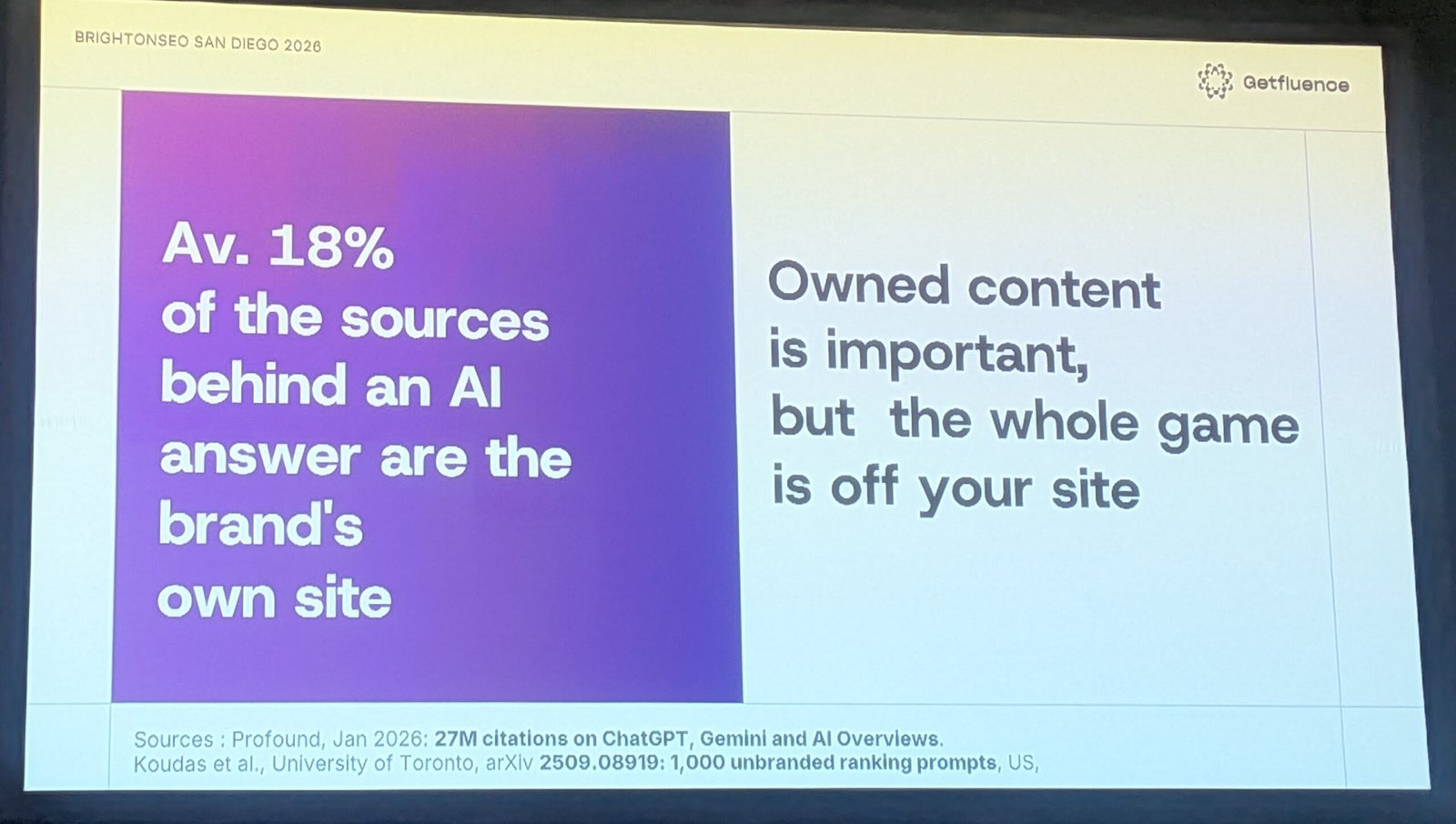
Christian opened with one number. On average, 18% of the sources behind an AI answer are the brand’s own site. He noted he has seen studies putting it even lower, sometimes in the single digits.
But his interest was the other side of it. 82% of the sources cited are external. Owned content is necessary groundwork, and you should absolutely keep doing it, but it is also the part the model discounts, because you control it completely. The model treats it as someone speaking about themselves.
His sources for the slide: Profound, January 2026, 27 million citations across ChatGPT, Gemini and AI Overviews; and Koudas et al., University of Toronto (arXiv 2509.08919), 1,000 unbranded ranking prompts in the US.
That framing set up the two variables the rest of the talk was about: which publisher you appear on, and what the article itself says.
The Dataset
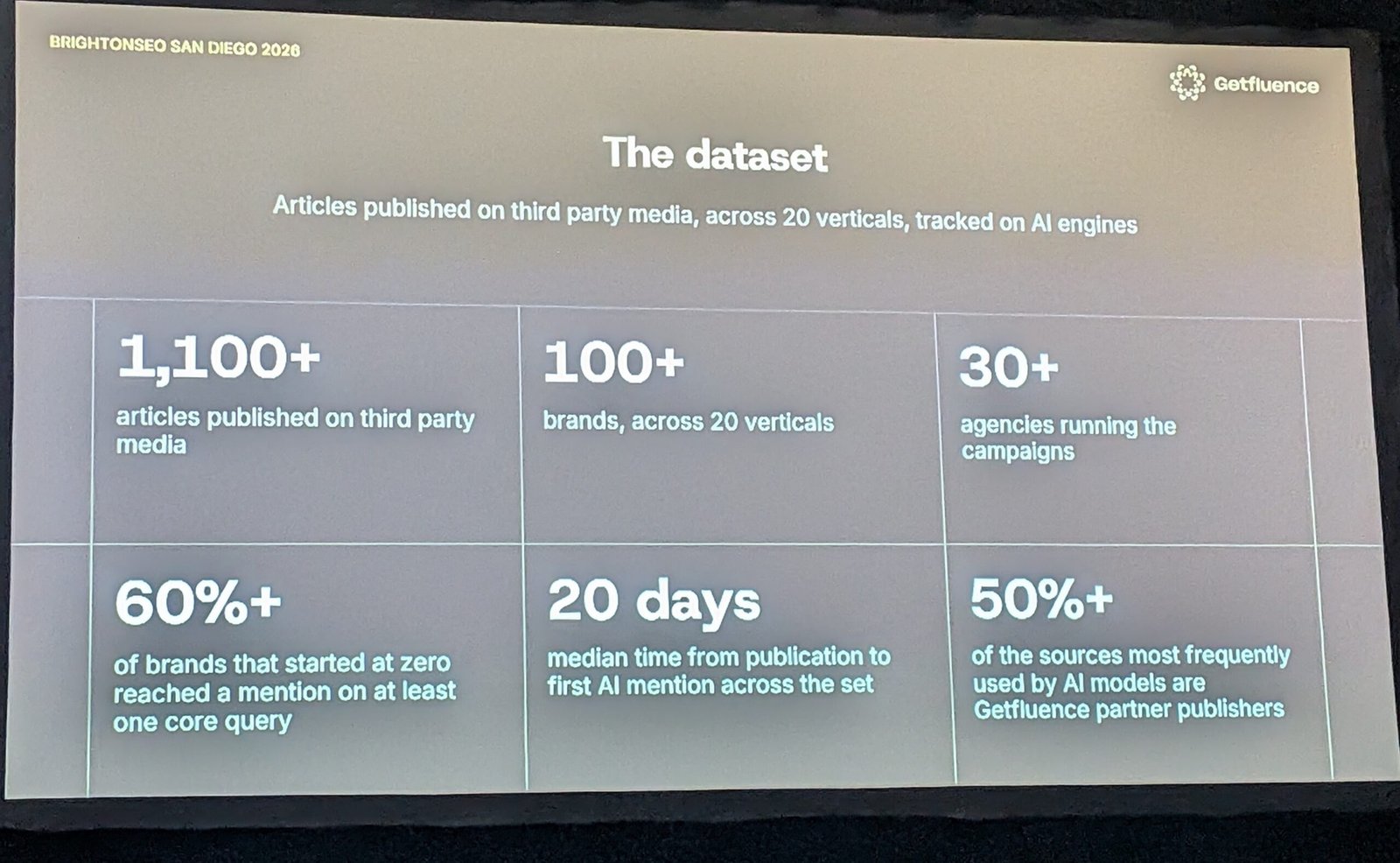
The study covered articles published on third-party media across 20 verticals, tracked on AI engines:
- 1,100+ articles published on third-party media
- 100+ brands, across 20 verticals
- 30+ agencies running the campaigns
- 60%+ of brands that started at zero reached a mention on at least one core query
- 20 days median time from publication to first AI mention
- 50%+ of the sources most frequently used by AI models are Getfluence partner publishers
Christian stressed that it did not matter whether the brand was large or small, which industry it was in, or whether the campaign was run directly or through an agency. The results were consistent. His word for it: mechanical.
He also said that sometimes the mention appeared in two or three days, and that in their case it was often just one article, not a wave of them.
Three Wrong Answers
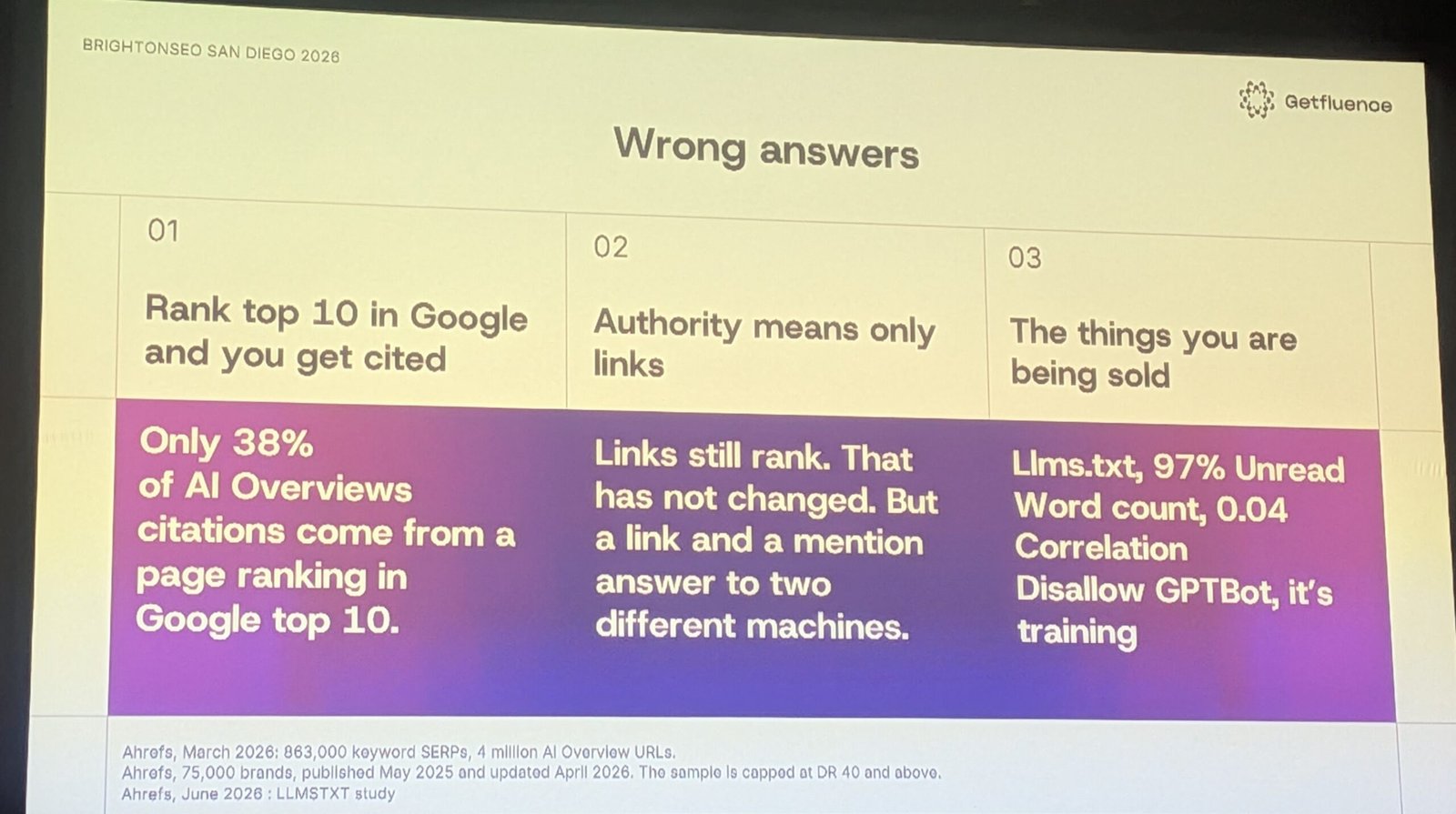
Before the tactics, he cleared away three assumptions.
1. “Rank in Google’s top 10 and you get cited.” Only 38% of AI Overviews citations come from a page ranking in Google’s top 10. Ranking is still good, but it is not enough and not the same job.
2. “Authority means only links.” Links still rank, and that has not changed. But as he put it, a link and a mention are answers to two different machines. He was careful here, saying he has spent years working on links and still loves that part of the job, but that the two should not be confused.
3. “The things you are being sold.” Three specific ones:
* llms.txt: 97% unread
* Word count: 0.04 correlation
* “Disallow GPTBot, it’s training”: blocking the crawler that builds the corpus does not help you get cited
Sources on the slide: Ahrefs, March 2026 (863,000 keyword SERPs, 4 million AI Overview URLs); Ahrefs, 75,000 brands, published May 2025 and updated April 2026, sample capped at DR 40 and above; and Ahrefs’ June 2026 llms.txt study.
Variable One: Choosing the Publisher
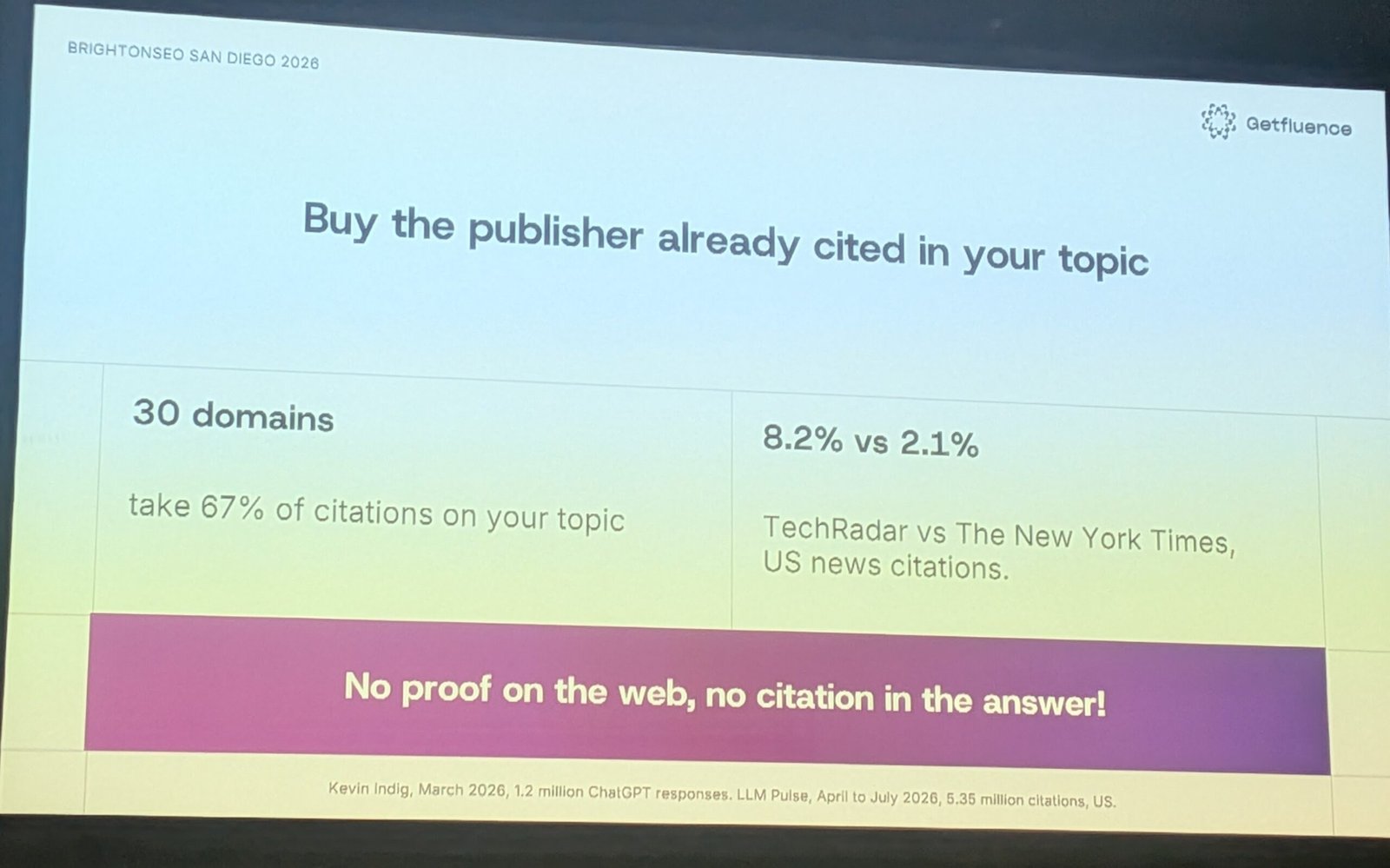
The shortlist is smaller than people expect. About 30 domains take 67% of the citations on a given topic. That means the list of publishers worth pursuing is short enough to build in a day.
And the winner is not the most prestigious title. What matters to the models is topical track record: how much that publisher has actually covered the subject. His example, offered with an explicit apology to the paper, was TechRadar at 8.2% of US news citations against The New York Times at 2.1%.
He called this good news, because a smaller specialist title is usually cheaper than a major masthead and often carries more weight as a source on your topic.
The line across the bottom of the slide was his summary of the whole talk: no proof on the web, no citation in the answer.
(Sources: Kevin Indig, March 2026, 1.2 million ChatGPT responses; LLM Pulse, April to July 2026, 5.35 million citations, US.)
Control Versus Credibility
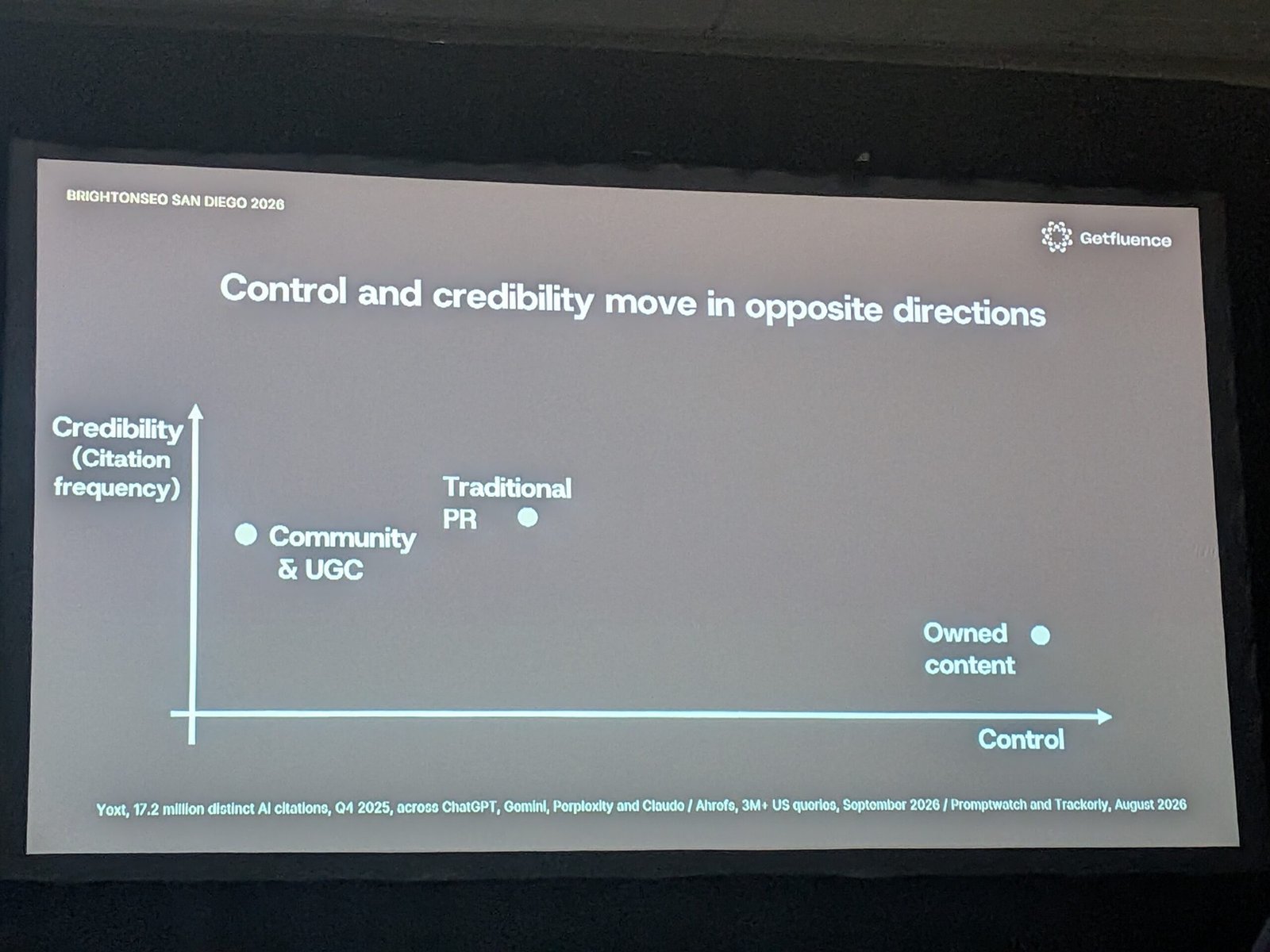
His framework plots citation frequency against how much control you have over what gets published:
| Channel | Credibility | Control | His view |
|---|---|---|---|
| Community and UGC | High | Very low | Effective, but you cannot direct it, and platform dynamics keep shifting |
| Traditional PR | High | Low | Still valuable, but you don’t control the timing, the wording, or whether it runs at all |
| Owned content | Low | Total | Necessary, but discounted because it is you talking about you |
| Paid editorial placements | High | High | The exception to the rule |
On community and UGC, he was candid about not knowing how it settles. He does not personally believe the “collapse of Reddit” narrative, but he does believe the models are changing what they build answers from and what they choose to display, and that the two are not the same thing.
On PR, his objection was practical: you don’t know when it is coming, where it lands, or what it says, and you cannot plan a campaign around it.
His conclusion, and the point where his commercial interest and his argument line up exactly: paid editorial placement is the one source you can order without owning, giving you both access and a say in the wording, while the publisher’s credibility remains intact.
(Sources: Yext, 17.2 million distinct AI citations, Q4 2025, across ChatGPT, Gemini, Perplexity and Claude; Ahrefs, 3M+ US queries, September 2026; Promptwatch and Trackerly, August 2026.)
Variable Two: Writing the Article
This was the practical half, drawn from the 1,100 articles, all written to a format Getfluence calls AI-First.
Write Passages That Survive Out of Context
Models do not scrape the whole page. They capture a fragment, and on average extract about 177 words. So the unit of writing is not the page, it is the paragraph.
His instruction: stop writing pages that rank, and start writing paragraphs that survive being read out of context. If a short paragraph carries the claim, the entity and the evidence on its own, it has a far better chance of being lifted into an answer.
Update, Do Not Republish
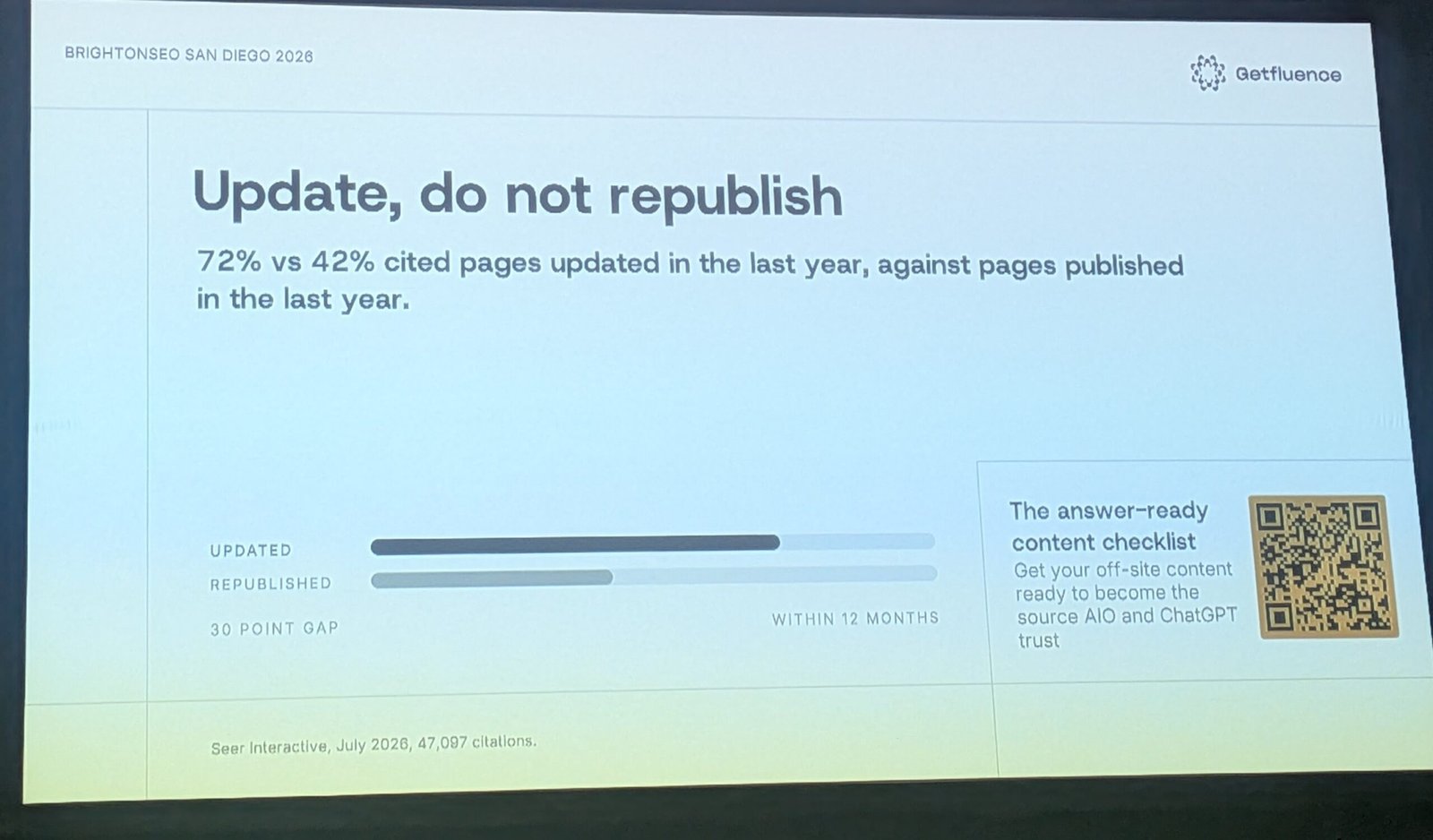
Freshness matters, but not the way people implement it. 72% of cited pages had been updated in the last year, against 42% that had been published in the last year, a 30 point gap.
He referenced Laura Beatty’s talk from earlier in the same session directly here. The lesson is the same on owned and off-site content: treat placed articles as a portfolio to maintain, not a campaign that ends at publication. An article from six months ago that gets refreshed will outperform a new one.
Lead With the Entity
Put the brand name early. Their data showed a difference based on where in the article the brand first appears, with the first section performing best. He added that FAQ blocks help with context but are weaker as a place to introduce the entity.
Numbers, Not Adjectives
Models are, in his words, lazy, and they like evidence they can verify. An adjective attached to your brand is a claim anyone could make. A number is checkable.
So: put numbers in wherever you honestly can. He called this the difference between a claim and a fact, and only one of them is quotable.
Let the Model Deliver the Verdict
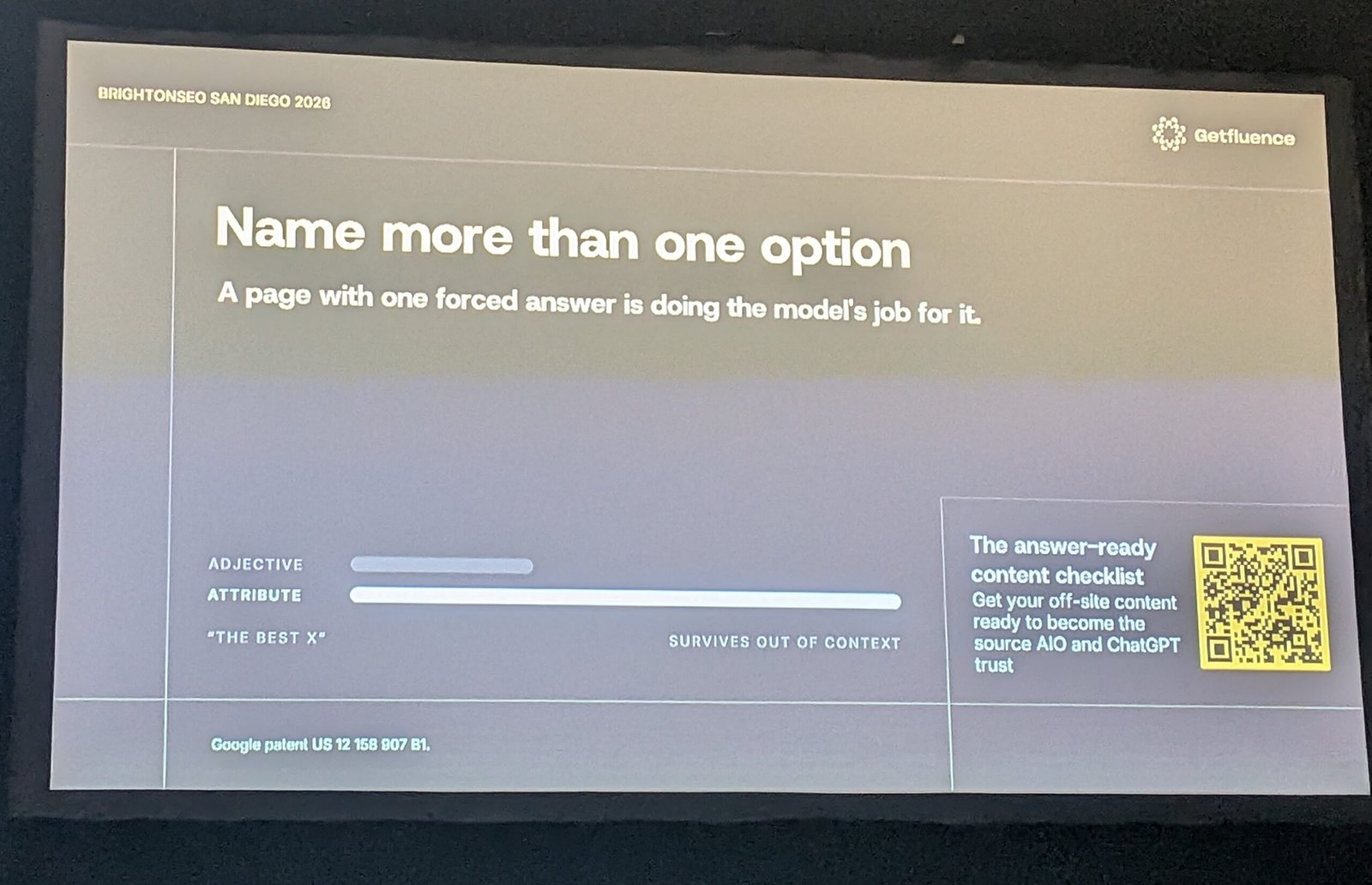
This was his favourite point, and he tied it to a joke about Brighton: the model is the judge, and it wants to deliver the verdict itself. Your article’s job is to be a source, not to hand down the sentence.
In practice:
- Name more than one option, including competitors. Counterintuitive, and it works. A page with one forced answer is doing the model’s job for it, reads as promotional, and gets discounted twice over.
- Be specific rather than superlative. “We are the best at X” is a claim. “The only provider able to do X under these conditions” is a fact with a defined scope, and it wins that scope outright.
- Let someone else say it. Third-party attribution beats self-assertion.
- Name a specific attribute. When an article named the brand in connection with one concrete attribute of the product, citation frequency went up. He called this one of the cheapest structural changes available: you are not asking a publisher to praise you, you are asking them to be precise about one thing.
The slide cited Google patent US 12 158 907 B1 alongside the adjective-versus-attribute contrast.
Case Study: Guerlain
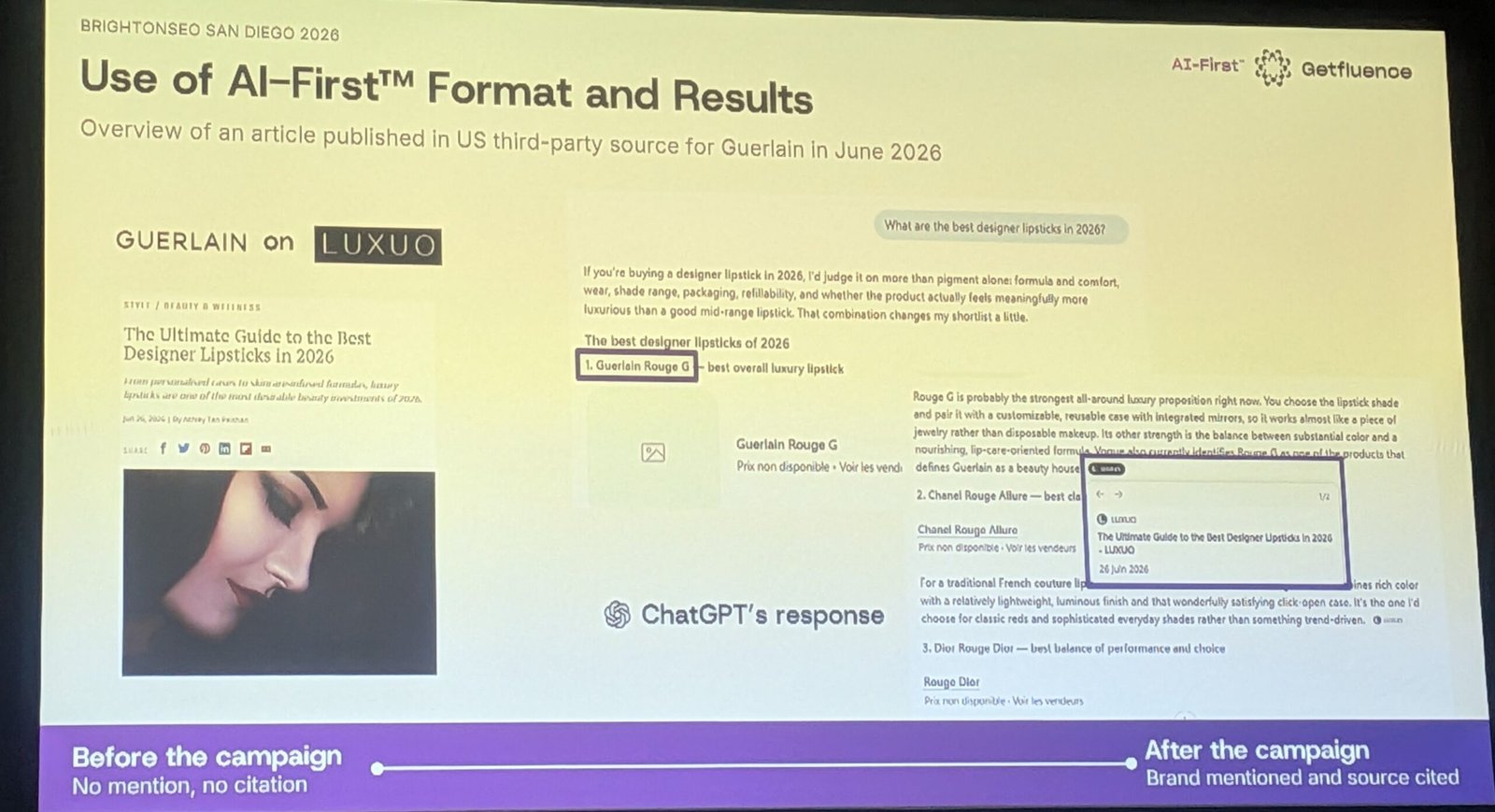
A US third-party placement for Guerlain on LUXUO in June 2026: “The Ultimate Guide to the Best Designer Lipsticks in 2026.”
Asked “What are the best designer lipsticks in 2026?”, ChatGPT returned a ranked list with Guerlain Rouge G at number one, described as best overall luxury lipstick, and cited the LUXUO article as a source. Note the shape of the answer: several brands named, Chanel and Dior among them, with the model doing the ranking.
Before the campaign: no mention, no citation. After: brand mentioned and source cited.
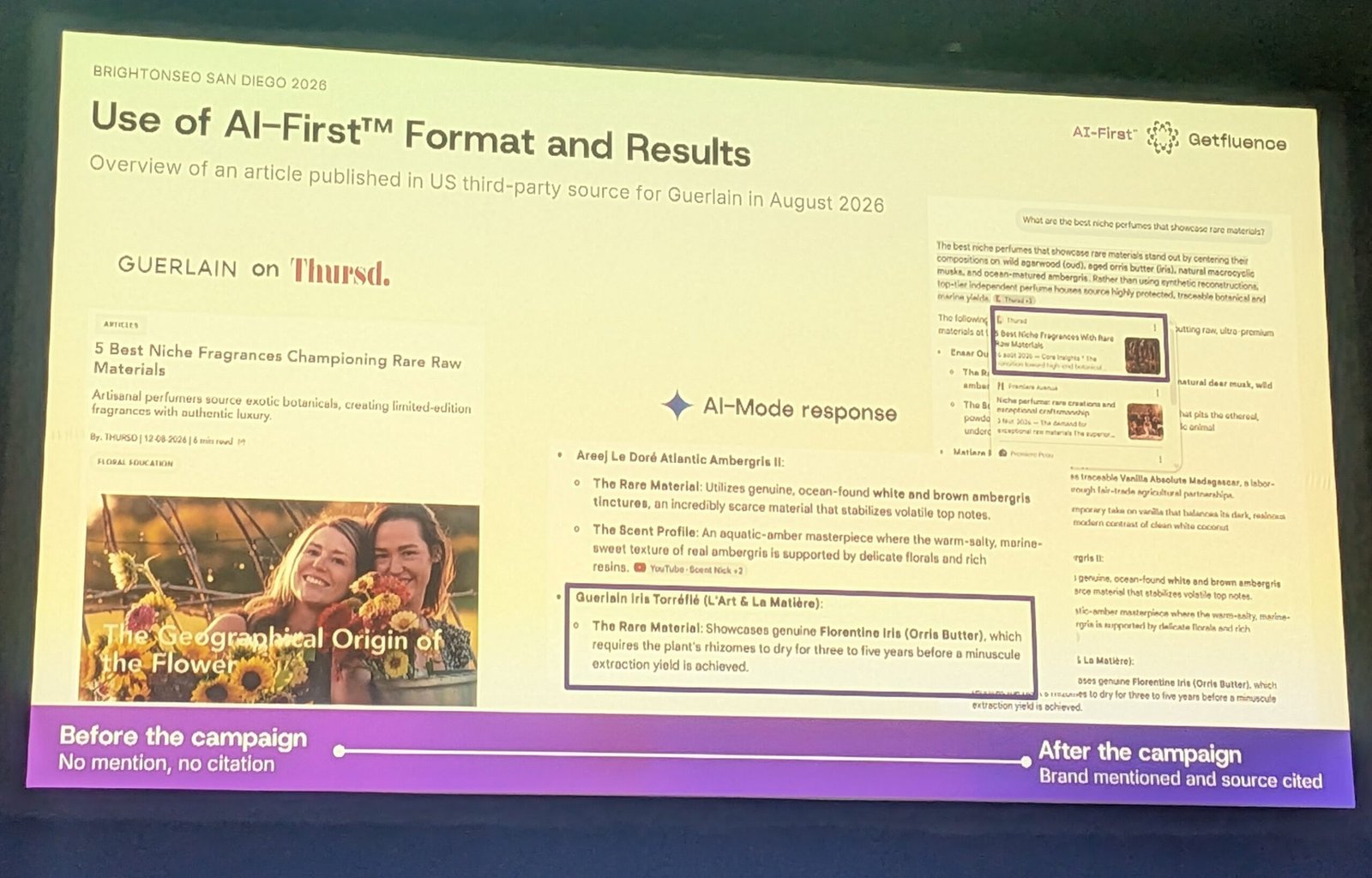
The second example, August 2026, on Thursd.: “5 Best Niche Fragrances Championing Rare Raw Materials.”
Asked “What are the best niche perfumes that showcase rare materials?”, Google’s AI Mode returned Guerlain Iris Torréfié with this line: “The Rare Material: Showcases genuine Florentine Iris (Orris Butter), which requires the plant’s rhizomes to dry for three to five years before a minuscule extraction yield is achieved.”
That sentence is the whole method in one example. It is an attribute, not an adjective. It carries a verifiable number. It survives being read out of context. And the brand sits inside a list of named alternatives.
Christian also described a placement for 24S, LVMH’s e-commerce site, where the team did not commission a new article at all. They added roughly 100 words into an existing, already well-positioned article, written to the same rules, and it got picked up.
The Blueprint
- Find the 30 domains that take the majority of citations on your topic. Any AI visibility tool will produce this list, and it is short.
- Judge publishers on topical track record, not on masthead prestige or traffic.
- Write in standalone passages of roughly 150 to 200 words that make sense lifted out of the page.
- Put the brand name in the first section.
- Replace adjectives with attributes and numbers.
- Name competitors and alternatives so the model has a choice to make.
- Claim a scope, not a crown. “The only X that does Y under Z” beats “the best X.”
- Have a third party state it, rather than asserting it yourself.
- Diarise updates. Refresh placed articles rather than publishing replacements.
- Measure at around 20 days, not on day three.
What Not to Do
- Don’t assume a Google top-10 ranking earns the citation. Only 38% of AI Overviews citations come from one.
- Don’t treat links and mentions as the same work. They answer to different machines.
- Don’t buy llms.txt, word count or crawler-blocking as AI tactics. 97% unread, 0.04 correlation, and blocking the crawler that feeds the corpus.
- Don’t chase the most prestigious publication. The specialist title on your topic is usually cited more, and costs less.
- Don’t write one forced answer. It reads as promotional and gets discounted.
- Don’t lead with adjectives. They are unverifiable, so they get dropped.
- Don’t bury the brand name.
- Don’t republish when you could update.
- Don’t judge the campaign in the first week.
Next Steps
- Pull the citation list for three of your core queries and note which domains recur.
- Check that shortlist against your current PR and placement targets. They will probably not match.
- Rewrite one existing off-site article into standalone passages with the entity early and numbers in place of adjectives.
- Add one named attribute to how you describe your product, and use the same phrasing everywhere.
- Set a review date for every placed article, and update rather than replace.
Personal Takeaways
This was the most vendor-shaped talk of my afternoon and also one of the most usable, which is an awkward combination. The tactics are worth having regardless of what you think of the business model behind them.
What I’m taking away:
- “Write paragraphs that survive out of context” is the single most portable idea of the day. It applies to owned content, guest articles and PR equally, and it changes how I would brief a writer.
- The attribute-over-adjective rule is the one I’d apply first. The Florentine Iris example shows why: a specific, checkable detail travels into an answer intact in a way that “luxurious” never will.
- It lines up with Thomas Peham’s PR findings. Thomas found that in nine of ten industries, publishers without AI licensing deals were cited more than partnered ones, and that specialist trade media beat expensive mastheads. Christian’s TechRadar-versus-NYT number is the same finding from a different dataset. For anything I do in education or Japan-related coverage, that means specialist titles, not big names.
- “Update, do not republish” closes a loop with Laura Beatty. She made the case for refreshing over retiring on your own site. Christian’s 30-point gap makes the same case for everything you place elsewhere.
- The naming-competitors advice is a hard sell to clients, and correct. It is genuinely difficult to persuade a brand to name its rivals in an article it paid for. The mechanism is convincing: the model wants to be the one choosing.
- Where I’d be cautious. The “50%+ of the most-used sources are our partner publishers” figure is a sales line, not a finding. And the control-versus-credibility chart puts his product alone in the top-right corner, which is a very convenient place for it to be. The writing rules are testable by anyone. The channel conclusion is not, at least not from this data.
Related Resources
- Speaker: Christian Desert
- Session: Content (brightonSEO San Diego 2026)
- His Brighton spring 2026 session: AI and Brand Authority
- Brandon Leibowitz session report: the first talk in the same session
- Laura Beatty session report: the talk just before, on refreshing rather than retiring content on your own site
- Thomas Peham session report: specialist media versus major mastheads, from an independent dataset
Written by Ayaka Uchida
CEO, A-Digital Works
This report covers Christian Desert’s session “From absent to mentioned: the article and publisher variables that put brands into AI answers” at brightonSEO San Diego (16 September 2026).
