

TL;DR
- Decide on potential, not just performance. A blog post with 1.9 million impressions, a 0.1% CTR, and an average position of 12.7 looks like a candidate for deletion. Laura’s answer was to refresh it, and the refreshed posts gained clicks while the rest of the blog kept falling.
- Consolidation pays, including in AI search. Merging duplicate blog posts and success stories, and fixing their internal links, brought +125% AI/LLM traffic and +40% organic traffic to the success stories, and +66% organic key events across the site.
- Fix the journey, not just the status codes. A 301 or even a 200 can still be broken if it lands somewhere that doesn’t match the intent. Cleaning up thousands of redirects and 404s doubled non-branded clicks for one global site.
- Structure should be boring. Use plain labels, skip category levels most sites don’t need, and only create a category or tag when it has at least five posts and will keep growing.
- Old content isn’t dead content. Put it in the right conditions and it can still produce results.
About the Speaker
Laura Beatty is the CEO and co-founder of No Bad Days Digital, an SEO consultancy that supports brands and agencies through high-stakes migrations. She has more than 20 years of experience leading SEO strategy, including complex site moves, platform changes, and redesigns.
The talk was built around a single metaphor: her husband’s banana trees, rescued from a Coronado lot about to be bulldozed, carried through apartments and studios in plastic bags, and finally replanted where they could bear fruit. It sounded whimsical, but it structured every section of the talk.
The Problem: We Judge Content Only by What It Already Did
Redesigns and migrations force hundreds or thousands of keep-or-cut decisions. Laura’s point was that performance marketers tend to look only at what has already performed, and that one metric is never enough to decide.
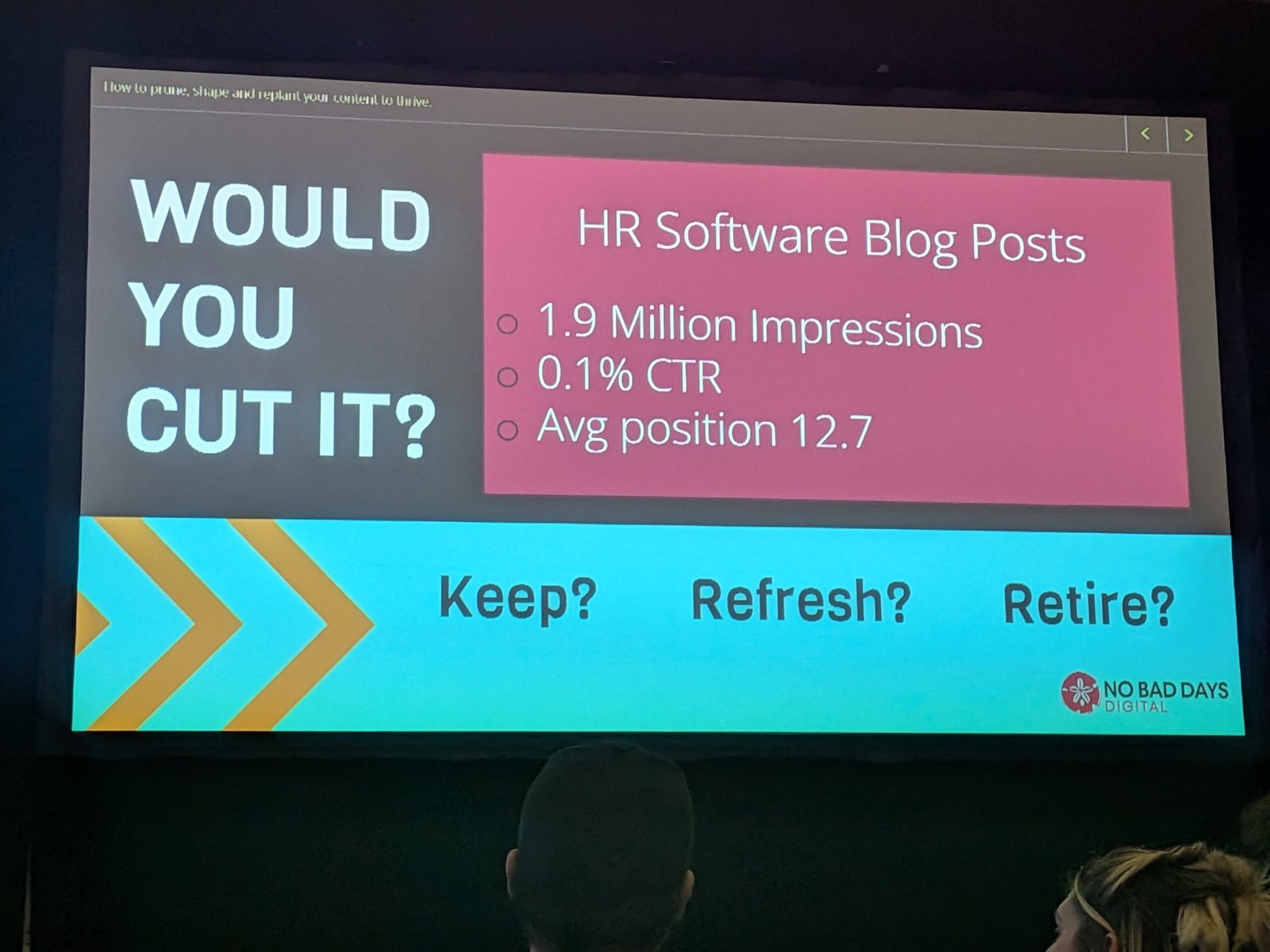
She opened with an audience question. An HR software client had blog posts with 1.9 million impressions, a 0.1% click-through rate that was falling further as AI Overviews took clicks, and an average position of 12.7, off page one. Keep, refresh, or retire?
Most of the room said refresh, and so did she. High impressions with a weak position signal potential, not failure. This is exactly where the famous SEO answer “it depends” comes from: the decision depends on several data points together.
The Solution: A Replanting Decision Matrix
Laura’s framework offers five options for every piece of content:
- Retain. Keep it as it is.
- Refresh. Update it so it matches current intent and quality.
- Prune or consolidate. Cut back, or merge overlapping pieces into one.
- Redirect. Send it somewhere more useful.
- Retire. Remove it.
The decision rests on four factors: performance, potential, purpose, and experience. In her words, your fruit tells you what has worked, but your roots tell you what might work.
Consolidate Where Topics Overlap
Rather than moving everything from point A to point B, look for topical overlap. Large content libraries built over a decade tend to contain near-duplicates, such as the same annual event written up year after year.
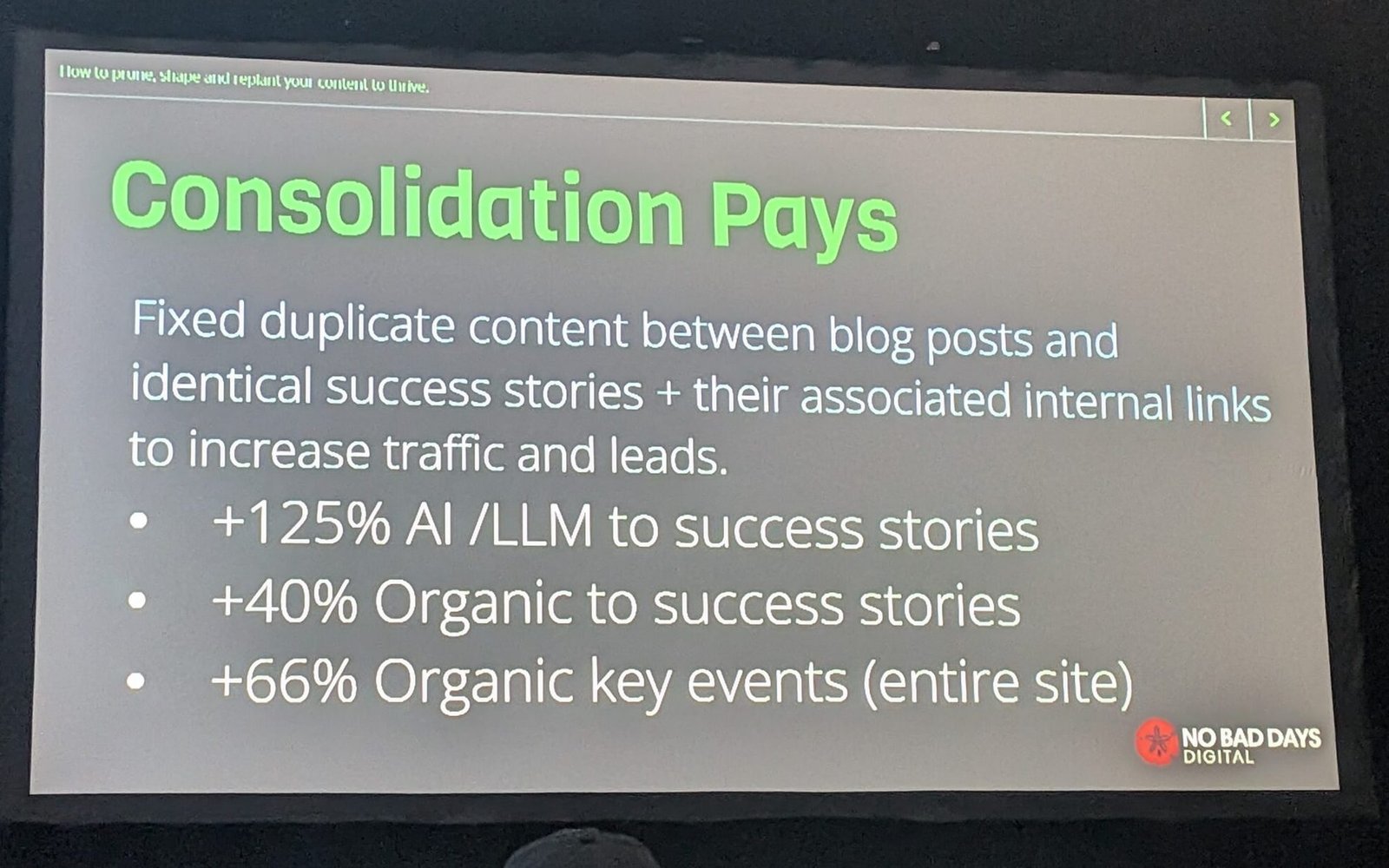
One client had the same content in both blog posts and success stories. No Bad Days Digital consolidated it so each story lived only in the success stories section, and fixed the internal links that pointed to the duplicates. The results:
- +125% AI/LLM traffic to the success stories
- +40% organic traffic to the success stories
- +66% organic key events across the entire site
She attributed the sitewide lift to clarity: the site was simply sending people to the right place.
Refresh What Is “Mostly Dead”
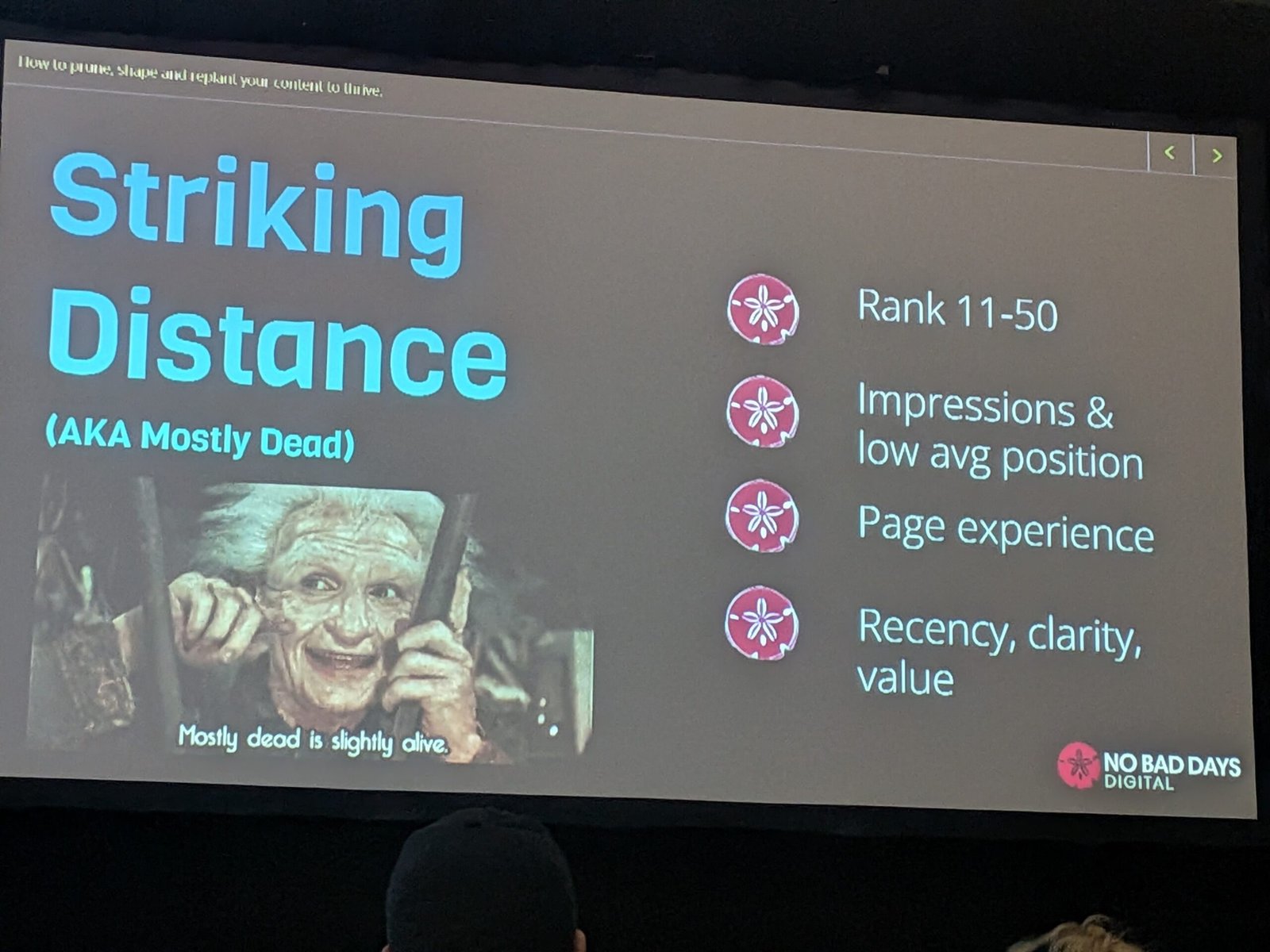
Laura’s name for striking-distance content, borrowed from The Princess Bride: mostly dead is slightly alive. Her criteria:
- Ranking in positions 11 to 50
- Impressions, but a low average position
- Page experience that can be improved
- Room to improve recency, clarity, and value
For the HR software client, the team refreshed only the posts that showed this kind of potential. In the talk, she reported that the targeted posts gained 25% more clicks, while the untouched part of the blog dropped 31% over the same period.
What went into those refreshes:
- Clear heading hierarchy. Often broken by CSS classes applied to the wrong elements, or by editors who don’t know the basics. It matters for how retrieval systems read content.
- Image alt text and featured images. Her reasoning: AI is trying to simulate what humans experience, so neglecting images signals that you don’t care about humans.
- Clear answers. It should be obvious what question the page answers.
- Accuracy and completeness. Answer fully and correctly.
The audience added technical fixes and external sources, and Laura added backlinks, PDFs and media, and AI citations: how often a page is already cited, and for which queries, is now part of deciding whether it is valuable. Her summary was that traffic is not the only measure of value.
Shaping: The Same Plant Grows Differently in Different Soil
A redesign changes the conditions content grows in. Some of those you control: CMS capabilities, domain, internal links, and navigation. Some you don’t: which search features appear, what algorithms and AI models favor, and market demand and positioning. Good decisions weigh both.
Keep Structure Simple
- Use intuitive labels. Clients often want creative section names like “From the Field” or “Water Cooler.” People are looking for your blog or your articles. Match your navigation to how people naturally speak.
- Most sites don’t need category levels. Unless you publish at high volume, keep posts in one common folder rather than nesting URLs by category. It’s more flexible if you ever rename categories.
- Categories must earn their keep. At least five pieces to start, and a realistic commitment to add to them at least quarterly. Otherwise, don’t create the category.
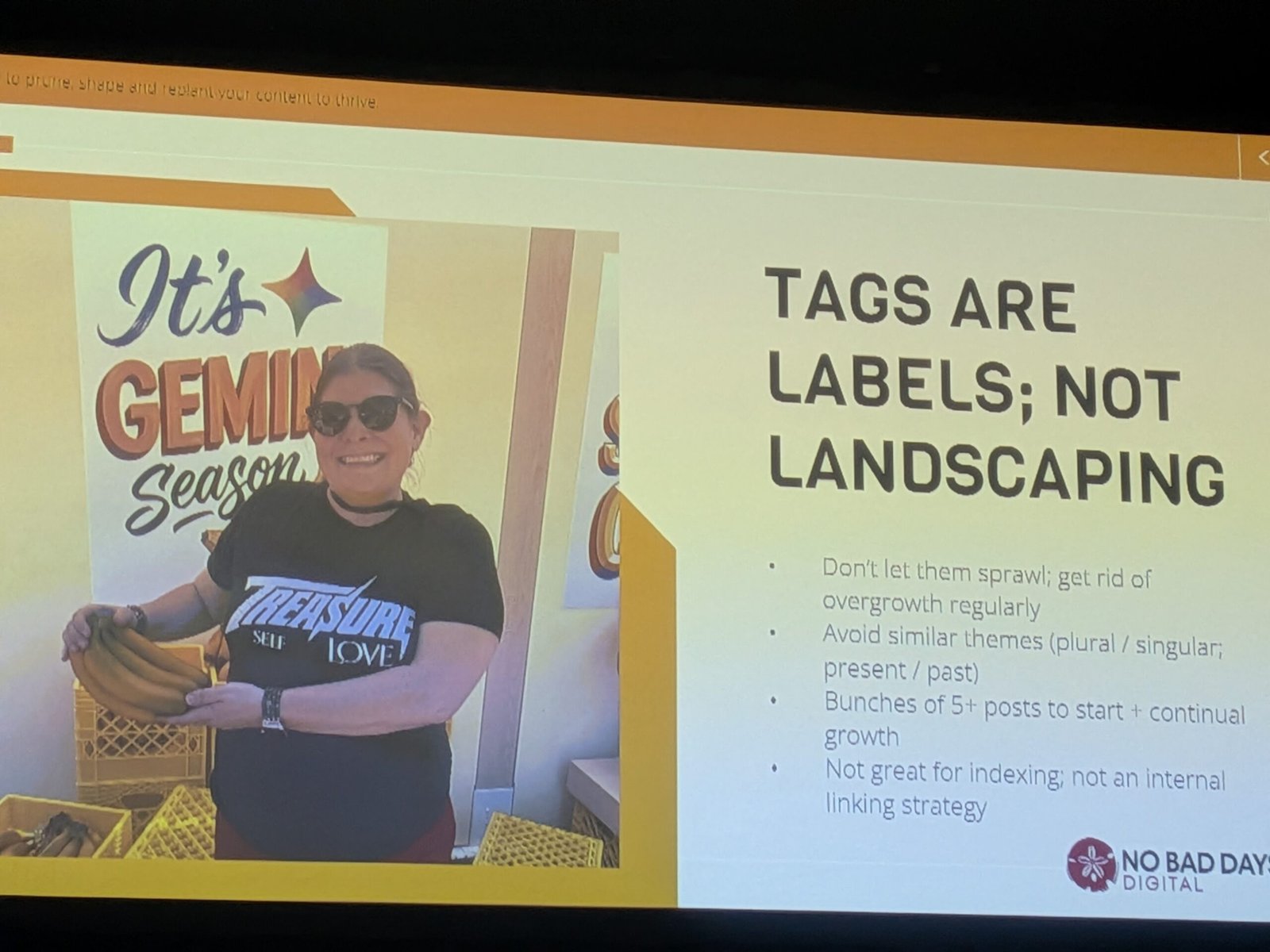
Tags follow the same rule. Don’t let them sprawl, clear out overgrowth regularly, avoid near-duplicates like singular and plural versions, and don’t treat them as an indexing or internal linking strategy.
Replanting: Don’t Migrate a Broken Experience
Laura’s warning: 301s and 200s can still be broken. A redirect that works technically but lands somewhere unrelated is a root that doesn’t match the tree.
Her example: an article ends with a call to action for a webinar, but the link redirects to the homepage or the general webinars page, and the reader can’t find that webinar anymore. Or the webinar still exists, but it has been on demand for three years and something more current would serve the reader better. Fix the user journey, not just the status code.
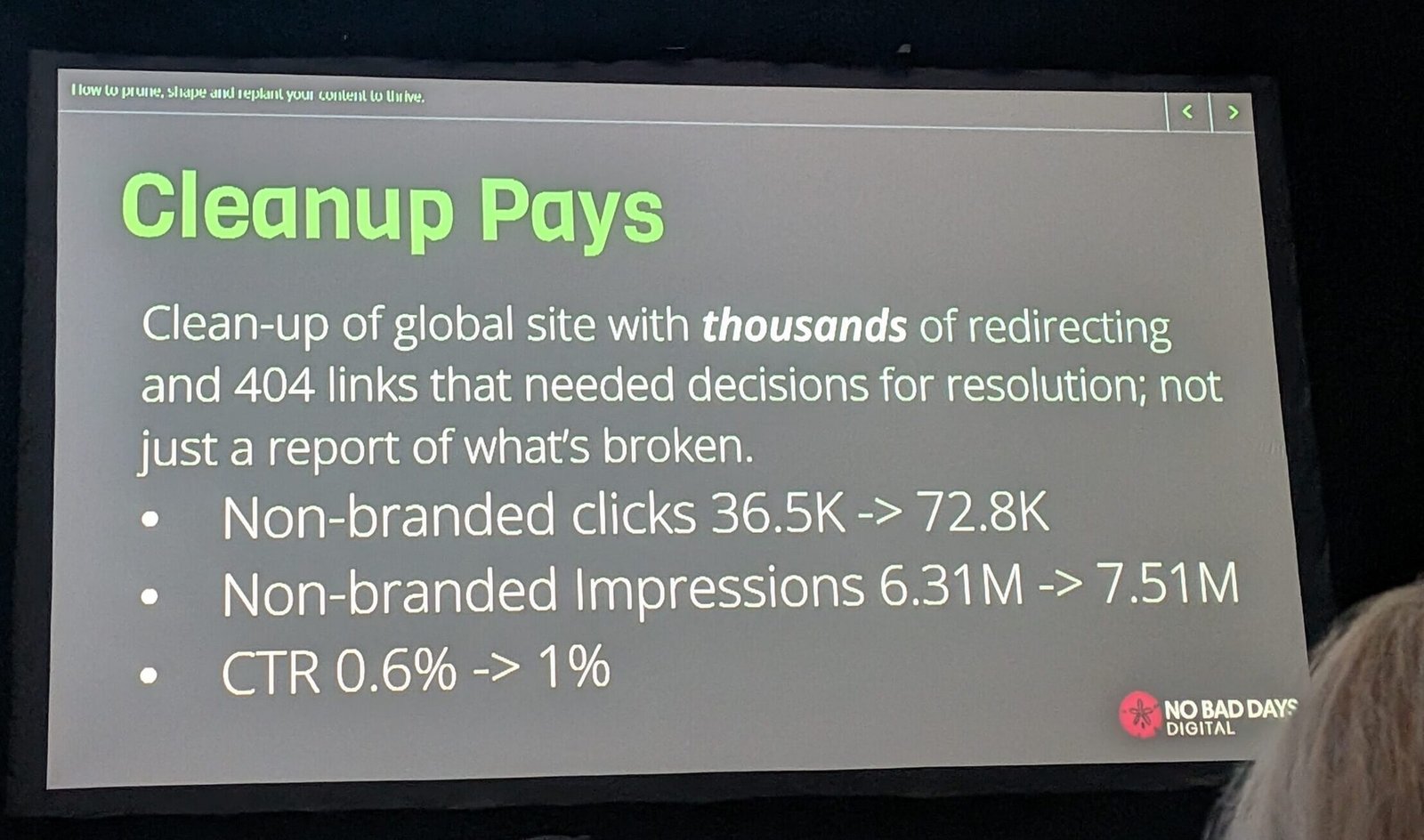
The key word on this slide is decisions. For a global site with thousands of redirecting and 404 links, her team didn’t just hand over a report of what was broken. They decided where each link should go. It took far longer, but the results:
- Non-branded clicks: 36.5K to 72.8K
- Non-branded impressions: 6.31M to 7.51M
- CTR: 0.6% to 1%
She read this as a signal to Google as well as a better experience: the pages became clearly more authoritative once people reached the right destinations.
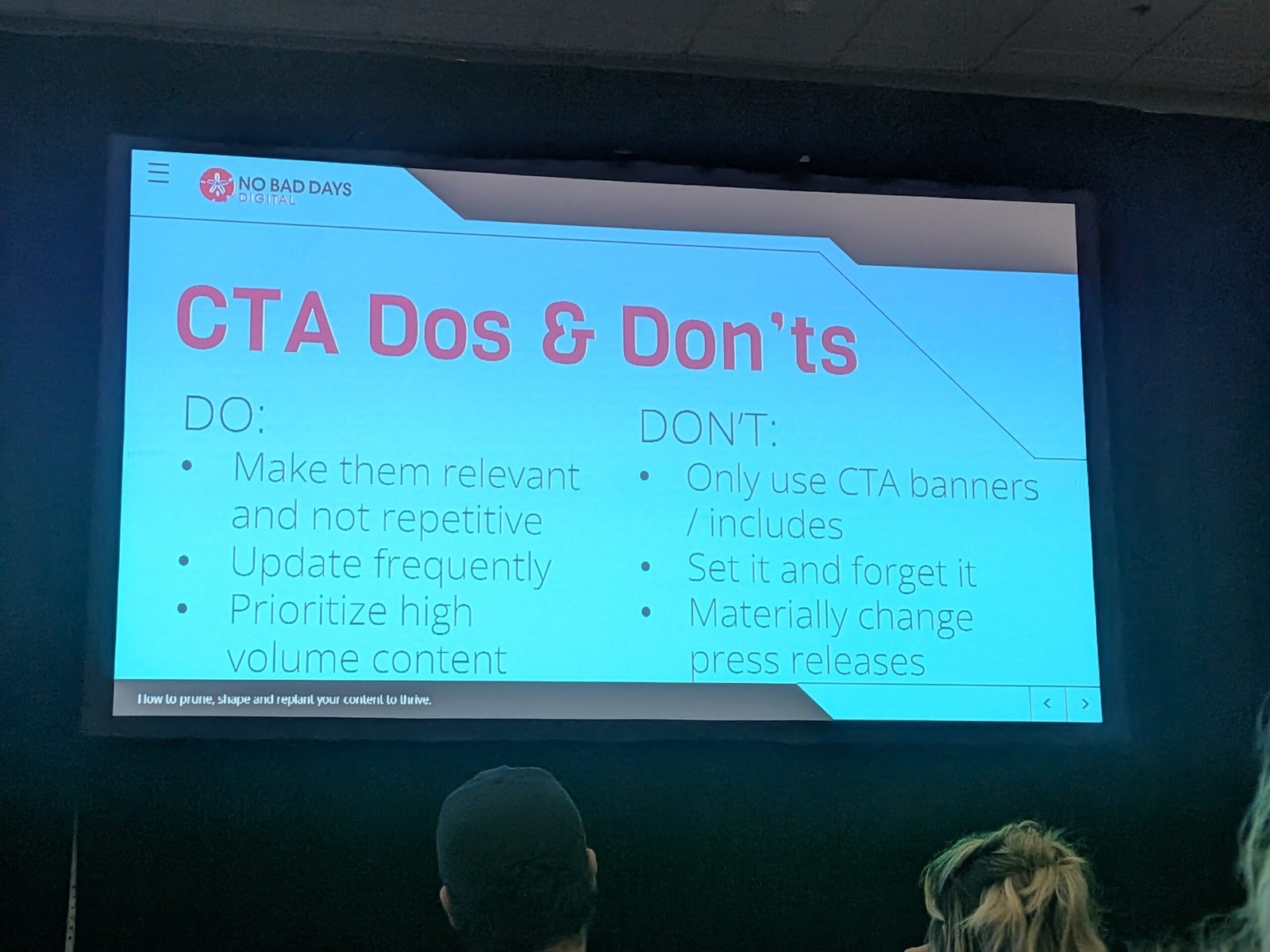
Her CTA rules, with one notable exception: don’t materially change press releases. They went out on the wire and should stay as published.
Give People a Reason to Stay
A visitor may not be ready to convert yet, but they should have a reason to stay engaged.
- Make content scannable. TL;DRs, FAQs, and clear headings. Not every page needs a TL;DR, but they help readers know they are in the right place.
- Think about Google’s search features. Ask whether the page has the right images, whether videos already on your social channels should be embedded, and whether forums, Q&A, or reviews should be referenced.
- Protect what you replant. After a redesign, watch new pages closely so they aren’t undone before they establish.
The Blueprint
- Pull multiple data points for every page. Impressions, clicks, CTR, average position, key events, backlinks, and AI citations.
- Assign each page one of five decisions. Retain, refresh, prune or consolidate, redirect, or retire.
- Find consolidation candidates. Look for topical overlap and repeated content across sections, then fix the internal links pointing to the duplicates.
- Build a striking-distance list. Pages ranking 11 to 50 with meaningful impressions go into the refresh queue.
- Refresh with a checklist. Heading hierarchy, images and alt text, clarity of answers, accuracy, completeness, and recency.
- Simplify structure. Plain labels, a flat folder for posts, and categories or tags only where there are five or more posts and ongoing publishing.
- Decide every redirect and 404. Choose a destination that matches intent, not just a working status code.
- Audit CTAs and internal links. Especially on high-volume pages.
- Monitor after launch. Protect the replanted content while it settles.
What Not to Do
- Don’t cut content based on one metric. High impressions with low CTR can mean potential, not failure.
- Don’t move everything as is. Migration is the moment to consolidate duplicates.
- Don’t get creative with navigation labels. Clever names carry little value for people or search.
- Don’t create categories or tags you can’t fill. Fewer than five posts, or no plan to keep publishing, means no category.
- Don’t treat a 301 or 200 as “fixed.” Check where it actually takes the reader.
- Don’t hand over a 404 report without decisions. The value is in deciding where each link should go.
- Don’t set CTAs and forget them. Outdated offers quietly break the journey.
- Don’t materially rewrite press releases.
Next Steps
- Export pages ranking 11 to 50 from Search Console and sort by impressions.
- Pick five to refresh and check each against the heading, image, clarity, and completeness checklist.
- Search your own site for duplicate topics, such as annual events or stories published in two sections.
- Count posts per category and tag. Merge or remove any with fewer than five.
- Click through the CTAs on your top 20 pages and note where each one actually lands.
Personal Takeaways
This was the most practical presentation, and so much fun that it held my attention right to the end. Laura kept talking with the audience the whole way through, and I really enjoyed it.
At the after party, I asked her how she got so good at presenting. It turns out she used to be a singer, which explains a lot!
What I’m taking away:
- It pairs directly with Thomas Peham’s experiments. Thomas found that 19.3% of URLs cited by AI search no longer resolve, and that pages OtterlyAI deleted were still cited eight months later. Laura’s rule to decide every redirect, rather than just report broken links, now matters for AI answers as well as for Google.
- The consolidation result is the one AI number in the talk, and it’s a strong one. +125% AI/LLM traffic to the success stories came from removing duplicates and clarifying internal links, not from any AI-specific tactic.
- Where Laura and Thomas differ is worth noticing. Laura emphasized alt text for AI retrieval, but Thomas’s tests found only ChatGPT reading alt text. On FAQs, they agree: Thomas found FAQs worked in both Google and AI search, and Laura recommends them for keeping readers engaged. My reading is that alt text is still worth doing for people and for Google, but it shouldn’t be sold as an AI tactic on its own.
- The category rule applies to our own content sites. Five posts to start and a quarterly publishing commitment is a simple test, and it would clear out a lot of thin categories and tags on content sites that have grown over several years.
- “Mostly dead is slightly alive” is a useful way to explain refreshes to clients. It reframes old content as an asset to restore, not a liability to delete.
Related Resources
- Talk: How to prune, shape, and replant your content so your SEO thrives after a redesign
- Speaker: Laura Beatty
- Session: Content (brightonSEO San Diego 2026)
- Brandon Leibowitz session report: the talk before Laura’s in the same session
- Christian Desert session report: the talk after Laura’s, which picked up her point about refreshing rather than republishing
- Thomas Peham session report: why deleted and redirected pages keep appearing in AI answers
Written by Ayaka Uchida
CEO, A-Digital Works
This report covers Laura Beatty’s session “How to prune, shape, and replant your content so your SEO thrives after a redesign” at brightonSEO San Diego (16 September 2026).
