

TL;DR
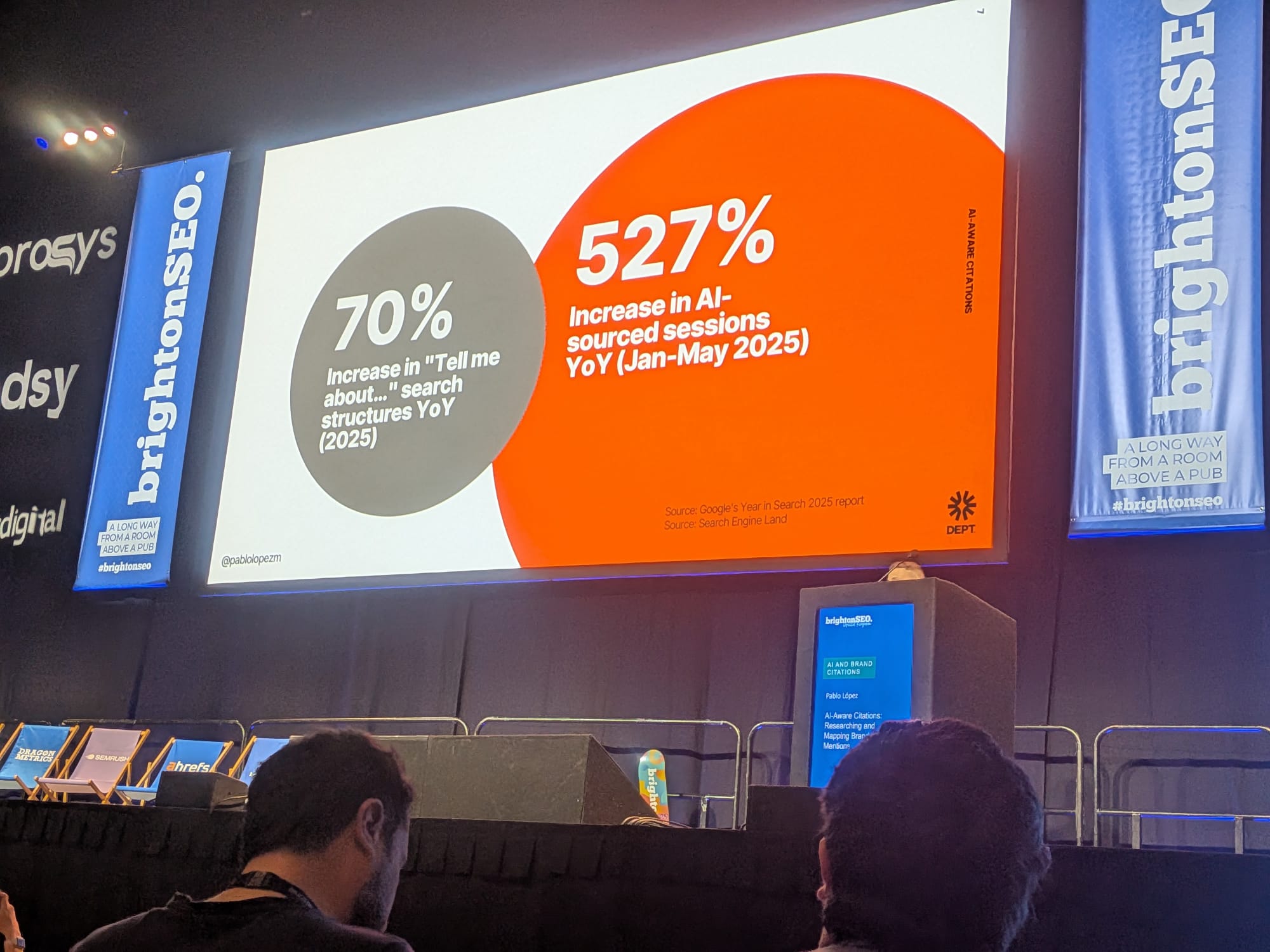
- User search behaviour has shifted: a 70% YoY increase in “Tell me about…” search structures (Google’s Year in Search 2025 report) and a 527% YoY increase in AI-sourced sessions (Jan–May 2025, Search Engine Land). Keyword research alone no longer captures intent
- Pablo walked through a single AI-mediated travel journey — Awareness, Evaluation, Purchase — happening inside one chat. The brand surfaces only at the bottom of the funnel, and is otherwise blind to the conversation that nurtured the user
- His prompt-research framework runs in five stages — Briefing, Data Dump, Schema Synthesis, Stem Creation, Prompt Creation — with hallucination guardrails (Brand Temperature, Funnel Targets, Persona Targets, Technical Boundaries) wrapped around the LLM step
- Applied to a US workstation-peripherals brand (keyboards, mice, webcams, headsets), the framework produced a holistic GEO programme across three pillars: a learning centre with 50+ GEO articles, Reddit brand-page and AMA activation (r/peripherals, r/CommercialAV), and a YouTube support video series including influencer collaborations
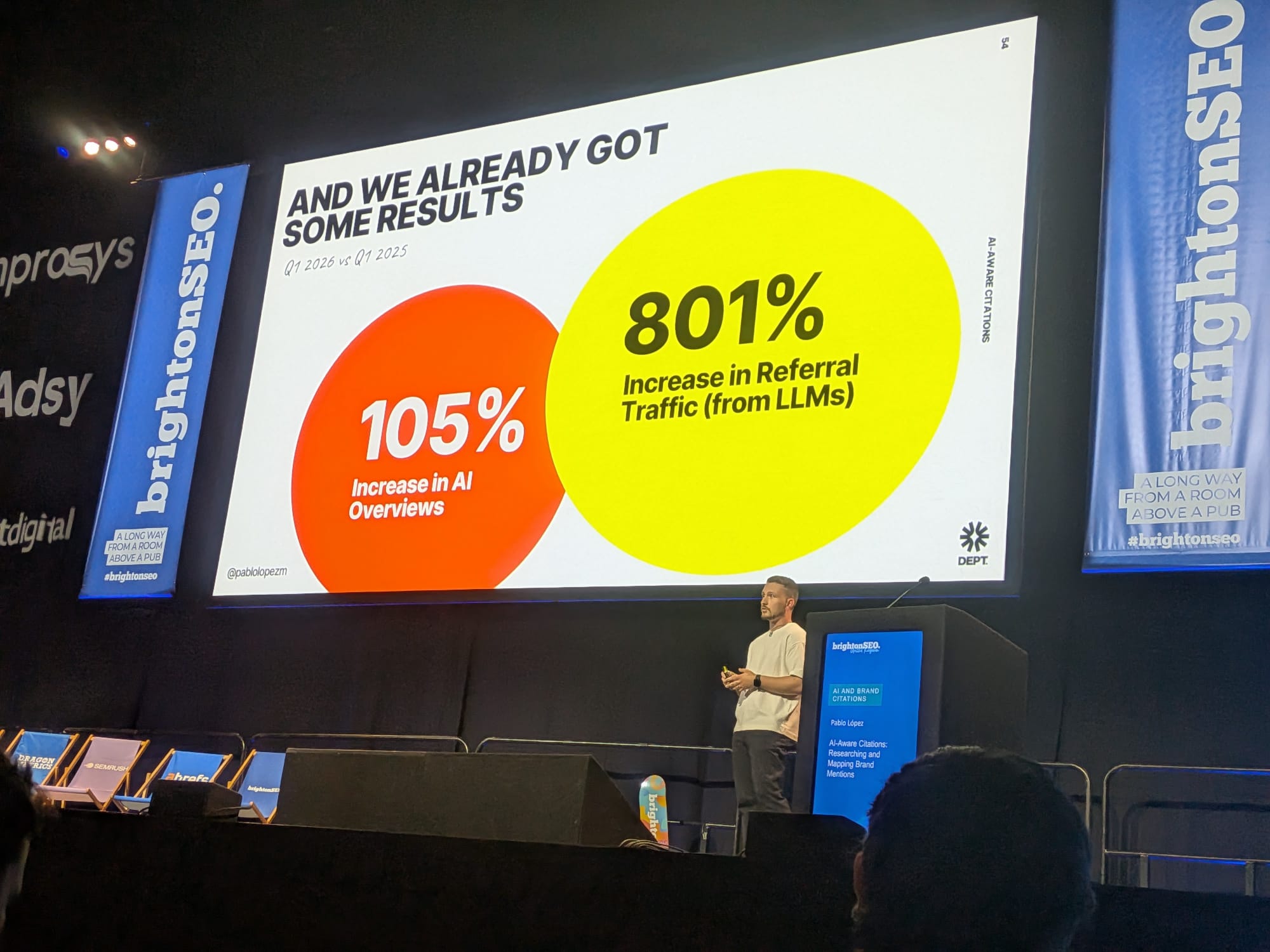
- Quarter-over-quarter result (Q1 2026 vs Q1 2025): 105% increase in AI Overview appearances; 801% increase in referral traffic from LLMs
About the Session
Talk title: AI-Aware Citations: Researching and Mapping Brand Mentions
(The deck title slide reads “AI-Aware Citations: Mapping Brand Mentions to Every Funnel Stage” — slightly different phrasing of the same talk.)
Track: AI and Brand Citations
Date: Friday 1 May 2026
Venue: Brighton Centre, Kings Road, Brighton and Hove, BN1 2GR, United Kingdom
About the Speaker
Pablo López — DEPT
Pablo (Twitter: @pablolopezm, deck: speakerdeck.com/pablolopezm) works on SEO and AI search at DEPT, the global digital agency. The framework he presented was built and validated on a live client engagement rather than packaged as theory.
The Behavioural Shift
Pablo opened with what is now the familiar reframing: users are explaining scenarios; we are still tracking strings (slide 3, “*keywords”). He showed the progression with an ergonomic-mouse example:
- Simple query: “best ergonomic mouse”
- Elaborated query: “best ergonomic mouse for wrist pain?”
- Conversation: “I’m a digital illustrator working 10 hours a day on a Mac. My wrist is starting to hurt. I need a silent, ergonomic setup that won’t clutter my desk.”
The two anchoring data points:
- 70% YoY increase in “Tell me about…” search structures (Google’s Year in Search 2025 report)
- 527% YoY increase in AI-sourced sessions (Jan–May 2025, Search Engine Land)
This diagnosis has now been delivered several times across both days at BrightonSEO Brighton 2026. Pablo’s contribution isn’t the diagnosis. It’s a methodology for researching prompts at scale.
The Funnel Inside One Chat
Pablo’s framing example walked through a single user planning a November UK holiday, all in one continuous chat session:
Awareness phase — “I’m looking to escape the UK cold in November. I want somewhere with guaranteed sun that is no more than a 5-hour flight away. What are my best options?” The AI behaves as a destination researcher, returning Canary Islands, North Africa, Red Sea, Sharm El-Sheikh.
Evaluation phase — “I’m in between Tenerife and Sharm El Sheikh for a one-week trip in November. Our budget is £2,000 for two people. Which destination offers better value for 5-star all-inclusive resorts?” The AI becomes a travel advisor: SUNRISE Arabian Beach Resort, Meraki Resort, Grand Rotana Resort & Spa.
Purchase phase — “I’ve decided on Sharm El Sheikh for the second week of November 2026. Which UK travel agencies are currently offering the best packages for 5-star resorts there that include flights?” The AI surfaces specific brands: TUI, Loveholidays, On the Beach.
The strategic point: none of those brands has any visibility into the fact that the user was being nurtured through all three funnel stages inside a single conversation. The brand can be present in the final answer, or invisible. The chat is the new funnel, and it is mostly opaque to the brands inside it.
SEO Doesn’t Live in a Single Dimension
Pablo’s slide 12 makes the platform point explicit. Traditional search focused entirely on web content (Amazon, RTINGS, Argos for the ergonomic-mouse SERP). LLMs pull from multiple platforms simultaneously — Web (RTINGS), Reddit (r/MouseReview), YouTube (product reviews) — and synthesise across them.
This matters because each platform has its own citation pattern, sentiment baseline, and content format. Optimising only the website misses two-thirds of the inputs the LLM is using.
Researching Prompts, Not Keywords
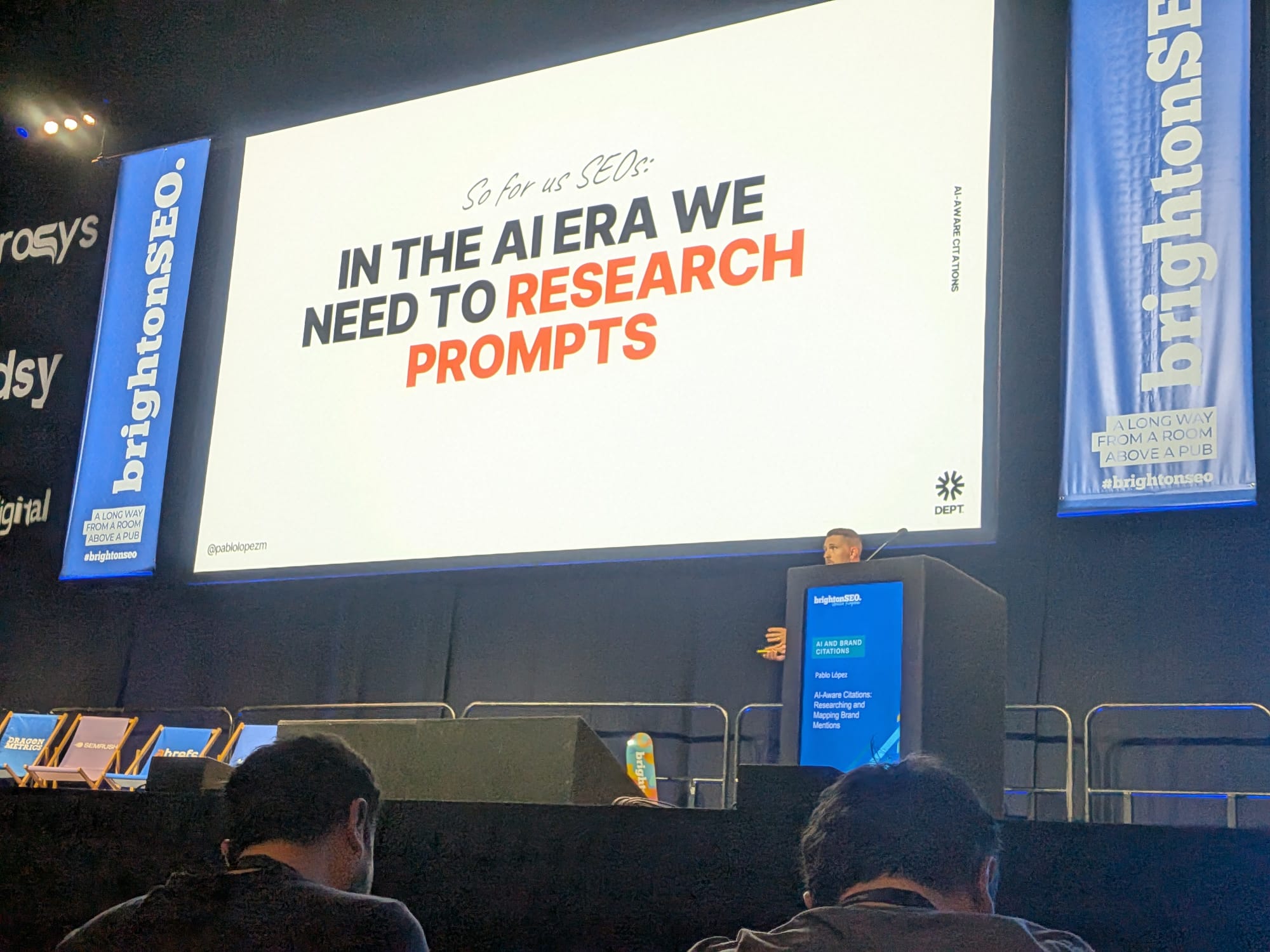
Pablo spent useful time on what prompt research is not:
- Not for chasing vanity metrics. Most high-intent prompts have a search volume of 1, because every user phrases their question slightly differently
- Not for predicting the exact wording of every user. Combinatorially impossible
- Not for building traditional keyword lists. Keywords feed prompts, not the other way round
What it is: research to make smarter content decisions, designed around three axes (slide 21):
- Funnel — is the user ready to convert? Do they know your brand yet?
- Channel — where is the user finding the content?
- Sentiment — how does the user feel about the content?
The Three Methodological Problems
Pablo identified three problems with naive prompt research:
#1 Search Volumes. Predicting prompt volumes is currently impossible — most high-intent prompts have a search volume of 1. Traditional keyword research tools work on aggregated historical data, which doesn’t apply to phrasing-variant prompts.
#2 Prompt Uniqueness. Mapping every user variation is impossible. Users provide unique context, tone, and restraints in every query. Even within the same product category, every person in the room would frame their question differently.
#3 Generic Data. Generic prompt research lacks brand intelligence. AI requires tailored, first-party data to understand your specific nuance. Build strategy on generic prompt research, you get a generic strategy.
The Five-Stage Framework
Pablo’s framework was built for a US workstation-peripherals brand — keyboards, mice, webcams, headsets, microphones — with ergonomic peripherals weighted at 55% of strategic themes. It runs in five stages.
Stage 1 — The Briefing
Ingest brand-critical first-party data: Scope Data (scope description, tone of voice, USPs, pain points), Personas (Hybrid Worker, Creative Mind, IT Expert, Student), plus Top Competitors, Product Categories, Relevant Topics.
Pablo’s simplified briefing example (slide 32) showed: Market = United States; Tone = Conversational and human, Professional; Product Categories = Workstation Peripherals 0.5, Software 0.3, Connectivity 0.2; Strategic Themes = Brand Relevance & Comparisons 0.25, Sustainability 0.2, Ergonomic Peripherals 0.55.
This stage also sets four guardrails to prevent LLM hallucinations (slide 33):
- Brand Temperature — branded vs non-branded prompt ratio
- Funnel Targets — weight per funnel stage
- Persona Targets — balance of personas
- Technical Boundaries — question ratios, number of prompts per stem, max tokens
Stage 2 — Data Dump
Add open-web signals. Long-tail keywords as seeds, competitor keyword-gap data, and — most usefully — People Also Ask questions scraped from Google, treated as a “how do real users phrase things” corpus rather than as content ideas.
Pablo’s full data-source list (slide 38) included eleven inputs: GSC data, keywords, conversion data, competitor data, PAA questions, Reddit data, merchant data, social signals, citation data, digital PR data, CRM integrations.
Stage 3 — Schema Synthesis
This is the structural insight. The AI model analyses all the ingested data and builds a slot dictionary — a structured set of variables and the values each can take. Pablo’s example (slide 40):
[CATEGORY]→ Webcam, Microphone, Headset, Analog Keyboard…[AUDIENCE]→ Traveler, Creator, Student, Professional, Mac User…[QUALITY]→ Sturdy, Portable, Comfortable, Quiet…
This dictionary is the engine for the next two stages.
Stage 4 — Stem Creation
A prompt stem is a template sentence with variable placeholders. Stems get assembled programmatically by stitching natural-language fragments (from the briefing’s pain points and tone) around the slot variables. Examples (slide 43):
- How to set up [PRODUCT] in a [USE_CONTEXT] without technical issues? — branded only
- Best [CATEGORY] for [AUDIENCE] — allow both
- Which [CATEGORY] do [AUDIENCE] actually recommend for [USE_CONTEXT]? — allow both
- Is there a [BRAND] [CATEGORY] that actually solves [PAIN_POINT]? — branded only
Each stem is tagged with brand acceptance (branded only vs allow both) for downstream control.
Stage 5 — Prompt Creation
Variables get substituted with concrete values from the slot dictionary, producing specific prompts:
Stem: “How to set up [PRODUCT] in a [USE_CASE] without technical issues?”
Output: “How to set up a webcam in a conference room without technical issues?”
Then the final move: semantic expansion. The framework wraps each prompt with realistic human framing — context sentences, conversational tone, persona-targeted constraints — so the prompt becomes indistinguishable from what a real user would type. Example (slide 47):
“I’ve struggled with wrist pain for months while working in the office, what keyboard would you recommend to help prevent this?”
All generated prompts are then polished and categorised by Funnel Stage (TOFU / MOFU / BOFU), Sentiment (Explanatory / Instructive), and Branded vs Non-Branded. From here they feed into an AI-visibility tracker like Profound to measure citation patterns across answer engines.
What the Audit Surfaced
Pablo used the categorised prompts to audit how AI was currently seeing the brand. Three findings (slides 50–52):
- LLMs prioritise how-tos and technical content — setup guides, editorial content, technical papers. They prefer content that helps them explain how things work
- Reddit citations have a sceptical sentiment and are driven by support cases. The two subreddits Pablo named: r/peripherals (“How do I troubleshoot persistent latency on a 2.4GHz wireless receiver in a crowded open office?”) and r/CommercialAV (“Does the Pro Video Bar’s build quality actually justify the higher price point?”)
- YouTube citations are mainly driven by product demos. Example prompt: “Which iPad stylus has the lowest latency for digital illustrators?” — surfaces hands-on test videos
The Holistic GEO Strategy
The three findings translated into three workstreams (slide 53):
- A new Learning Centre on the brand site — 50+ GEO articles, tailored to the citation gaps surfaced by the audit, structured around user needs
- Reddit brand presence — updating the official brand page, active participation in threads, running AMAs
- A support video series on YouTube — video storytelling, product demos, influencer collaborations
Quarter-over-quarter outcome (Q1 2026 vs Q1 2025): 105% increase in AI Overview appearances and 801% increase in referral traffic from LLMs.
Closing Thesis
Pablo closed on two lines worth keeping (slides 55–56):
- “AI doesn’t rank pages, it synthesises evidence.” The unit of optimisation has shifted from page to evidence
- “Generic strategies get generic results — trust your data.” The framework is only as good as the first-party inputs in Stage 1
Personal Takeaways
This is my third BrightonSEO (Brighton April 2025, San Diego September 2025, Brighton April 2026 — scholarship recipient for the most recent). Pablo’s session was the most directly implementable methodological contribution I saw on Day 2.
A few specific things I’m taking home:
- Schema Synthesis is the genuinely novel part, not Stem Creation. The “slot dictionary” — extracting structured variables and their valid values from messy ingest data — is what makes the downstream prompt explosion controllable rather than chaotic. Most prompt-generation approaches I’ve seen (mine included) skip this step and produce flat lists. Treating it as a discrete stage with its own logic is what unlocks the rest
- The four guardrails (Brand Temperature, Funnel Targets, Persona Targets, Technical Boundaries) are the bit clients should ask about first. They’re what stop an LLM-driven framework from producing a 1,000-prompt list that’s 80% off-brand or wrongly weighted. They aren’t optional
- Using Data for SEO’s People Also Ask as a phrasing corpus rather than a content-idea source is a quiet but important reframing. PAA tells you how real users phrase things, which is exactly what the semantic expansion step needs
- The Reddit-sceptical / YouTube-product-demo split is consistent with what Jon Earnshaw argued on Day 1 about brands earning their citations through depth and authentic content. Pablo’s data-led version gives Jon’s argument something quantitative to point at
- The 105% / 801% numbers are a single quarter from a single client — useful as directional evidence, but not the same calibre as Tom Capper’s pixel position study, Ryan Law’s ~75,000-brand correlation work, or Philip Armstrong’s 20-billion-event panel data
Across the BrightonSEOs I’ve attended, the strongest sessions have introduced a genuinely new analytical contribution rather than refining existing consensus. Pablo’s session was solid, copyable, working-agency practice — the kind of methodology you can pilot on a client engagement on Monday. That’s a real contribution, even if it’s not a paradigm shift.
Related Resources
- Speaker profile: Pablo López (BrightonSEO)
- Pablo’s deck on Speaker Deck
- DEPT — the global digital agency where Pablo works on AI search
- Data for SEO — referenced as a source for People Also Ask extraction
- Profound — AI-visibility platform for measuring citation patterns from generated prompts
- Ryan Law’s session report — the deeper mechanical explanation of how AI search engines work, which Pablo’s framework operates on top of
- Philip Armstrong’s session report — the empirical view of consumer journey behaviour that frames why prompt research matters
About the Author
Ayaka Uchida (打田彩夏) — Founder & CEO of A-Digital Works Ltd. Founder of Nihon GO! World (Fitzrovia, London and Manchester). 10+ years in international business development across Japan, Singapore, US, and UK. BrightonSEO attendee 3 times (April 2025 Brighton, September 2025 San Diego, April 2026 Brighton — scholarship recipient). Aoyama Gakuin University, Faculty of Law. Fluent in Japanese and English; studying Spanish, French, and German.
Connect: a-digitalworks.com | LinkedIn
About A-Digital Works
A-Digital Works Ltd is a London-based Japan–UK SEO and EN↔JA localisation consultancy supporting UK, EU, and US companies entering the Japanese market. Services span keyword research in Japanese, content localisation, technical SEO, and market entry strategy. Flagship case study: Descartes Systems Group (Canadian logistics technology) — full Japanese-market SEO programme covering 物流システム, EDIシステム, and 配車システム.
This report covers Pablo López’s session “AI-Aware Citations: Researching and Mapping Brand Mentions” at BrightonSEO Brighton on Friday 1 May 2026.
