

TL;DR
- SEO is not dead. Last-click attribution is. Clicks are down and AI is growing, but when revenue holds steady while clicks fall, the problem is the measurement model, not the channel.
- AI and search coexist in the same journey. In Semrush Journey clickstream data from Q4 2025, 80% of consumer journeys include an AI/LLM waypoint, and 90% of those AI journeys also include a search waypoint.
- Consumers trust AI, then check it. In Semrush’s Q4 2025 survey, 75% said they trust AI recommendations, yet 68% confirm those recommendations with search.
- AI changes what people buy, not just what they see. 79% said AI influenced their purchase decisions, and more than half were introduced to new products through it.
- The most influential touchpoints are invisible to your analytics. A shopper can consult two AI assistants, never click a link, and buy on your site. Your reporting will credit direct traffic.
About the Speaker
Skyler Rudolfsky is a Digital Strategy Consultant at Semrush (now an Adobe company).
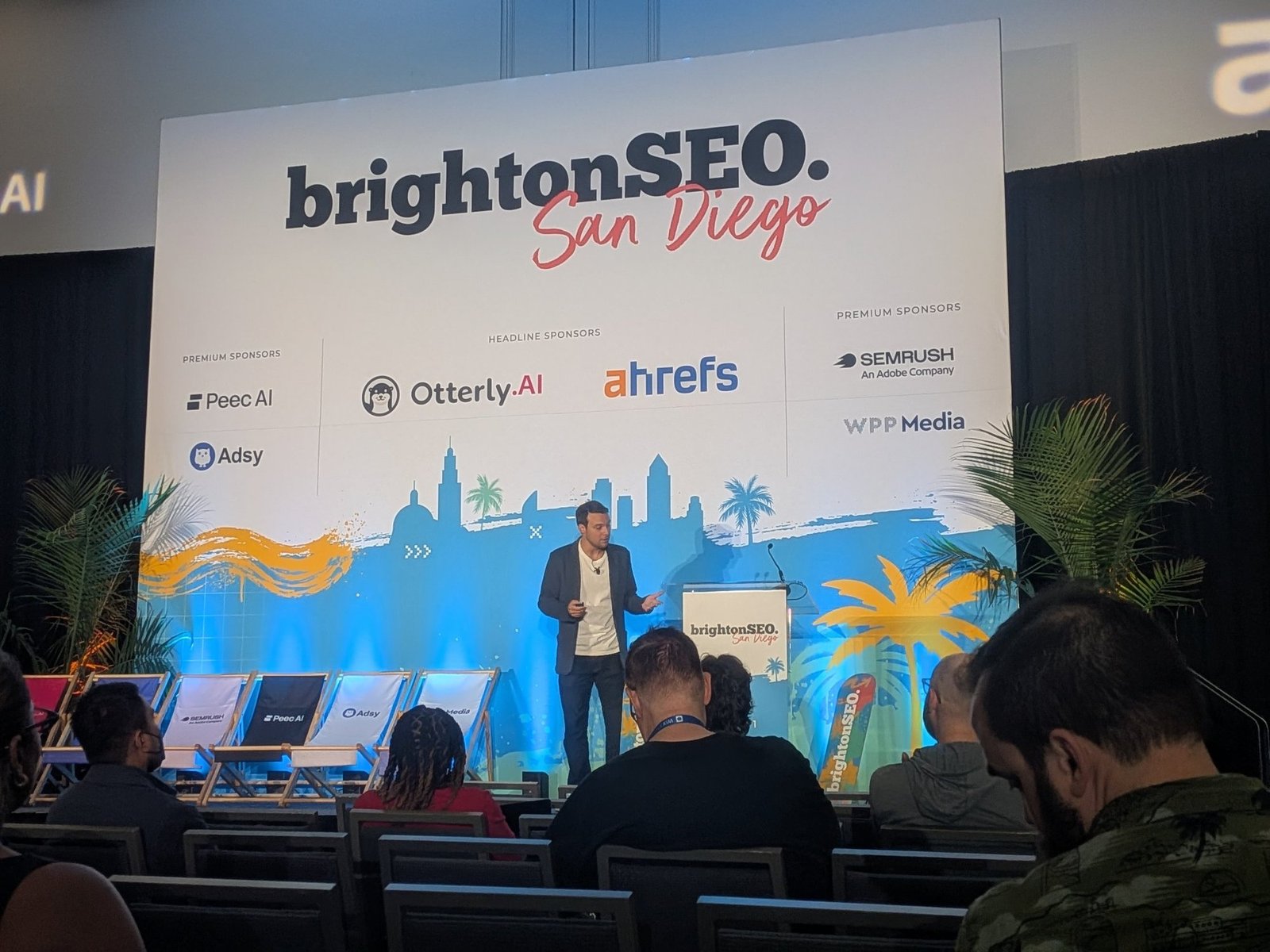
The session draws on Semrush Journey, which Semrush describes as the world’s largest near-time clickstream database: 20 billion monthly click events from 20 million global monthly active users. That scale is what separates this talk from the many “the customer journey is messy now” presentations circulating this year. It is observed behavior, not a conceptual diagram.
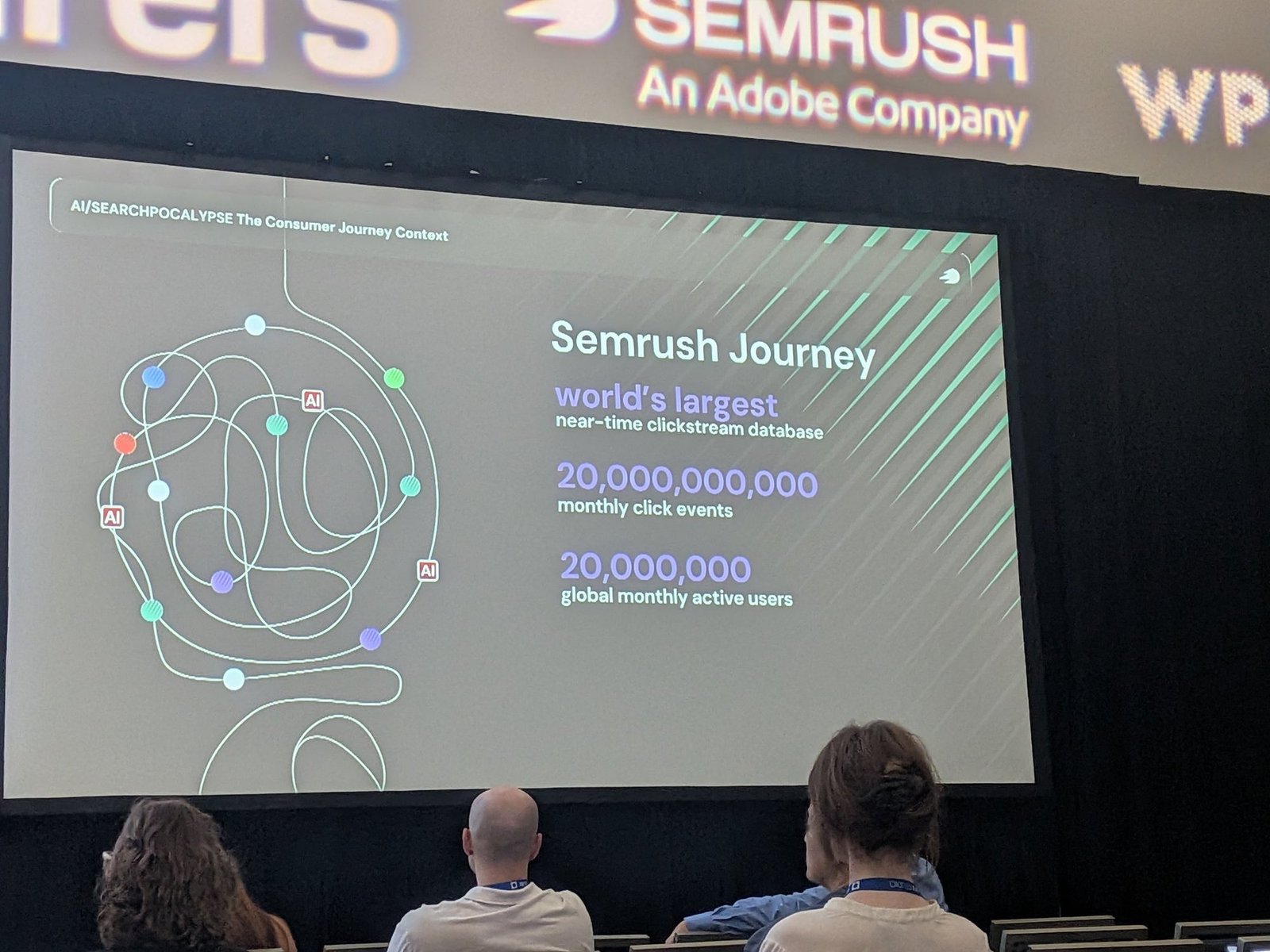
A note for regular readers: this is the same research programme Philip Armstrong presented at brightonSEO Brighton in April. I’ve written this report to focus on what the San Diego version added and on how the argument landed with a US audience, rather than repeating the earlier write-up. The link is in Related Resources.
The Problem: The Numbers Don’t Add Up
Skyler opened by taking the “SEO is dead” narrative at face value. The case for it runs like this: zero-click searches are rising, click-based efficiency metrics are falling, and the queries must have migrated to AI.
He then applied a trust-but-verify test. Zero-click behavior is growing, but gradually. AI referrals are growing too, but remain a small share of site traffic. When Semrush looks at client analytics, the traffic arriving from AI tools is nowhere near large enough to fill the gap left by lost clicks. If clicks moved to AI, the math should balance. It doesn’t.
So either the industry is collapsing, or the question is framed wrong. Skyler’s answer: if clicks are down but the business outcome, usually revenue, is not, then clicks have stopped working as a measure of performance. This is an attribution problem, not an SEO problem.
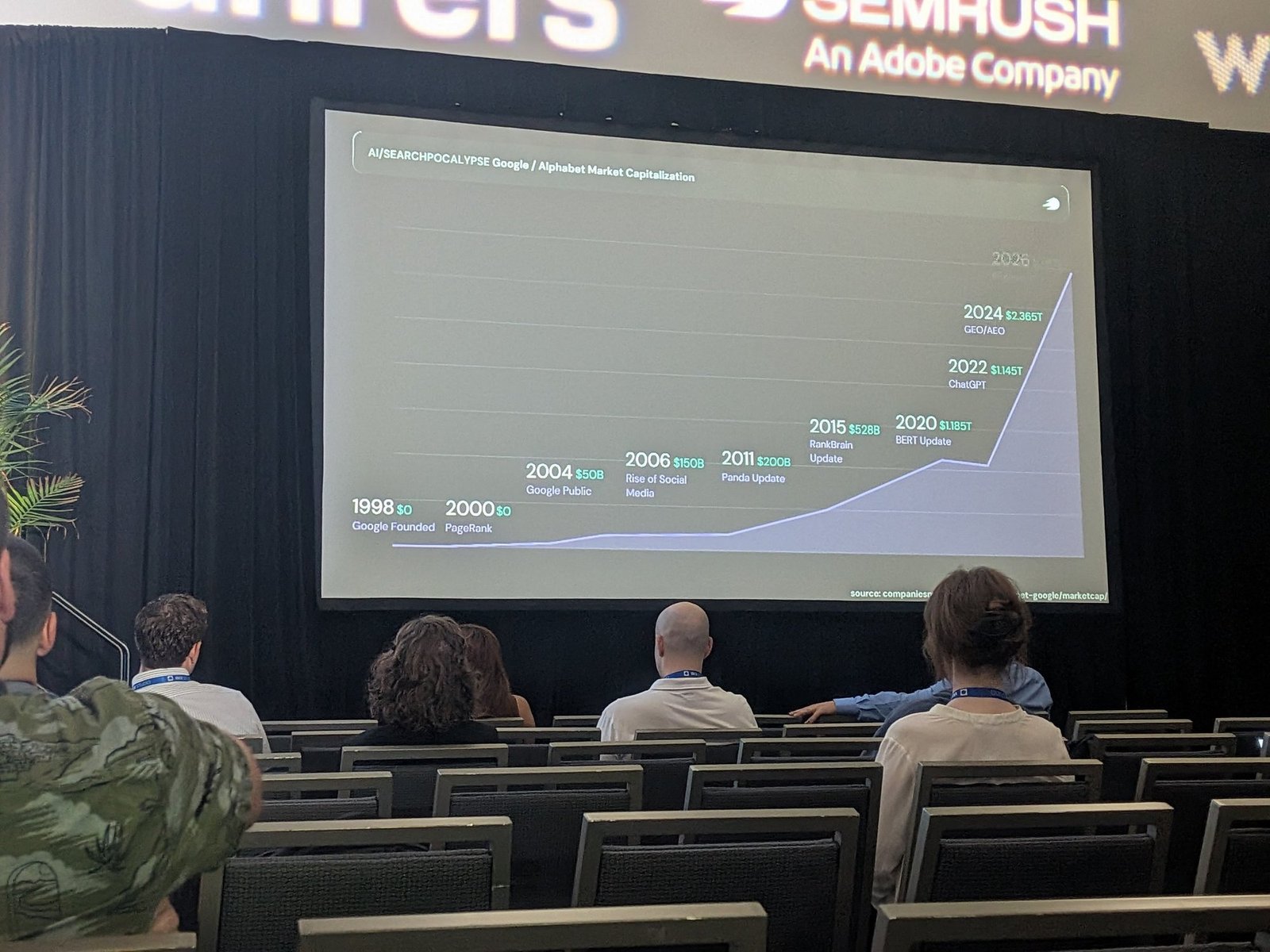
He backed this up with a slide that is easy to overlook but hard to argue with: Alphabet’s market capitalization over time. It rose from roughly $1.1 trillion in 2022, the year ChatGPT launched, to about $2.4 trillion in 2024, the year GEO and AEO entered the vocabulary. The company whose search business was supposedly being destroyed roughly doubled in value during the “searchpocalypse.”
The Real Shape of the Consumer Journey
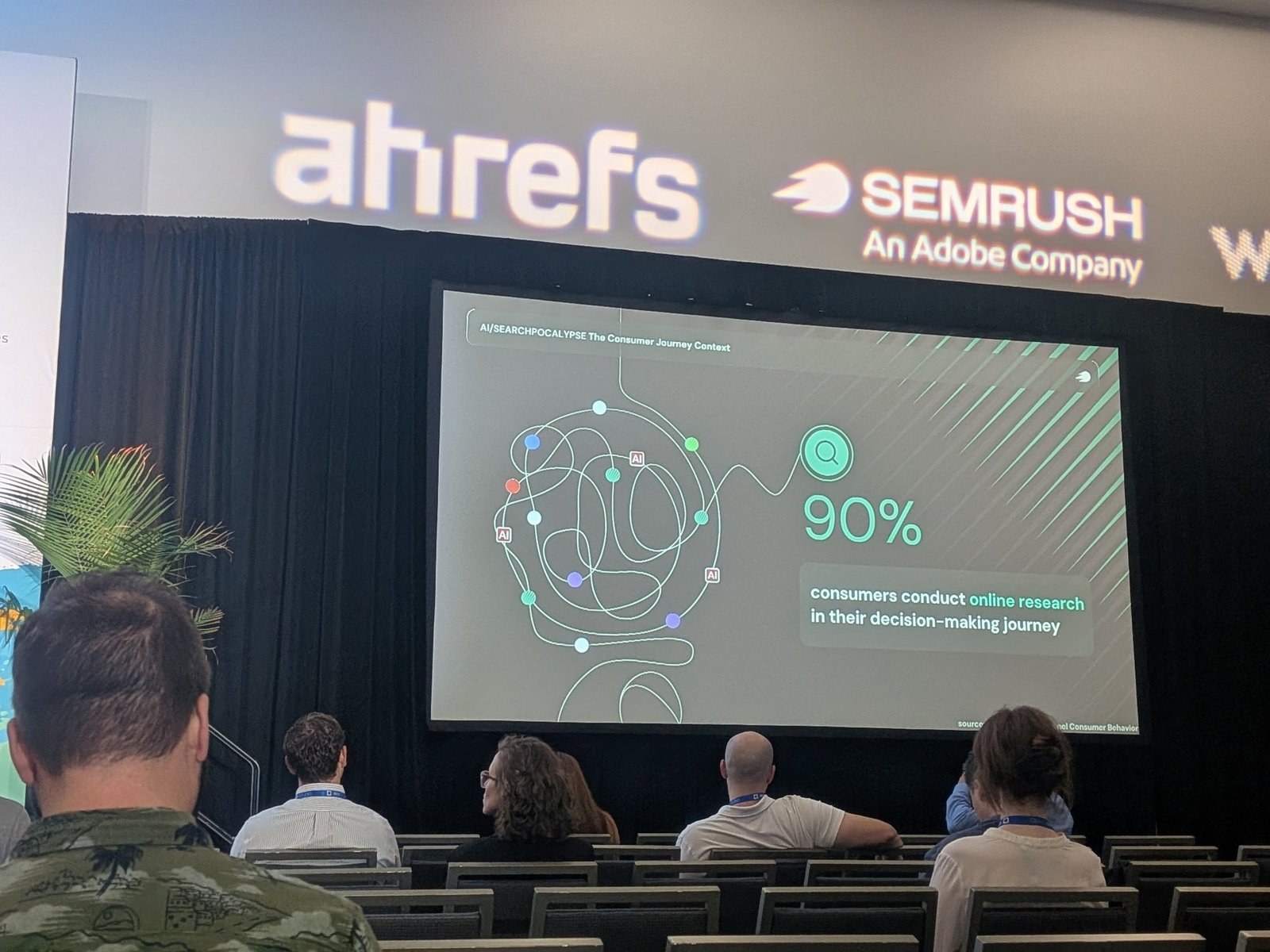
The framing section set out why linear funnels no longer describe how people buy:
- 90% of consumers conduct online research during their decision-making journey.
- 85% of Gen Z use social media to research products.
- Most marketers agree that understanding the full consumer journey is key to success.
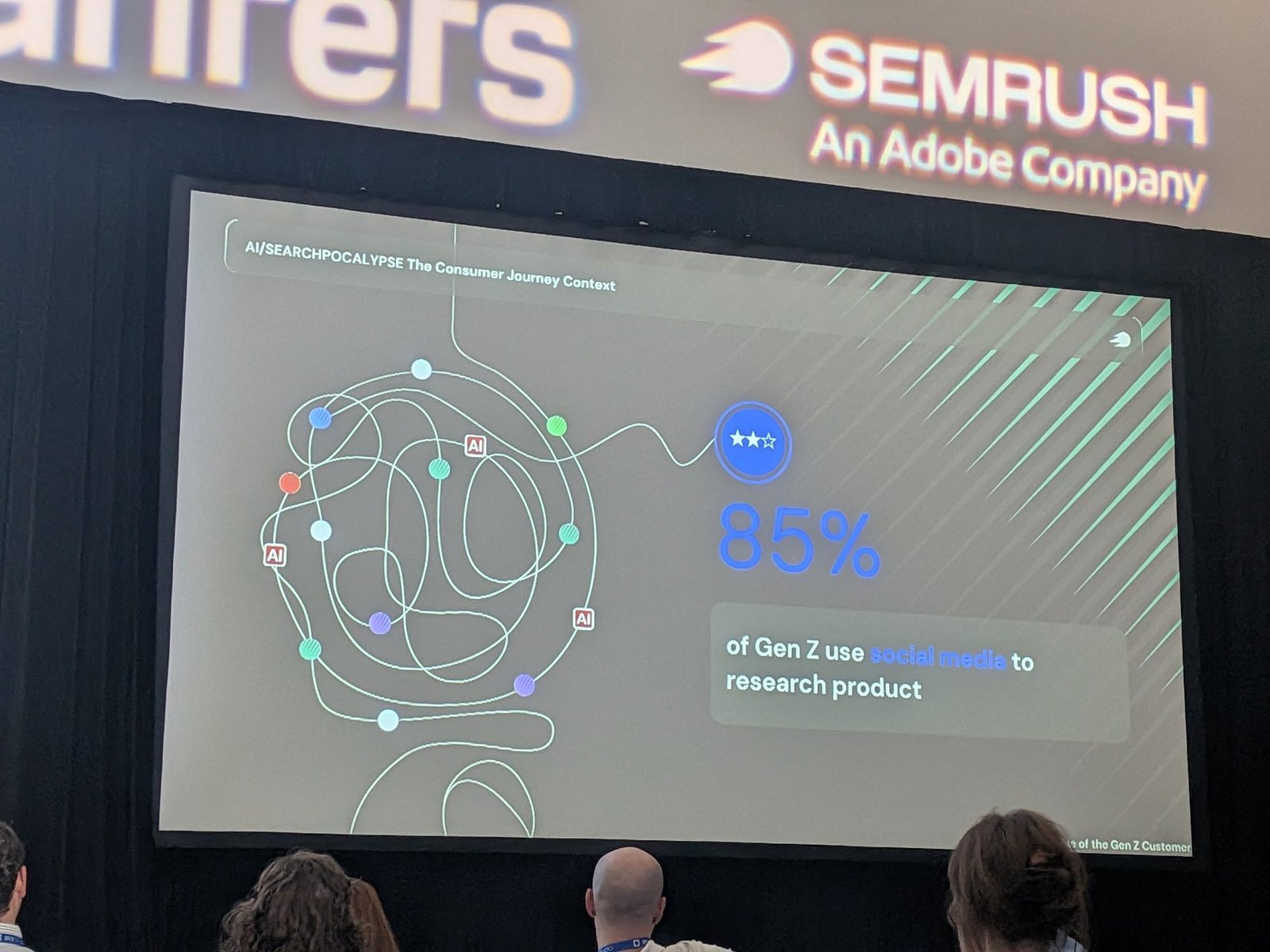
The visual metaphor throughout the deck is a tangled line looping back on itself, with AI waypoints scattered across it. People jump from awareness to consideration and back again, across search, social, email, marketplaces, and AI assistants. A simple click-based model cannot represent that.
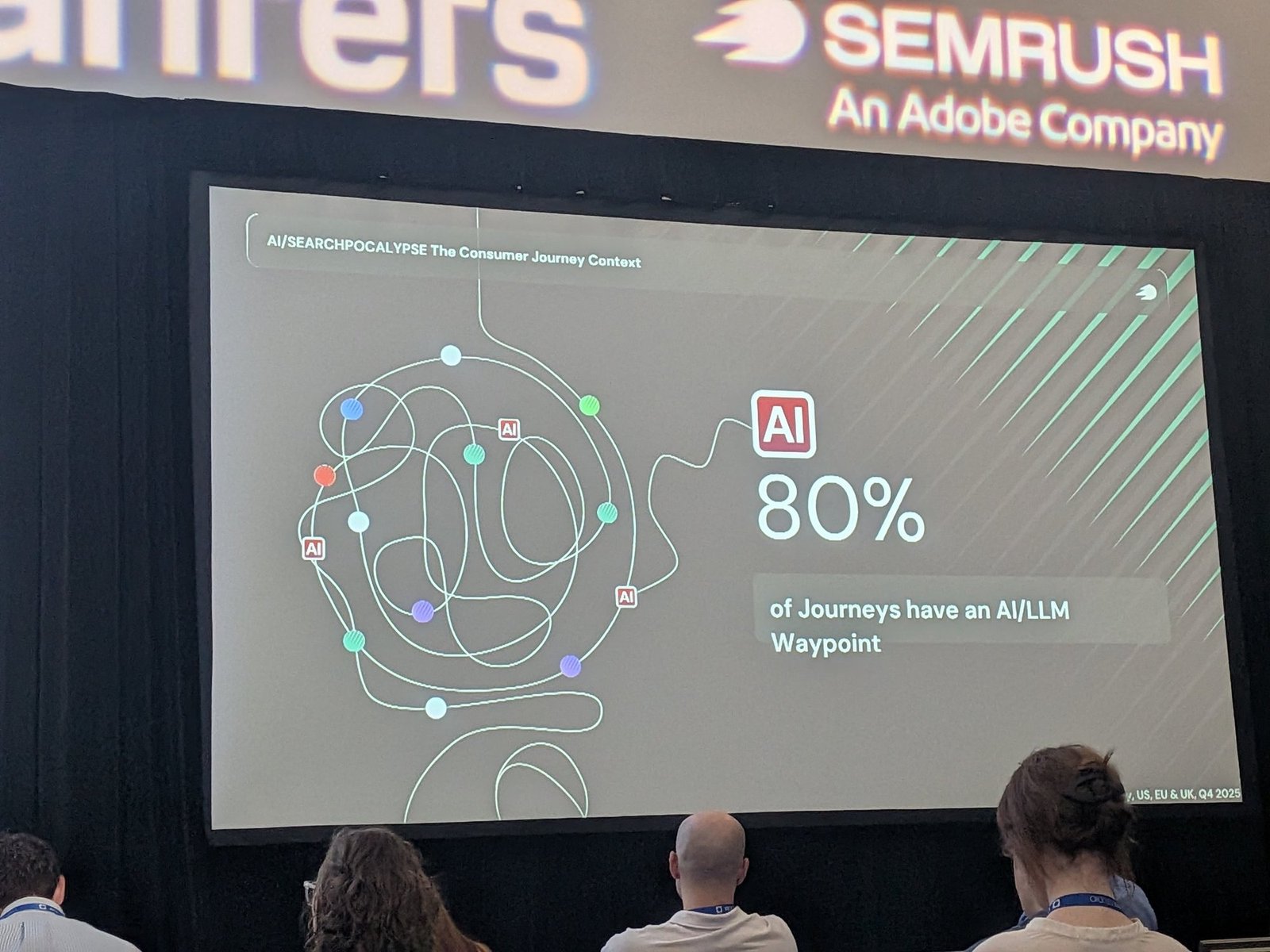
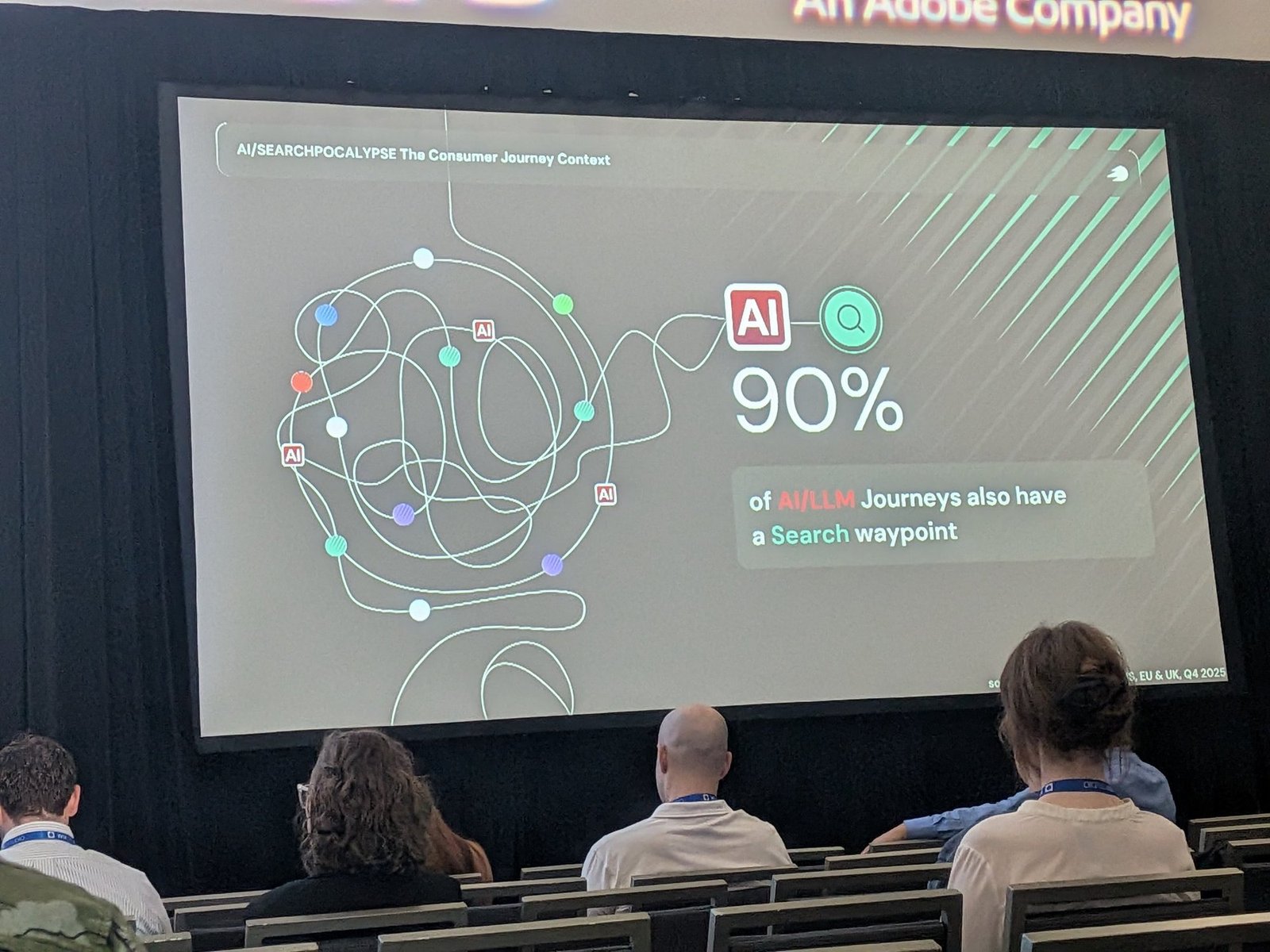
The two headline numbers from Semrush Journey (US, EU and UK, Q4 2025) are the heart of the talk:
- 80% of journeys include an AI/LLM waypoint.
- 90% of those AI/LLM journeys also include a search waypoint.
If AI were replacing search, the second number would be low. It isn’t. The two channels are being used together.
What Consumers Say About AI
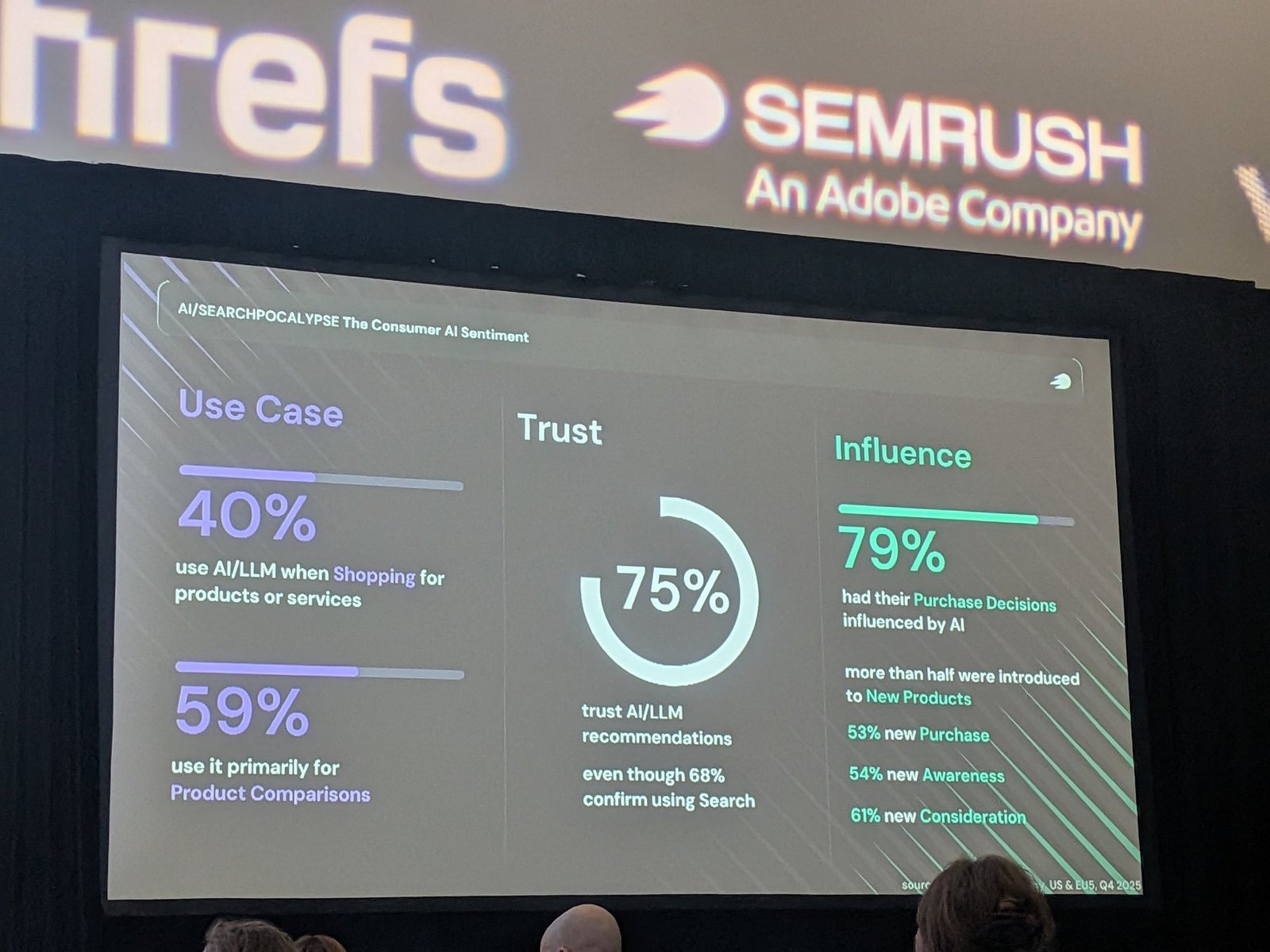
Semrush paired the observed data with a survey (US and EU5, Q4 2025), organized into three themes:
Use case. 40% use AI when shopping for products or services, and 59% of those use it primarily for product comparisons.
Trust. 75% trust AI recommendations, even though 68% confirm them by using search. This is the most useful statistic in the deck for anyone making the case for continued SEO investment. AI earns a place in the consideration set; search is where the answer gets checked.
Influence. 79% had their purchase decisions influenced by AI. More than half were introduced to something new: 53% to a new purchase, 54% to new awareness, and 61% to new consideration.
That last group matters. AI is not simply another exposure point that increases frequency. It changes which products end up on the shortlist.
A small note on the numbers: the session’s published abstract cites 71% for purchase-decision influence. The slide shown on the day says 79%, and that is the figure I’ve used here.
Three Journeys, Observed
The most memorable part of the session was three real, anonymized journeys from the clickstream panel. Skyler ran them as audience participation, inviting volunteers to “adopt” each journey. None of the data contains personal information.
Case Study 1: The Foundation Shade
A shopper’s journey included a search for a luxury jewelry brand, browsing premium haircare, and then research on a foundation at Sephora. She added it to her cart, left to look at another site, returned, and bought it.
Minutes after checkout, she was in Sephora’s FAQ and customer support pages trying to cancel. The cancellation window had closed. Only by following the rest of the journey does the reason become clear: she had become unsure whether she had picked the right shade. Sephora’s product page hadn’t given her the certainty she needed, so she turned to AI assistants, TikTok, and Google, which eventually led her to a third-party site that confirmed her choice. She kept the order.
Three lessons Skyler drew from this:
- Journeys are complex jobs to be done. This was not a replacement purchase. It was a self-care journey spanning jewelry, haircare, and makeup, and a single product fits inside that bigger picture.
- Fear of a better option happens during and after checkout. The item is already bought, and the customer is still deciding. That is the moment alternatives get considered.
- Journeys don’t end with conversion. She re-entered product evaluation after buying.
Case Study 2: The Weight-Loss Medication
This journey began with a pizza order. Something about it prompted a decision to change habits. The user bought an extra-large blood pressure cuff on Amazon, searched Bing for treadmill replacement parts, researched a GLP-1 weight-loss medication, and watched before-and-after content on YouTube. He then researched costs and savings options.
Then came the obstacle: a fear of needles. He went back to YouTube, searched how to self-inject, watched the content, and got comfortable with it. His final step was asking Perplexity how much the medication would cost with his insurance. Minutes later, he was on the manufacturer’s patient site.
The lessons:
- AI appeared at the very end of the journey, not the top. We usually place AI in the awareness stage. Here it was the last touchpoint before conversion.
- User-generated content does the trust work. People want to see a product used in real lives by real people. Polished marketing doesn’t answer “can I actually do this?”
- Consumers still go to the original source. Even with UGC doing the persuasion, he visited the brand’s own site. Both content types need to exist.
Case Study 3: The 77-Inch TV
A buyer started with a broad Google search for the best TVs and soon had a 77-inch Samsung model in his cart. Before committing, he pasted the model name into Perplexity with no question and no instructions.
Perplexity built a decision framework, filled it with specifications, and passed judgment, drawing on what it remembered about him from previous conversations. Skyler’s point: this is the fundamental difference between search and AI. Search surfaces information. AI anticipates the underlying intent and gives an opinion.
The buyer then checked the answer with ChatGPT. Along the way, one of the AI answers relied on outdated information from an older Samsung model. It wasn’t strictly a hallucination; it was stale data, which is abundant online. He bought the TV on Samsung.com.
The critical detail: he never clicked a link inside either AI tool. Samsung has no record that AI shaped this decision, and no way of knowing that one assistant described its product using the wrong specs.
Skyler’s analogy: search is a polite librarian who points you to the right shelf and lets you decide. AI is the opinionated relative who tells you exactly which one is best.
The Blueprint: Journey Insights
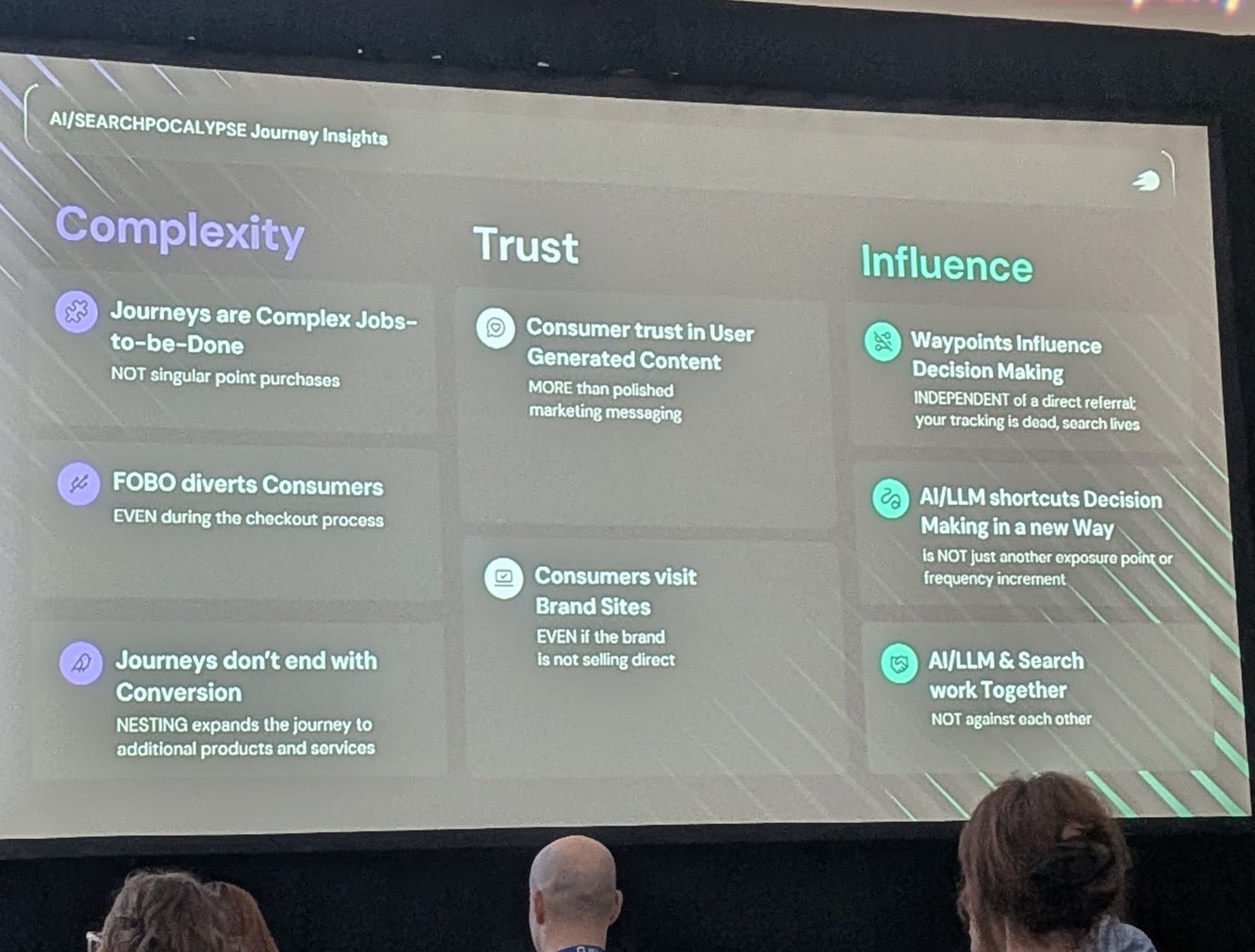
Skyler closed with a summary slide that works as a checklist:
Complexity
* Journeys are complex jobs to be done, not single-point purchases.
* Fear of a better option diverts consumers, even during checkout.
* Journeys don’t end with conversion; they expand into additional products and services.
Trust
* Consumers trust user-generated content more than polished marketing messages.
* Consumers visit brand sites even when the brand doesn’t sell direct.
Influence
* Waypoints influence decision-making independently of a direct referral. Tracking is failing; search is not.
* AI shortcuts decision-making in a new way. It is not just another exposure point.
* AI and search work together, not against each other.
What Not to Do
- Don’t declare SEO dead because clicks fell. Check whether business outcomes fell with them. If they didn’t, change the measurement, not the strategy.
- Don’t move your whole SEO budget into AI visibility tools. The observed data shows AI referrals can’t replace the lost clicks, and most AI journeys still pass through search.
- Don’t rely on referral data to judge AI’s impact. The most influential AI moments in all three case studies produced no click at all.
- Don’t place AI only at the top of the funnel. In the medication journey, it was the final step before purchase.
- Don’t let your product pages leave questions open. The foundation shopper went elsewhere to resolve uncertainty your page could have answered.
Next Steps
- Audit the gap between clicks and revenue. If organic clicks are falling while revenue is stable, document it. That is the evidence that your KPIs, not your channel, need changing.
- Map the full journey for one key product. Include what happens outside your owned properties: marketplaces, social platforms, AI assistants, and post-purchase behavior.
- Find the moments of doubt. Look at FAQ, returns, and support traffic immediately after purchase. These pages show where your product information is failing.
- Check what AI says about your products. Test your main models in several AI tools and look for stale specs or older-model information being presented as current.
- Invest in both content types. Keep your brand site as the definitive source of truth, and support user-generated content that shows your product in real use.
Personal Takeaways
This was my second time seeing this research presented, and the argument has become stronger. In April, the case studies carried the story. In San Diego, the Q4 2025 survey numbers made the case measurable, and the Alphabet market cap slide added a simple rebuttal to the “search is dying” narrative that any executive will understand.
A few things I’m taking into client work:
- “Trust, then verify” is the best framing I’ve heard for AI and search. The pairing of 75% trust with 68% verification through search gives me a clear, data-backed way to explain why SEO still matters to clients who have been told to redirect budget to AI.
- Attribution conversations need to happen before visibility conversations. When clients in Japan-UK market entry projects ask whether their content “worked,” I increasingly need to show them what their analytics can’t see. The Samsung journey is the example I’ll use.
- Stale information is an underrated risk. For brands that update product lines regularly, including Japanese manufacturers selling internationally, outdated model information showing up in AI answers is a real and fixable problem.
- The post-purchase moment deserves more attention. The foundation journey shows that a well-written product page doesn’t only drive conversions. It prevents cancellations.
This session also set up the rest of the morning well. Garrett French followed with a practical framework for measuring and improving AI recommendations, which answers the obvious question left by Skyler’s talk: if clicks can’t show AI’s influence, what can?
Related Resources
- Session: AI & Search Behavior, brightonSEO San Diego 2026
- Speaker: Skyler Rudolfsky
- Semrush
- Philip Armstrong’s session report, brightonSEO Brighton April 2026: the earlier presentation of this research, with more detail on the April case study framing
- Garrett French’s session report: the next session in the same block, on measuring AI recommendations
Written by Ayaka Uchida
CEO, A-Digital Works
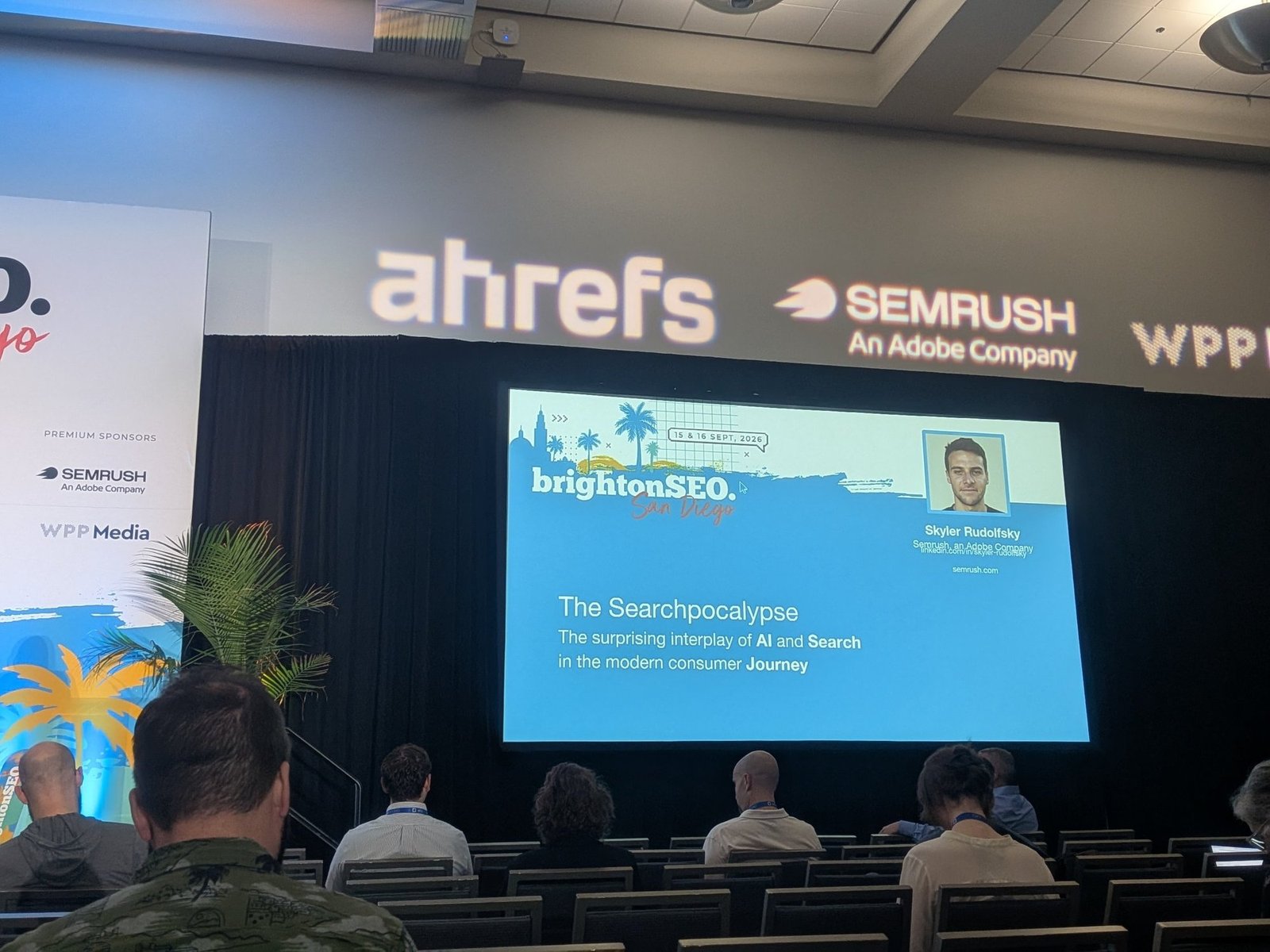
This report covers Skyler Rudolfsky’s session “The Searchpocalypse: The Surprising Interplay of AI and Search in the Modern Consumer Journey” at brightonSEO San Diego, September 16, 2026.
