

TL;DR
- Customers don’t pick platforms rationally. The Default Effect and Status Quo Bias explain why most people stick with whatever was there first.
- Delegating choice to AI doesn’t remove bias. In Azeem’s words, we don’t escape bias, we inherit someone else’s.
- The UK has the highest zero-click rate of any country studied, higher than the US. People aren’t leaving Google, they’re leaving the click.
- The funnel hasn’t broken, it has forked. Gen Z and Alpha, Millennials and Gen X, Boomers, and people who delegate to AI each have different defaults and different trust signals.
- Start with the Default Mapping Exercise. Three questions: which fork is your audience, which platform do they use for your category, and what trust signal do they need.
About the Session
- Event: PPC.London 2026
- Date: 25 September 2026
- Venue: De Vere Grand Connaught Rooms, London
- Slot: 12:00 to 12:30
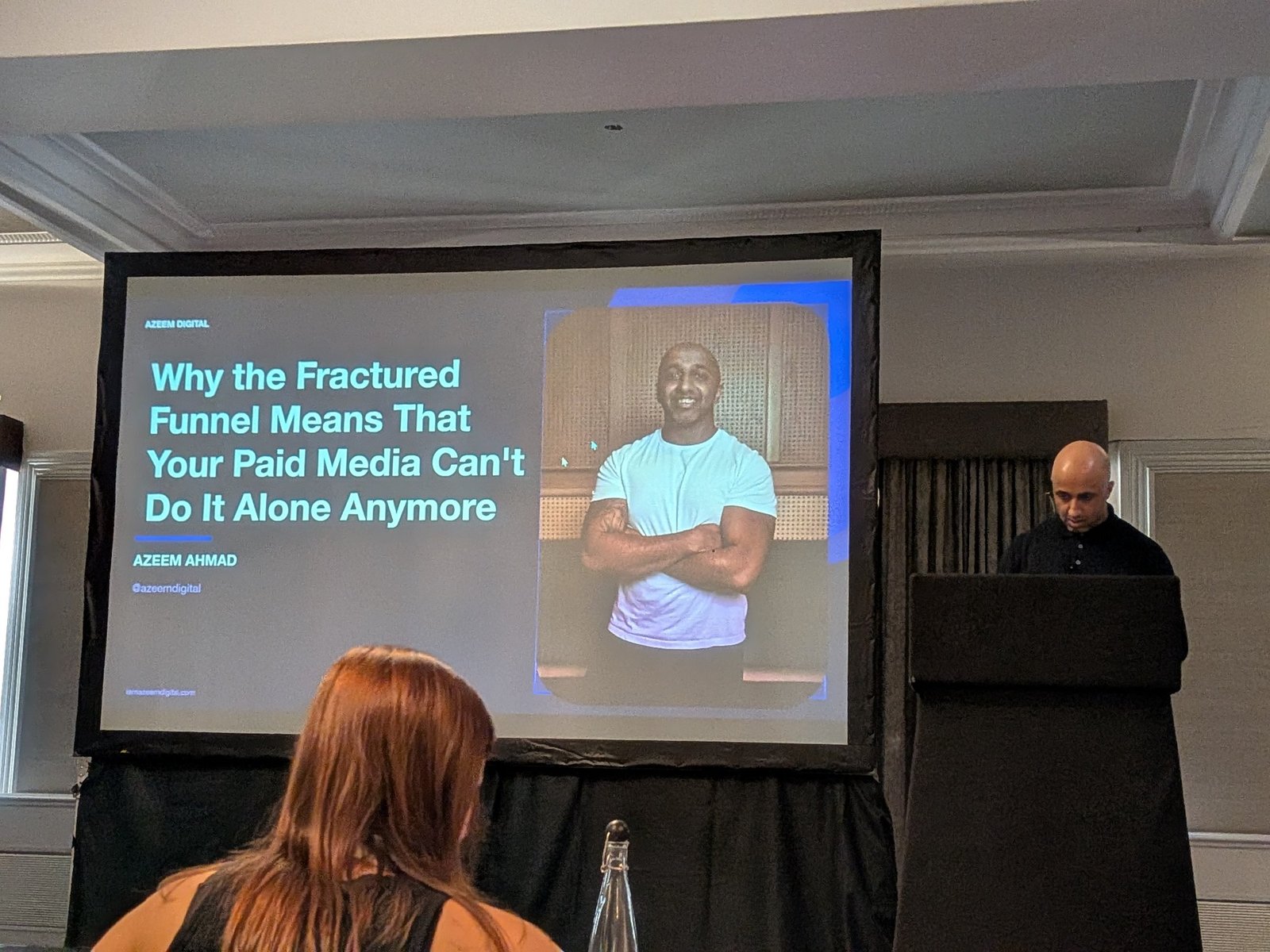
Azeem opened by saying he wouldn’t talk about PMax or any specific tactics. This was a strategy talk, built on behavioural science, about why customers end up on the platforms they use and what that means for paid media.
About the Speaker
Azeem Ahmad is Strategy Director at Azeem Digital. He is “a strategy consultant and international keynote speaker, who can apply behavioural science to paid media and search strategy.” He translates psychological principles into marketing decisions and helps organisations rethink their budget allocation and audience targeting approaches. He also serves as an awards judge, hosted a top 10 UK digital marketing podcast, and develops evidence-based marketing strategies for businesses.
The Opening: A $15bn Presentation and a Fake Scottish Tea
Azeem opened with two set-ups. First, a slide that read “This is a $15bn presentation.” Second, he asked the room to imagine biting into a slice of lemon, and to notice the face they pulled.
Then came the story. In Perthshire, Scotland, a man named Tam O’Braan claimed to grow tea at The Wee Tea Plantation. He presented himself as a polymer scientist, botanist and multi-millionaire. His tea reached The Balmoral, The Dorchester and Fortnum & Mason, was described as a favourite of the late Queen Elizabeth, and earned BBC and national press coverage and industry awards.
The tea was imported. He was eventually jailed. But, as Azeem put it, it worked. He didn’t manufacture a product. He manufactured a default.
Act 1: The Psychology of Digital Habit
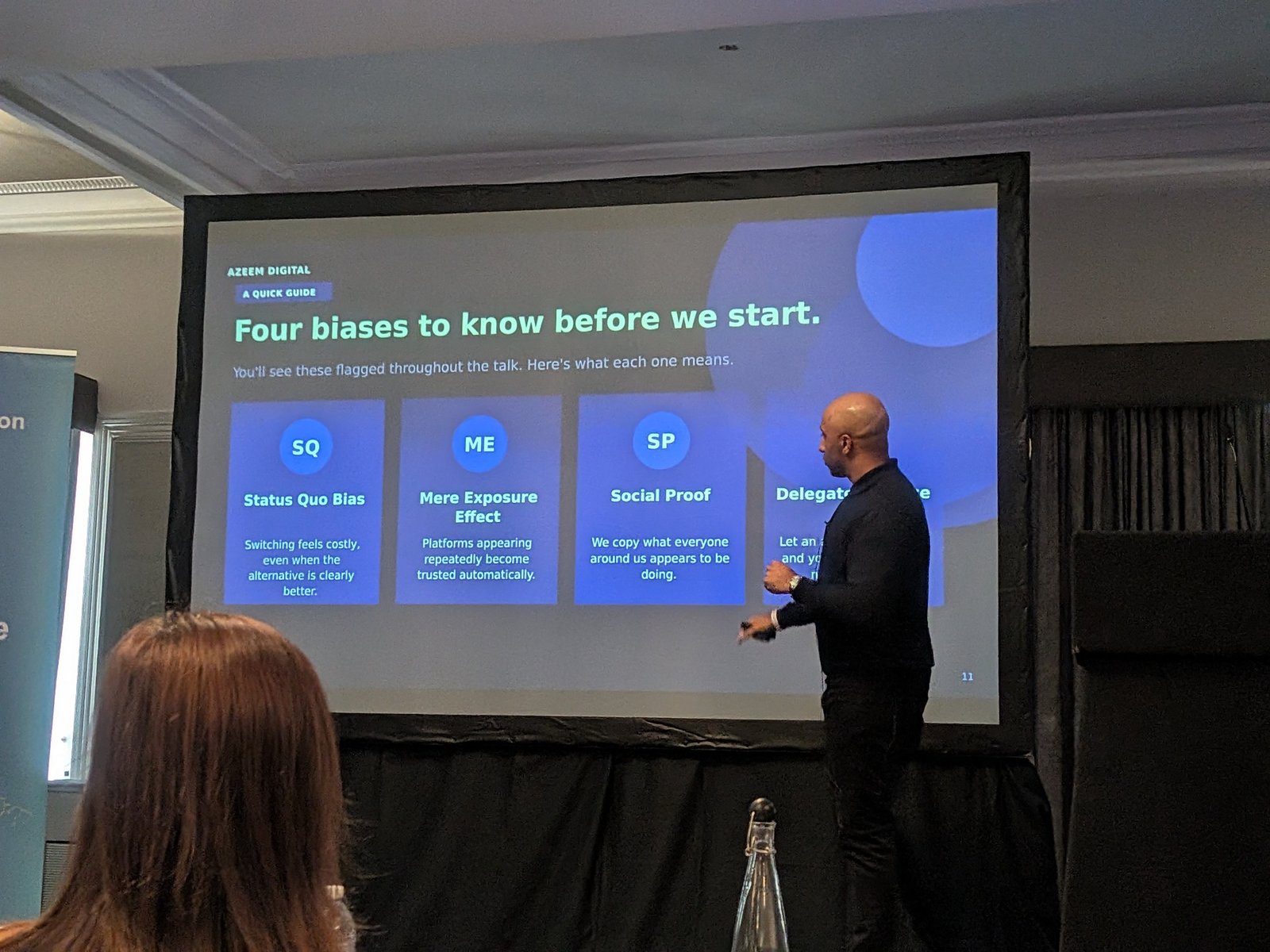
Tam understood two forces that, in Azeem’s view, most marketers don’t:
- Default Effect. We accept what’s already there and don’t question the pre-selected option. Google ships as the default on Chrome, Safari and Firefox, and most people never change it. Not because it’s best.
- Status Quo Bias. Switching feels costly, even when the alternative is clearly better. Familiarity wins, every time.
He asked the room who had Googled something that day. Almost everyone. Then who could explain why they used Google. Almost no one. That, he said, is the Default Effect.
It isn’t just about search:
- Organ donation. In opt-in countries, the donor rate is 4 to 28%. In opt-out countries, it is 85 to 90% or more.
- Apple ATT (2021). When tracking became opt-in, 96% chose not to share. The cost to Meta was around $10 billion.
He added a third force reshaping search: Delegated Choice. When we let AI, algorithms or platforms make decisions for us, we don’t escape bias. We inherit someone else’s.
And not everyone inherited the same defaults. Gen Z and Alpha are social-first from birth, on TikTok and Instagram. Millennials and Gen X have hybrid defaults, Google plus social. Boomers default to Google, full stop. Status Quo Bias then locked each group in place.
Act 2: The Data
Azeem promised real data, not just theory. The highlights:
UK search share (2026)
- Google still holds 91.5% of all-platform UK search share, though it has slipped about 0.9 points a year since 2024, after 13 years at 92 to 94%.
- Bing has 5.9%, rising to 12.8% on desktop.
- Around 30% of UK Google searches now trigger an AI Overview.
- ChatGPT had 1.8 billion UK visits between January and August 2025, up from 368 million a year earlier.
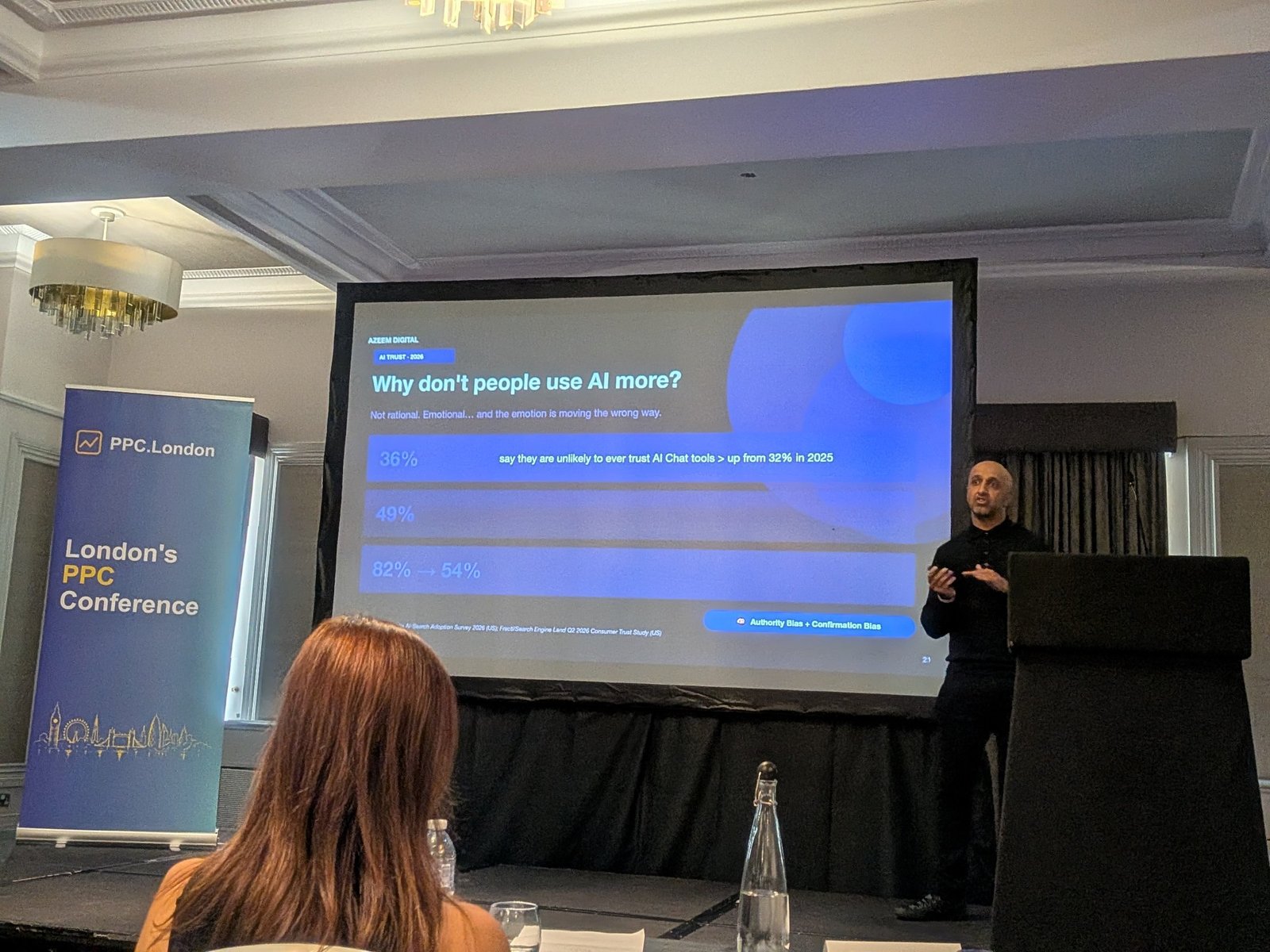
Trust in AI is emotional, and moving the wrong way (US surveys)
- 36% say they are unlikely to ever trust AI chat tools, up from 32% in 2025.
- 49% still trust Google more than AI chat for a factual answer.
- The share who rate AI as more helpful than search fell from 82% to 54% in one year.
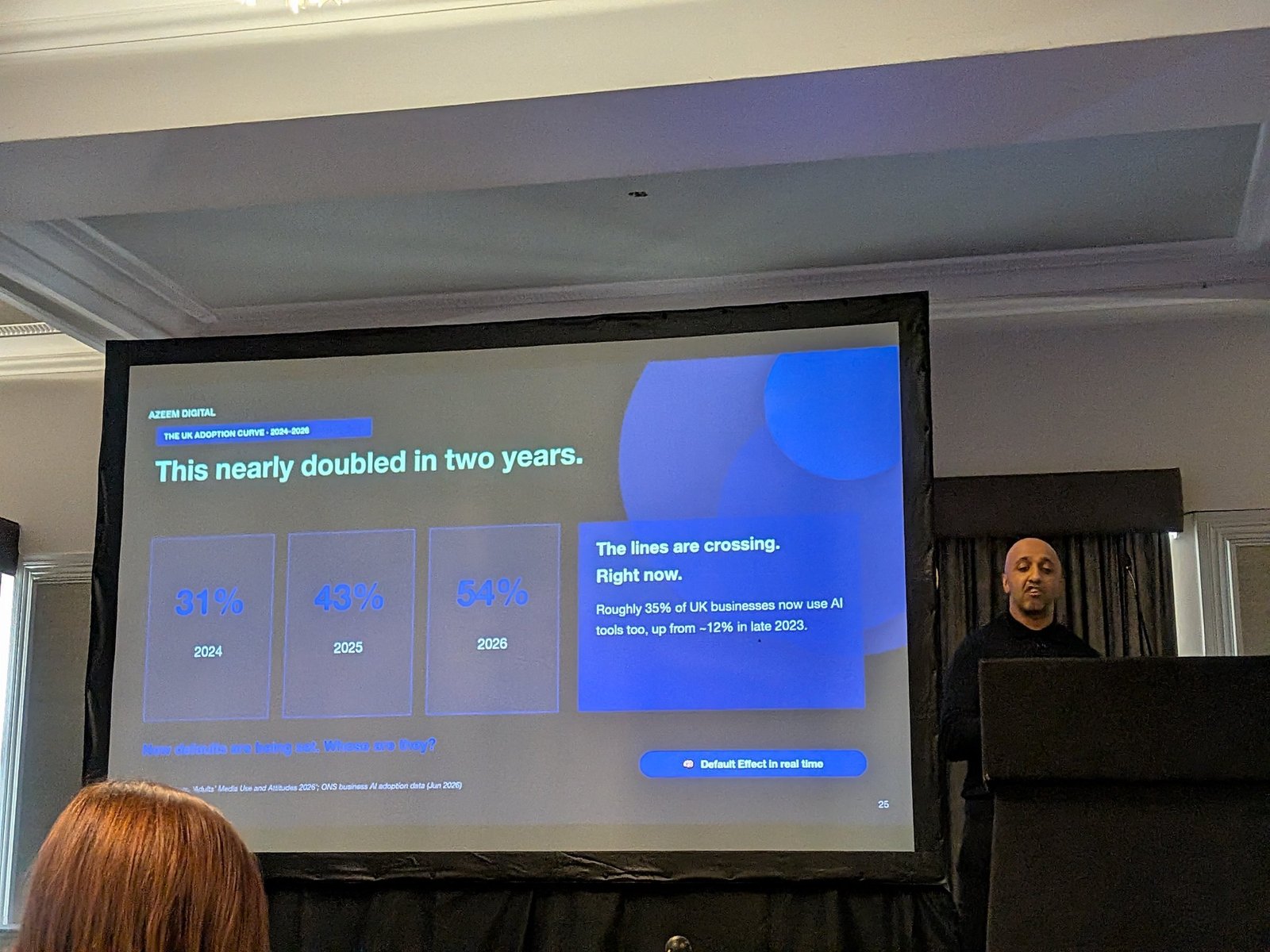
UK AI adoption
- 54% of UK adults now use an AI tool, up from 31% in 2024 and 43% in 2025. More than half the country has adopted a technology that barely existed three years ago.
- 79% of 16 to 24s and 74% of 25 to 34s use AI tools, against 18% of adults 65 and over.
- Around 35% of UK businesses now use AI tools, up from about 12% in late 2023.
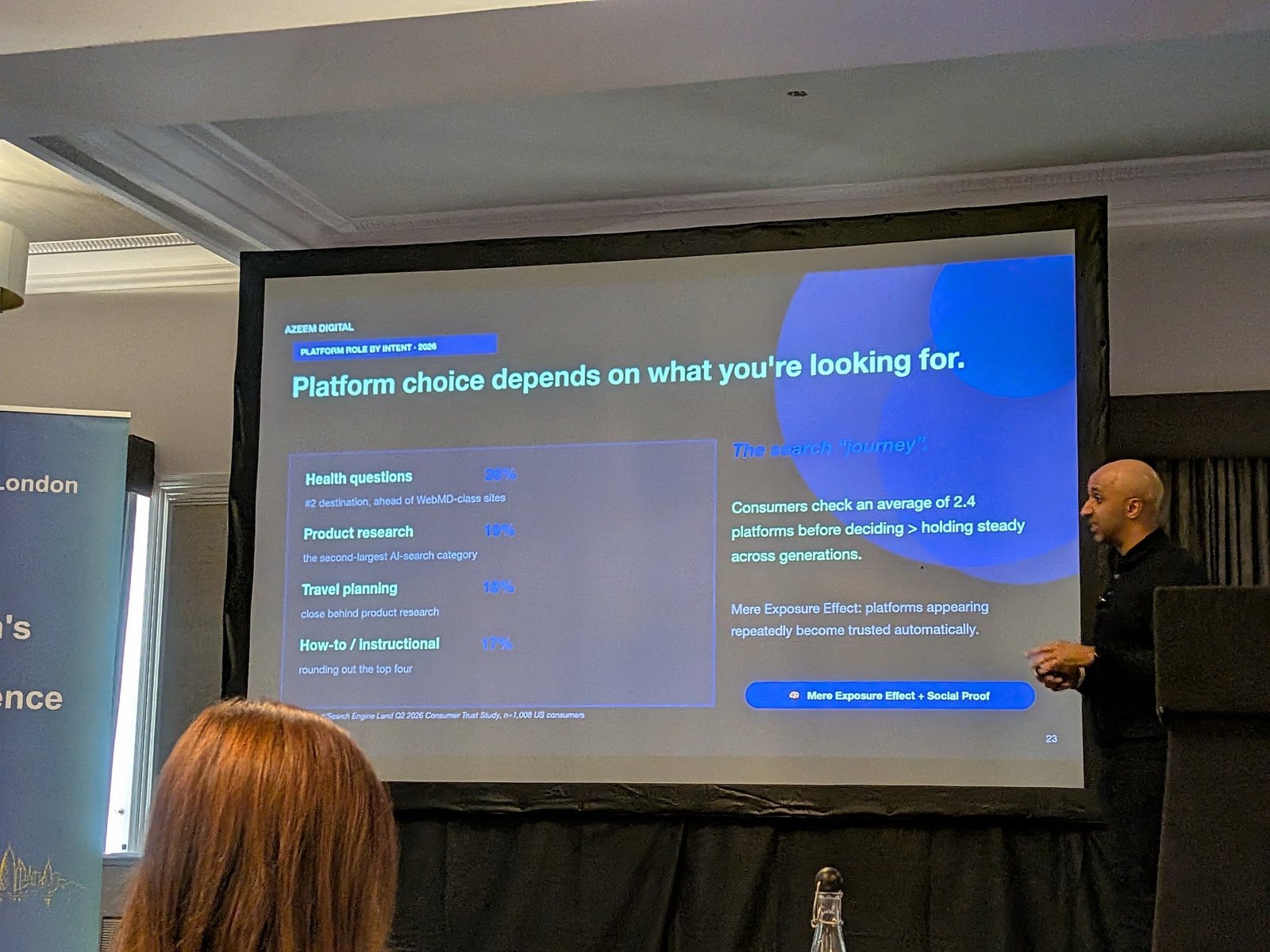
Platform choice depends on intent (US)
- AI search is used most for health questions (26%), product research (19%), travel planning (18%) and how-to questions (17%).
- Consumers check an average of 2.4 platforms before deciding.
Gen Z search behaviour
In 2022, a Google SVP remarked that almost 40% of young people go to TikTok or Instagram instead of Google. By 2024, a US survey put hard numbers on it: for local search among 18 to 24s, Instagram 67%, TikTok 62%, Google 61%.
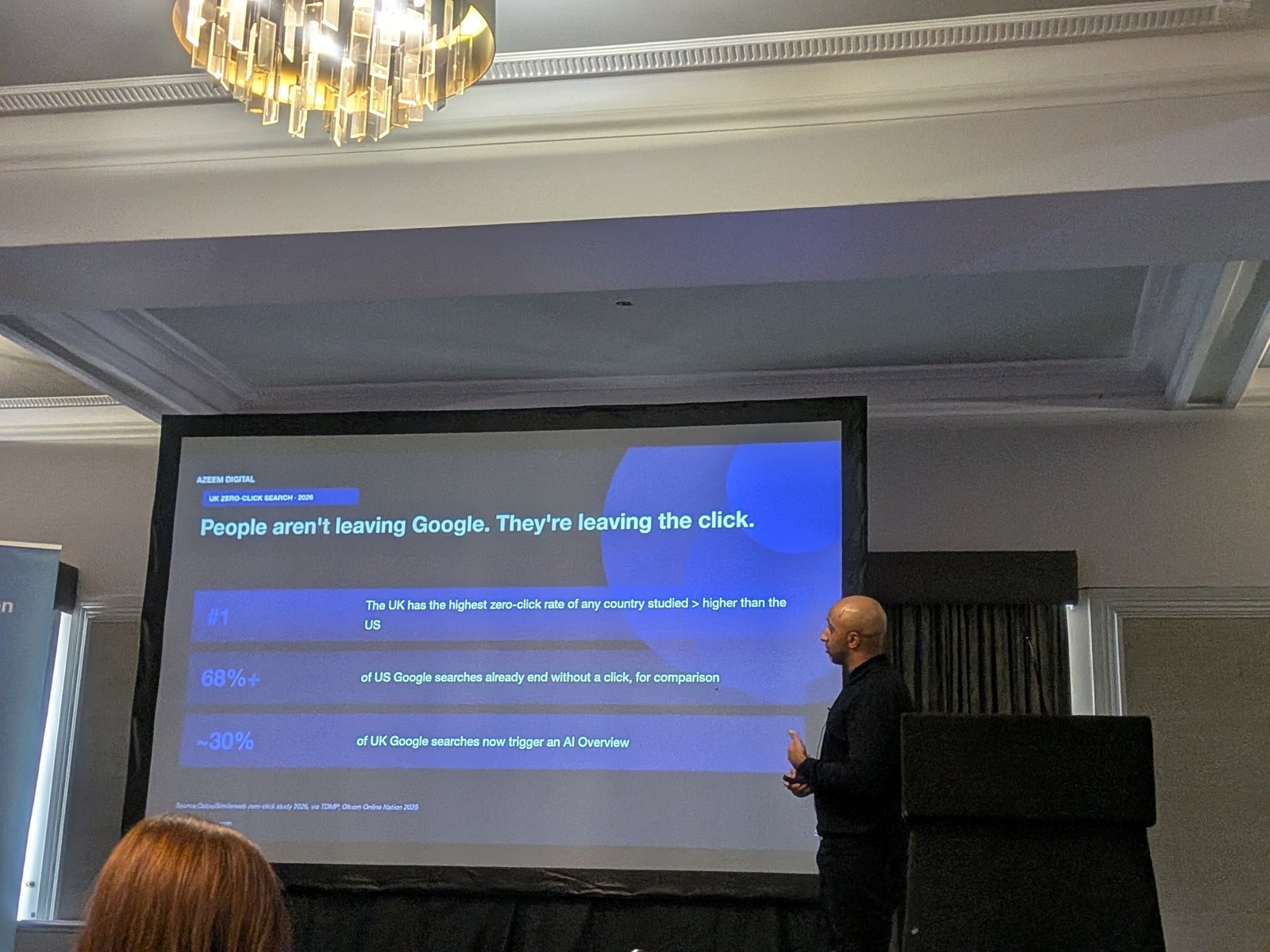
Zero-click in the UK
The UK has the highest zero-click rate of any country studied, higher than the US, where more than 68% of Google searches already end without a click. Azeem called this Delegated Choice happening inside Google itself. UK searchers want answers, not links to answers, more than anywhere else studied. For paid search teams, it is one explanation for accounts with plenty of impressions but fewer clicks.
Along the way, he shared a small example of his own: auditing 600 Google Ads accounts was estimated at two to three days of team time. With Claude and Python, it took an hour while he worked on something else.
Act 3: The Fractured Funnel
Azeem’s central point: the funnel hasn’t broken. AIDA still makes sense. It has psychologically forked.
- Fork 1: Gen Z and Alpha. No Google default, social-first from day one. Trust comes from peer validation. 58% of Gen Z don’t trust AI chatbots to give the best answer.
- Fork 2: Millennials and Gen X. Hybrid, and the most complex fork to reach. Their journey runs from Google (first instinct), to Reddit and YouTube (deeper research and peer input), to ChatGPT (when Google fails them), to social (inspiration and validation). Trust comes from authority. 41% of consumers bought a product AI recommended in the past six months.
- Fork 3: Boomers and older demographics. Status Quo Bias compounded by decades. Trust comes from simplicity. Only 10% of people 65 and over have ever used ChatGPT, and 79% of 55 to 64s still choose Google first for local search.
- Fork 4: AI Delegated Choice. Platform-agnostic, the fastest-growing fork, and the most invisible. Most people reading Google AI Overviews don’t know they are using AI. Trust goes to whoever trained the model. High-income shoppers (over $150k) are 64% more likely to use AI for discovery, and McKinsey expects $750bn of consumer spend to go through AI search globally by 2028.
His own example for Fork 2: he wanted to buy a treadmill. Google showed him the brand’s own pages and paid-for listicles. YouTube showed him more of the brand. He wanted to hear from an ordinary person who had used it, so he went to ChatGPT. That, he said, is the moment Google fails this fork.
What This Means for Paid Media
Four forks, four different jobs for targeting, creative and budget. In the talk, Azeem described them as four types of searcher:
- Traditional searchers. Protect branded search. Creative should be authoritative with a clear offer. This is the highest-volume channel, so defend it. He was clear that moving all your money into AI search would be the wrong move.
- Streamlined searchers. Layer social retargeting onto search. They need aesthetic proof and user-generated content. Split budget across search and social.
- Multi-platform searchers. They use two to five platforms before deciding. Use native social search, not just feed ads, with platform-native, creator-style content. Publishing one piece of content everywhere and seeing what sticks loses value to competitors. Shift test spend out of search-only.
- Digital explorers. Media buys can’t reach this fork. It’s about being cited, not served. Shift budget toward AI visibility, which is a wider problem than PPC alone.
He used a fishing analogy from his years in pure paid search. If you keep fishing the same pond for the same customers, you eventually run out of fish. You can’t buy new fish. You have to make the pond bigger.
Act 4: The Default Mapping Exercise
Azeem’s takeaway was a one-page exercise with three questions:
- Which fork is your primary audience? This tells you which bias you’re fighting. Once you know this, the rest is straightforward.
- Which platform are they using for your category? This tells you the channel mix. Create content for the platform it’s going on, rather than using the same piece everywhere.
- What trust signal does that persona need? This tells you the content and positioning. Gen Z: peer validation. Millennials and Gen X: authority. Boomers: simplicity. AI-first: citation volume.
His illustrative example was a fashion retailer targeting 18 to 35 year olds. 38% of that audience is not Google-first (10% multi-platform and 28% streamlined). Search starts with inspiration, such as what to wear to a wedding or a concert, so social media is the primary discovery channel. The bias at play is the Mere Exposure Effect: the brand that appears repeatedly becomes trusted automatically. The trust signal is peer validation and visual proof, through UGC, creator content and social proof at scale. The channel mix runs from TikTok (discovery) and Instagram (inspiration) to AI (comparison) and Google (intent). If you do the hard work at the start but aren’t there at the end, you’ve gift-wrapped a conversion for a competitor.
He then asked the room who was optimising for more than two forks. His view: if you’re single-fork, you’re already losing ground. You may only notice when your search impressions start to drop, and by then it may be too late.
Three things to fix in your paid media
- Manually built audiences. Interest and demographic targeting can’t see which fork someone is in. Rebuild targeting around platform behaviour, not assumed profiles.
- Attribution telling the wrong story. Last click credits whichever platform closes the sale, not the one that earned trust. Four forks, one flattened number. Fix the metric first.
- One creative, four angles. The same product needs four different trust signals. Angle-specific creative beats a single always-on ad.
The Close: The Lemon, the Tea and the $15bn
Azeem closed by revealing both set-ups.
Tam O’Braan didn’t build a better product. He built a better default. And the lemon face? The room had accepted a default he set in 90 seconds. Customers accept theirs over a lifetime, and those defaults are being reset right now. The question isn’t whether the funnel has fractured. It has. The question is which fork you are showing up on.
The “$15bn presentation” was anchoring. Give someone the biggest number first and it frames everything after it. His practical advice for forecasts and pitches: lead with what the work will make the client, not ten slides about your agency and its awards. The figure itself was a slice of McKinsey’s $750bn forecast.
What Not to Do
- Don’t assume every customer starts on Google. For many 18 to 24s, Instagram and TikTok come first.
- Don’t move your whole budget into AI search. Traditional searchers are still the largest group, so defend that channel.
- Don’t publish one piece of content everywhere. Each platform needs native content.
- Don’t target on assumed profiles. Interest and demographic settings can’t see which fork someone is in.
- Don’t judge channels on last click. It rewards whoever closed the sale, not whoever earned the trust.
- Don’t optimise for a single fork. By the time search impressions drop, competitors may already be ahead.
Next Steps
- Run the Default Mapping Exercise for one client or product. Answer the three questions on a single page.
- Check which platforms your audience uses for your category. Look beyond Google, especially for audiences under 35.
- List the trust signal each persona needs. Peer validation, authority, simplicity or citations.
- Write one product message four ways. One angle per fork, then test them against your always-on ad.
- Look at impressions and clicks together in your account. Rising impressions with falling clicks may be zero-click behaviour, not poor ads.
- Review your attribution model. Make sure last click isn’t the only view leadership sees.
Personal Takeaways
This was easily my favourite session of the day, and one of the most fun to sit in.
After the talk, I caught Azeem to ask why the UK has a higher zero-click rate than the US. His take: life here is expensive and people are busy, so they simply don’t have time to compare. He even had data from one brand, in cosmetics if I remember rightly, showing UK shoppers buying with around six fewer clicks than US shoppers. Whatever you ask him, he has the data to back it up. Seriously impressive.
What stayed with me most: same language, completely different behaviour. Even across English-speaking markets, you can’t just copy and paste the same plan. Every region needs its own strategy.
Related Resources
- Speaker: Azeem Ahmad (PPC.London)
- Azeem Digital
- PPC.London 2026 agenda
- Rob Evans’ session report: the session just before, on why Google Ads conversions so often don’t match business value
- Sophie Logan’s session report: the morning B2B talk, which also argues for PPC at every stage of the funnel and moving away from last-click attribution
Written by Ayaka Uchida
CEO, A-Digital Works
This report covers Azeem Ahmad’s session “Why the Fractured Funnel Means That Your Paid Media Can’t Do It Alone Anymore” at PPC.London 2026, 25 September 2026.
