

TL;DR
- The shift to AI search isn’t a 2022 phenomenon. It’s a 25-year journey of search engines catching up to how humans naturally speak. We were forced into 1–2 word keywords because early engines couldn’t handle anything else
- The pivotal year was 2013 — Google’s Hummingbird update (the engine overhaul, not just an algorithm tweak) coincided with the publication of Word2vec. Vector embeddings have been quietly powering organic search for 13 years
- Pete’s experiment with 1,000 prompt-style queries in classic Google search: only 0.5% had exact-phrase match in result titles. Average Jaccard (partial match) similarity: 0.23. Average cosine similarity: 0.76. Google has been doing semantic matching for years — this is not new with LLMs
- Web Guide (Google’s hybrid AI-organic experiment) is powered by the same FastSearch vector technology that grounds Gemini and AI Overviews. Organic, AI Mode, and AI Overviews all share the same core engine
- Pete’s prompt fan-out taxonomy: 10 categories across 3 tiers — Semantic / Entity at the top; Follow-up / Anticipate / Attribute in the middle; Factual / Compare / Tutorial / Transact / Insight at the bottom. Built for thinking about prompt research as journey mapping, not exact-match tracking
- Brand bias warning: in Pete’s analysis, branded prompts return ~14.5 brand mentions per response on average; soft prompts ~1.7; hard prompts <1. Tracking only branded prompts in AI visibility tooling massively biases the picture
About the Session
Talk title: Keynote — The Infinite Tail: Keyword Research for AI
Format: Closing single-track keynote, Day 2
Date: Friday 1 May 2026, 16:50
Venue: Auditorium 1, Brighton Centre, Kings Road, Brighton and Hove, BN1 2GR, United Kingdom
About the Speaker
Dr. Pete Meyers — Marketing Scientist, Moz
Pete is Moz’s long-standing Marketing Scientist and a frequent SEO industry researcher. The 2013 article on pixel position decline that Tom Capper referenced in his Day 1 keynote on the Great Decoupling — that was Pete’s.
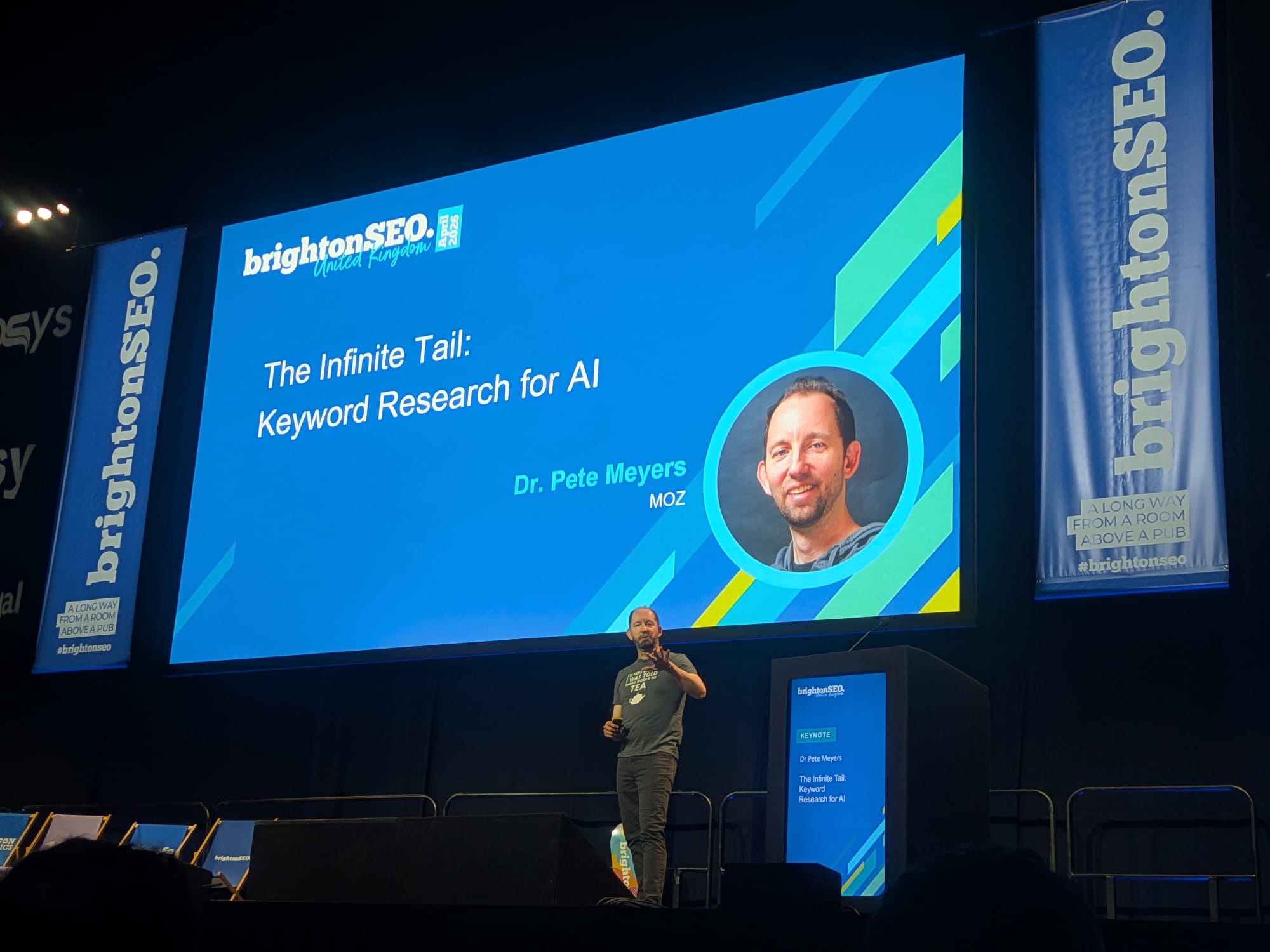
He also confessed, for the record, to microwaving tea water — a confession his “I’m here because I was told there would be tea” T-shirt did nothing to disguise. The moment he admitted to the microwave, the room erupted into audible booing. A very BrightonSEO-UK reaction.
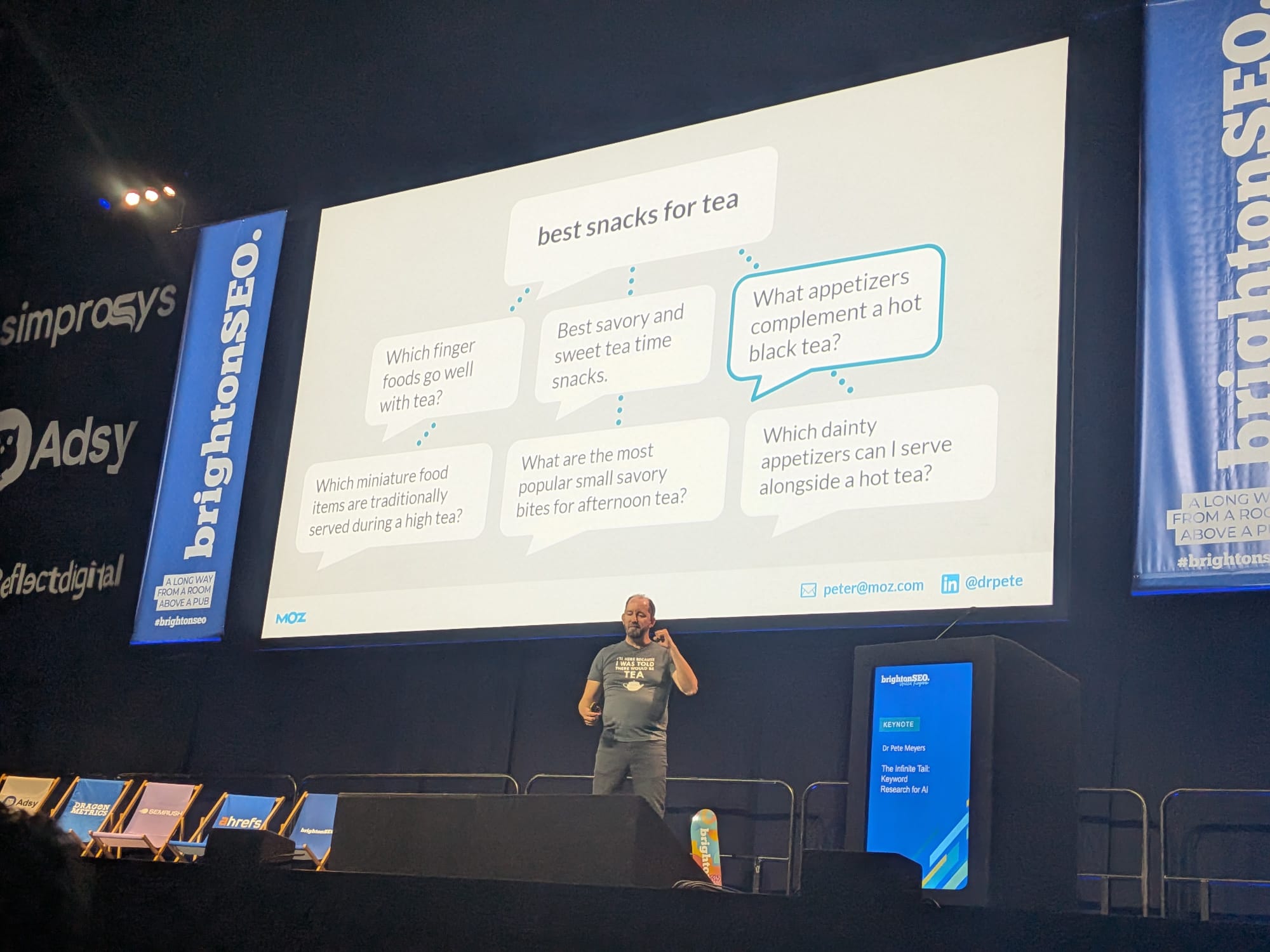
The session was so engrossing I forgot to take more photos. The two I did capture are the title slide above and a slide from the fan-out taxonomy section below — everything else, I was simply absorbed in.
The Frame: It’s Not About LLMs
Pete opened by reframing the entire industry conversation. Most “AI search” discourse anchors on November 2022 and ChatGPT’s release. Pete’s reframe:
“Bringing search has always been trying to catch up with us in the use of language. This evolution has been going on the back end the entire time. Our evolution has been going on the entire time.”
The history he walked the room through:
- 2000 — Google for “London” returned a list of pages that contained the word “London.” That was it. We typed 1–2 keywords because search engines couldn’t handle anything else
- 2013 — Hummingbird. The engine, not an algorithm. Significantly boosted Google’s processing capability. Same month: Word2vec paper (Mikolov et al.), which kicked off vector embeddings as a practical NLP technique
- 2016 — Knowledge Graph integrated, vertical results, more relevant matching
- 2022 — Featured snippets matured, People Also Ask, voice-driven conversational queries
- 2026 — AI Overviews, AI Mode, Web Guide, Gemini integration
Pete’s argument: the line you draw between “pre-LLM organic” and “post-LLM AI search” is mostly artificial. The same vector-based technology has been quietly powering both. We’ve just been able to see it more clearly since 2022.
Vector Embeddings: A Useful Fiction
Pete spent useful time on what vectors actually are. His framing for non-technical audiences:
“Vectors are not three-dimensional models for each dimension means something we know. They are a whole series of floating points. This is a 768-dimensional alignment vector embedding.”
He showed a slide of actual vector values for “How late can I check into a hotel?” — hundreds of floating-point numbers, individually meaningless, collectively encoding semantic meaning the model can compare against other vectors.
The classic semantic relationships:
- king − man + woman ≈ queen
- walking − walk + swim ≈ swimming
These relationships predate LLMs by over a decade. They’re the foundation that LLMs were built on — not the other way around.
The 1,000-Query Experiment
The most data-rich section of the keynote was an experiment Pete ran specifically for this talk: take 1,000 prompt-style queries (the kind people now type into ChatGPT) and submit them to classic Google search. Then look at how Google’s organic results respond.
The findings:
Exact-phrase matching is dead.
- On the example query “pros and cons of meal kit delivery,” 3 of the top 10 Google organic titles contained the exact phrase
- Across the full 1,000-query data set: only 0.5% of result titles contained the exact prompt phrase
- The other 99.5% of relevant Google organic results don’t even attempt exact-match titles
Partial matching is moderate.
Pete used Jaccard similarity (intersection over union of words). For Sørensen-Dice and other variants, he noted:
“I use Sørensen-Dice not because it’s better. I use it because it’s named after Thorvald Sørensen, which is badass. And I think that’s a very important thing to consider when picking a metric — how cool the name sounds.”
Across the 1,000 queries: average Jaccard similarity ≈ 0.23. Considerable word overlap, but well below full match.
Semantic matching is strong.
The most significant number of the keynote: average cosine similarity of 0.76 across all 1,000 prompt-Google result pairs.
Cosine similarity measures vector-space distance — how semantically similar the prompt’s meaning is to the meaning of the title Google returned. 0.76 isn’t a perfect match, but it’s far above what keyword-based matching would explain.
Pete’s example at 0.82 cosine similarity (essentially zero exact-match words):
- Query: “how are electric vehicle batteries recycled?”
- Top result: “Batteries for Electric Vehicles” from the US Department of Energy’s Alternative Fuels Data Center
No exact keyword overlap. But the meaning is clearly the same. Google understands this. Has understood this for years.
The strategic implication: organic SEOs already have to compete in a meaning-based, vector-similarity world. The “AI search” shift is, in a meaningful sense, a continuation of trajectories that have been visible in organic for years.
Same Engine, Different Surfaces
Pete made a critical technical point that ties together what other speakers covered across the conference. From the US Google antitrust testimony:
“To ground its Gemini models, Google uses a proprietary technology called FastSearch. FastSearch is based on RankEmbed signals—a set of search ranking signals—and generates abbreviated, ranked web results that a model can use to produce a grounded response.”
The same underlying engine that powers Google organic also powers:
- Search grounding for Gemini
- AI Mode result generation
- Web Guide
- AI Overviews
This is the vector technology that’s been quietly running organic for 13 years, now exposed across multiple surfaces. Optimising for organic still feeds AI. The two are not competitors — they’re built on the same underlying engine.
Web Guide: The Hybrid Future
Pete walked through Web Guide — Google’s opt-in Labs feature, currently visible in some US and UK searches, that he believes signals where the broader interface is heading.
His example query: “how to properly brew tea.” Web Guide returned a hybrid layout — a curated AI-organised list of organic results grouped by sub-topic, rather than the traditional 10 blue links or a pure AI Overview summary.
Pete’s reading: Web Guide is the “compromise interface” — not pure organic, not pure AI. A blended surface that uses FastSearch’s vector technology to cluster organic results semantically, then presents them in a structure that resembles AI Overviews without fully replacing the underlying organic pages.
His prediction: the long-term equilibrium for Google search isn’t pure-LLM (which has unsustainable economics — see below) and isn’t traditional 10 blue links (which user behaviour has already moved past). It’s hybrid surfaces like Web Guide.
The Prompt Fan-Out Taxonomy
The most actionable contribution of the keynote was Pete’s prompt fan-out taxonomy — 10 categories arranged across 3 tiers of how far the prompt strays from the original phrasing. Built around the brewing-tea example:
Top tier — closest to the original query:
- Semantic — paraphrases and direct rewordings.
“How to brew tea” → “What’s the best way to make a hot cup of tea?”, “How do I prepare a perfect cup of tea at home?” - Entity — variations across entities in the same category.
“How to brew tea” → “Are Adagio Teas easy for a beginner to brew correctly?”, “How do I prepare a traditional cup of Earl Grey tea?”
Middle tier — one step further from the original:
- Follow-up — the next logical question after the initial query.
“Should I add the milk before or after the tea brews?”, “Is it okay to leave the tea bag in the teacup?” - Anticipate — 2–3 steps further down the user journey.
“Should I buy an electric kettle with specific settings?”, “How to host my first afternoon tea party” - Attribute — drilling into properties or sub-features of the topic.
“Does the shape of the tea leaf change the brewing time?”, “Are there any tricks to brewing loose-leaf tea?”
Bottom tier — intent-shifted variations of the journey:
- Factual — verifiable information lookups.
“How many teas are made from Camellia Sinensis?”, “How long has tea been brewed as a beverage in China?” - Compare — head-to-head evaluations.
“Is an electric kettle or stovetop kettle better for tea?”, “Using a ball versus a basket infuser for tea brewing” - Tutorial — step-by-step how-to requests.
“Step-by-step guide to making a perfect cup of Matcha”, “How to bloom a flowering tea bulb in a glass mug” - Transact — purchase-intent queries.
“Where can I buy a good tea brewing starter kit?”, “Best budget-friendly electric kettles for tea” - Insight — opinion, cultural, or perspective-led prompts.
“Is it considered a mistake to add milk to green tea?”, “How has tea culture changed in the United States?”
The point of the taxonomy isn’t that Google does exactly this. It’s that you can use these 10 categories to build prompt clusters yourself — for any topic — without manually trying to predict every possible user phrasing.
Pete’s caveat: the bottom of the tail is essentially infinite. He ran a query like “Why can’t I book a direct flight from Chicago to Gatwick without a layover in Madrid? I’m sure Spain is lovely in April, but not 10-hours-in-the-airport-lovely.” — global volume: 3. (He admitted he made the volume look higher because he duplicated the slide.) You can’t track every variant. You don’t need to. You need to track the archetypes people pass through on the journey.
The Brand Bias Trap
A warning Pete gave significant emphasis.
Pete tested how prompts behave when they contain a brand vs when they don’t. He took 100 prompts of three types:
- Branded — explicitly contains a brand name
- Hard non-brand — competitive informational queries with no brand context
- Soft non-brand — topical queries that imply a brand-heavy answer (like “best SEO tools”)
The results:
- Branded prompts: 100% mention a brand in the response. 1,450 total brand mentions across 100 prompts (~14.5 per response)
- Soft non-brand prompts: 78% mention brands. 168 total mentions (~1.68 per response)
- Hard non-brand prompts: 53% mention brands. 79 total mentions (~0.79 per response — less than 1)
The implications for AI visibility tracking:
“If you only track those branded prompts in your brand visibility table, you would learn nothing. You’re 100% — you’re everywhere — next week and the week after that. It’s just that your tool is brand-biased.”
If your brand visibility platform only monitors prompts that include your brand name, your dashboard will look great and tell you nothing useful. You need to spread your tracking across the full spectrum of brand-bias intensity to get an accurate picture of how AI engines are actually mentioning you when users aren’t prompting them with your name.
The Economic Argument
Pete went up a level in altitude at the end of the keynote — into the question of whether pure-LLM search is economically sustainable.
His read of OpenAI’s financials: stunning annual losses projected until 2028. The cost of running pure-LLM answer engines at scale, with no advertising layer comparable to Google’s, is currently subsidised by venture capital. That can’t continue indefinitely.
His prediction: the medium-term equilibrium for search isn’t a pure-LLM future, because the economics don’t work. It’s a hybrid future where vector-driven retrieval (cheap, has been working for 13 years) supplies most of the answer, and LLM generation is reserved for the synthesis step where it earns its compute cost.
Which means: organic content, vector-indexed, semantically relevant, structured for the journey — is not going away. It remains the layer everything else builds on. The interface might keep evolving toward Web Guide-like hybrids, but the underlying SEO work doesn’t fundamentally change.
Personal Takeaways
This is my third BrightonSEO (Brighton 2025, San Diego 2025, Brighton 2026), and Pete’s closing keynote was the structurally most satisfying session of the entire two days.
The structural beauty of the day was hard to miss. Tom Capper opened Day 1 by referencing a 2013 article on pixel position decline written by his Moz colleague Dr. Pete. Pete closed Day 2 with the 13-year follow-up to that same line of thinking — natural language has always been the destination, vector embeddings have always been the mechanism, and the AI search era is just the version of this we can finally see clearly. As an attendee experiencing the conference as a single arc, that frame was deeply satisfying.
What I’m taking home:
- The “we’ve been doing this since 2013” reframing is the most useful narrative shift of the conference. Most client conversations I have right now start with the implicit assumption that “AI search” is a new and unprecedented thing requiring a new and unprecedented strategy. Pete’s data shows it’s a 13-year evolution we already have tools and intuitions for. That changes the conversation from panic to continuity.
- The 0.5% exact-match / 0.76 cosine-similarity numbers are headline stats I’ll be using. They cleanly answer the question every client asks: “Are keywords still relevant?” The honest answer is no, exact-match keywords haven’t been the unit of relevance for years — Google has been operating in semantic space, we just haven’t been measuring it that way. Pete made that legible with one experiment.
- The 10-category prompt fan-out taxonomy is immediately portable. I’ll be using it as a content brief structure: for any topic, intentionally generate prompts across the three tiers (Semantic/Entity at the top, Follow-up/Anticipate/Attribute in the middle, Factual/Compare/Tutorial/Transact/Insight at the bottom) to ensure the content covers the journey rather than just the entry-point query.
- The brand bias warning is the single most consequential operational insight from the keynote. I’ll be auditing every AI visibility tool A-Digital Works uses to confirm that the prompt mix being tracked spans branded, soft, and hard prompts — not just branded. If you only monitor branded prompts, your dashboard lies to you.
- The economic argument about OpenAI’s sustainability is the kind of macro context most SEO conferences avoid. Most speakers stick to tactics. Pete went up a level: what’s economically possible determines what interfaces survive. This is the right altitude for strategic conversations with clients planning multi-year SEO investment.
Across the eleven sessions I attended over two days, the standouts for me were Tom Capper’s pixel position research (Day 1), Ryan Law’s five-mechanism stack and Philip Armstrong’s Semrush panel data (Day 2 morning), Malte Landwehr’s ChatGPT shopping analysis (Day 2 morning), and now Pete’s keynote. What unites them: original empirical research, large-N data sets, and analytical contributions that update working models rather than reaffirming consensus. Most other sessions across the two days repackaged existing industry conversations. These five didn’t.
If I could only recommend five sessions from BrightonSEO Brighton 2026 to clients when the videos go live, those would be the five.
Related Resources
- Session: Keynote — The Infinite Tail: Keyword Research for AI (BrightonSEO)
- Speaker profile: Dr. Pete Meyers (BrightonSEO)
- Moz — Pete’s company; Moz Prompt Suggestions (the new tool built on the fan-out taxonomy) was demoed in beta during the keynote
- Word2vec original paper (Mikolov et al., 2013) — the moment vector embeddings entered the SEO timeline
- Google Hummingbird update (2013) — the engine overhaul that started everything
- Tom Capper’s session report — the Day 1 opening keynote that referenced Pete’s 2013 pixel position research, framing Pete’s Day 2 closing keynote as the 13-year follow-up
- Ryan Law’s session report — the same-day session whose 5-part AI search stack uses the vector technology Pete explained
About the Author
Ayaka Uchida (打田彩夏) — Founder & CEO of A-Digital Works Ltd. Founder of Nihon GO! World (Fitzrovia, London and Manchester). 10+ years in international business development across Japan, Singapore, US, and UK. BrightonSEO attendee 3 times (April 2025 Brighton, September 2025 San Diego, April 2026 Brighton — scholarship recipient). Aoyama Gakuin University, Faculty of Law. Fluent in Japanese and English; studying Spanish, French, and German.
Connect: a-digitalworks.com | LinkedIn
About A-Digital Works
A-Digital Works Ltd is a London-based Japan–UK SEO and EN↔JA localisation consultancy supporting UK, EU, and US companies entering the Japanese market. Services span keyword research in Japanese, content localisation, technical SEO, and market entry strategy. Flagship case study: Descartes Systems Group (Canadian logistics technology) — full Japanese-market SEO programme covering 物流システム, EDIシステム, and 配車システム.
This report covers Dr. Pete Meyers’s closing keynote “The Infinite Tail: Keyword Research for AI” at BrightonSEO Brighton on Friday 1 May 2026.
