

TL;DR
- AI doesn’t make you faster — it just enables you to take on more work. The promise is scale; the fear is losing quality. The challenge is finding the balance
- The traffic-driven content playbook (1,000-piece-a-year clusters, optimised for keywords, refreshed never) is dead
- Demand isn’t found in keyword research. It’s found in LinkedIn conversations, customer feedback from beta product launches, community events and conferences, subreddits, product roadmap, and emerging trends
- Storytelling is the non-negotiable layer. Every Chima workflow — webinars, blog content, research-led content — uses AI for execution, but the storytelling has to come from the human
- Chima’s most successful workflows: a webinar pulling 1,738 sign-ups, a repurposed blog post bringing in 1,400 leads, and an “AI SEO Topic Clusters” content piece that doesn’t rank on Google but still drives heavy traffic — pure demand-led content
About the Session
Track: Content Creation
Date: Thursday 30 April 2026, 02:00 PM
Venue: Auditorium 1, Brighton Centre, Kings Road, Brighton and Hove, BN1 2GR, United Kingdom
About the Speaker
Chima Mmeje — Moz | Senior Content Marketing Manager
Chima leads content marketing at Moz, where she’s known for unusually candid, hands-on talks about how AI actually fits into a working content team’s day. Her talks are heavy on her own data — what she shipped, what worked, what flopped, with the numbers attached. She’s also the founder of The Freelance Coalition for Developing Countries, a UK nonprofit providing free resources and training for BIPOC marketers globally.
The Opening Provocation: Everyone Gets an AI
Chima opened by surveying the room: how many of you have been told to produce more content because AI will make you faster?
Most hands went up.
Her framing: it’s like Oprah giving away cars. “You get an AI. You get an AI. Everyone gets an AI.” But unlike the Oprah audience, you walk away with nothing tangible. Just the pressure to use AI without sacrificing quality — under the assumption that AI will make you faster.
But will it?
Chima referenced a recent tech CEO memo (paraphrased): “Intelligence tools have changed what it takes to build and run a company. A significantly smaller team, using the tools, can do more and do it better.”
“If you read between the lines: do more — scale. Do better — quality. He’s saying that a smaller team using AI can scale without sacrificing quality. Can they? Can they really?”
Chima’s experience says no. Her observation, backed up by the research she’s seen:
“AI doesn’t make you faster. It just equips you with the skills to take on more work.”
The promise of AI is scale. The fear of AI is losing quality. The whole talk was about how to navigate that tension without breaking.
Why the Old Content Playbook Is Dead
The reason we have the AI search problem in the first place, Chima argued, is that content marketing has spent the last decade focused exclusively on traffic.
The familiar playbook: a SaaS company hires a content marketing lead, traffic becomes the ultimate goal, budget gets spent on bloated keyword clusters, and the entire content strategy depends on an outdated playbook that nobody has time to refresh because they’re too busy producing the next 100 pieces.
“Brands were bragging about writing 100 to 1,000 content pieces a year — and nobody was reading them.”
Chima made what she called a “conspiracy-sounding” prediction:
“Four or five years from now, all of this AI search — everything Google is trying to do — is going to be about keeping people inside their platform. We’re fighting and losing battles trying to get scraps from them, instead of using that same effort to bring people directly into our own ecosystem.”
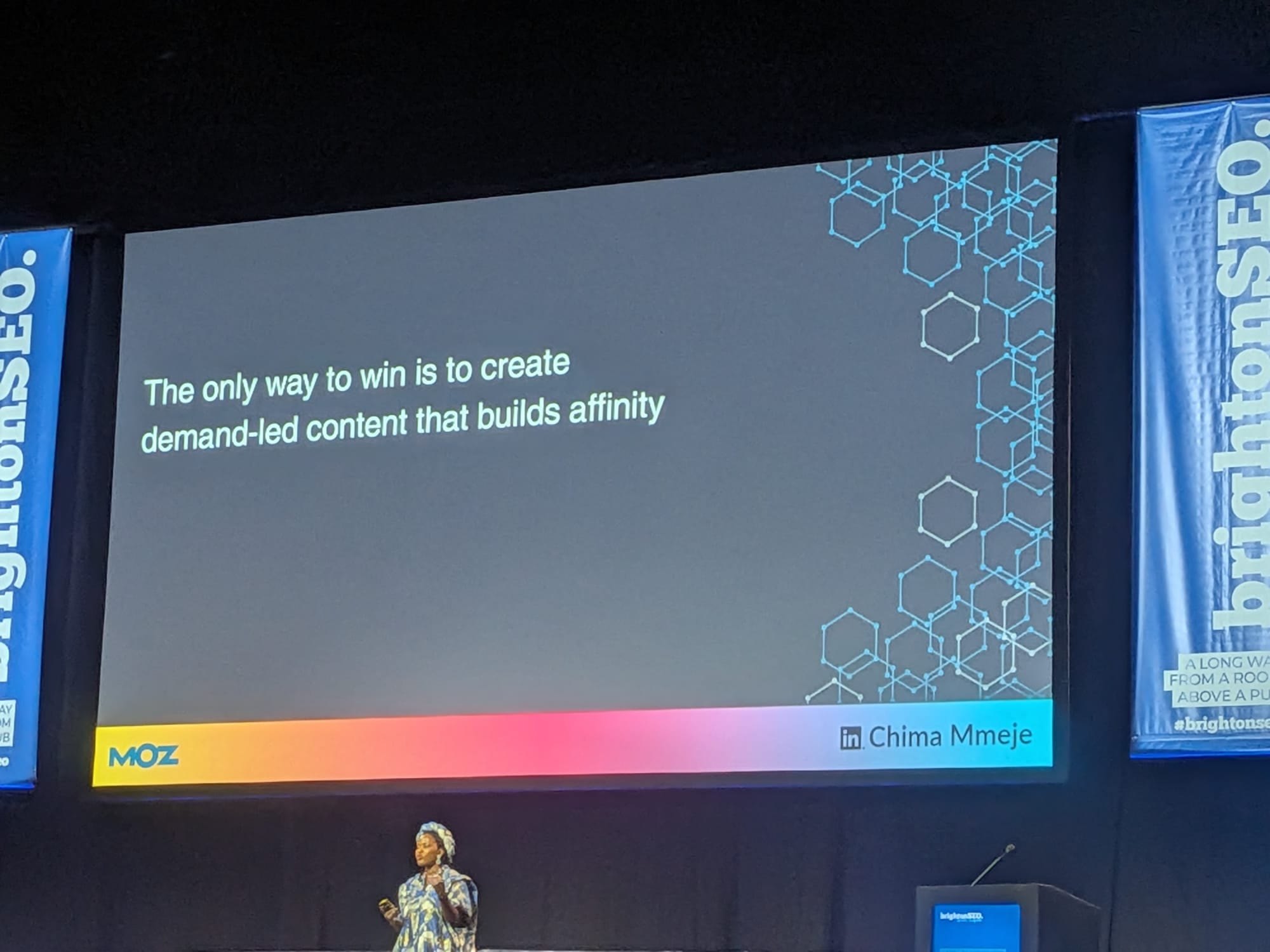
Her thesis: stop trying to win Google’s traffic game. Build your own ecosystem. Demand-led content is the way to do that.
How to Find Demand (It’s Not in Keyword Tools)
Chima keeps her demand-discovery process deliberately simple. Six sources:
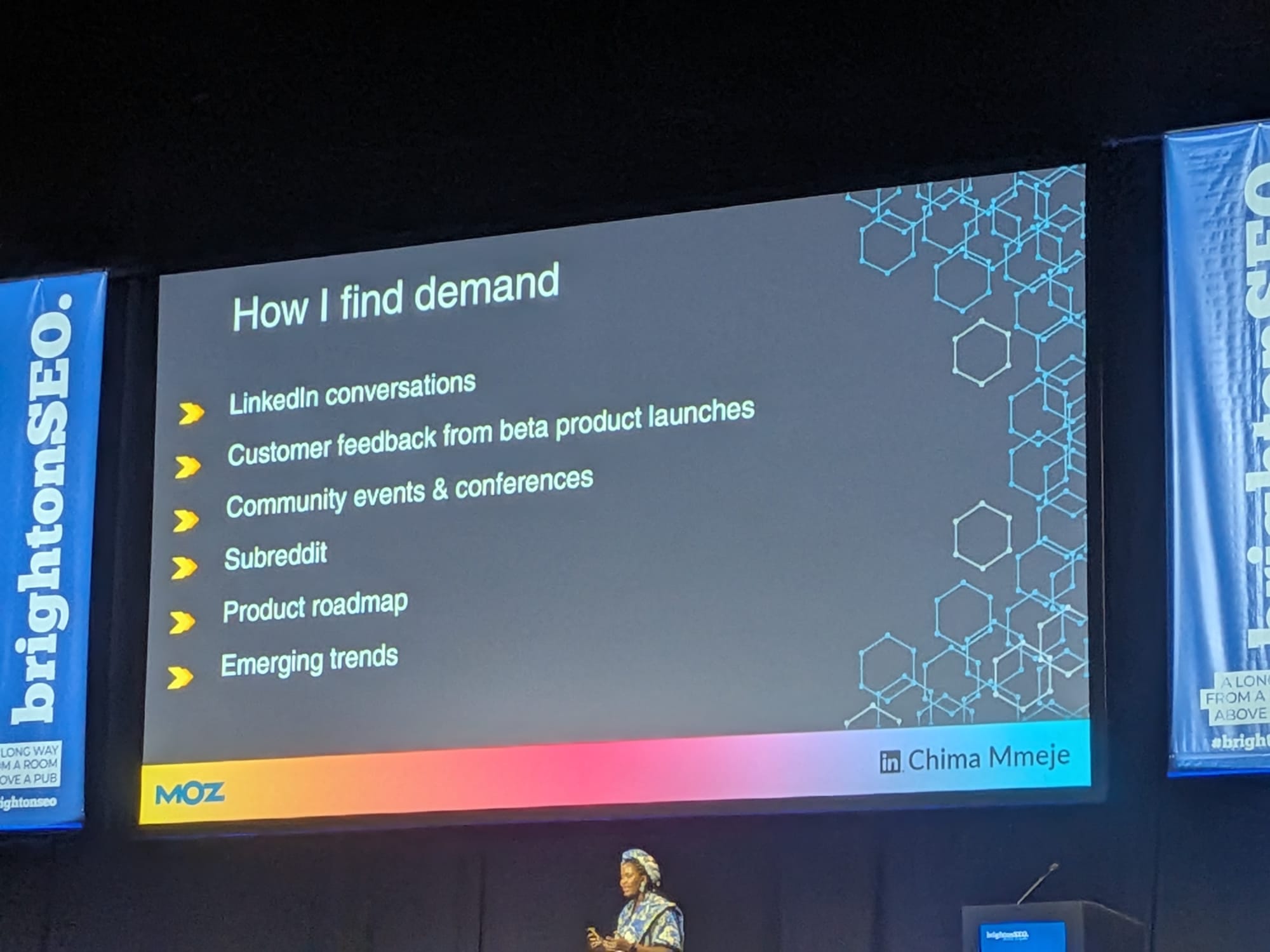
- LinkedIn conversations
- Customer feedback from beta product launches
- Community events and conferences (her words: “I learn so much from speaking to new folks at events like this”)
- Subreddit
- Product roadmap
- Emerging trends
The thing in common: keep your ear to the ground, listen to what people actually want, and write to that. Most of her work, she said, is no longer keyword-led at all.
Three Types of Content Chima Creates
Once she understands the demand, she works in three buckets:
- Thought leadership content (often webinar-led)
- Research-led content (data-driven analysis pieces)
- Product-led content
She walked through each in detail.
Lessons from the Moz Webinar Programme
When Chima joined Moz in 2023, one of the first things she did was launch a webinar programme. She tried to automate it with AI from day one — and learned a stack of expensive lessons.
What didn’t work:
- Putting her own face on promotional assets for webinars where she wasn’t the speaker. (“Nobody wanted to see my face on webinars I wasn’t even hosting.”) When she removed her face and platformed the actual speaker, sign-up numbers improved.
- Promoting on social instead of email. When she switched the primary channel to email, the numbers jumped.
- Planning topics too far in advance. Demand moves quickly. She now reacts within days to topical conversations rather than committing to a quarterly content calendar.
- Running webinars weekly. Unsustainable to manage at quality.
- Not repurposing the webinars. “All the content we have in the graveyard right now — it absolutely breaks my heart.”
What works now — the topic categories:
- Trending industry conversations
- Seasonal content
- How-to content
- How-to product workflows and launches
The Webinar Repurposing Workflow
Chima’s “fly rule” for getting maximum value from each webinar:
- Understand demand — what topic does the audience genuinely care about right now?
- Find a thought leader who can share substantive context on that topic
- Use qualifying questions at registration to segment the list
- Repurpose as a blog post (the webinar transcript becomes the foundation)
- Chop into short-form content for social
- Turn into social posts at distribution scale
- Repurpose into downloadable assets for lead generation
- Re-market via nurture sequences to the segmented list
The result on her best-performing webinar: 1,738 sign-ups, mostly powered by email.
The AI Workflow for Webinar Promotion
Chima uses a tightly scoped AI workflow rather than asking ChatGPT to “write a webinar landing page.”
Step 1: Landing page
Give the LLM an example of a landing page you like. Tell it specifically what you like about the example. Explain how you want the copy structured. Provide all the information needed to write the page, using the example as a template.
Step 2: Email sequence
Take the landing page copy. Plug it into an email-sequence GPT. Ask for a strategy for the first four emails.
- Provide a sample email — what’s worked in the past, what you’ve seen others do well
- Explain why it worked
- Give as much context as possible (Chima’s rule: “You can never give an LLM too much context”)
Step 3: Tap into fear
Chima’s stated favourite emotional trigger for promotional copy: fear. When she gets an LLM output, she explicitly asks the model to:
- Tap into the reader’s fear of missing out
- Show what happens if the reader doesn’t take action
- Expose the false hopes and dreams they may be holding onto
“I want to keep tapping that pain until the person feels like they absolutely need me.”
The “give it a model, give it constraints, give it feedback” loop is what makes the difference. AI alone produces generic copy. AI with structured human direction produces copy that converts.
From Webinar to Blog Post to Lead-Gen Asset
The webinar doesn’t stop being useful when it’s done. Chima takes the recording plus transcript and turns it into a long-form blog post — and on Moz, this format consistently drives more traffic than any other content type they produce.
She then takes the blog post and feeds it into another GPT to plan a downloadable lead-gen asset.
The result on one repurposed blog post: 1,400 leads from a single asset.
Even at a 2% conversion rate, 3,000 marketing-qualified leads gives you 60 new customers — which is meaningful depending on tool pricing. Worth doing.
Informational Content: The Old Way vs. The New Way
This was the most candid part of the talk. Chima admitted that almost everything on the Moz blog — including content widely shared and quoted — is written with AI. She’s been doing this openly for a while.
But the old way she did it produced content that was, in her words, like a Wikipedia page:
- Bulleted introductions
- Too many sub-headings
- No workflows
- Just text — no multimodal assets
- Regurgitating what was already in the SERPs
“I was trained by Google to write like that. I was trained to write that way. My content used to look like a Wikipedia page.”
The new way:
- Start by understanding demand
- See what competitors have already said — set the benchmark
- Create the outline based on her own experience with the problem, not based on the SERP
- Write in first person — she is the thought leader, not the LLM
- Provide actionable resources
- Add insight that AI couldn’t generate
- Multimodal — diversify with assets, screenshots, video, frameworks
- Distribute everywhere, not just publish-and-pray
The “AI SEO Topic Clusters” example: a piece for which she created 10 content assets. The piece doesn’t rank on Google. It still drives a ton of traffic to the Moz site — pure demand-led content.
The non-negotiables for informational content under this model:
- Storytelling
- First person
- How-to depth
- Downloadable assets
- Multimodal
- A natural product connection
The Moz Content Brief + Custom GPT Workflow
For informational pieces specifically, Chima walked through her exact production stack:
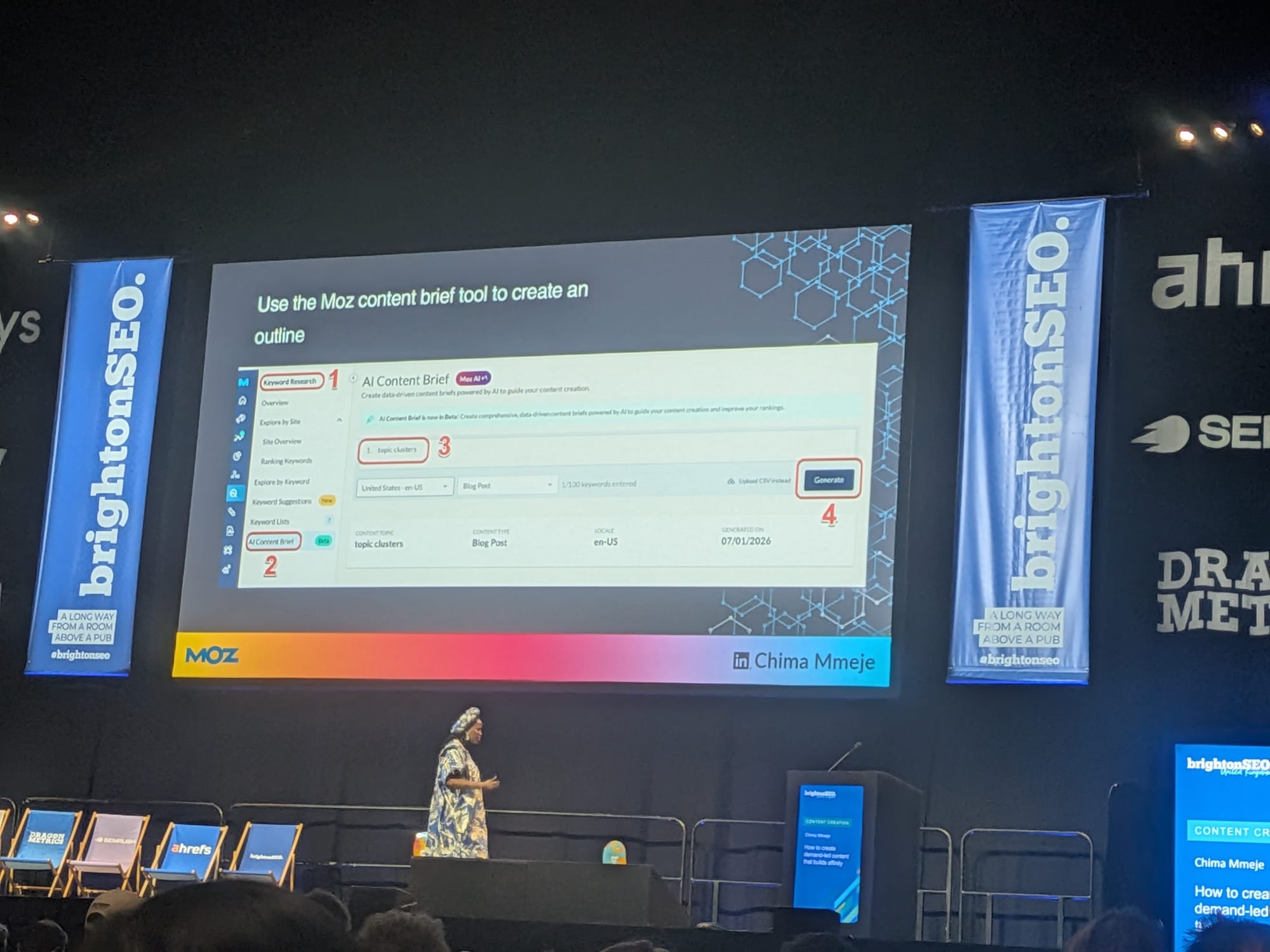
- Go to the Moz Content Brief tool. Plug in the keyword. It generates a brief with target audience, content structure, statistics, and recommended angles
- Drop the brief into a custom Content Assistant GPT
- Have the GPT analyse existing content already performing for the topic — pull title ideas from the analysis
- Give the GPT both its own analysis and the Moz Content Brief; ask it to combine them into a more detailed brief than either alone could produce
- Write — using the combined brief as the working document
Chima’s note: Moz Content Brief is free to try (credit card required for sign-up). Worth testing.
Research-Led Content: Chima Hates Maths
This was the funniest section. Chima admitted she’s hated maths her whole life and used to feel jealous of writers like Ryan Law (Ahrefs) who could analyse big datasets fluently.
LLMs solved this for her.
Her workflow for research-led content:
- Hand the dataset to ChatGPT — ask it to read the file and give data points
- Ask for an overview to find the story
- Ask the most important question of all: “What questions should I be asking if I were to write a blog post that turns this data into research findings?”
- Use Julius AI in parallel — it gives reviewable Python scripts, so she can verify the analysis rather than trust a black box
- Cross-verify in Google Colab by running the Python scripts against the source data
A worked example: AI Mode citation rates. Julius gave her 95.69%. ChatGPT gave her 95.7%. The two LLMs returning consistent answers gave her confidence in the finding.
She then takes the verified analysis into the Content Assistant GPT to write the blog post — adding storytelling, framing, insight.
“There really is a way to use these AI tools, but there’s something that connects all of it: storytelling.”
The Demand-Led Content Playbook
Chima’s closing summary — the same five steps she follows every time:
- Understand demand for your audience (LinkedIn, communities, conferences — “how do I tell the story from this?”)
- Create content strategy based on that demand
- Use AI to support execution — the keyword is support, not do
- Repurpose for multimodal — video, podcast, downloadable, social
- Distribute everywhere
“If you don’t understand storytelling, you don’t understand pain. If you don’t understand storytelling, you’re just like everyone else — and that is absolutely boring.”
Personal Takeaways
Chima is one of the most polished presenters at BrightonSEO. Having attended three BrightonSEOs now (Brighton 2025, San Diego 2025, and Brighton 2026), the energy in the room during her Day 1 afternoon Content Creation session was as high as any talk I’ve sat in at any of them — and her honesty about her own missteps (the face on the webinar promos, the over-automation, the content graveyard) made the session genuinely entertaining to sit through.
The strategic ideas themselves, though, will be familiar to anyone who’s been following Chima’s writing or the broader content marketing conversation over the past two years. “Demand-led content,” “AI as support, not execution,” “storytelling is the unifying layer,” and “stop optimising only for keywords” are all positions she — and others — have been articulating since at least 2024. So this wasn’t a session that shifted my strategic thinking.
What I will be using:
- The specific AI-prompting workflows. The webinar landing page → email sequence GPT chain, and the Moz Content Brief → Content Assistant GPT chain, are concrete enough to copy directly into client work. The “give it a model, give it constraints, give it feedback” loop is a more disciplined approach than I’ve been applying.
- The “what would competitors say first?” benchmark step before drafting. Most of my content workflows start from the topic, not from a deliberate read of the existing SERP as something to surpass. Putting this in as an explicit step changes the angle.
- First-person voice as an explicit prompt instruction. I default to neutral voice in client content because it travels better, but Chima’s point — that first-person is what AI structurally cannot produce — is well taken. It’s where the human shows up.
- The 1,738 sign-ups / 1,400 leads numbers as honest agency benchmarks. Not Macy’s-scale 4.25x stories. Real working-team-of-a-few-people numbers. That makes them more useful for benchmarking what’s actually achievable than the headline data points from larger-budget case studies.
The throughline across the Day 1 sessions I attended — Tom Capper on pixels, Ainhoa Lizarralde on a North Star for zero-click, and Jon Earnshaw on conversational visibility in the morning Zero Click SEO track, then Annika Haataja, Chima, and Matt Beswick in the afternoon Content Creation track — is broadly the same: classical SEO measurement is broken, and the discipline is moving towards visibility-and-affinity work that looks much closer to brand marketing than the keyword-and-rank work that defined the last decade. The strongest single contribution among them, for my money, was Tom Capper’s pixel-position data — the only session of the day that introduced an analytical framework that genuinely changed how I think about reporting, and frankly the standout session across all three BrightonSEOs I’ve attended. The rest were good repackaging of conversations the industry has been having for some time.
Related Resources
- Session: How to Create Demand-Led Content That Builds Affinity (BrightonSEO)
- Speaker profile: Chima Mmeje (BrightonSEO)
- Chima Mmeje on LinkedIn
- Moz Content Brief — Chima’s referenced free trial
- Julius AI — data analysis tool with reviewable Python output
About the Author
Ayaka Uchida (打田彩夏) — Founder & CEO, A-Digital Works Ltd. Founder, Nihon GO! World (London Fitzrovia & Manchester). Over a decade of international business development across Japan, Singapore, the US, and the UK. Three-time BrightonSEO attendee (Brighton April 2025, San Diego September 2025, and Brighton April 2026 — the latter on scholarship). Aoyama Gakuin University Faculty of Law. Fluent in Japanese and English; studying Spanish, French, and German.
Connect: a-digitalworks.com | LinkedIn
About A-Digital Works
A-Digital Works Ltd is a London-based Japan–UK SEO and EN↔JA localisation consultancy supporting UK, EU, and US companies entering the Japanese market. Services span keyword research in Japanese, content localisation, technical SEO, and market entry strategy. Flagship case study: Descartes Systems Group (Canadian logistics technology) — full Japanese-market SEO programme covering 物流システム, EDIシステム, and 配車システム.
This report covers Chima Mmeje’s session “How to create demand-led content that builds affinity” in the Content Creation track at BrightonSEO Brighton, April 30, 2026.
