

TL;DR
- AI works best when an expert is paired with an engineer. G2 learned this the hard way after giving its whole sales team AI access and watching productivity drop.
- Measure cost per outcome, not tokens. If it takes 100 runs to get 5 good pieces of content, the real cost includes the 95 bad ones and the human review.
- Keep humans in the loop with the lightest touch possible. At Weglot, one emoji on Slack can be the only human decision in a workflow.
- Taste stays human. Brand voice, what counts as a “good” translation and which examples to feed back to the AI are human calls.
- AI search is local, even in the same language. The US and the UK have the biggest citation gap, and most citations come from third party sites, not your own.
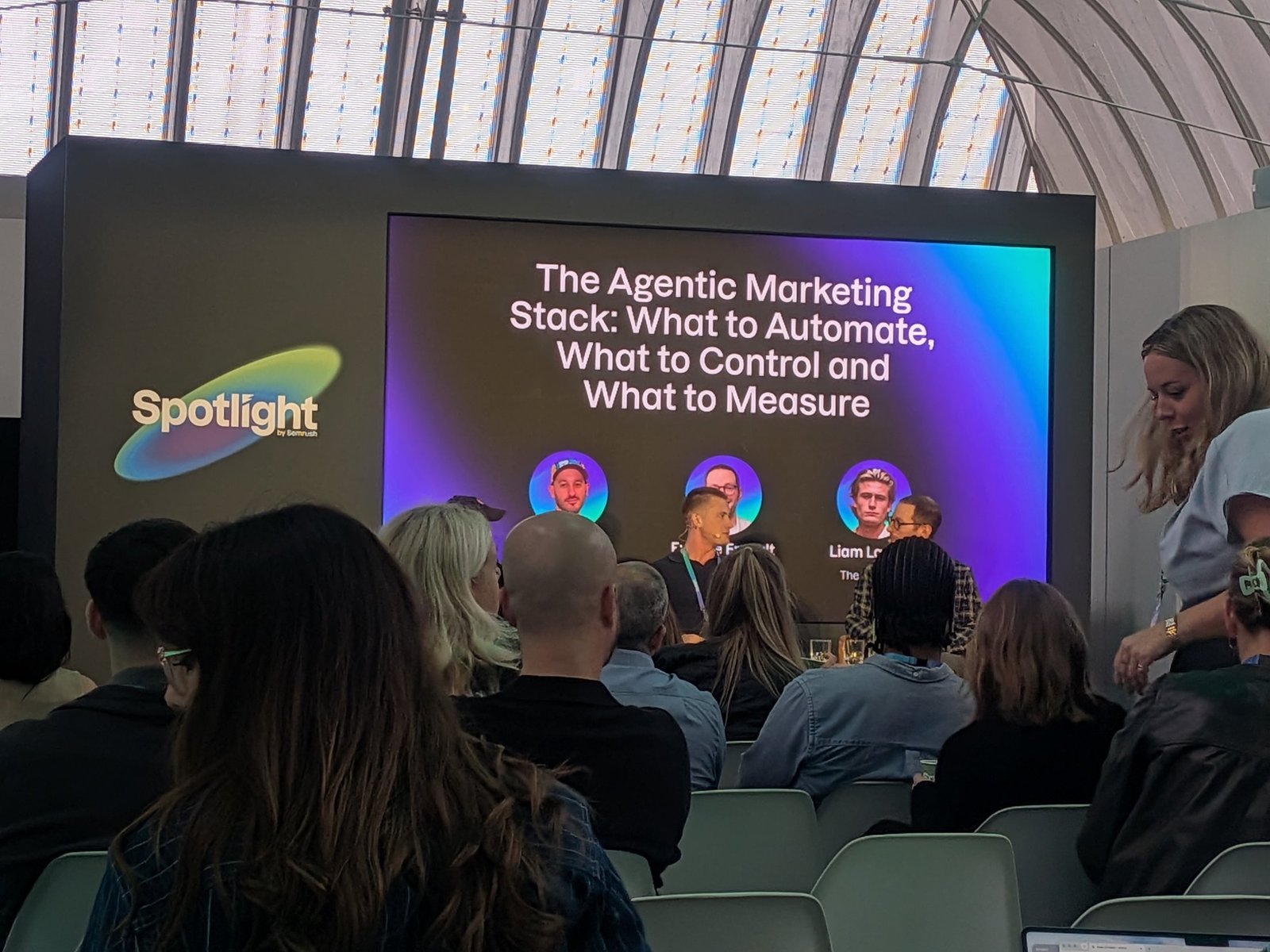
About the Session
- Event: Spotlight by Semrush 2026
- Date: 13 October 2026
- Venue: Old Billingsgate, London
- Stage: Signals Stage
- Format: Panel discussion
The host promised to skip the theory and go straight to practice: where teams are really using AI today, what has failed, and where humans still need to be involved.
About the Speakers
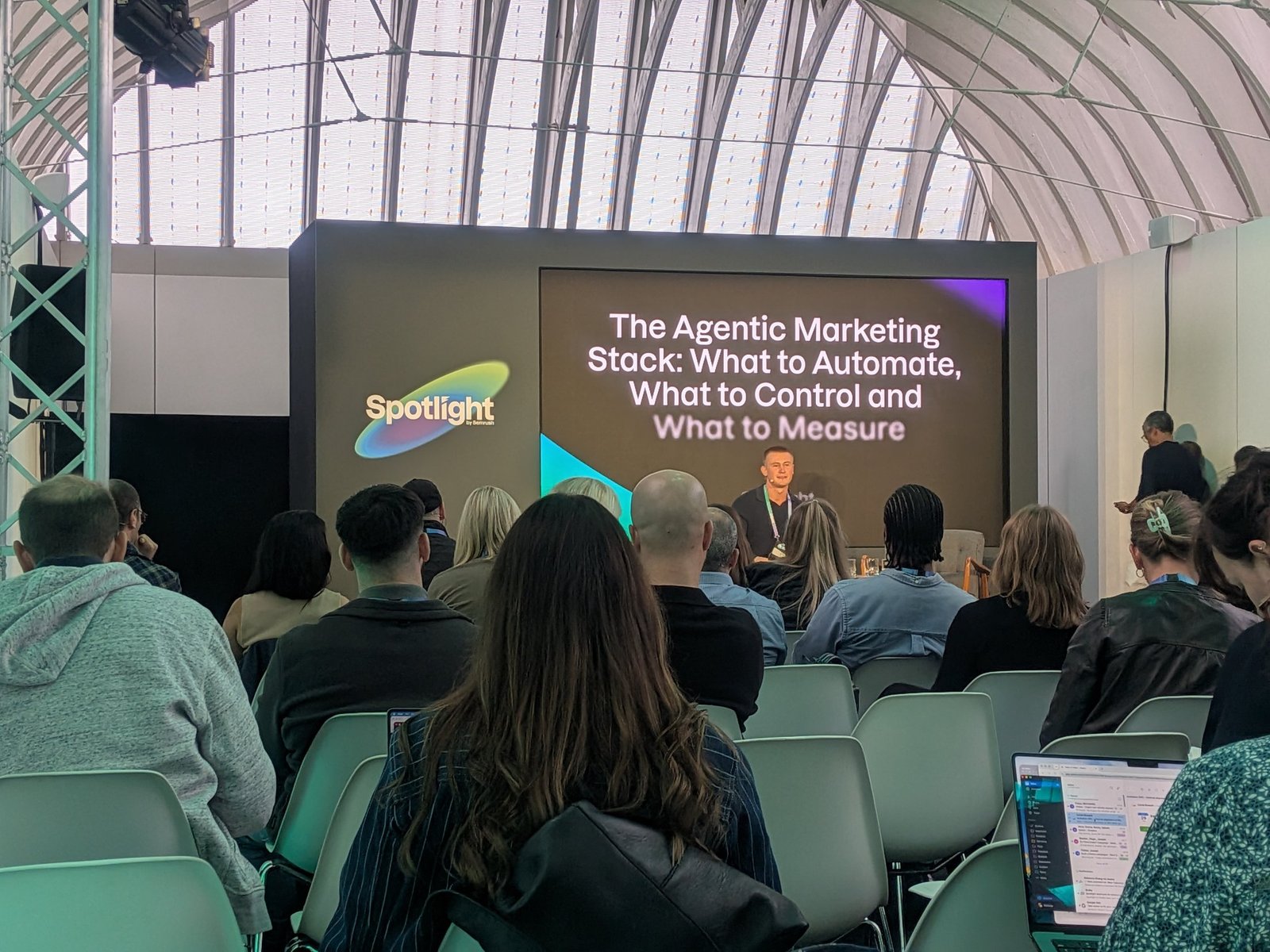
- Liam Lawson (host), CEO of The AI Report, a daily newsletter read by more than 400,000 business professionals
- Eugène Ernoult, Chief Marketing Officer at Weglot, the AI website translation platform that helps more than 110,000 websites grow internationally
- Alex David, GM of AI Solutions at G2, the world’s largest software review site. As he put it, if you’ve ever asked ChatGPT which software to use, you have probably seen a G2 citation
Where AI Is Working Right Now
Alex’s answer to “where are you using AI?” was simple: everywhere. But the setups that work best all have one thing in common. They pair a subject matter expert with a technical expert.
- G2’s finance team works with a forward deployed engineer who learns their workflows, then builds and deploys agents and skills for them
- The marketing team has its own marketing engineer doing the same
Weglot is less agentic, and Eugène was open about that. Instead of one agent running a whole workflow, AI surfaces ideas from Weglot’s own database of past experiments and insights.
He gave an example. When the team noted that a test with ChatGPT ads wasn’t working, a Slack message arrived the next day with a related idea. Eugène reacted with a light bulb emoji to say “good idea”, and the AI drafted a post for him to review.
One human decision, and a very small one. The aim is not full automation, but less time spent on each step.
What Didn’t Work
Alex shared a very honest failure from G2. The company gave the sales team access to AI and told them to use it for content and outreach.
- Every person built their own skills and workflows
- The team had to spend huge amounts of time reviewing the output, so nothing inaccurate reached customers
- Productivity went down, sales slowed and token costs went up
That is why G2 moved to the model of pairing technical experts with subject matter experts.
How to Measure the Value
Liam said the big consultancies he talks to are now trying to tie AI spend to a business outcome in dollar terms. Before usage based pricing, companies just threw AI at everything to see what happened.
Weglot keeps it simple. It measures value mainly in human time saved, and then asks whether a tool is worth integrating for the minutes it saves per day or per week.
G2 recently interviewed CFOs and CIOs, the people who actually buy AI. What they found:
- Most decision makers ignore technical benchmarks. They don’t need a frontier model for most tasks
- What they care about is how well a tool completes a task, and at what cost
- They don’t think in tokens. They think in cost per task or per outcome, and that is not standardised yet
G2 calculates a fully loaded cost. If it takes 100 runs to get 5 good pieces of content, the cost is not the tokens for one piece. It is all 100 versions, the 95 bad ones, and the human time spent reviewing them.
Liam added that even the biggest consultancies admit they don’t have the answer yet, because the models and tools keep changing.
Where Humans Still Matter
Eugène: weigh the cost of no review. If an agent drafts posts automatically, there is a small chance it takes a private internal conversation and publishes something it shouldn’t. The chance is low, but the cost is high. So a human does a quick check, sometimes just with an emoji on Slack.
He also suggested reducing what humans need to look at. Instead of giving someone 100 drafts, let a second AI pick the best 5, and let the human choose from those.
Alex: risk, examples and taste. He sees three places where humans add the most value:
- Risk assessment. More risk, more human involvement
- Choosing the good examples that get fed back to the AI so it improves over time
- Taste. He referred to a talk on taste at OpenAI’s DevDay a few weeks earlier, and the point that AI is just not good at it
Taste is subjective, and for a brand it becomes even more important. Is this aligned with our voice? AI can be trained on it, but the output can still feel off.
Will an Agent Take Your Job?
Eugène’s answer: not yet, not as a marketer. He used events as an example. AI can shortlist marketing events using criteria like audience and sponsors. But choosing Spotlight over another event came down to the team’s own taste, which isn’t written down anywhere for an AI to learn from.
He also pointed out that people still ask to speak to a human, especially when money is involved.
Alex thinks engineering is much closer. G2 hasn’t cut its engineering team, but each team can now do far more. Engineering outcomes are binary, it works or it doesn’t, so they are easier to automate. Marketing is subjective, so it is much harder.
He shared an example from Software Advice, a G2 company. Around 100,000 people a year still call a human advisor for 15 to 20 minutes to ask which software they should buy, like a dental hygienist working across three offices who just wants someone to guide her.
Even Translation Comes Down to Taste
This was Eugène’s home ground. Customers come to Weglot asking for the best translation, but what makes a translation good is subjective.
Often, the local team in a market and the head office don’t agree on how the brand should be presented. Deciding how you want to sound in each market will remain a human decision.
Getting Cited in AI Search
Ask the questions buyers really ask. Alex sees many companies trying to get cited for feature prompts, like “which tool has this feature”. But people don’t buy that way. They ask which tool solves their problem, or what you would recommend. Finding the right prompts for your customers is key.
Most citations are third party. By Alex’s figure, around 85% of citations come from third party sites, not your own website. That could be G2 for software, GitHub for dev tools, or Reddit. Check where you and your competitors are being cited.
Each model behaves differently. G2 tested recency. Fresh content mattered for ChatGPT, but much less for Gemini or Claude.
- For enterprise buyers, who Alex believes lean more towards Claude, detailed case studies and ROI reports matter more than recency
- For more consumer style buyers on ChatGPT, publish new information every month and be visible on review sites
Localisation Is Not Just Translation
Eugène shared a study showing that the biggest citation gap between two countries is between the US and the UK. The same prompt, in the same language, leads ChatGPT or Claude to cite different sources in each country.
Weglot also ran a test in Mexico, asking questions in English and in Spanish:
- Spanish content was cited much more for searches in Spanish
- Sites with both English and Spanish content got more Spanish citations than sites only in Spanish
- Weglot doesn’t know yet if this is causation. It could be that bilingual sites tend to be bigger brands
The lesson: monitor AI visibility by country and by language, because the answers and the sources change. Local media gets cited locally, French media in France, UK media in the UK. And if your website is only in English, you are basically invisible in other markets.
What the Panel Is Watching Next
- Alex: agents as first class citizens at work, living inside Slack and other tools like employees. He is learning by watching what skills people build and share on GitHub
- Eugène: AI that tests products on the buyer’s behalf, creating accounts and trying tools before recommending one. His future job may be making sure AI can test Weglot easily
What Not to Do
- Don’t hand AI to a whole team without technical support and shared workflows
- Don’t measure AI cost in tokens alone
- Don’t make humans review everything. Filter first, then ask for one decision
- Don’t fully automate anything where one mistake is costly
- Don’t optimise only for feature prompts
- Don’t assume one English site works for both the US and the UK
Next Steps
- Pair one expert with one technical person. Start with a single team and a single workflow.
- Calculate a fully loaded cost for one AI task. Include failed runs and review time.
- Map where a human must approve. Use risk as the deciding factor and make the approval as light as possible.
- Write down your brand’s taste. Voice, examples you like and examples you don’t, so AI has something to learn from.
- List the problem based prompts your buyers use. Then check which third party sites get cited for them.
- Track AI visibility per country and language. Especially if you sell in both the US and the UK.
Personal Takeaways
The whole conversation was fun to listen to, but the part on translation was what really caught my attention.
Related Resources
- Weglot
- G2
- Spotlight 2026 agenda
- Nikhil Lai’s session report: the Forrester talk just before this panel on the same stage, on why answer engines are the new upper funnel
Written by Ayaka Uchida
CEO, A-Digital Works
This report covers the panel “The Agentic Marketing Stack: What to Automate, What to Control and What to Measure” at Spotlight by Semrush 2026, 13 October 2026.
