

TL;DR
- AI transformations fail at adoption, not technology. Only 4% of AI investment goes to training, even though people and process are where projects break.
- Start with a “phase zero”. Co-create the plan with the people you need, before phase one begins.
- Substitute the low stakes work, augment the high stakes work. AI clears the path on repetitive tasks. Humans keep the judgement on the rest.
- HP’s GEO programme moved fast. A content ecosystem of reviews, creators and affiliates brought +92% traffic and +82% AI share of voice in one quarter.
- Simplify before you automate. HP’s back-office project cut turnaround time by 34% and delivered $190M back to the business.
About the Session
- Event: Spotlight by Semrush 2026
- Date: 13 October 2026
- Venue: Old Billingsgate, London
- Stage: Signals Stage
Carmen said most of the day had been about the “what” of AI in marketing. Her talk was about the “how”: making all those ideas actually stick inside a large organisation.
About the Speaker
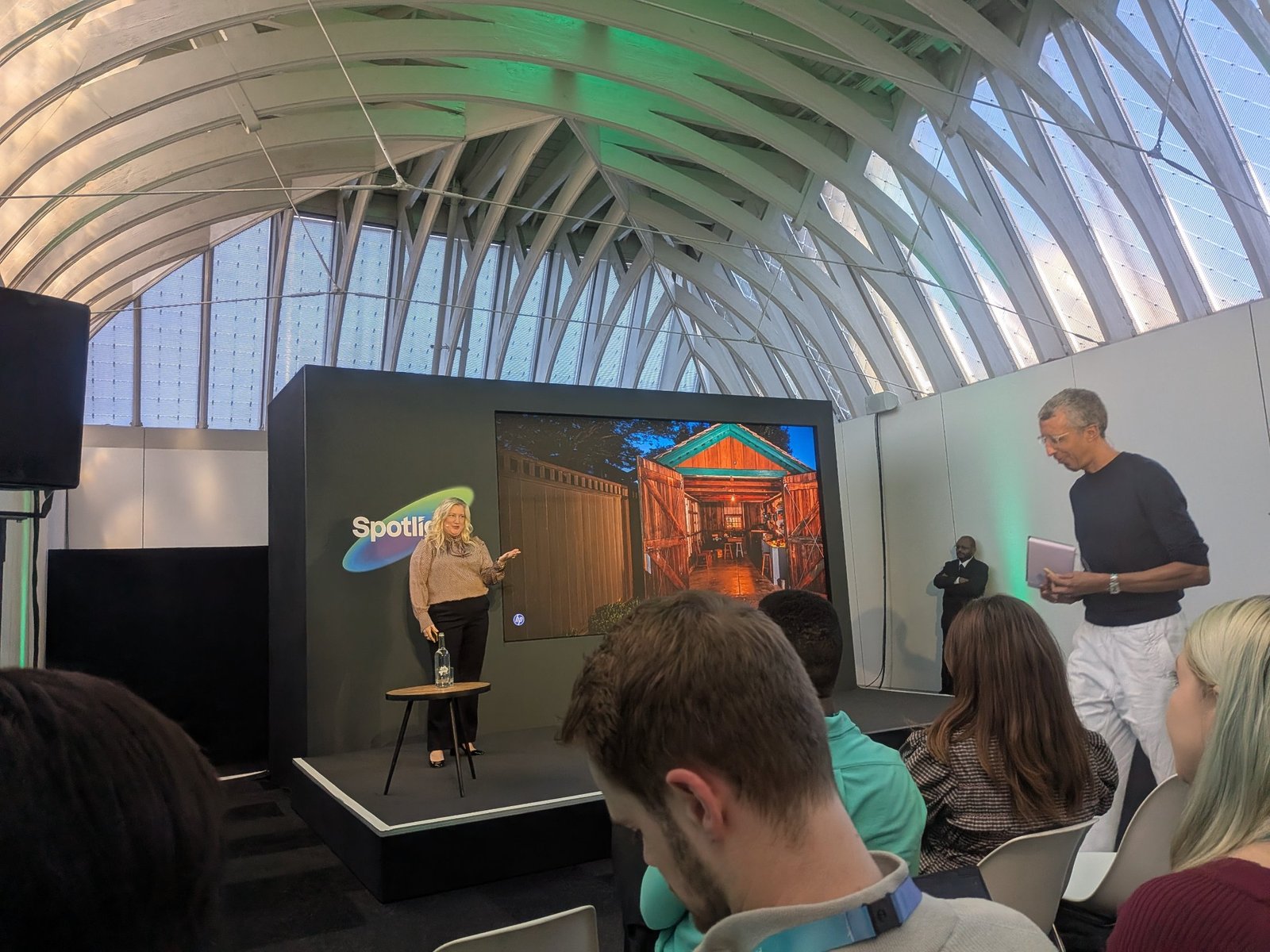
Carmen True is SVP of Solutions Marketing at HP, leading global marketing for HP’s growth businesses, including AI, data and customer experience. She has held leadership roles at HP for many years and previously worked at Qualcomm, leading large-scale transformation projects focused on measurable growth.
Introducing her, the host shared an idea from their first conversation: the “multilingual C-suite”. A CMO who can speak fluently with the CTO, the CIO and the CFO brings far more value to the business.
The Opening: Just Ask
Carmen opened with a video of Steve Jobs telling a famous story. At 12 years old, he found Bill Hewlett’s number in the phone book and called to ask for spare parts to build a frequency counter. Hewlett answered, gave him the parts, and gave him a summer job at HP.
His point: most people never pick up the phone and ask. That is often what separates people who do things from people who just dream about them.
For Carmen, that is the heart of transformation too. Calling for help, and figuring out how to build and change together.
HP in Numbers
To set the scale, Carmen shared where HP stands today:
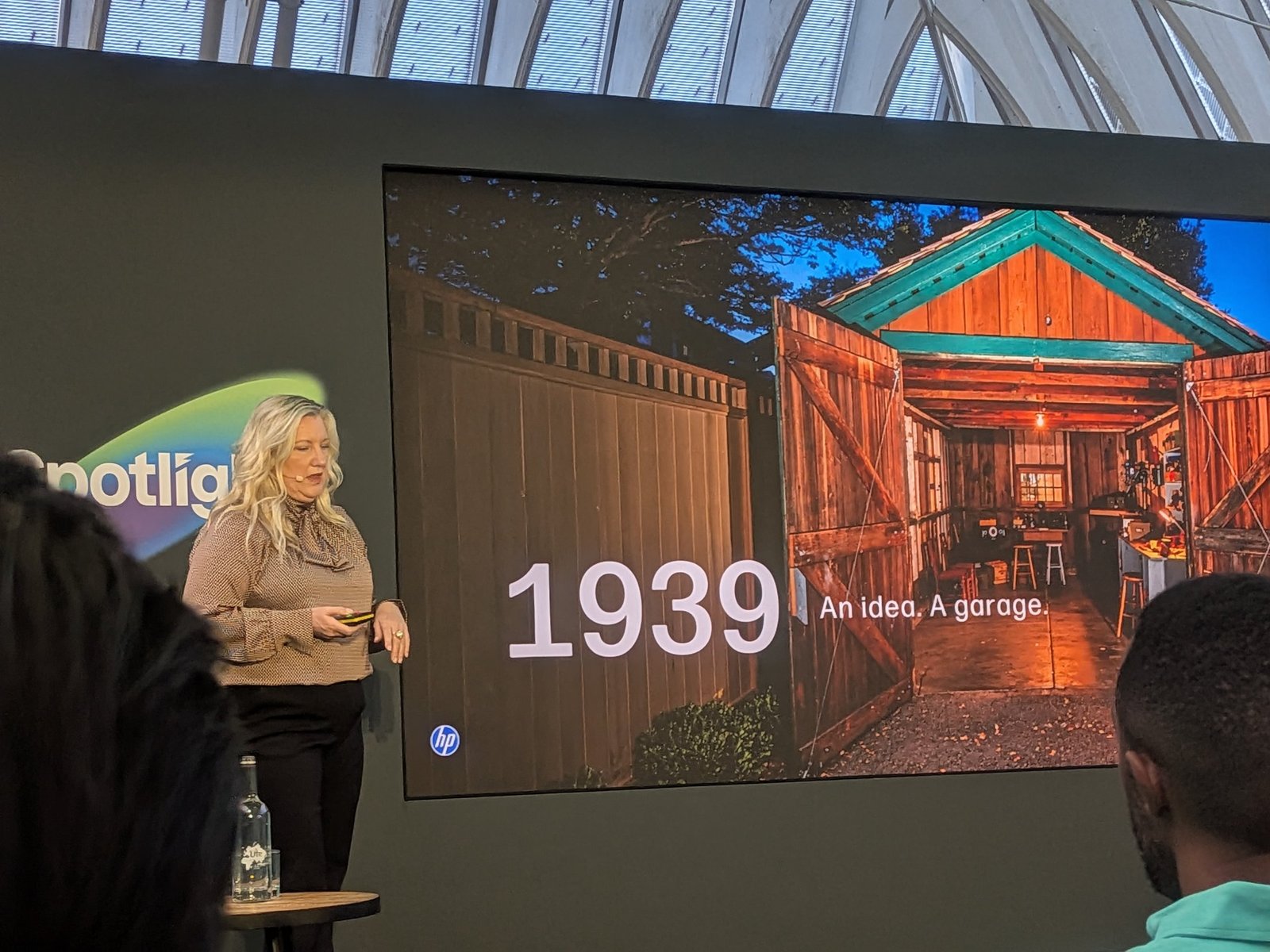
- Started in a garage in 1939, and now 87 years old
- Around $55 billion in revenue, across 180 countries
- Around $12 billion in brand value
- The tenth domain name ever registered
A great history, but like every marketing team, HP still faces the same pressure: how do we deliver this quarter for the business?
The Transformation Gap
Having ideas is easy. Making them stick at scale is the hard part. Carmen learned early in her career that when she worked alone, she didn’t get very far. When she reached across the aisle, the depth and stickiness of the change were tenfold.
That means building the hard relationships: the CTO, the CFO, regional marketing teams around the world, and the product teams whose experiences you need to transform.
- Assess who is in the room. Not who usually shows up, but who you need to call and invite
- Go after the hard relationships. When you bring someone in who didn’t expect a call, they often become your strongest supporters
- Use the word “help”. People respond to it far more than you expect, across cultures and team dynamics
Phase Zero
A concept Carmen picked up from Deloitte on one of her projects. Everyone arrives with their own idea and their “five things to do” slides. You are ready to go, but nobody else is.
Phase zero is the step before phase one, where everyone co-creates the plan together and owns the problem together.
Owning it also means saying “I don’t know”. On several Adobe transformations, Carmen had an honest conversation with her CTO: the team had the passion, but zero of the knowledge. So they brought in specialists at the start, who then taught the team to do the work themselves.
One project started with five people in a room. By the time she left that company, they were running quarterly scrum workshops with 250 people across sales, IT, marketing and product.
Why AI Transformations Fail
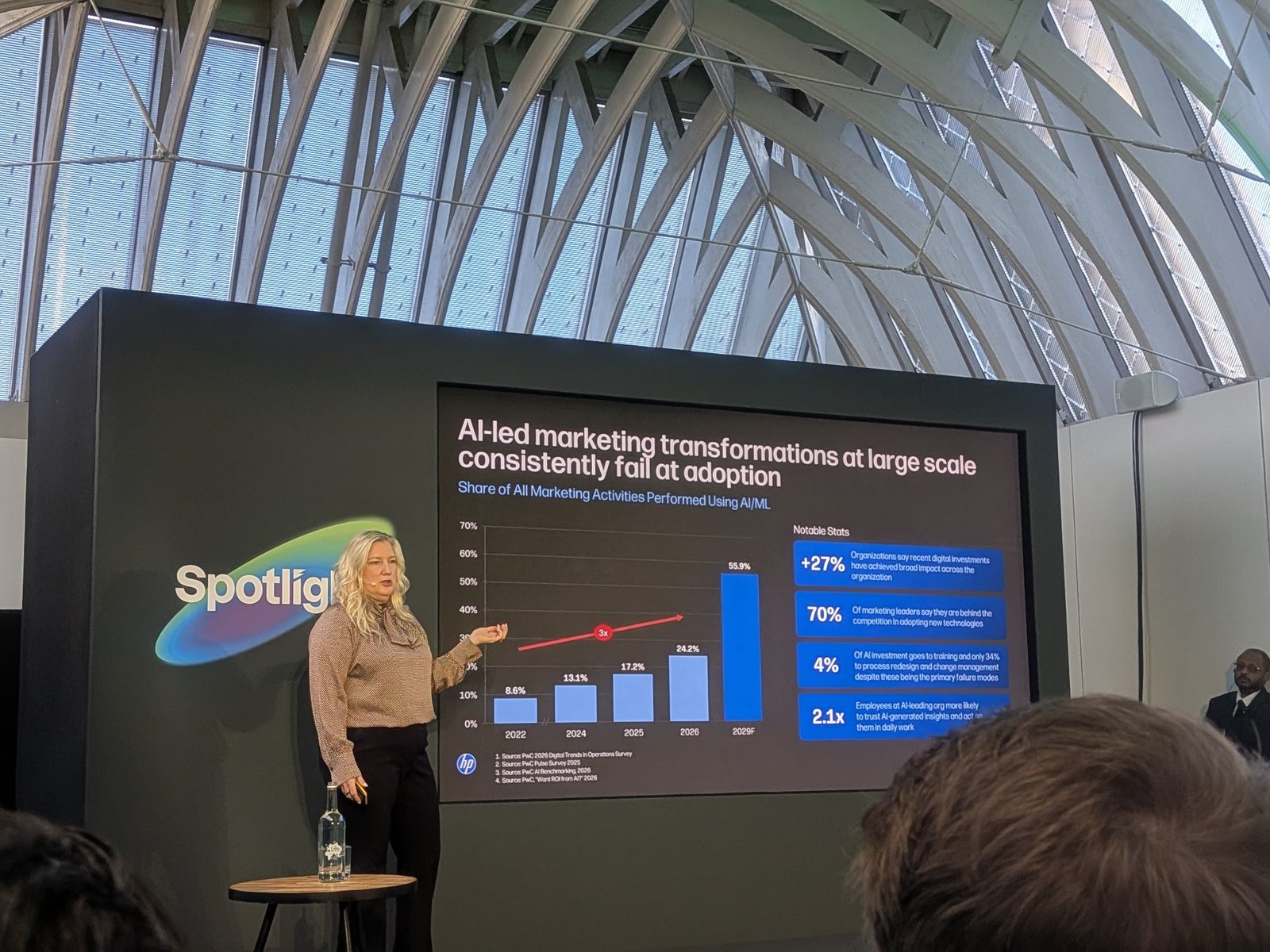
As a company that builds AI technology, HP has to move fast. And people inside marketing are asking for AI in their workflows. But the data shows a gap. According to the PwC research Carmen shared, the share of marketing activities performed using AI or machine learning is growing fast:
- 8.6% in 2022
- 13.1% in 2024
- 17.2% in 2025
- 24.2% in 2026
- 55.9% forecast for 2029
Yet large-scale AI-led marketing transformations consistently fail at adoption:
- 70% of marketing leaders say they are behind the competition in adopting new technologies
- Only 4% of AI investment goes to training, and only 34% to process redesign and change management, even though these are the main reasons projects fail
- Employees at AI-leading organisations are 2.1x more likely to trust AI-generated insights and act on them
Putting People First
HP’s transformation started with one human-centred question: what would it look like if every person in marketing could do their best work every day?
From there, the team set its principles:
- Put employees at the centre of every decision
- Redesign the work, don’t just add AI to it
- Let AI absorb the burden, while humans hold the judgement
- Measure value, not activity
- Move together, not at the speed of the fastest
They also worked hard on psychological safety. AI touches how people do their work, so the room has to be safe for questions like: What is my value? Will I still have a job? Where does my creativity fit?
Substitution vs Augmentation
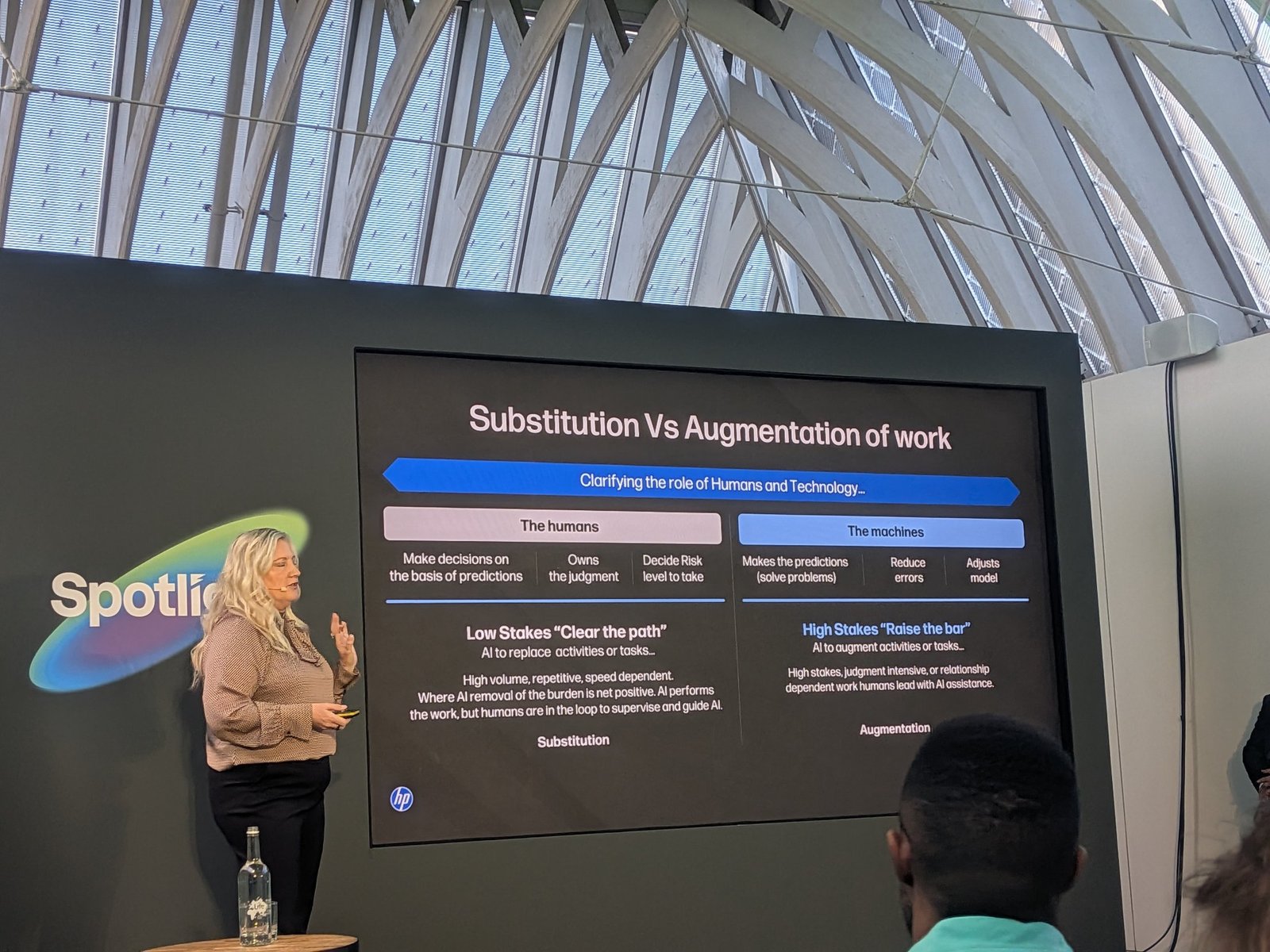
To move from discussion to action, HP clarified the roles of humans and technology:
- Humans: make decisions based on predictions, own the judgement, decide the level of risk to take
- Machines: make the predictions, reduce errors, adjust the model
Then they split the work in two:
- Low stakes, “clear the path” (substitution): high volume, repetitive, speed dependent work. AI does the work, with humans in the loop to supervise and guide it
- High stakes, “raise the bar” (augmentation): judgement-intensive or relationship-dependent work, where humans lead with AI assistance
HP mapped every marketing process on this matrix. Insights, measurement and back-office operations were ready now. Brief development, media activation and content production sat in the middle. Journey orchestration sat furthest out, partly because HP has been rebuilding its B2B practice over the past two years after a decade focused on consumers.
For each project, the team worked through the same steps: the business challenge and friction, the data and technology available, the workflow to redesign, the execution and organisation, and finally the ROI and risk.
Example 1: AI and GEO
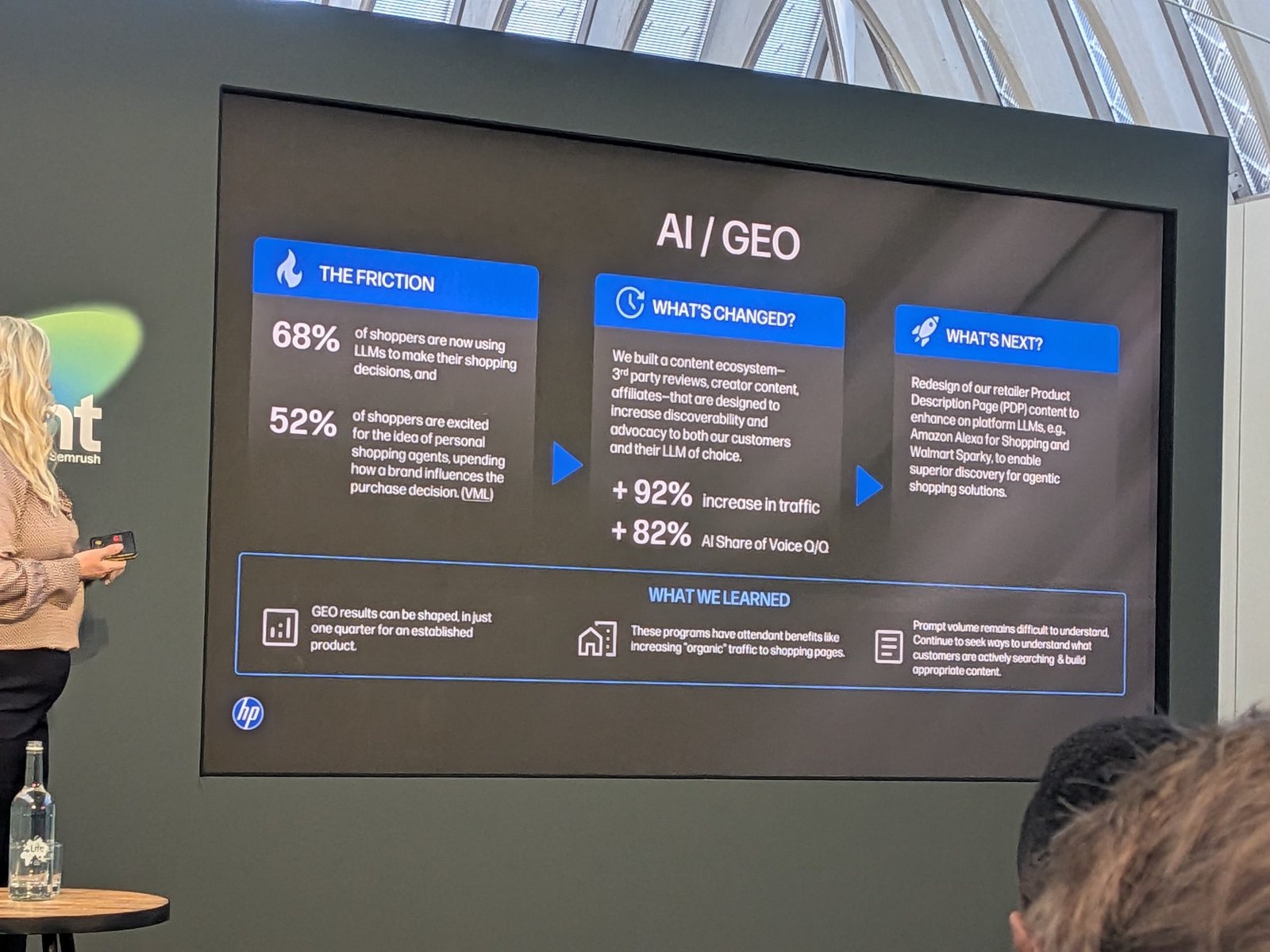
The friction: 68% of shoppers now use LLMs to make shopping decisions, and 52% are excited about personal shopping agents, which changes how a brand influences the purchase (source: VML).
What changed: HP built a content ecosystem of third party reviews, creator content and affiliates, designed to increase discoverability and advocacy with customers and their LLM of choice.
- +92% increase in traffic
- +82% AI share of voice, quarter on quarter
What’s next: redesigning retailer product page content for on-platform AI assistants, such as Amazon Alexa for Shopping and Walmart Sparky, for better discovery by shopping agents.
What they learned:
- GEO results can be shaped in just one quarter for an established product
- These programmes bring extra benefits, like more organic traffic to shopping pages
- Prompt volume is still hard to understand, so keep looking for ways to learn what customers are really searching for
Example 2: Data and Infrastructure
HP had around two terabytes of data spread across 20 different databases. The team brought them together into one, which cut the total cost of ownership by 75% and made it possible to run AI on the data.
To get there, they had to be strict about where data lives and how it is managed.
Example 3: Back-Stage Operations
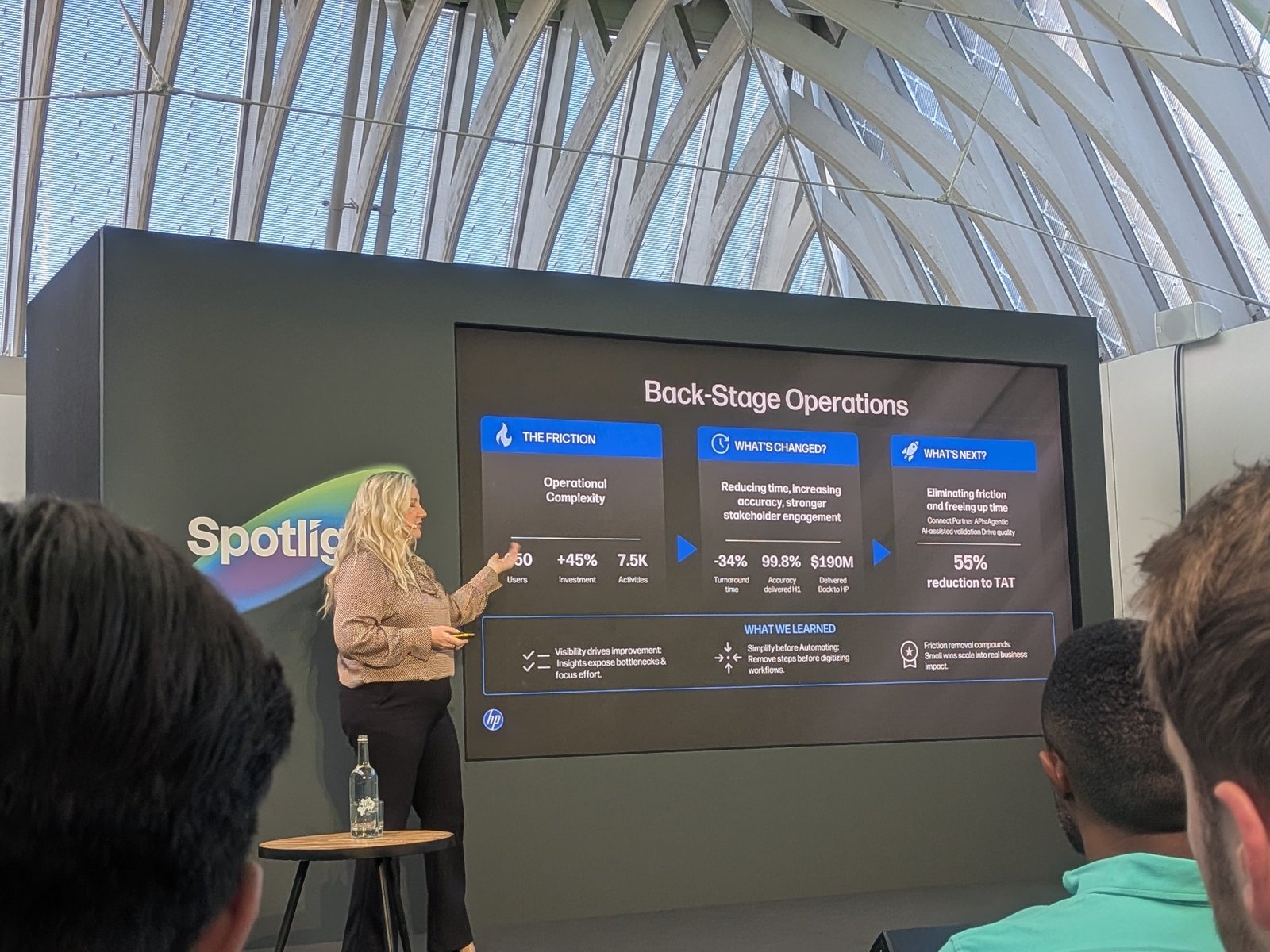
Carmen thinks this is where most organisations have the biggest opportunity. Operating in around 180 countries, HP had serious operational complexity: 650 marketing users, 7,500 activities, and investment needs growing 45% a year.
- Turnaround time down 34%
- 99.8% accuracy delivered in the first half
- $190M delivered back to HP
Next, the team is aiming for a 55% reduction in turnaround time, by connecting partner APIs and adding agentic, AI-assisted validation.
What they learned:
- Visibility drives improvement. Insights expose bottlenecks and focus effort
- Simplify before automating. Remove steps before digitising workflows
- Friction removal compounds. Small wins scale into real business impact
The Close: Drive the Transformation
Carmen also shared advice from her technology partners: give it a minute. When she was patient and let the work take its time, the results were stronger.
Her final message: build a marketing organisation where transformation doesn’t happen to you. You drive it, with an enterprise mindset and the capability to transform the whole business.
What Not to Do
- Don’t run a transformation with only the five people at the front of the room
- Don’t skip phase zero and jump straight into implementation
- Don’t pretend to know what you don’t. Bring in specialists, then learn from them
- Don’t just add AI to old workflows
- Don’t spend on technology and forget training and change management
- Don’t automate a process before simplifying it
Next Steps
- List the people you need but haven’t invited. Call at least one of them this week.
- Run a phase zero session. Agree on the problem together before choosing tools.
- Map your marketing tasks on a low stakes vs high stakes grid. Start AI on the low stakes, ready-now work.
- Review your AI budget. Check how much goes to training and process redesign.
- Audit your third party presence. Reviews, creators and affiliates shape what LLMs say about you.
- Pick one back-office process. Remove steps first, then automate what is left.
Personal Takeaways
The numbers in this session were so concrete, which made it really easy to follow.
Related Resources
- Spotlight 2026 agenda
- Nikhil Lai’s session report: Forrester on why off-site authority drives AI visibility, which HP’s GEO results back up
- Fred Vallaeys’ session report: Optmyzr on where humans still matter when AI runs the workflow
Written by Ayaka Uchida
CEO, A-Digital Works
This report covers Carmen True’s session “The Transformation Gap: How to Make Marketing Change Stick at Global Scale” at Spotlight by Semrush 2026, 13 October 2026.
