

TL;DR
- Humans do a lot of the work, but move little volume. Across 578 million changes in Optmyzr accounts, people working by hand made up 22.8% of work sessions but only 10.8% of changes.
- The new era asks for the most trust. We have moved from “I do it” to “help me do it” to “do it for me”, and agents are not deterministic.
- Your job is doctor, teacher, chef and pilot. Pick the right model, teach it what good looks like, add the taste, and take over when needed.
- Let one machine check another. Alerts, rules and account policies sit on top of Google’s automation, so only safe changes go live.
- Give AI the right goal. Maximize Conversion Value, working perfectly, gives you exactly zero profit. Someone who knows the margin has to set the target.
About the Session
- Event: Spotlight by Semrush 2026
- Date: 13 October 2026
- Venue: Old Billingsgate, London
- Stage: Signals Stage
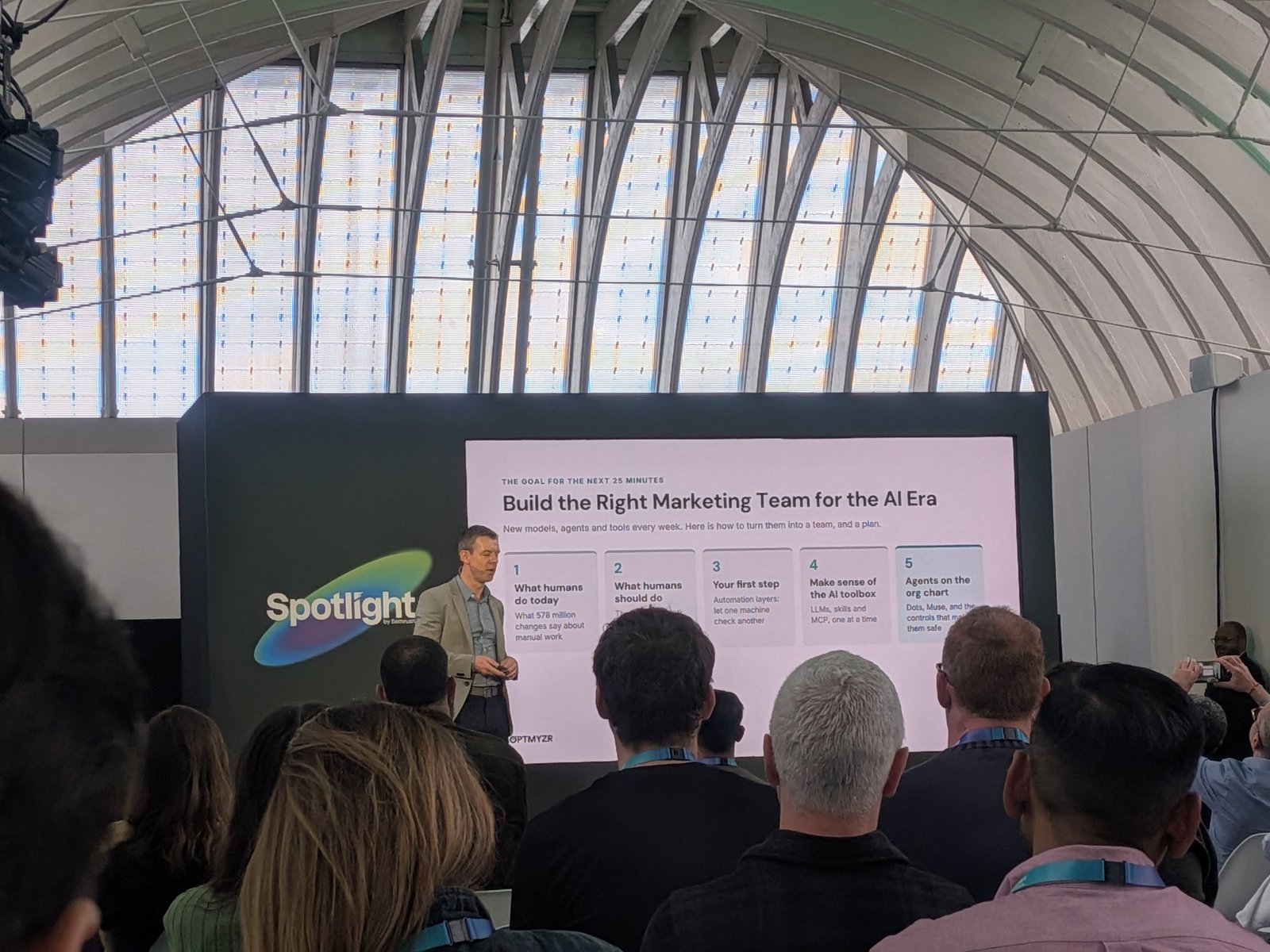
Fred set the goal for his 25 minutes: how to build the right marketing team for the AI era, when there are new models, agents and tools every week. He split the talk into five parts: what humans do today, what they should do, the first step, the AI toolbox, and agents on the org chart.
About the Speaker
Frederick Vallaeys co-founded Optmyzr in 2013 to make managing PPC accounts quick and simple. Before that, he was one of Google’s first 500 employees and spent about 10 years working on AdWords, including Quality Score. He hosts Optmyzr’s PPC Town Hall and was named Search Marketer of the Year by Search Engine Land in 2021. He has written several books on marketing and AI, most recently “AI Amplified Marketer”.
The Opening: 100 AI Billboards, Zero MCPs
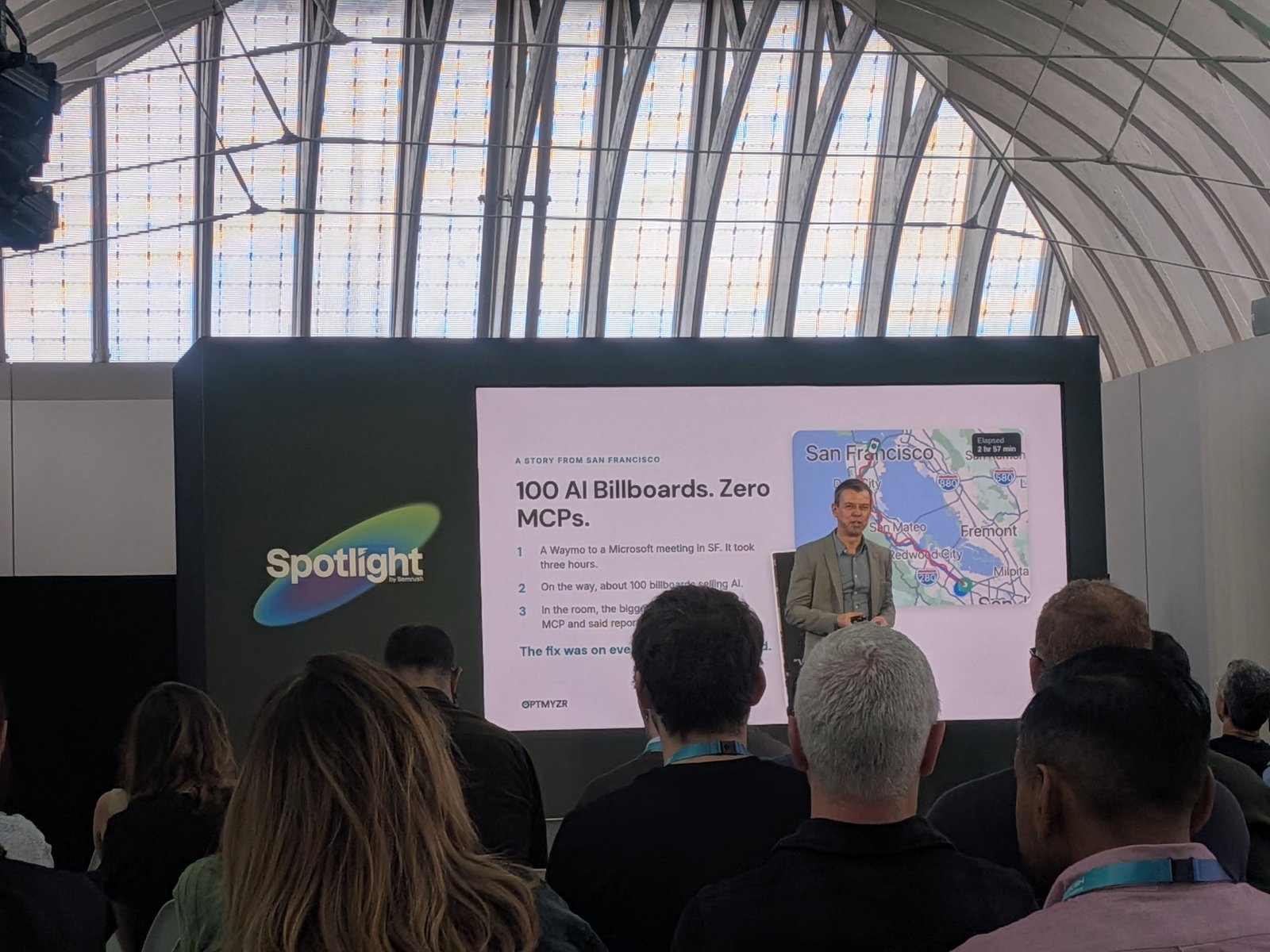
Fred took a Waymo to a Microsoft meeting in San Francisco. On the way, he passed billboard after billboard for AI companies, around 100 of them.
In the room were big advertisers, including Fanatics and Williams-Sonoma. When Microsoft asked about their biggest problem, the answer was the same: a different data request every day, and hours spent fetching data and building reports.
To Fred, the fix was obvious. That is exactly what AI and MCPs can do. But nobody in the room was using them.
Then the twist. A drive that should take 40 minutes took three hours. At 8am the Waymo avoided a busy freeway, which made sense. By 9am the traffic was gone, but the car still refused to get back on the freeway, despite several chances. And he couldn’t get out.
That, he said, is the downside of AI. It can be great, but it still has these issues. The question is how to make it work for us.
Part 1: What Humans Do Today
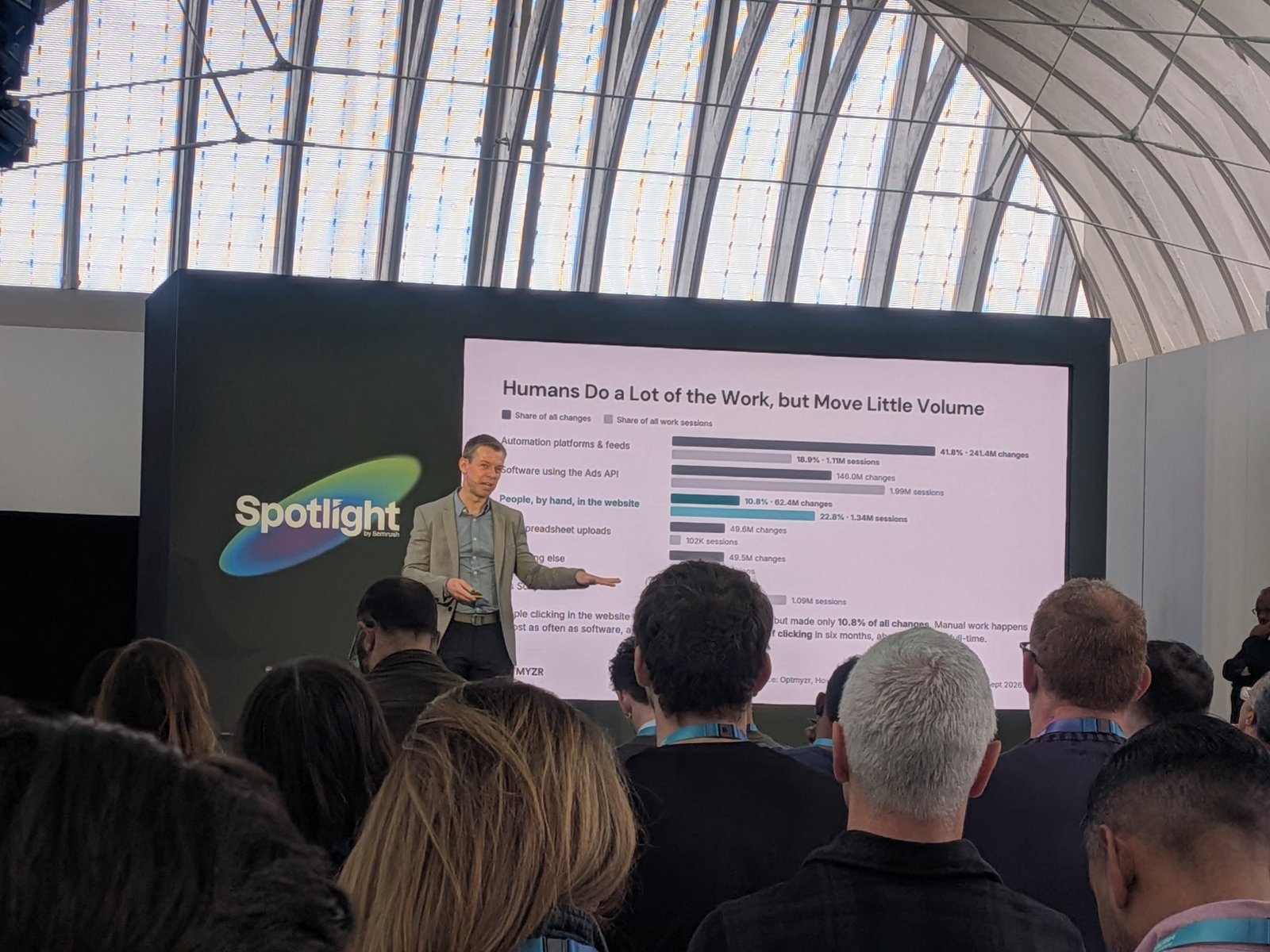
Optmyzr looked at 578 million changes made in ad accounts over six months, and where they came from:
- Automation platforms and feeds: 41.8% of all changes (241.4M), but only 18.9% of work sessions
- Software using the Ads API: 146.0M changes
- People, by hand, in the website: 22.8% of work sessions, but only 10.8% of changes (62.4M)
- Spreadsheet uploads: 49.6M changes
So people working by hand show up more often than automation, but move far less. Doing things by hand simply takes longer.
Optmyzr also asked users why they still make changes manually. The responses were few, but the top reason was clear: they don’t trust automation.
Fred also had a theory about the San Francisco meeting. If most of your job is moving data from one place to another, AI looks like a threat. If your job is making decisions and setting strategy, AI frees up time to do more of that.
Part 2: What Humans Should Do
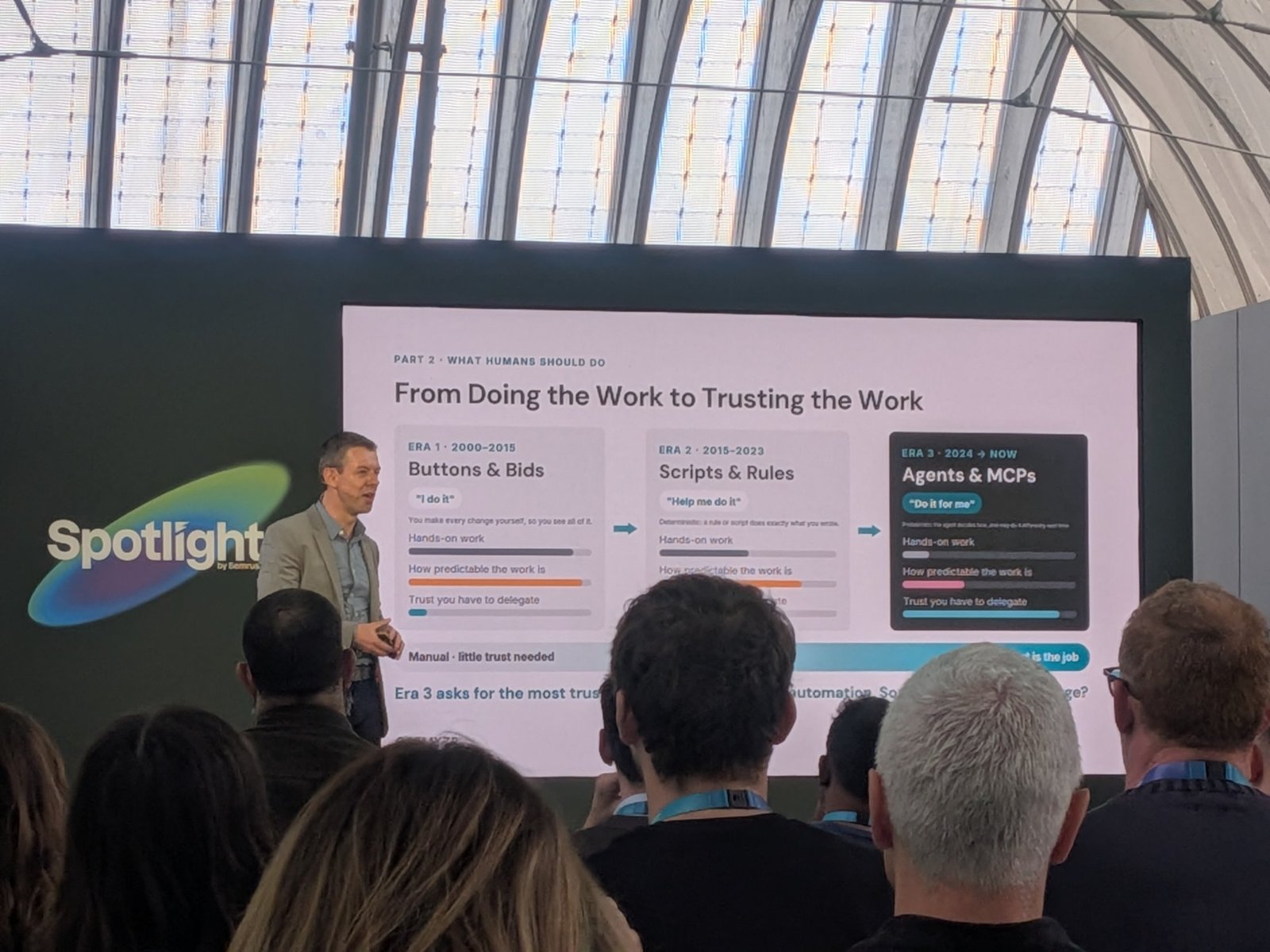
Fred described three eras of PPC:
- Era 1, 2000 to 2015: Buttons and bids. “I do it.” You make every change yourself, so trust isn’t an issue
- Era 2, 2015 to 2023: Scripts and rules. “Help me do it.” Automation is deterministic. If X happens, always do Y
- Era 3, 2024 to now: Agents and MCPs. “Do it for me.” An agent decides your negatives, match types, bids and budgets. It is creative, it does things differently every time, and it needs the most trust
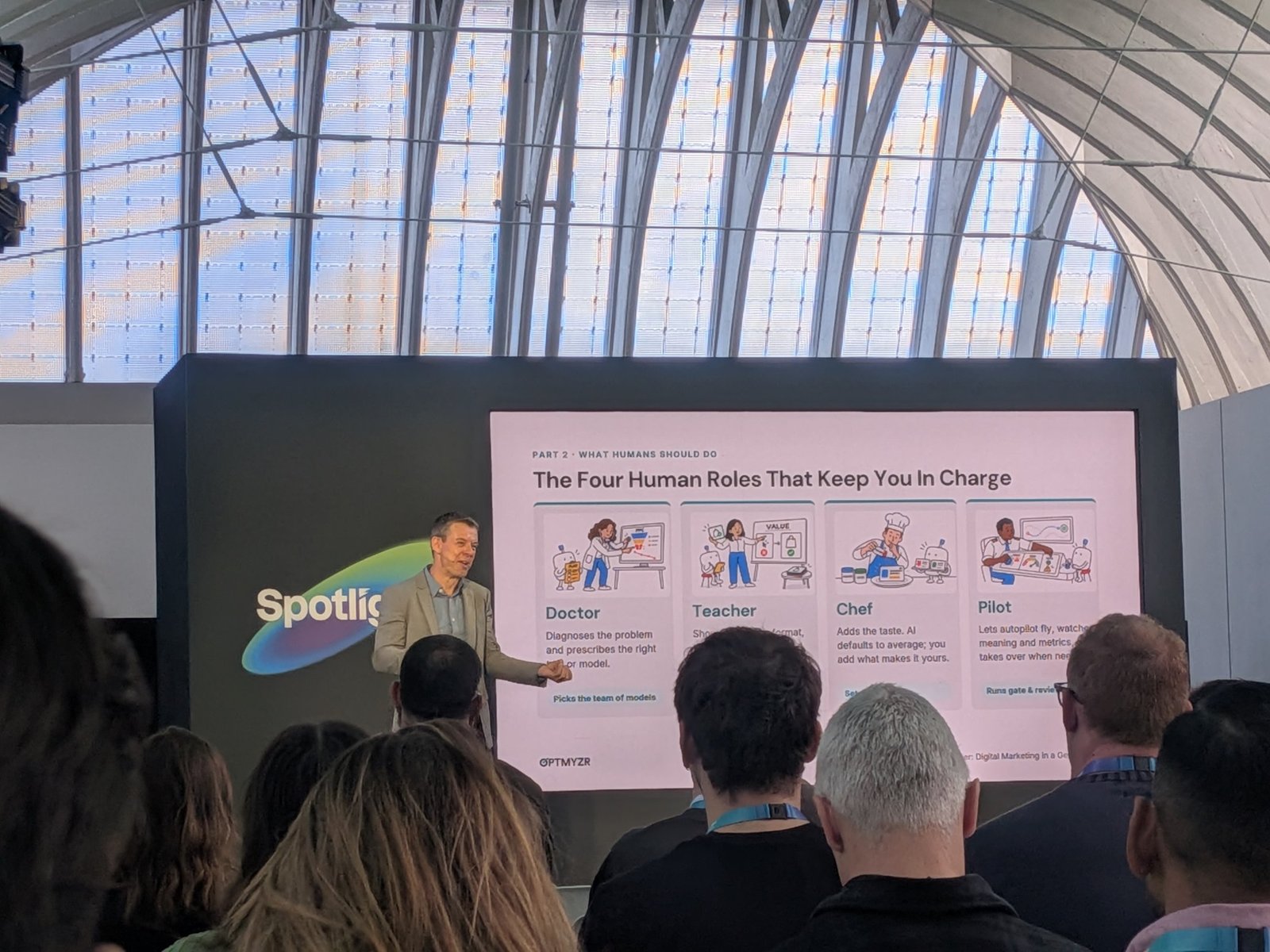
In his first book in 2018, Fred described three human roles in an AI world. He still thinks they hold, and his latest book adds a fourth:
- Doctor: diagnoses what the business or client needs, and prescribes the right tool or model. There are hundreds of AI options, and picking the right one makes a huge difference
- Teacher: teaches the machine what good looks like, and gives it the context to do a better job
- Chef: adds the taste. AI defaults to average unless you tell it exactly how you want things done
- Pilot: lets the autopilot fly, watches the meaning and the metrics, and takes over when something is wrong. Like seeing the freeway is empty when the car doesn’t
Part 3: Your First Step, Automation Layers
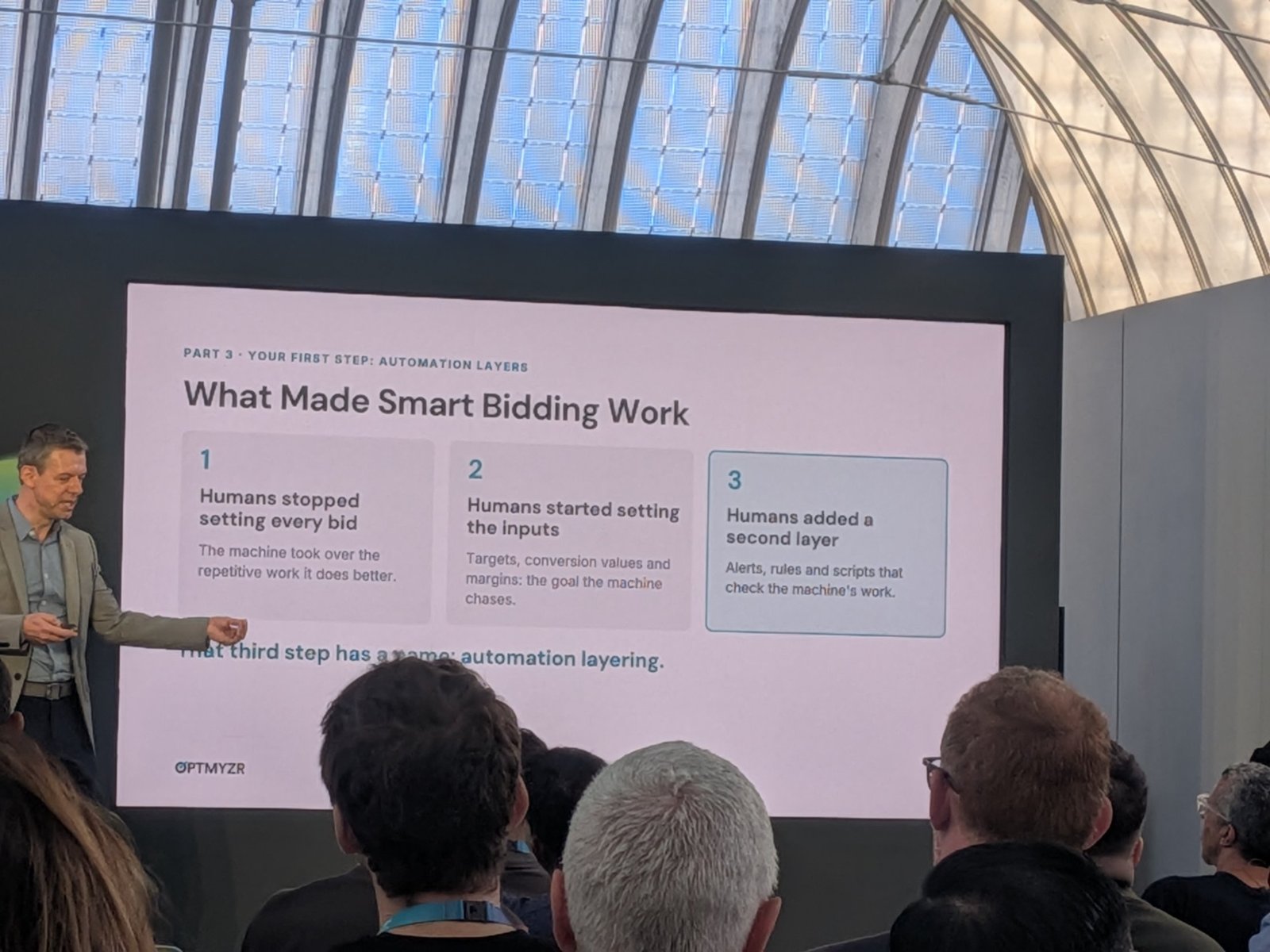
Fred pointed to Smart Bidding as the model that already works:
- Humans stopped setting every bid. The machine took over the repetitive work it does better
- Humans started setting the inputs: targets, conversion values and margins
- Humans added a second layer: alerts, rules and scripts that check the machine’s work
That third step has a name: automation layering.
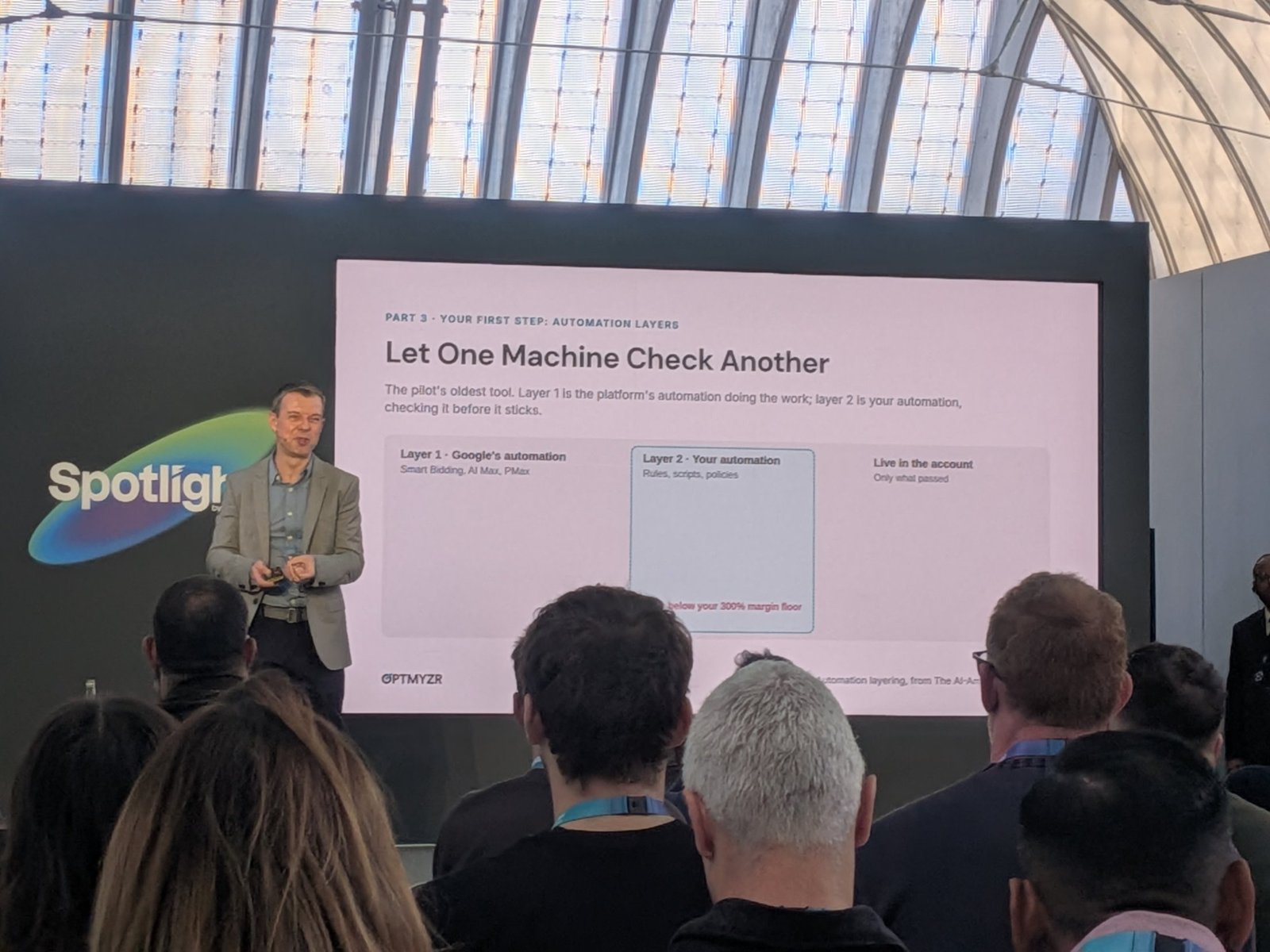
Layer 1 is the platform’s automation doing the work, like Smart Bidding, AI Max and PMax. Layer 2 is your own automation checking it before it sticks. Only what passes goes live in the account.
He asked who accepts every Google recommendation. Not many hands went up. A recommendation to raise budgets sends more money to Google, but it only makes sense for some campaigns.
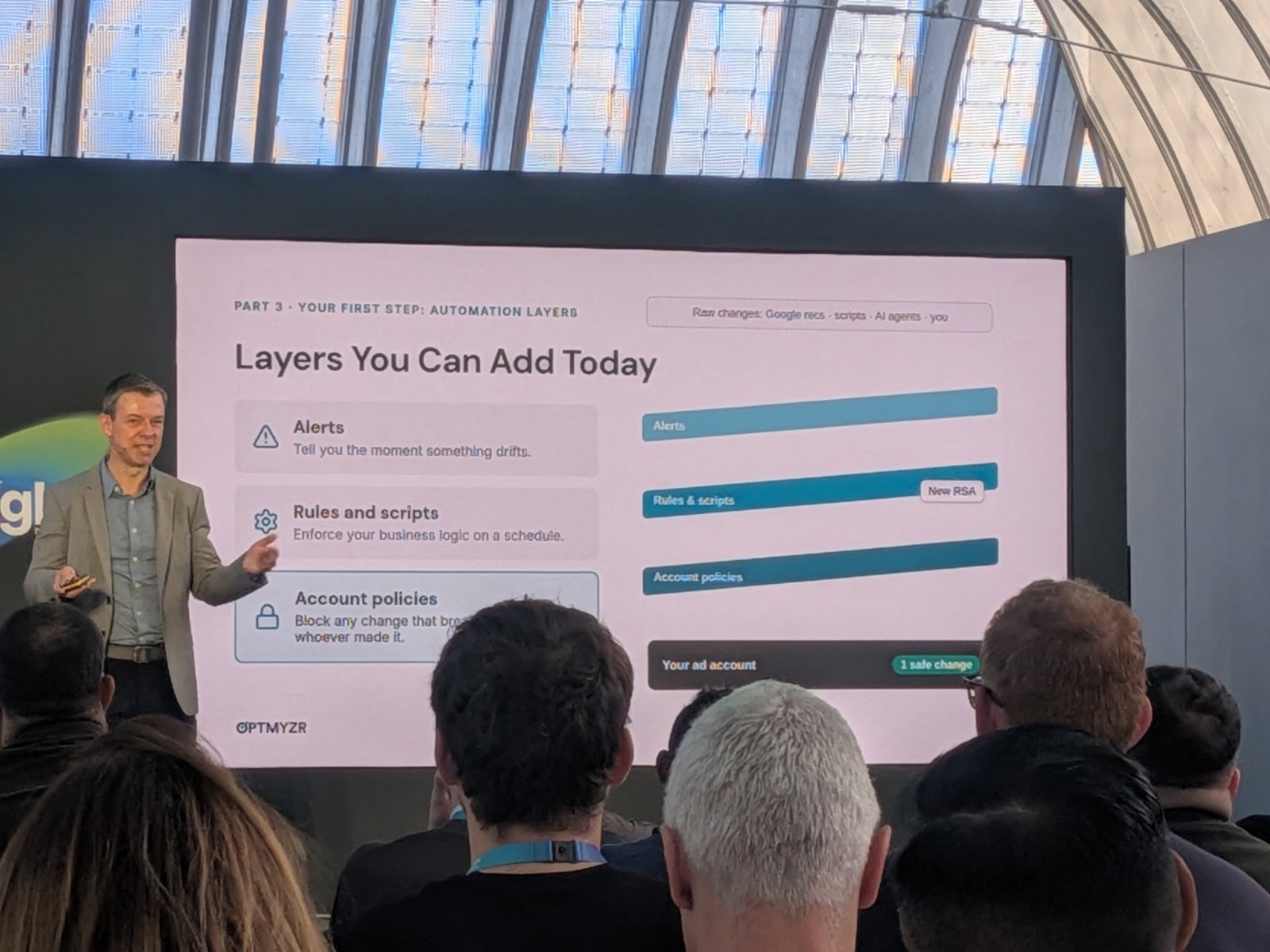
Three layers you can add today:
- Alerts: tell you the moment something drifts. But a notification is not a brake
- Rules and scripts: enforce your business logic on a schedule, and stop changes that look wrong until someone reviews them
- Account policies: block any change that breaks your policy, whoever made it. For example, never double a bid or a budget without a review
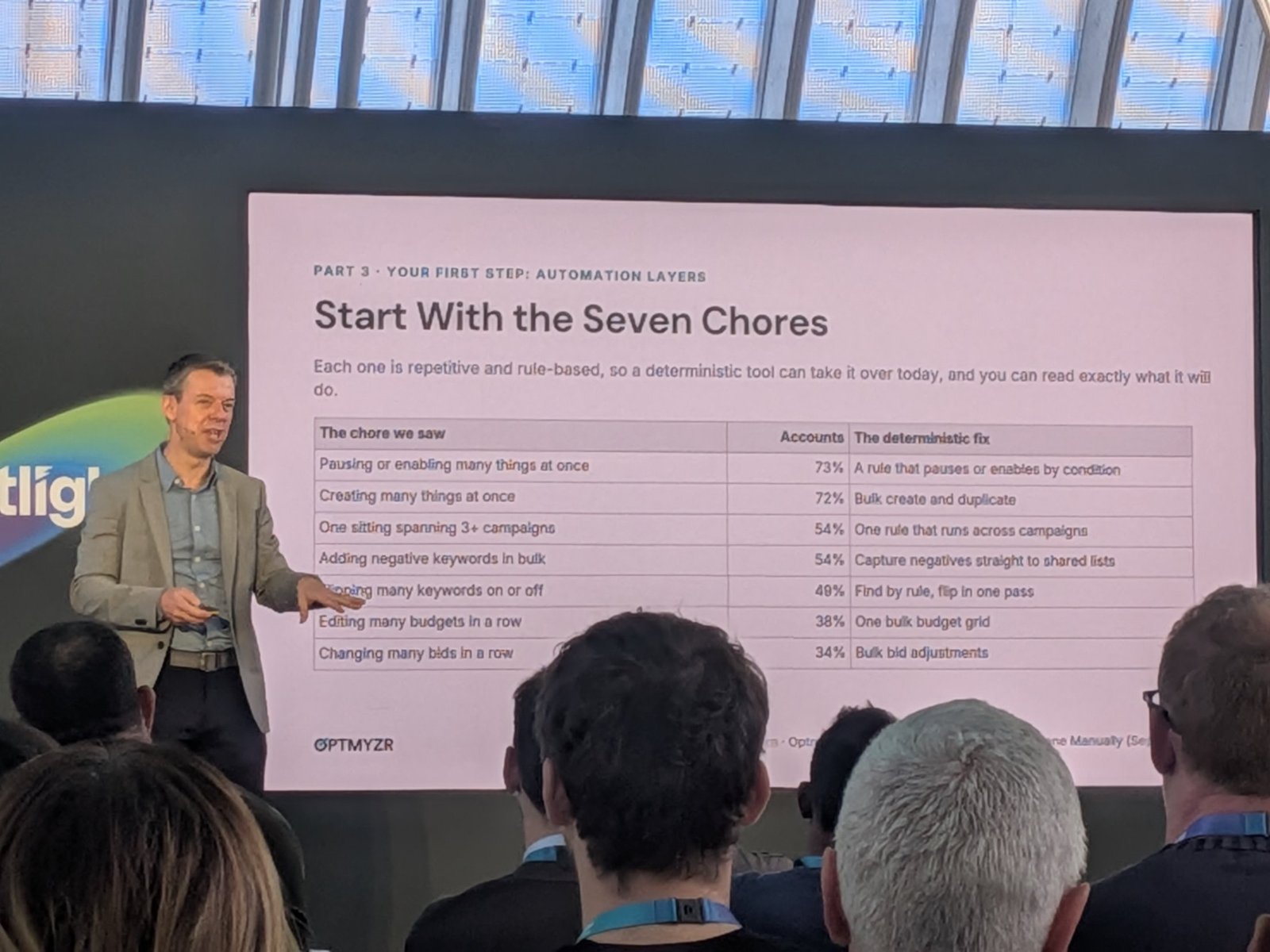
To start, Fred listed seven chores people keep doing by hand, with the share of accounts where Optmyzr saw them:
- Pausing or enabling many things at once (73%): a rule that pauses or enables by condition
- Creating many things at once (72%): bulk create and duplicate
- One sitting spanning 3+ campaigns (54%): one rule that runs across campaigns
- Adding negative keywords in bulk (54%): capture negatives straight to shared lists
- Flipping many keywords on or off (49%): find by rule, flip in one pass
- Editing many budgets in a row (38%): one bulk budget grid
- Changing many bids in a row (34%): bulk bid adjustments
Each one is repetitive and rule based. If there is no human judgement in it, and you are just following a formula, it is not a good use of your time.
Part 4: Making Sense of the AI Toolbox
Fred broke the toolbox into four parts:
- LLMs: Claude, ChatGPT, Gemini and others, each with different strengths
- Skills: how the model should do a task. Your team’s standard operating procedures, written down, become your skills
- MCP: the data connection that lets the AI use your real data
- Agents: always working on their own towards a goal
His formula is You × LLM × Skills × MCP. If you are not in the equation, the result is zero, no matter how good the tools are.
Goals need guardrails. An agent told to grow a business could decide the easiest way is to attack its competitors. It is the same idea as the famous paperclip thought experiment: the AI does the goal, but not what you meant.
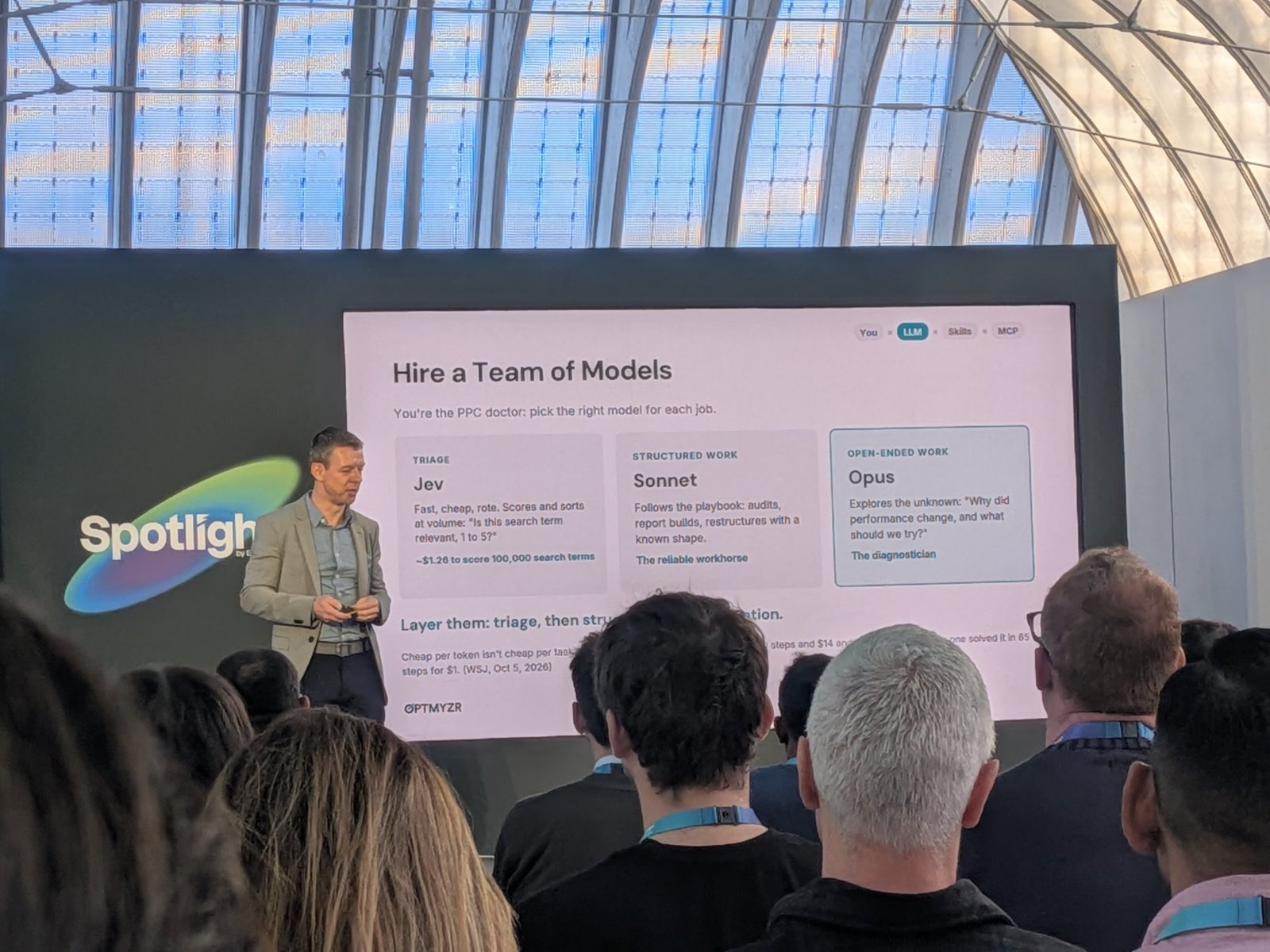
Hire a team of models. As the PPC doctor, pick the right model for each job:
- Triage: a fast, cheap model that scores and sorts at volume, like “Is this search term relevant, 1 to 5?”. About $1.26 to score 100,000 search terms
- Structured work: Sonnet follows the playbook for audits, report builds and restructures. The reliable workhorse
- Open-ended work: Opus explores the unknown, like “Why did performance change, and what should we try?”. The diagnostician
Layer them: triage first, then structured work, then exploration. And remember that cheap per token isn’t cheap per task. In one example on the slide (WSJ, 5 October 2026), a cheaper model ran up $14 and failed, while a more capable model solved the same task for $1.
MCPs change the answer. Ask a general AI why your CPA dropped and you get a generic list of possible reasons. Ask the same question with an MCP connected to your real ads data, and you get an answer about your own account, even with charts.
Part 5: Agents on the Org Chart
The newest step is always-on agents, like Dots, that run 24/7 on their own machine with thousands of skills. You could give one the job of finding new opportunities, building the content and running it.
Fred’s advice for staying in charge:
- Close the loop. Too many people use AI once and move on. Compare what the machine wrote with what a human actually published, and feed that back so it learns
- Set policies. Tell the agent the things it must never do, and make it stop if they happen
- Use change review. Just like developers review code before it goes live, marketing teams should review agent changes
- Keep your software as the control surface. Your tools are where you go to see what the agents did and why
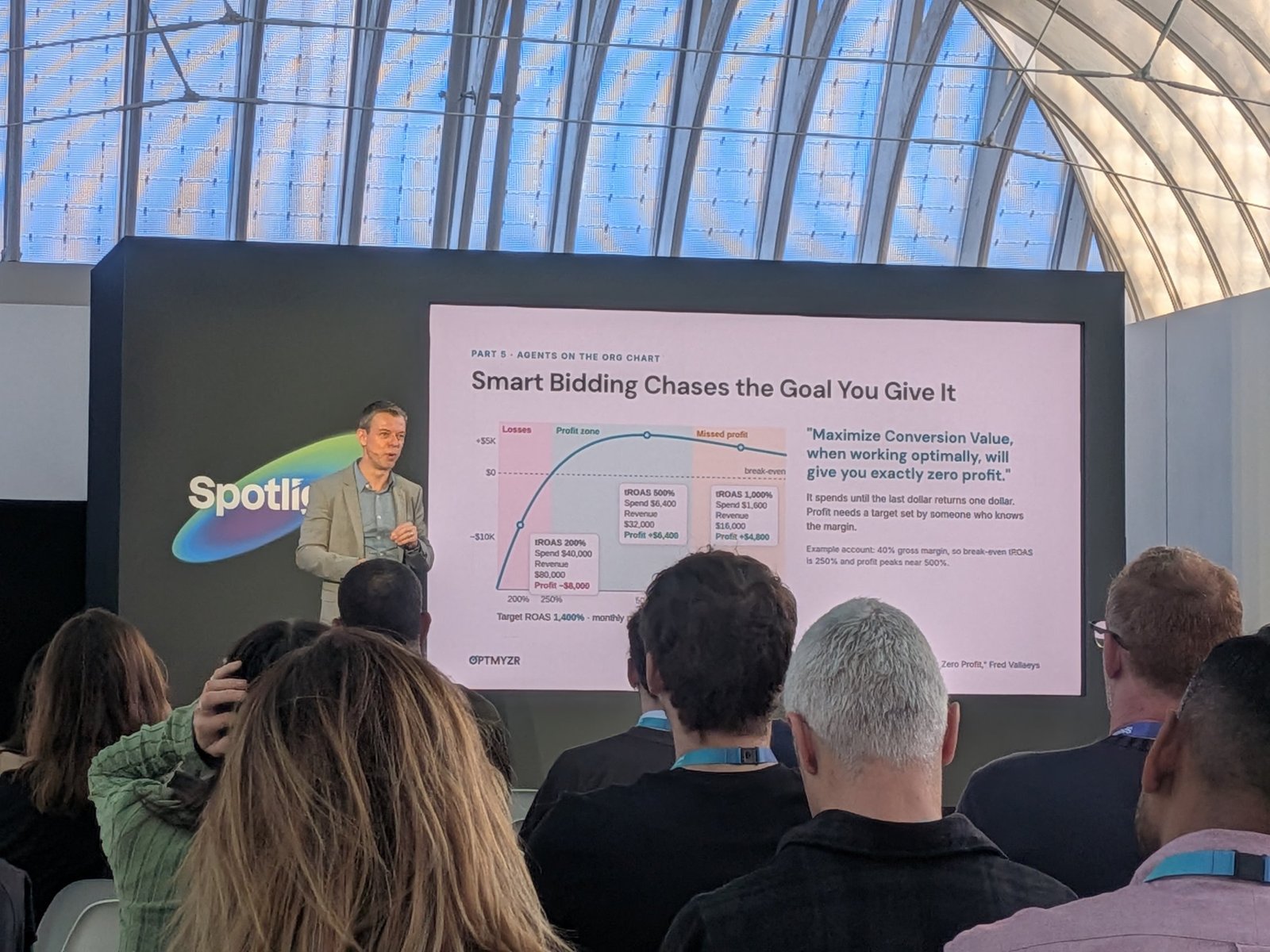
Give agents the right goal. Fred’s key line: “Maximize Conversion Value, when working optimally, will give you exactly zero profit.” It keeps spending until the last dollar returns one dollar.
His example account has a 40% gross margin, so break-even target ROAS is 250%:
- tROAS 200%: spend $40,000, revenue $80,000, profit minus $8,000
- tROAS 500%: spend $6,400, revenue $32,000, profit $6,400
- tROAS 1,000%: spend $1,600, revenue $16,000, profit $4,800
Profit peaks near 500%. A target ROAS is not a business goal, just a control. Someone who knows the margin has to set it.
What Not to Do
- Don’t accept every Google recommendation by default
- Don’t treat an alert as a brake
- Don’t spend time on chores that follow a formula
- Don’t use your most expensive model for simple sorting, or your cheapest for hard problems
- Don’t give an agent a goal without guardrails
- Don’t use Maximize Conversion Value without a target based on your margin
Next Steps
- Pick one of the seven chores you do by hand. Replace it with a rule or a bulk tool this week.
- Add one account policy. For example, no bid or budget can double without review.
- Write down one standard operating procedure. Turn it into a skill for your AI.
- Match models to tasks. Cheap for triage, mid range for playbooks, top tier for diagnosis.
- Connect your ads data through an MCP. Then ask your account specific questions.
- Calculate your break-even ROAS. Set targets for profit, not revenue.
Personal Takeaways
The Waymo story was brilliant.
Related Resources
- Optmyzr
- Spotlight 2026 agenda
- The Agentic Marketing Stack panel report: the Weglot and G2 panel earlier on the same stage, also on where humans still matter when AI runs the workflow
- Nikhil Lai’s session report: Forrester on why answer engines are the new upper funnel
Written by Ayaka Uchida
CEO, A-Digital Works
This report covers Fred Vallaeys’ session “The Agentic PPC Team: Where Humans Still Matter When AI Runs the Workflow” at Spotlight by Semrush 2026, 13 October 2026.
