

TL;DR
- There is no single AI search. Only about 1 in 5 top UK sites appear on all four AI models studied. About 2 in 5 appear on just one.
- Each model pulls from different sources. 30% of ChatGPT’s UK sources are news sites, against 20% for Gemini. PR is now AI visibility work.
- Being named is not the same as being cited. On ChatGPT, Asda ranks 24th for mentions but 606th as a cited source.
- AI answers differ by market. The same question can have a different leader and different sources in the UK and the US.
- The decision happens before the click. In one journey, a month of off-site research came first, and the brand only appeared 25 minutes before approval.
About the Session
- Event: Spotlight by Semrush 2026
- Date: 13 October 2026
- Venue: Old Billingsgate, London
- Stage: Signals Stage
This panel presented the UK edition of Semrush’s AI Visibility Index. The first edition, released earlier this year, was mostly a US story. This one takes a proper deep dive into the UK, with the US for comparison.
The study covers four models (ChatGPT, Gemini, Google AI Mode and AI Overviews), 22 categories and seven months from January to July 2026. It looks at millions of prompts, every brand each model named and every website it relied on to build its answers.
About the Speakers
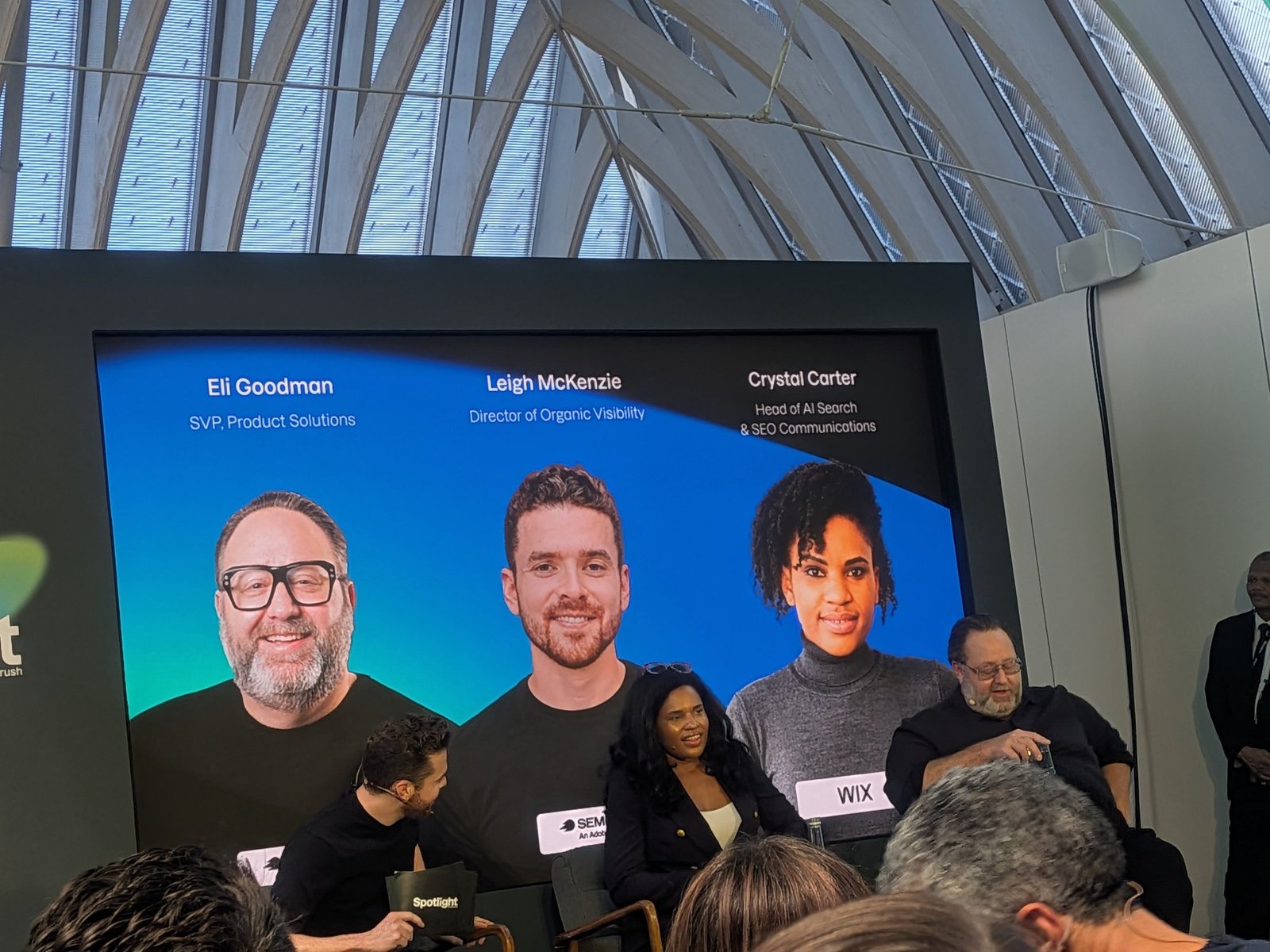
- Leigh McKenzie, Director of Organic Visibility at Semrush, moderated the panel.
- Eli Goodman, SVP of Product Solutions at Semrush. He comes from the clickstream data world, having founded a clickstream company himself.
- Crystal Carter, Head of AI Search and SEO Communications at Wix, with around 20 years of experience. Originally from California, she has lived in the UK for about 20 years, which gave her a view of both markets.
What Most Marketers Get Wrong
Leigh opened by asking what marketers get wrong about AI search.
Crystal’s answer: marketers still think they can solve everything by working on their own website. But LLMs see everything, everywhere. If you only work on your site, you miss most of the opportunity. Other channels matter too.
Eli’s answer: treating all LLMs the same. Each one has a distinct personality. What works on ChatGPT will not necessarily work on Gemini.
There Is No Single AI Search
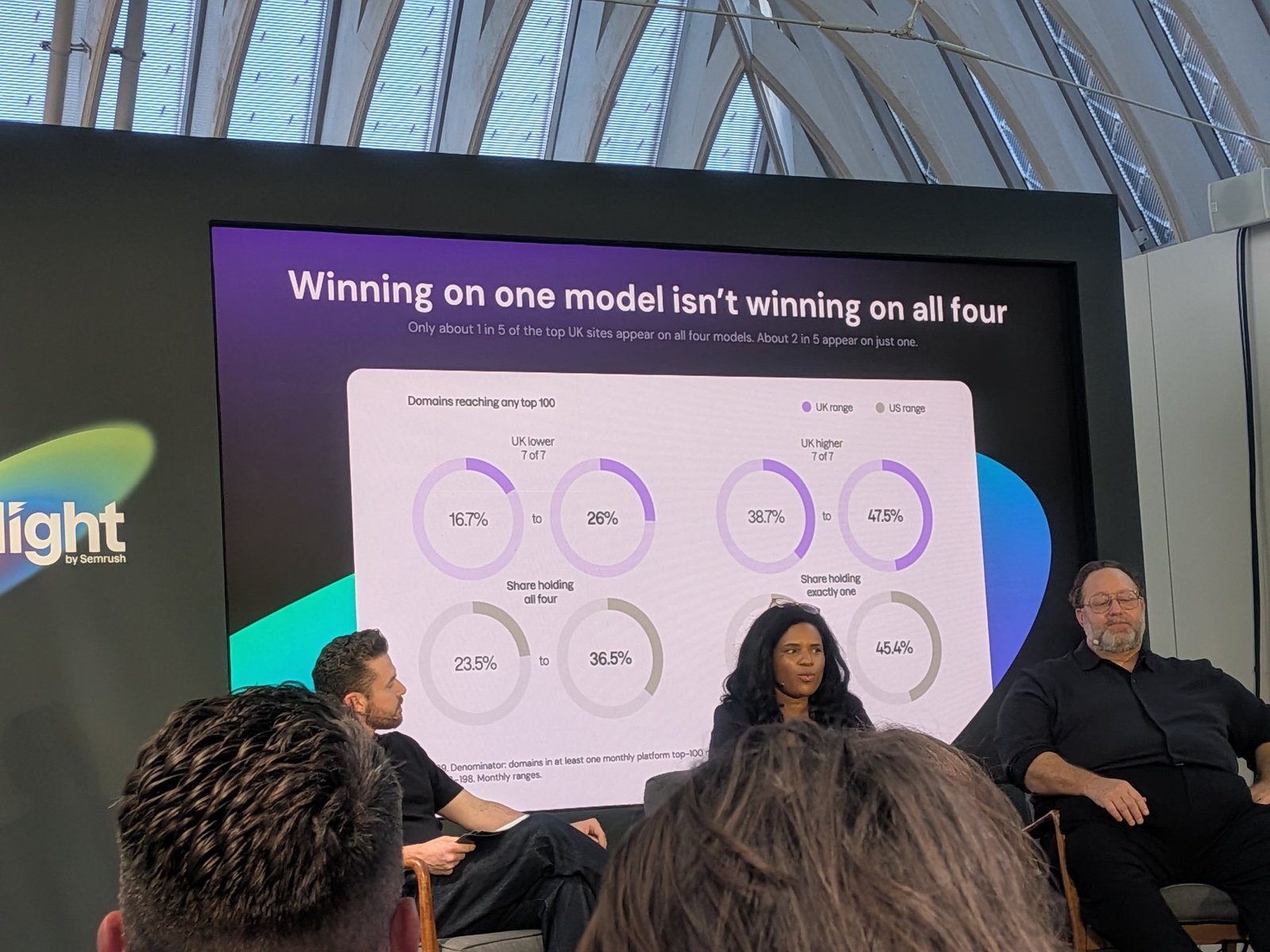
The four models disagree a lot. If a brand was in one model’s top 100, there was only about a one in five chance it was in all four.
Looking at domains that reached any top 100, by month:
- Share holding all four models: UK 16.7% to 26%, US 23.5% to 36.5%. The UK was lower in all seven months
- Share holding exactly one model: UK 38.7% to 47.5%. The UK was higher than the US in all seven months
In other words, the UK is significantly more fragmented than the US. Winning on one model is not winning on all four.
Which Models Should You Track?
Crystal’s advice was to start from your audience, not from the tools.
- She knows many developers who love Grok, while she never uses it herself. Grok’s audience skews heavily male
- ChatGPT’s audience is fairly evenly split by gender. Most of the others lean male
- If your audience leans female, that is worth taking into account when deciding where to look
Google’s AI features are always worth tracking. Google still gets a huge amount of search, and many people move between AI Overviews and AI Mode without even noticing.
Leigh added that future editions will cover more models, including Grok. The models will keep changing, so the aim is to focus on what stays consistent and allocate resources around that.
Each Model Pulls From Different Sources
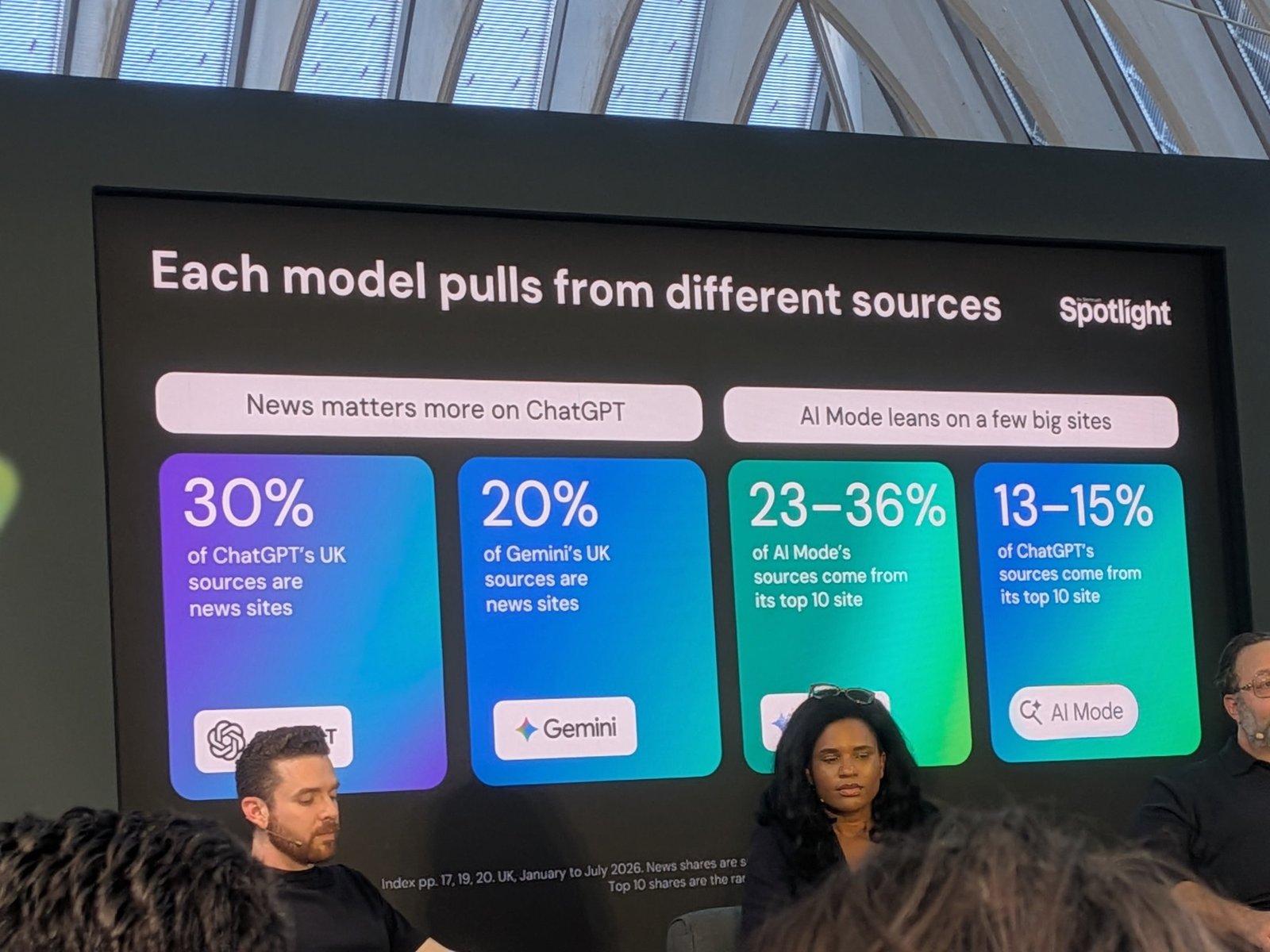
- News matters more on ChatGPT: 30% of ChatGPT’s UK sources are news sites, against 20% for Gemini
- AI Mode leans on a few big sites: 23% to 36% of AI Mode’s sources come from its top 10 sites, against 13% to 15% for ChatGPT
The takeaway from the first point: PR is doing real AI visibility work. As Marcus Tober had shown in the session just before, third-party validation is critical. From the second: you need to know which sites carry the most weight in your category, in the region you focus on.
Eli found it fascinating how quickly LLMs have learned to mimic human behaviour in each country, while stopping short of saying they reason like humans. As an American, he admitted that news and opinion have merged in the US over the past ten years. In the UK, news is treated very differently, and the US has no real equivalent of BBC News. So it is not surprising that ChatGPT’s citations in the UK take on some of the personality of UK users.
The same goes for AI Mode’s focus on a few domains. Most people only use a handful of apps on their phone. People concentrate on a few sources of information too, and the models reflect that.
Crystal added that the BBC covers far more than news. It does GCSE revision content, very niche coverage of tiny towns in Wales and a huge amount of other information, yet it would likely be seen as a news source. Leigh pointed out that the New York Times works the same way, with cooking, Wirecutter and Wordle alongside its news. Publishers’ business models are changing to reflect how people want to use them.
Tesco and Asda: Mentioned vs Cited
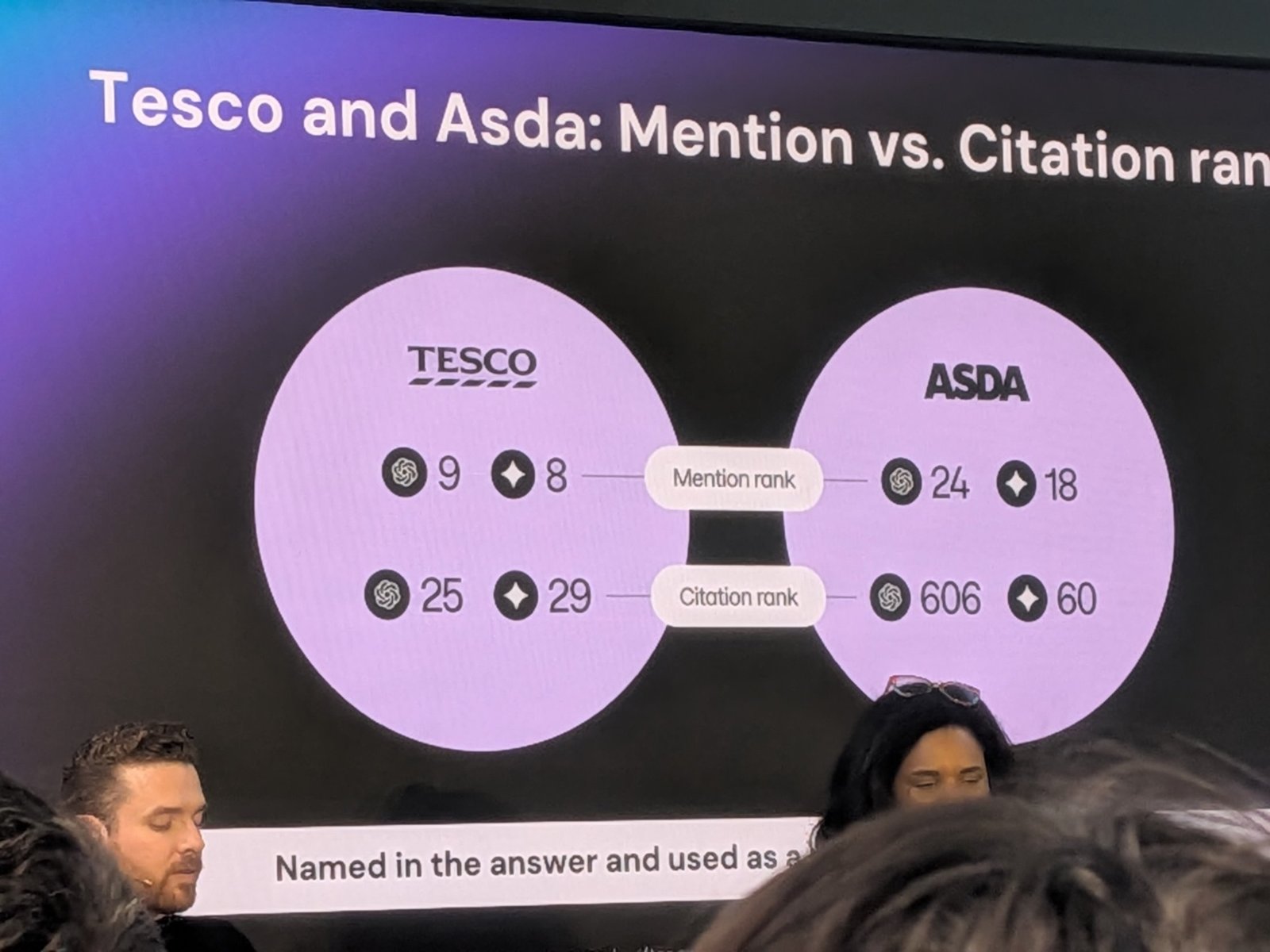
The report also looked at two of the UK’s biggest supermarket chains:
- Tesco: mention rank 9 on ChatGPT and 8 on Gemini. Citation rank 25 on ChatGPT and 29 on Gemini
- Asda: mention rank 24 on ChatGPT and 18 on Gemini. Citation rank 606 on ChatGPT and 60 on Gemini
Both brands are named fairly often. But as a source, Asda’s own site falls all the way to 606th on ChatGPT. On Gemini, the gap is much smaller.
Leigh asked Crystal how she would advise a brand in Asda’s position. She said to use the data as a starting point, then filter it. She asked the room who shopped at Asda and who shopped at Tesco. Her in-laws in Sheffield would shop at Asda all day and don’t even like the layout of Tesco.
Tesco simply has more coverage. There is the Clubcard, Tesco Metro, Tesco petrol stations, Tesco Bank and more. Asda does not have that kind of footprint. So if she were Asda, she would work out which areas actually compete with Tesco in her business model, and which are not on the radar yet. Don’t compare apples with oranges. Focus on the prompts that are relevant to your brand, rather than treating the data as one big lump.
AI Answers Differ by Market
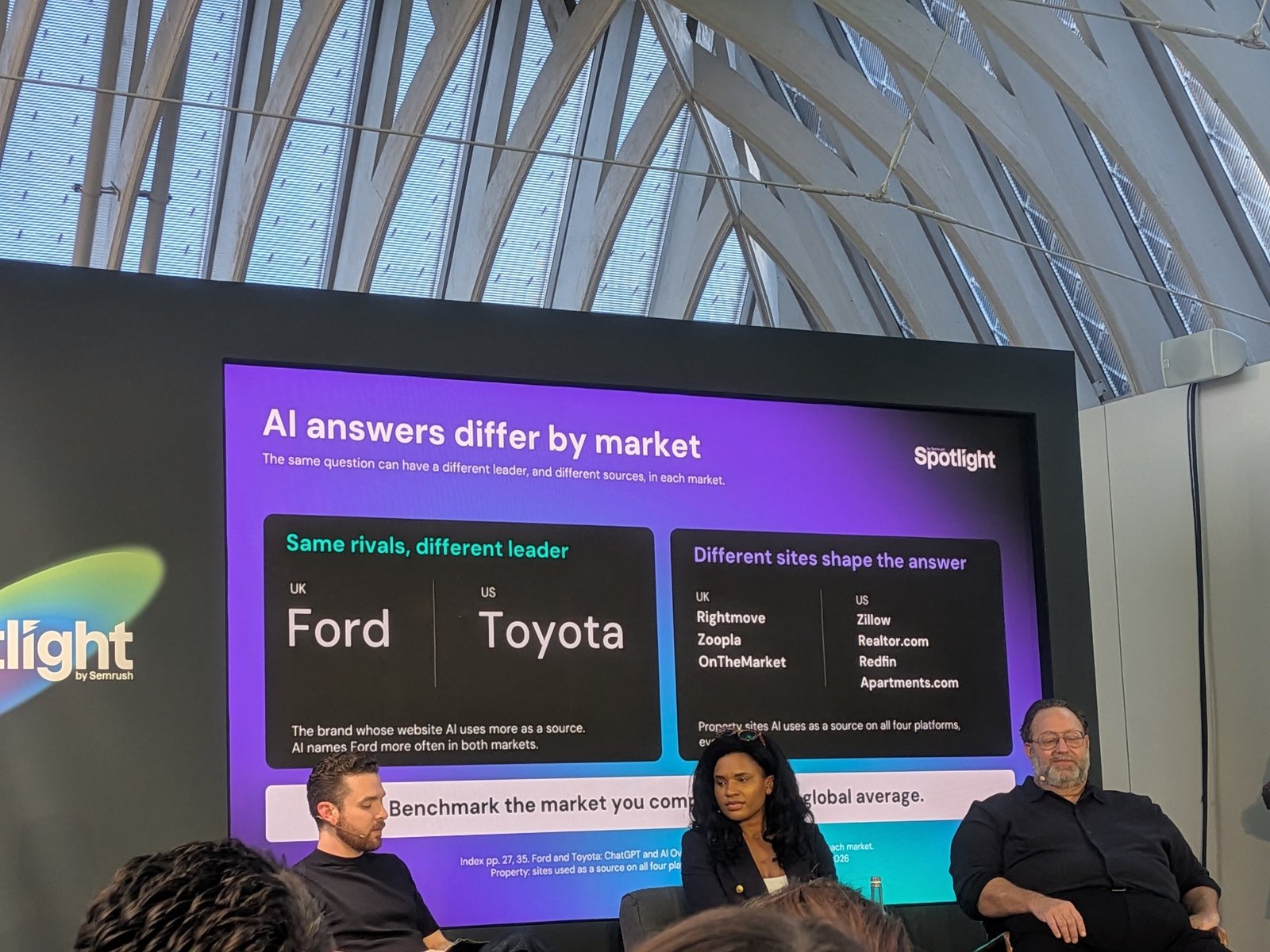
- Same rivals, different leader: the brand whose website AI uses more as a source is Ford in the UK and Toyota in the US, even though AI names Ford more often in both markets
- Different sites shape the answer: for property, AI relies on Rightmove, Zoopla and OnTheMarket in the UK, and on Zillow, Realtor.com, Redfin and Apartments.com in the US
Leigh, as someone from the US, didn’t recognise the UK property brands at all. But it makes sense that AI relies on the sites specific to each market. The lesson on the slide: benchmark the market you compete in, not the global average.
There were also differences by category. Lloyds Bank was not among the top cited sources for any of the finance prompts studied. It was often mentioned, but not cited. To validate its claims against competitors, the models turned to third-party finance sites. So for a big brand, the competition for citations may not be other big brands at all. It may be the sites that influence the answer.
The Decision Happens Before the Click
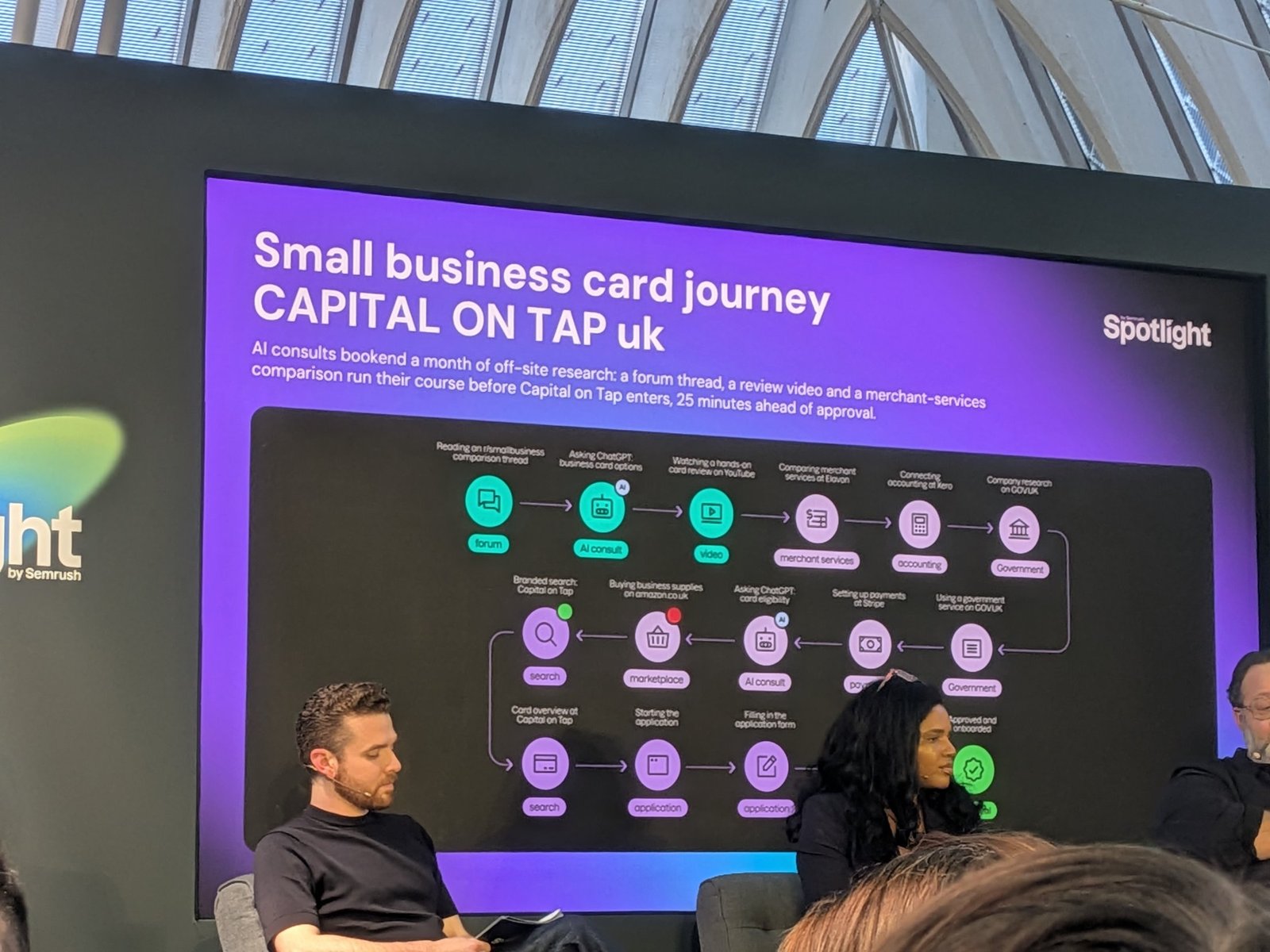
Eli walked through a journey built from clickstream patterns around Capital on Tap, a UK business credit card company. It is an amalgamation of journeys, not a single person.
- It starts with a comparison thread on r/smallbusiness, then a question to ChatGPT about business card options
- Then a hands-on card review on YouTube, comparing merchant services at Elavon, connecting accounting at Xero and company research on GOV.UK
- Then a GOV.UK service, setting up payments at Stripe, another ChatGPT question about card eligibility and buying business supplies on Amazon
- Only then a branded search for Capital on Tap, the card overview page, the application and approval
AI consults bookend a month of off-site research. Capital on Tap only enters 25 minutes before approval.
Eli described it as an echo chamber. Over many days, the person went back and forth between LLMs, YouTube, Reddit and other sites, having in-depth conversations. That is where the decision was made. Then, in 25 minutes, they went from the LLM to the application and sat there waiting to be approved. None of the earlier days of analysis touched Capital on Tap’s site.
He compared it with buying a TV in November 2024, just after ChatGPT took off. Back then, in the last seven days before purchase, days seven to four were all Google and Reddit. ChatGPT only appeared in the last three days, for very specific questions. Two years later, AI runs through the whole journey.
He also noted that people spend far longer per session in AI tools than in Google: almost 10 minutes on ChatGPT and almost 11 on Claude, according to his data. That is a lot of time inside the decision. People who arrive from AI are more educated and further down the funnel, because they have already made some of their decisions.
How to Explain This to Your Boss
Leigh asked how marketers planning for next year should take insights like these to their leadership.
Crystal said this is a great example of why channels need to get out of their silos. Social media teams don’t need to run SEO, but they do need to understand what AI reads. Customers move across all these touchpoints, and AI reads everything about you, so it all needs to support the same story. Coordination is the tricky part. SEOs are used to fixing things on their own site. Now they have to bring PR and other teams on board, and the way to do it is to show how each team’s work affects AI visibility.
She added that when you work on being visible to LLMs, you are also reaching customers in all the same places. There is no way to lose by investing where your customers are. It is messy and it needs budget, but it is worthwhile.
Leigh’s advice was to benchmark against your competitors. Everyone is moving in this landscape, so what matters is where you stand relative to them. Your competitors in AI may also be different from your competitors in classic search. He has seen sites nobody had heard of cited above well-known brands, including someone’s own “best of” listicle with themselves at the top.
Eli’s advice: focus. You can’t use every strategy on every LLM. Start with diagnosis and measure the gap. Pick one thing, master it and build a playbook from there. Ownership needs to sit with someone senior, because this is not just the SEO team. It involves PR, marketing, partnerships and content. In the end, AI visibility is a popularity contest.
Start by Fixing What Is Wrong
Crystal’s practical starting point: find inaccurate and outdated information about your brand across the web.
Wix has been around for a long time and has launched, changed and pivoted many products. Old information hangs around, and LLMs repeat it. Her suggestion is to look at what AI says about you that is wrong, find where it comes from, and update or remove it. LLMs want to quote experts, and the best expert on your brand is your own site.
When Wix fixed pages like this, they saw their citation mix change and their positioning in AI answers improve. A win like that also helps bring everyone else on board.
Leigh closed with the main message: there is no single view of AI search. What AI says about you changes by model, by market and by category.
What Not to Do
- Don’t treat all AI models as one channel
- Don’t measure yourself against a global average when you compete in one market
- Don’t assume being mentioned means your site is being used as a source
- Don’t compare yourself with a competitor whose business model is different
- Don’t leave AI visibility to the SEO team alone
- Don’t leave outdated information about your brand online
Next Steps
- Pick models based on your audience. Always include Google’s AI features.
- Check both mention rank and citation rank. Find out whether AI names you, cites you, or both.
- Find the top sites in your category and region. These are the sources the answers are built from.
- Bring PR into AI visibility work. News and third-party sites carry real weight, especially on ChatGPT in the UK.
- Audit what AI says about you. Fix or remove inaccurate and outdated pages.
- Give ownership to someone senior. AI visibility needs PR, content, marketing and partnerships together.
Personal Takeaways
The Tesco and Asda data was really interesting.
Related Resources
- Spotlight 2026 agenda
- Marcus Tober’s session report: Semrush data on mentions, citations and why B2B and B2C differ
- Nikhil Lai’s session report: Forrester on why off-site authority drives AI visibility
- The Agentic Marketing Stack panel report: Weglot and G2 on why AI citations differ by country and language
Written by Ayaka Uchida
CEO, A-Digital Works
This report covers the panel “From AI Visibility to Business Action” with Eli Goodman, Leigh McKenzie and Crystal Carter at Spotlight by Semrush 2026, 13 October 2026.
