

TL;DR
- Your tooling is a record of your scars. Every mistake you make while building with Claude Code should turn into something permanent: a memory, a skill, or, most importantly, a hook.
- If something has to be true, make it a hook. Noah’s view is that rules have become far less reliable with the newest Claude models. Hooks give you deterministic control.
- Domain expertise and constraints matter more than coding knowledge. SEOs already know their problem domains. What they need to learn are the limits they’re building within: API quotas, runtimes, cost, storage, and speed.
- Build painkillers, not vitamins. A tool should be tied to revenue, easy to use, part of existing workflows, cheap to own, and fast.
- Stay in the first 20% of your context window. Use a handoff to summarize the conversation, clear the context, and start fresh.
About the Speaker
Noah Learner is Director of Innovation at Sterling Sky and the founder of The SEO Community, which runs the Boardwalk Bash networking party at brightonSEO San Diego. The day before the conference, he taught a full-day training course on Claude Code for digital marketers.
He started using Claude Code about a year and a half ago with no computer science background, and has since built a SaaS product.
The Framing: We Never Forget Our Scars
Noah opened with a story from his childhood in Israel: a summer accident that left him badly injured, a 45-minute drive to a hospital in Jerusalem, and an operation on his leg that he watched reflected in the surgeon’s glasses. We never forget our scars.
His point was that the tooling you build around Claude Code on your own computer ends up as a compendium of everything that went wrong along the way. Those lessons get stored in three places:
- Memories. Claude Code has automatic memory, and you can also write memories manually.
- Rules. These used to be central to working with Claude Code. With the newest model family, Noah said, they have become close to useless, and if you rely on them they will drive you crazy.
- Hooks. His rule of thumb: if something has to be true when you’re building, it has to be a hook.
He closed the talk the same way: hooks, hooks, and more hooks. Deterministic controls over AI.
The Problem: SEOs Don’t Know What They Can Build
Noah spoke directly to agency SEOs who want to move in-house, or who want to build. When he started with Claude Code as a solo developer, he realized he could teach himself agile methods and eventually build in a way that works with a team.
The foundation is something SEOs already have: domain expertise. We know our work, we have processes and SOPs, and we know how to drive impact. That’s what you build on.
But he urged realism about scale. Without a computer science background, don’t try to build a full, powerful application. Focus on the user experience, because a tool your team finds hard to use will sit on a shelf.
The Solution: Learn Your Constraints, Not Just Code
You don’t need to become a coder, but you do need to understand constraints: the edges of the world your tool operates in.
His example was Google Search Console, the data source most SEOs trust most. Its API limits how fast you can query, how many rows you can pull per day, and how many rows come back per page. Other platforms have their own limits: Google Apps Script has a six-minute runtime, and Google Cloud Functions went from nine minutes in the older version to 60 minutes in the newer one.
Beyond runtime and quotas, think about:
- Cost. What does each operation cost?
- Storage. Where will the data live?
- Speed. How fast does it need to be for people to enjoy using it?
Use Claude Code for Research
Noah uses Claude Code as a primary research tool, sending subagents down several paths at once to map an entire problem domain. When he wanted users to drill down quickly through a huge dataset, he chose DuckDB, and it took two days of research with Claude Code to get it working. When Claude says something you don’t understand, his advice is simple: ask Claude, until you know enough to make the decision.
Build Painkillers, Not Vitamins
Most SEOs love data and insights, but more information often just creates confusion. Noah’s rules for any tool:
- Tied to revenue
- Easy to use
- Part of your workflows
- Cheap to own
- Fast
Case Study: SEOLoop, and Tying Search Console Data to Revenue
Noah previously built a tool for going deep into Search Console data. It worked, but onboarding took an hour and needed a customer service person to walk users through it. For his new product, SEOLoop, he set out to fix onboarding and to connect search data to money.
His method works backwards from business value. Take the traffic going to a page for a query, multiply it by the conversion rate, the lead-to-close rate, and the value of a job, and search data suddenly has revenue attached. He then breaks the search journey into stages across columns and personas down the rows, with colors showing where the money is. That tells you which topics are worth building.
All of this, he stressed, came from deep domain knowledge of Search Console: the quirks of the API, and how to build an idempotent data pipeline, one that returns exactly the same data if you ask the same question again tomorrow. That’s harder than it sounds.
The business driver was churn. At Sterling Sky, each year has one big problem to solve, and this year it was churn. So he built tools that help agencies prove their worth: fast reports, proposals, and content briefs.
How He Builds: Tests, Subagents, and Hooks
Test Every Function
His advice for builders who don’t know what they’re doing: create a test for every function. Not full unit or integration tests, but what he called shape tests. Run the function and check whether you get data back. If you do, you’re good.
Invest in Yourself
Noah pays for his own Claude Max plans rather than waiting for a company to fund it. Having skin in the game, he said, is what let him go from limited experience to shipping a SaaS product in about a year. Heavy use of subagents and dynamic workflows consumes a lot of tokens, and a Max plan makes that possible.
The Most Expensive Scar
His biggest scar was a single, very expensive database query. Two lessons came out of it:
- Ask for your money back. He used Claude Code to research Google support forums for precedents where Google refunded people for the same mistake, and it worked.
- Create a hook immediately. He built a database query guard that works across 15 database technologies, including BigQuery and Supabase.
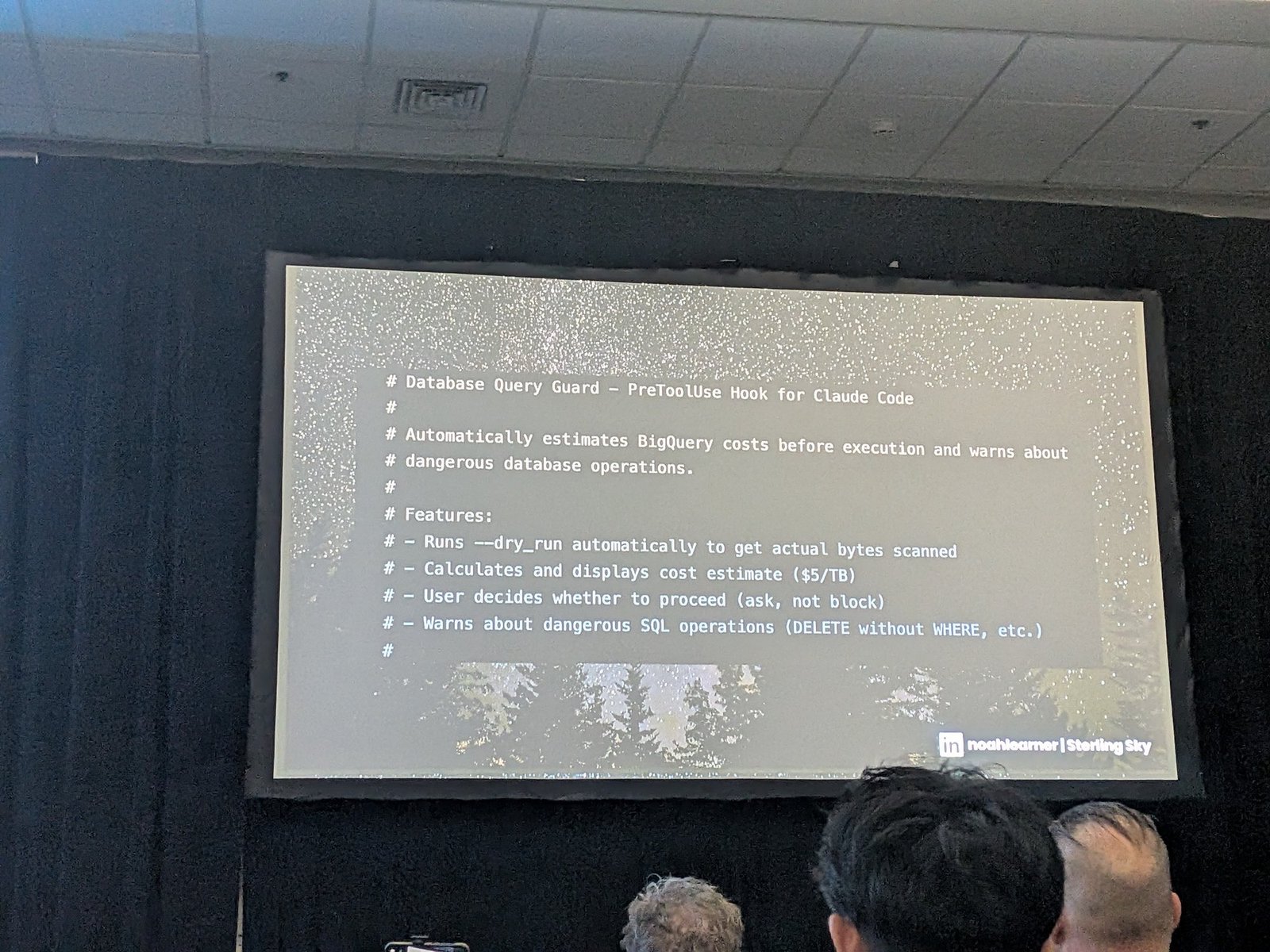
The hook runs before the agent executes anything. Its stated behaviour:
- Runs
--dry_runautomatically to get the actual bytes a query will scan - Calculates and displays a cost estimate at $5 per terabyte
- Asks, rather than blocks. The user decides whether to proceed
- Warns about dangerous SQL operations, such as a
DELETEwith noWHEREclause
The ask-don’t-block choice is worth noting. A hook that blocks gets disabled the first time it is wrong. A hook that shows you the number and waits survives.
Stay in the First 20% of Your Context Window
Even with a million-token context window, Noah only works in roughly the first 150,000 to 200,000 tokens. When a conversation gets long, he runs a handoff skill that summarizes the whole session in about 60 lines and copies it to the clipboard. Then he clears the context, pastes the handoff into a new conversation, and carries on. A status line shows how much of the context window is in use.
Keep Memory Short
Claude Code’s memory holds only about 200 lines, so structure matters: the most important information at the top, historical detail at the bottom.
Let Claude Review Your Habits
Noah recommended the /insights command, which analyzes how you’ve been working over a period of time, tells you what you’re doing right and wrong, and even recommends new hooks and skills based on your own workflows.
Applying these changes helped him cut a lot of bugs and shrink his average commit from roughly 1,800 lines to 500, which made review cycles far more efficient.
Two More Ideas
- UX passes with Playwright. Claude Code can browse your app with Playwright and improve the user experience over multiple passes.
- Self-updating documentation. A hook can check what you just edited or committed and update the relevant documentation automatically.
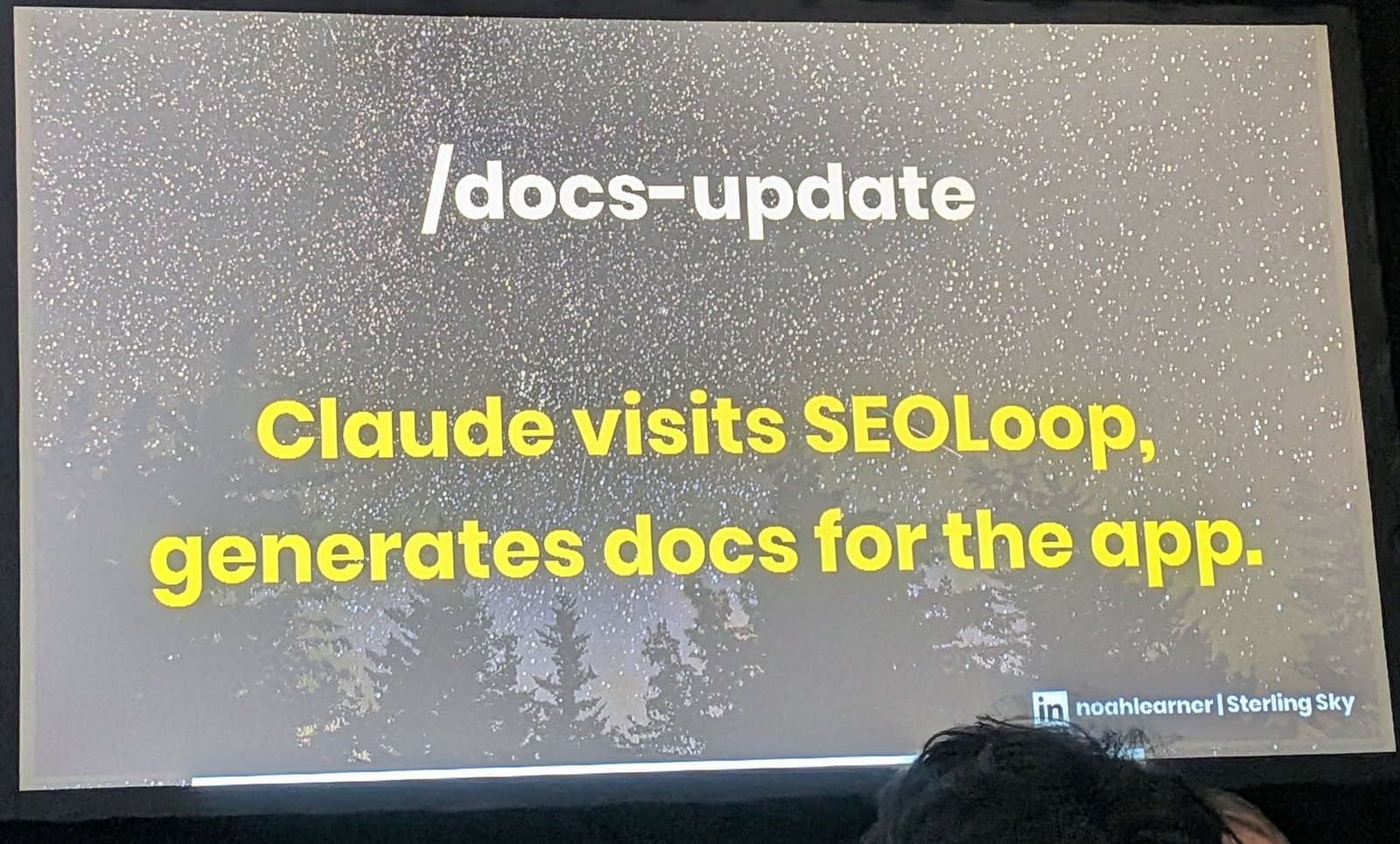
His /docs-update command has Claude visit the running app and generate the documentation from it. He said it built out the entire set of docs for the whole application, which he described as ridiculous in the best sense. For anyone who has watched documentation rot the week after launch, this is the more interesting of the two ideas.
He shared a GitHub repository with his setup. It was built in April and still contains many rules, which he is converting to hooks.
Career: Live at the Intersections
Noah also spoke about careers, since everyone in the room is uncertain about where they fit. His advice is to live at as many intersections as possible: soft skills like connecting people and motivating them to act, and hard skills like working with data and AI.
You don’t have to master AI, but you need to know what it can and can’t do. That sets the floor, and your work has to be better than that floor. The more intersections you occupy, the more valuable you become.
The Blueprint
- Start from a problem you know deeply, ideally one tied to revenue or a business problem like churn.
- Research the constraints first. Use Claude Code with subagents to map API limits, runtimes, cost, storage, and speed.
- Design for ease of use before power.
- Add a shape test for every function.
- Turn every mistake into a hook, especially anything involving cost or data.
- Keep memory short and ordered by importance.
- Hand off before the context gets long. Summarize, clear, paste, continue.
- Run
/insightsregularly and act on its suggestions. - Automate the boring parts, like documentation updates.
What Not to Do
- Don’t rely on rules for anything that must be true. Use hooks.
- Don’t build something powerful that nobody can use.
- Don’t build vitamins. If it isn’t tied to revenue and workflows, it won’t last.
- Don’t run expensive queries without a guard.
- Don’t work deep into a huge context window.
- Don’t let memory grow into a dumping ground.
- Don’t accept an answer you don’t understand. Ask Claude until you do.
Next Steps
- Write down your last three Claude Code mistakes and decide which should become hooks.
- Add a cost guard before any AI agent can query a paid database or API.
- Create a handoff skill or template for moving between conversations.
- Review your memory file and move the most important lines to the top.
- Run
/insightsand try one recommended hook or skill this week.
Personal Takeaways
This was the most hands-on Claude Code talk of the afternoon, and Noah’s “scars” framing made it memorable.
What I’m taking away:
- The handoff workflow is something I already rely on. I write handoff notes when I move a long piece of work into a new chat, including for this series of conference reports. Hearing Noah recommend it as a core habit, with a skill to automate it, confirmed it’s worth formalizing.
- “If it has to be true, it’s a hook” is the clearest rule I heard all day. It changes how I think about instructions that keep getting ignored.
- It pairs with Ray Grieselhuber’s talk in the same session. Ray argued that tests are the most important thing you build, and that every bug should become a regression test. Noah’s version for non-engineers is lighter, shape tests for every function, but it comes from the same principle: make lessons permanent.
- The cost guard is the idea I’d adopt first. Anyone connecting AI agents to paid databases or APIs should have this before anything else, and the ask-don’t-block design is the part that makes it stick.
- Tying Search Console data to revenue is a strong way to fight churn. Traffic multiplied by conversion rate, close rate, and job value is a simple formula clients understand.
Related Resources
- Session: Experimental AI & Vibecoding (brightonSEO San Diego 2026)
- Ray Grieselhuber session report: the engineering view of testing and deployment from the same session
- John Caiozzo session report: building automated audits with Claude Code
- Christian Desert session report: the last talk of the previous session
Written by Ayaka Uchida
CEO, A-Digital Works
This report covers Noah Learner’s session on Claude Code for SEOs at brightonSEO San Diego (16 September 2026).
