

TL;DR
- GEO is an organizational problem. SEO earns rankings. GEO earns inclusion in AI answers, and no single team controls all the signals that decide inclusion. The constraint is coordination.
- Two inputs, one multiplier. SEO visibility and brand reputation both feed AI models. Neither pays off alone, and AI mentions are where they compound into revenue.
- Build a bridge between performance and brand marketing. Share a scorecard, run a joint operating rhythm, and avoid forcing one team to adopt the other’s dashboard.
- Give GEO an owner. One director-level leader over organic growth and reputation, reporting to the CMO, with SEO, affiliate, reputation, and PR under one roof.
- Build the bridge before the program. In the first 30 days: name an executive owner, choose 20 to 50 priority buyer questions, map signal owners, create one scorecard, and diagnose gaps together.
About the Speaker
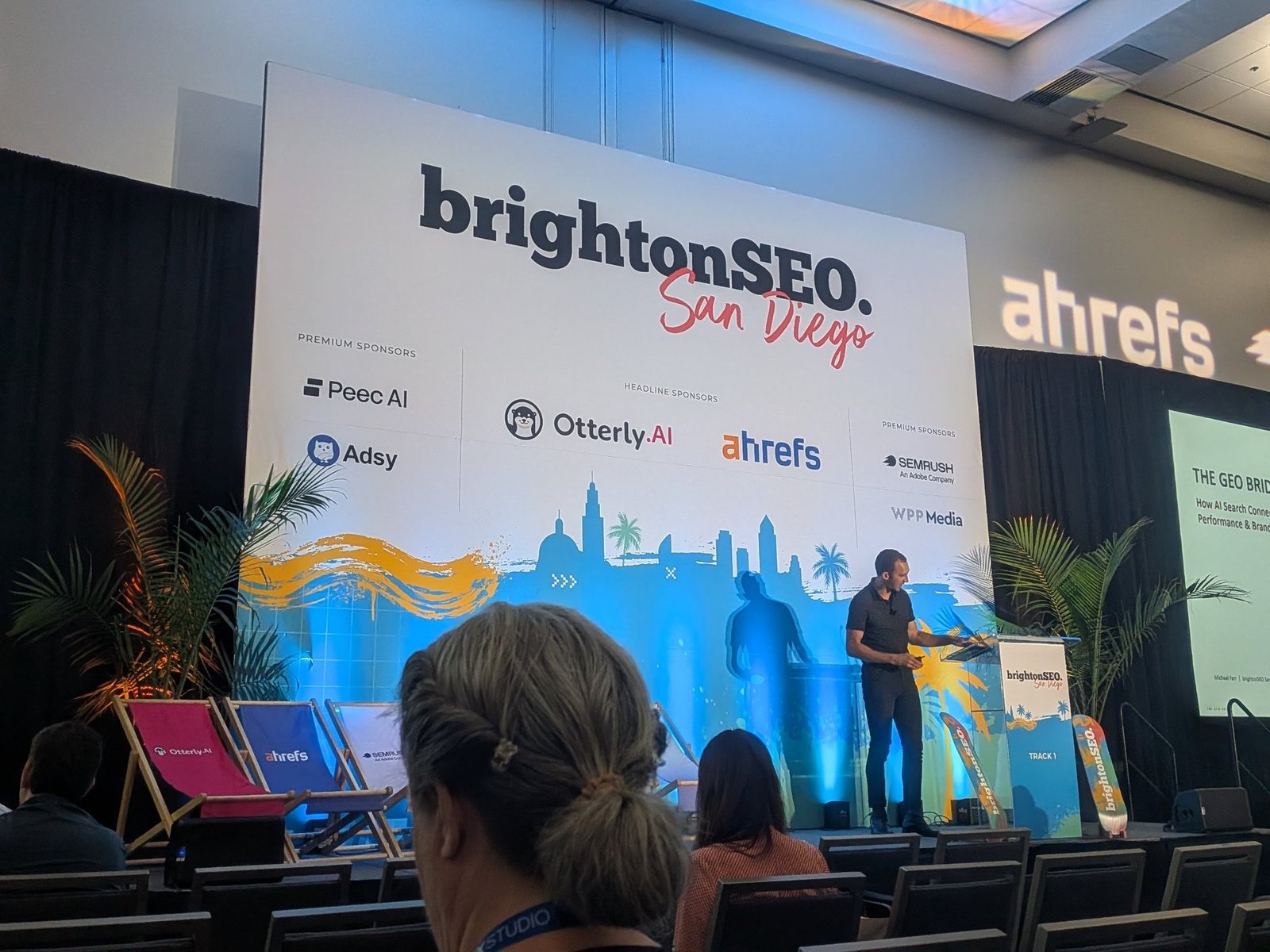
Michael Farr leads SEO and AI search work at Paylocity, the HR and workforce management software company, where he founded a cross-functional AI search initiative within the go-to-market organization. According to the session abstract, that group tripled Paylocity’s AI visibility over the past year. He also runs FarReach Digital, an SEO consultancy based in Vancouver, Washington, and his slides carried its branding.
His background is unusual for the field: journalism, military intelligence, and agency web design before moving into SEO. That mix showed in the talk, which was about storytelling, strategy, and organizational design more than tactics.
Note that the printed programme listed Tom Critchlow in this slot; Michael presented instead.
The Premise: A Mindset Shift, Not a Tactic
Michael was clear from the start that this wasn’t a tactics talk. It was about mindset, and about how search professionals define themselves.
He framed the moment as an opportunity. With AI-generated content flooding the web and layoffs affecting the industry, search professionals have a chance to redefine their role, moving from being seen as technical checklist owners to being strategic business leaders.
He also addressed the argument that has run through much of the past year: is GEO, or AEO, or whatever you call it, just SEO with a new name? He acknowledged the overlap. But he argued that it is genuinely new work, and more importantly a new way to frame the work search teams have always done.
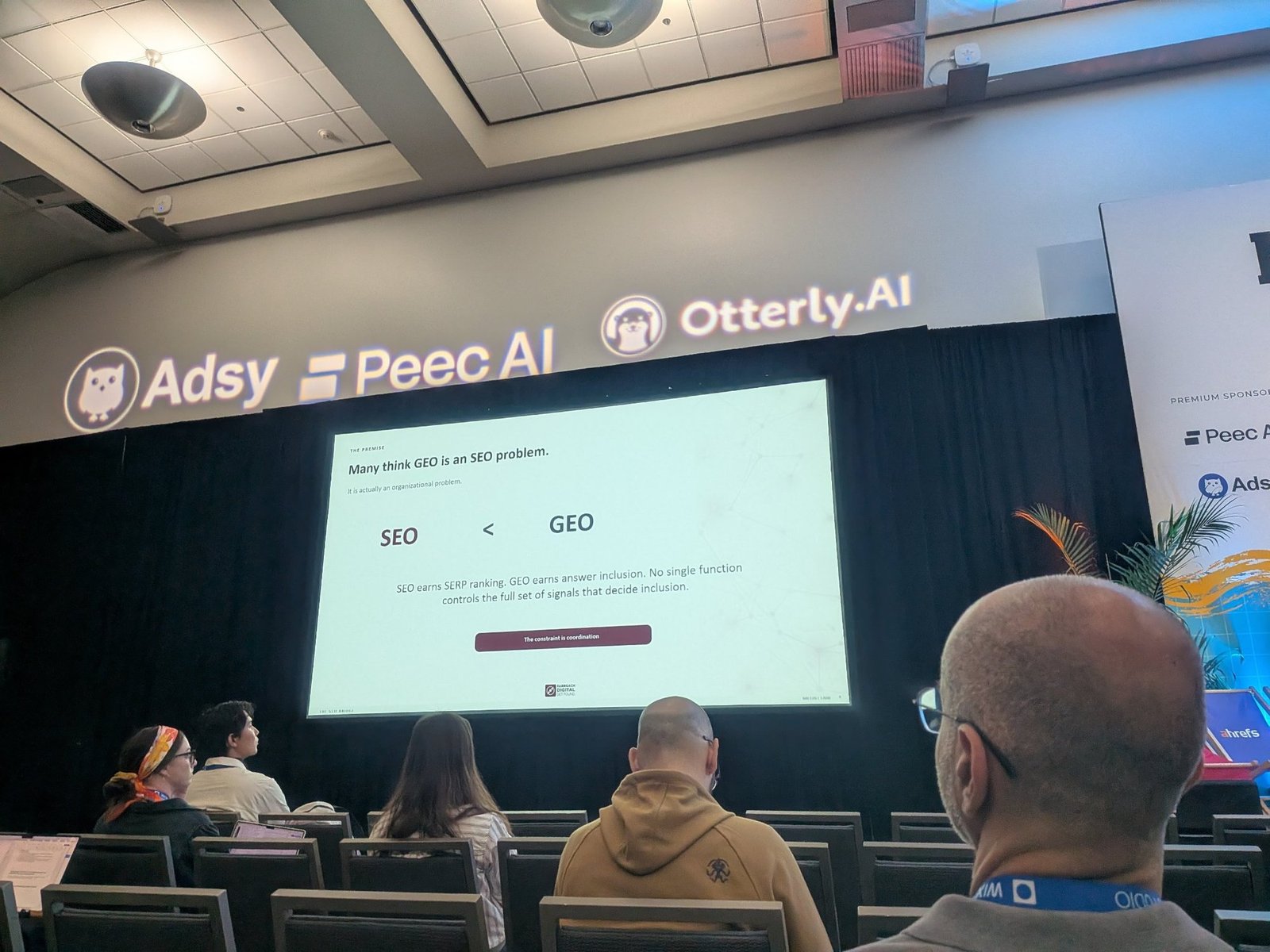
His central slide: many people think GEO is an SEO problem. It is actually an organizational problem. SEO earns a ranking in search results. GEO earns inclusion in the answer. No single function controls the full set of signals that decide inclusion. The constraint is coordination.
The Problem: The Signals Are Spread Across the Company
Michael described the sheer range of signals that might influence whether a brand is recommended in an AI answer: where content is placed, how the company describes itself, how others describe it, expert voices reinforcing the message, and the context found in reviews, Reddit threads, YouTube videos, and more. There are hundreds, perhaps thousands, and no one team owns them all.
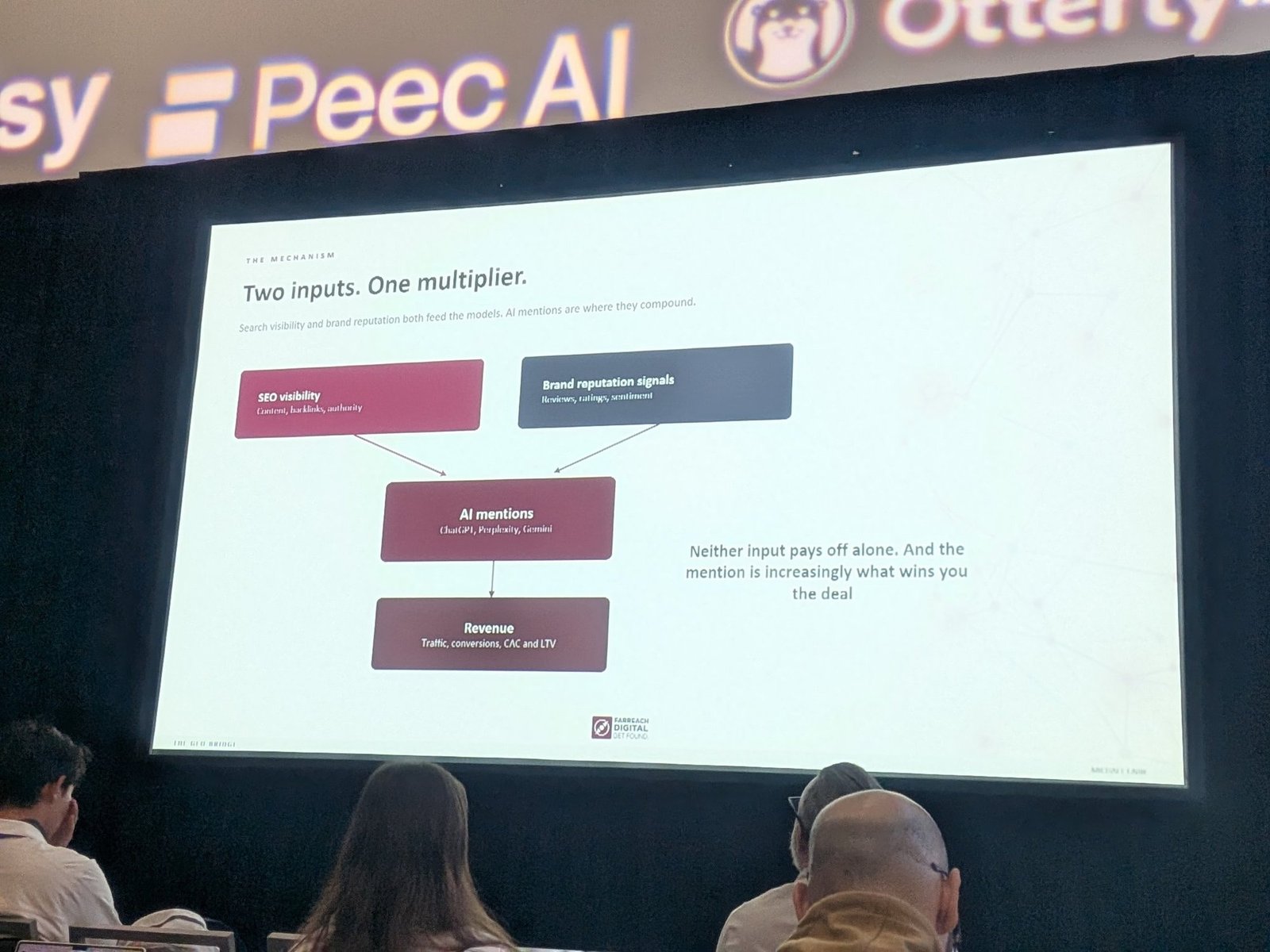
He simplified this into a model:
- SEO visibility: content, backlinks, and authority
- Brand reputation signals: reviews, ratings, and sentiment
Both feed into AI mentions in tools such as ChatGPT, Perplexity, and Gemini, which in turn drive revenue through traffic, conversions, customer acquisition cost, and lifetime value.
Neither input pays off alone. And the mention, he argued, is increasingly what wins the deal.
Why the Two Teams Don’t Work Together
The two inputs map to two teams that have operated in separate silos for decades:
- Performance marketing focuses on capturing demand, optimization, and conversion.
- Brand marketing focuses on awareness, message, and reputation.
Michael was realistic about why the gap exists. These teams often have different cultures, different leaders, different budgets, and different metrics. One culture favors experimentation, the other favors consistency. In many companies there is very little built-in incentive to share ownership, however good it sounds in theory.
The GEO Bridge is his answer. It isn’t a replacement for either team. It is a connecting layer, closer to an operating system, that creates space for collaboration, shared metrics, and shared wins. When you ask another team to support something, it helps enormously if the result is a win for them too.
The Solution: Three Bridge Pillars
Pillar 1: Shared Language
Michael’s first pillar, as far as I could capture it, is about agreeing on what AI should say about the company. When search teams bring brand into the effort, the questions change: which messages should we reinforce, and what proof should AI find to support them? The goal is a shared specification of the narrative that both teams work toward.
Pillar 2: Create a Shared Scorecard
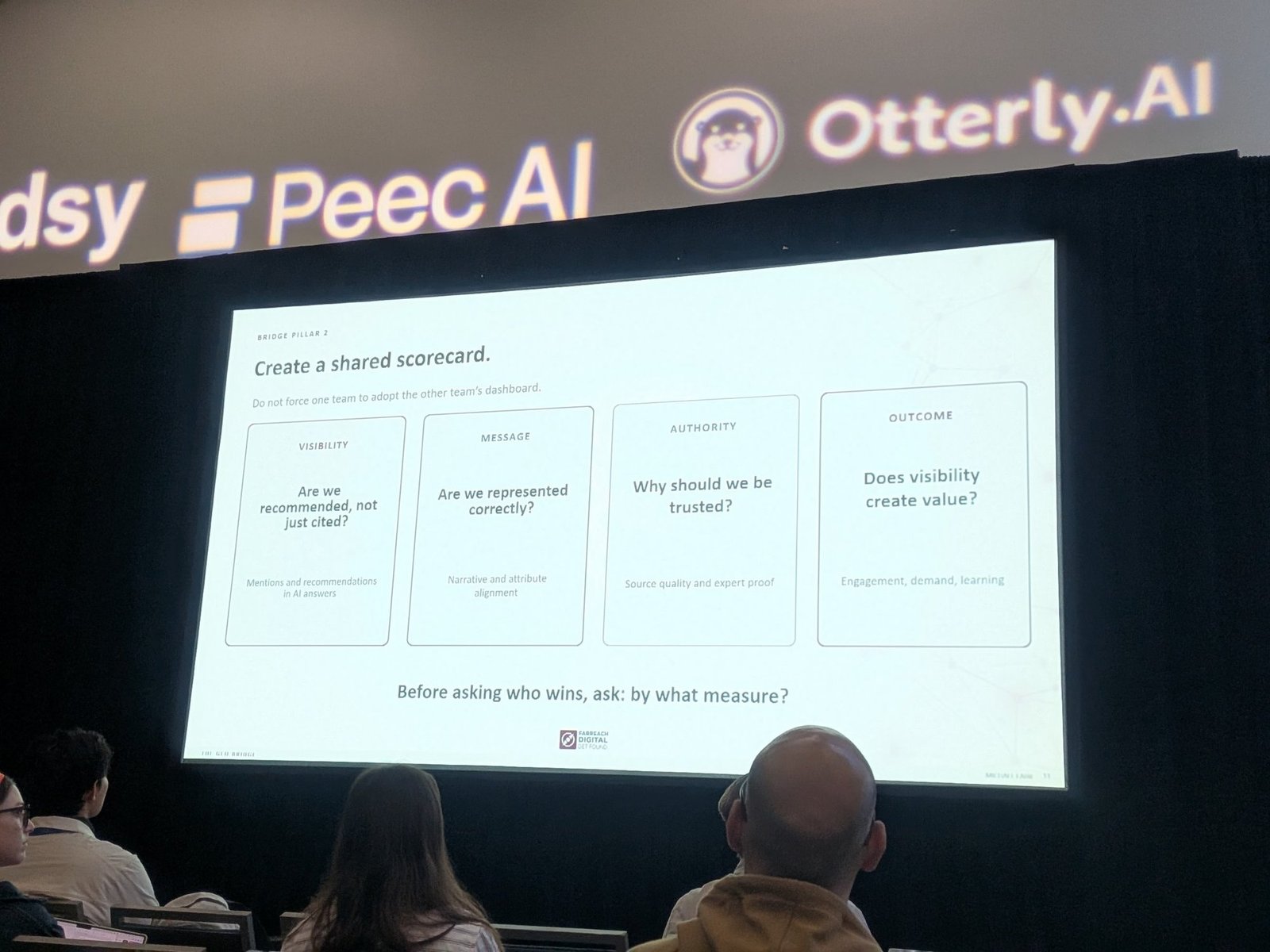
The instruction on this slide is one I’d underline: do not force one team to adopt the other team’s dashboard. Instead, build one scorecard with four dimensions:
| Dimension | Question | What to track |
|---|---|---|
| Visibility | Are we recommended, not just cited? | Mentions and recommendations in AI answers |
| Message | Are we represented correctly? | Narrative and attribute alignment |
| Authority | Why should we be trusted? | Source quality and expert proof |
| Outcome | Does visibility create value? | Engagement, demand, and learning |
His closing line for the slide: before asking who wins, ask by what measure.
Pillar 3: Install a Joint Operating Rhythm
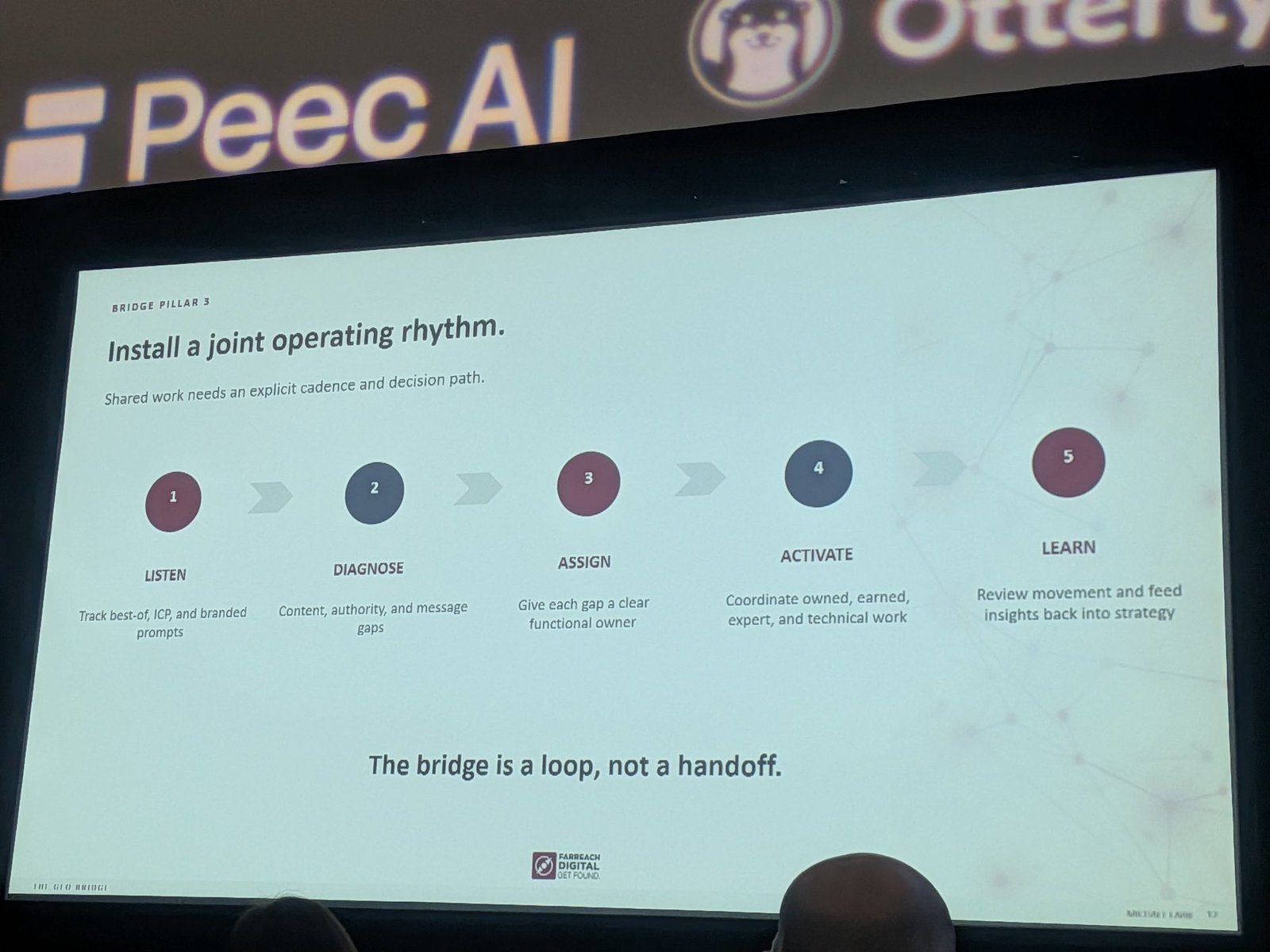
Shared work needs an explicit cadence and a clear decision path. Michael’s five-step loop:
- Listen. Track best-of prompts, prompts related to your ideal customer profile, and branded prompts.
- Diagnose. Identify content, authority, and message gaps.
- Assign. Give each gap a clear functional owner.
- Activate. Coordinate owned, earned, expert, and technical work.
- Learn. Review what moved and feed insights back into strategy.
The bridge, as the slide put it, is a loop, not a handoff.
The Structure: Give GEO an Owner
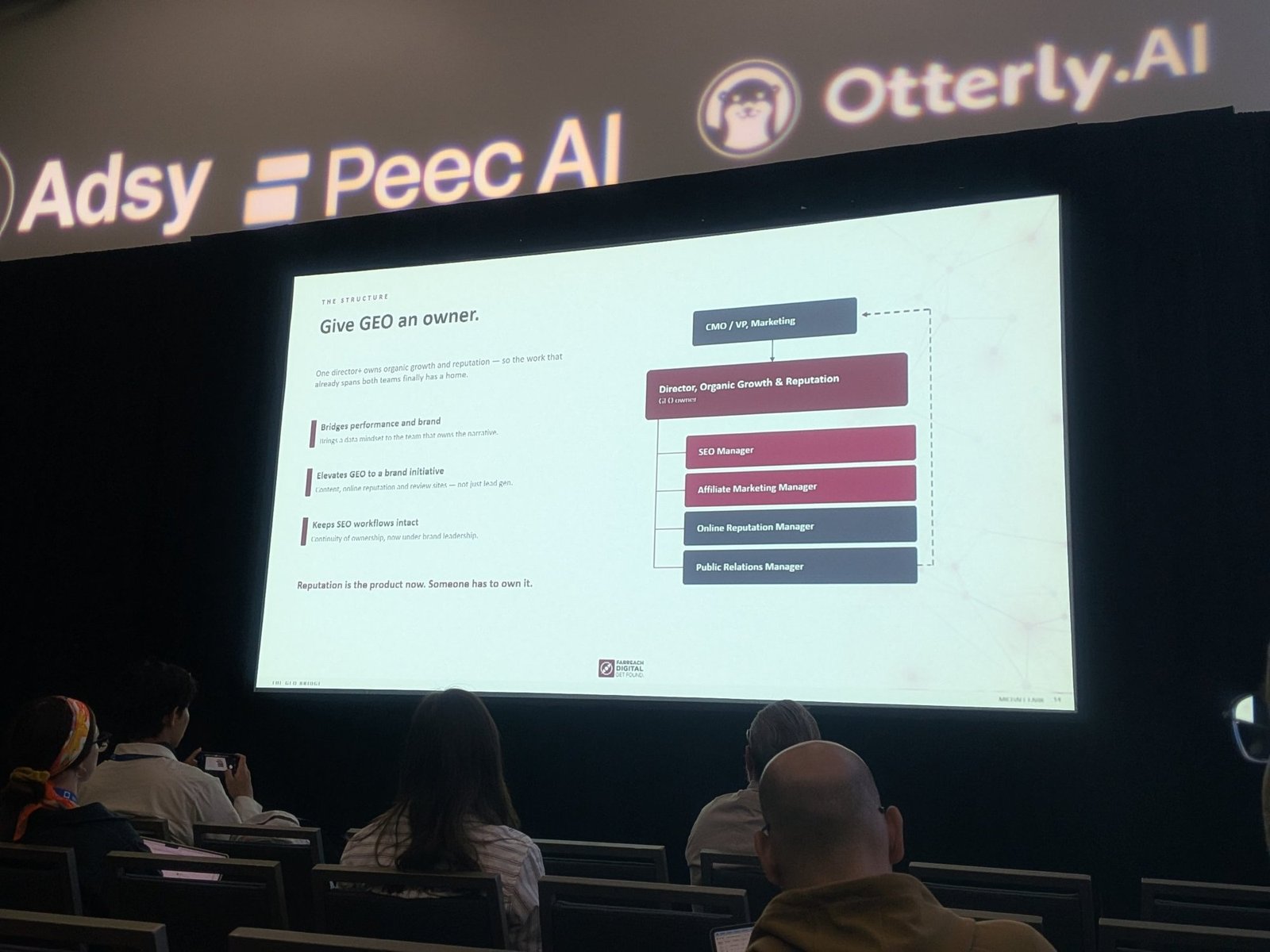
The part Michael said he felt most strongly about: someone has to own this.
His proposed structure places a Director of Organic Growth and Reputation under the CMO or VP of Marketing, as the named owner of GEO. Reporting into that role:
- SEO Manager
- Affiliate Marketing Manager
- Online Reputation Manager
- Public Relations Manager
The reasoning behind the design:
- It bridges performance and brand. It brings a data mindset into the team that owns the narrative.
- It makes GEO a brand initiative. Content, online reputation, and review sites become part of the scope, not just lead generation.
- It keeps SEO workflows intact. Ownership continues, now under brand leadership.
His summary: reputation is the product now, and someone has to own it.
He added two conditions. The owner must be genuinely empowered, with real influence rather than just a title. And the role depends heavily on soft skills: speaking other teams’ language, understanding what they need, and translating it for leadership. He acknowledged that a title like this may sound unusual today, but expects it to seem normal within a few years.
The Blueprint: The First 30 Days
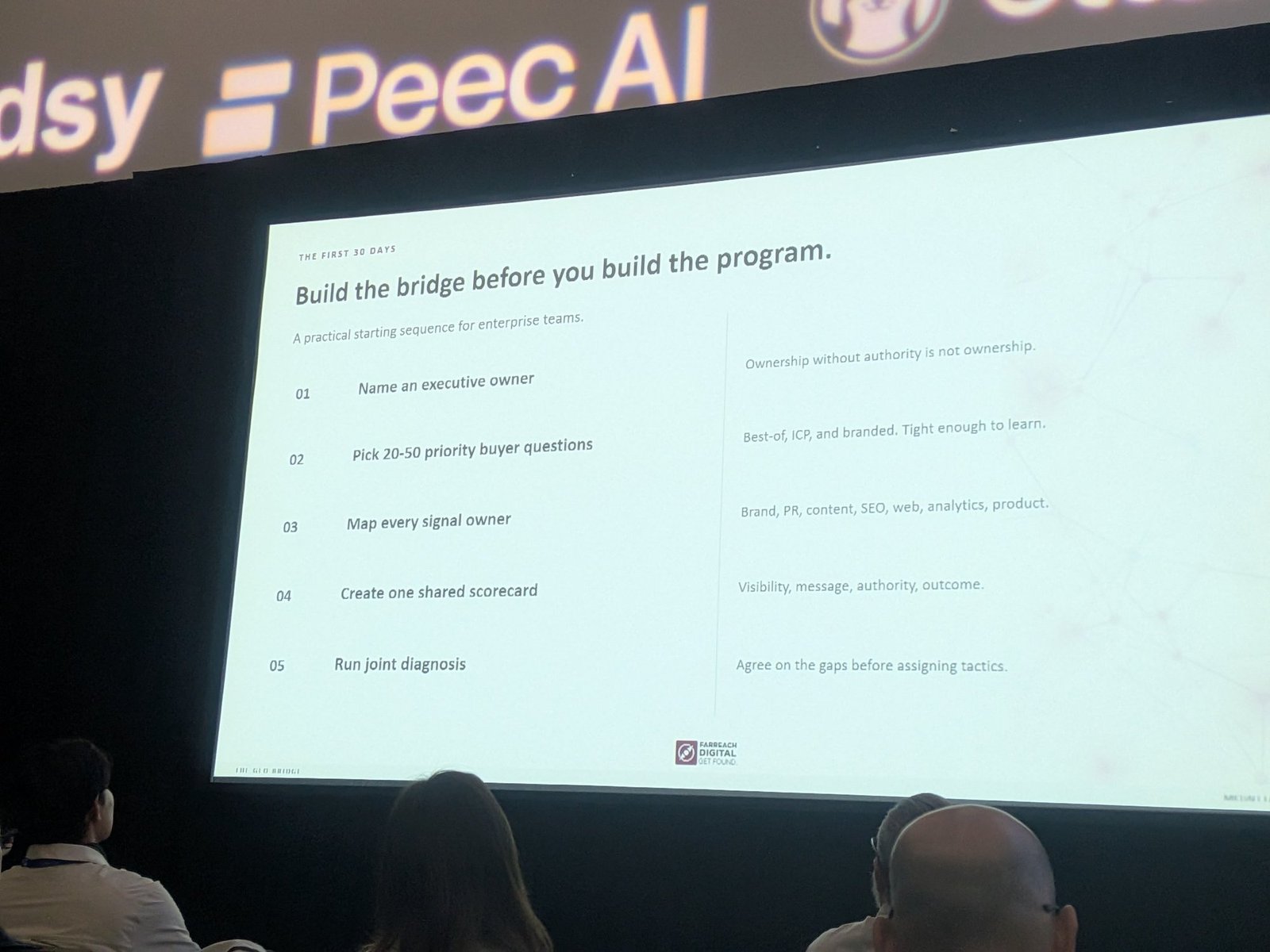
A practical starting sequence for enterprise teams:
- Name an executive owner. Ownership without authority is not ownership.
- Pick 20 to 50 priority buyer questions. Best-of, ideal customer profile, and branded. Keep the set tight enough to learn from.
- Map every signal owner. Brand, PR, content, SEO, web, analytics, and product.
- Create one shared scorecard. Visibility, message, authority, and outcome.
- Run a joint diagnosis. Agree on the gaps before assigning tactics.
What Not to Do
- Don’t treat GEO as a side project inside the SEO team. The signals it depends on sit across the organization.
- Don’t force one team onto another team’s dashboard. Build a shared scorecard both sides recognize.
- Don’t appoint an owner without authority. A title without influence won’t move other departments.
- Don’t jump to tactics. Agree on the gaps first, then assign work.
- Don’t track too many prompts at the start. 20 to 50 priority questions is enough to learn from.
Next Steps
- List who controls each AI visibility signal in your company. Include brand, PR, content, SEO, web, analytics, and product.
- Write down 20 to 50 buyer questions. Mix best-of, customer-profile, and branded questions.
- Draft a four-part scorecard. Visibility, message, authority, and outcome, with one or two measures each.
- Hold one joint diagnosis session. Bring SEO and brand together to agree on the biggest gaps.
- Make the case for an owner. Identify who could realistically hold authority across both teams.
Personal Takeaways
This was a talk about organizational design delivered at an SEO conference, and it filled a gap that most technical sessions leave open. Garrett French, earlier in the morning, showed how to pitch AI visibility to legal, PR, and sales one department at a time. Michael went a step further and asked whether those departments should be reorganized around the work.
What I’m taking away:
- “The constraint is coordination” matches what I see with international clients. For Japanese companies operating in the UK or US, the signals are split not only between teams but between countries. Headquarters often owns the brand narrative, while local teams own SEO and PR. Mapping signal owners across both is an essential first step.
- The shared scorecard is immediately usable. Especially the rule not to force one team onto another’s dashboard. That is often exactly where cross-team projects stall.
- For small companies, the owner is often one person. The structure is designed for enterprises, but the principle scales down: whoever handles SEO also needs to think about reviews, PR, and how the brand is described elsewhere.
- “Reputation is the product now” is the line I’ll remember from this session.
A limitation worth noting: the talk offered little data on how the model performs in practice beyond the abstract’s reference to tripling AI visibility. I’d have liked to hear more about how Paylocity measured that and what the transition looked like internally.
Related Resources
- Session: The Future of SEO, brightonSEO San Diego 2026
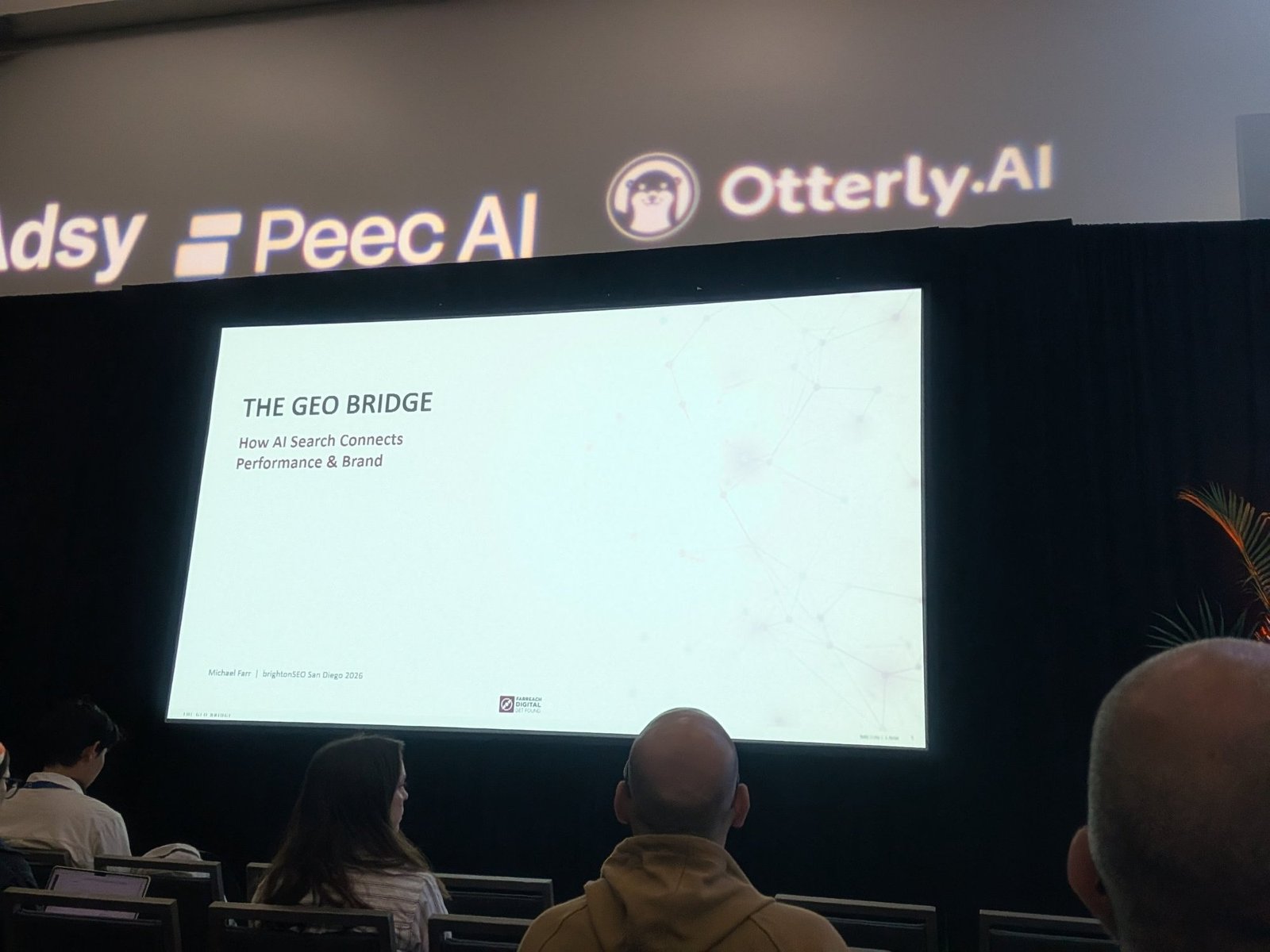
- Talk: The GEO Bridge, How AI Search Connects Performance & Brand
- FarReach Digital
- Garrett French’s session report: on diagnosing AI visibility and building buy-in across departments
Written by Ayaka Uchida
CEO, A-Digital Works
This report covers Michael Farr’s session “The GEO Bridge: How AI Search Connects Performance & Brand” at brightonSEO San Diego, September 16, 2026.
