

TL;DR
- The current “SEO is dead” narrative is largely vibes, not data — and Philip came to fix it with Semrush’s 20-billion-events-per-month behavioural panel
- 23% of all searches are now zero-click (up 4 points year-on-year), but the missing clicks have NOT migrated to AI: only 3% of all queries currently go to AI, and only 1% of website traffic comes from AI/LLM referrals — the math doesn’t math
- From Semrush’s panel: 80% of consumer journeys now include an AI/LLM waypoint, and 90% of those AI-touched journeys also include a search waypoint. AI and search coexist, not compete
- 40% use AI/LLM when shopping; 59% use it primarily for product comparisons; 75% trust AI/LLM recommendations (even though 68% confirm using search to verify); 79% had their purchase decisions influenced by AI
- 85% of Gen Z use social media to research products before they buy — discovery has fragmented across surfaces (TikTok, Reddit, YouTube) that don’t return referral data to GA4
- Three observed customer journeys (Sephora / Wegovy / Samsung) show what’s actually happening: complex jobs-to-be-done, FOBO mid-checkout, post-conversion nesting, UGC trusted over polished marketing, and direct visits to manufacturer pages even when the brand sells indirectly
- Philip’s close: SEO doesn’t die, neither does clickbait — Google/Alphabet’s market cap has gone from $0 in 1998 to $3.676T at BrightonSEO 2026. What’s broken isn’t the channel; it’s last-click attribution and legacy traffic KPIs
About the Session
Talk title: AI/Searchpocalypse — The surprising interplay of AI and Search in the modern consumer Journey
Track: Understanding AI Behaviour
Date: Friday 1 May 2026, 14:00
Venue: Syndicate 1&2 — Anything is Possible stage, Brighton Centre, Kings Road, Brighton and Hove, BN1 2GR, United Kingdom
About the Speaker
Philip J Armstrong — VP, Insights & Analytics, Semrush
Philip leads insights and analytics work at Semrush, where he focuses on consumer journey research using the company’s behavioural panel — Semrush Journey, the world’s largest near-time clickstream database, with roughly 20 billion click events per month across 20 million global monthly active users. He is a marketing science leader specialising in consumer decision making, incrementality measurement, and attribution modelling. His talk closed the “Understanding AI Behaviour” track on Day 2, following Ryan Law (Ahrefs) and Veronika Ulla Höller (Tresorit). Where Ryan’s session explained how AI search engines work mechanically, Philip’s brought the empirical view of what consumers are actually doing on top of those engines.
The Condolences: “SEO Died”
Philip opened with a wall of headlines. “SEO is dead.” “SEO Is Dead. Say Hello to GEO.” “Is SEO Dead in 2025?” “Google CTRs Drop 32% For Top Result After AI Overview Rollout.” “Google users are less likely to click on links when an AI summary appears in the results.”
The industry has agreed on the obituary. The question Philip put to the room: is the obituary actually data-driven, or vibes?
Cause of Death: The Unholy Trinity
Philip’s diagnostic, drawn from Semrush’s Q4 2025 journey and customer-testimony data across the US, EU and UK:
- 23% of all searches are now zero-click — up 4 percentage points year-on-year
- As zero-clicks rise, traditional search efficiency tanks
- 3% of all queries (across search, social, retail, AI combined) currently go to AI/LLM
- 1% of website traffic on Semrush customer logs comes from AI/LLM referrals
That last pairing is the crucial one. AI/LLM is steadily picking up query share, but it is not making up for the search referral shortfall. The math doesn’t math. Something else is going on.
The Consumer Journey Context
Philip pivoted from the obituary into a different framing: the consumer journey itself has restructured. The old linear funnel (awareness → consideration → conversion) has collapsed into something looped, tangled, and multi-source. The visual that anchored this section was a tangled spaghetti of journey waypoints with AI nodes scattered throughout — a deliberate echo of McKinsey’s classic Consumer Decision Journey.
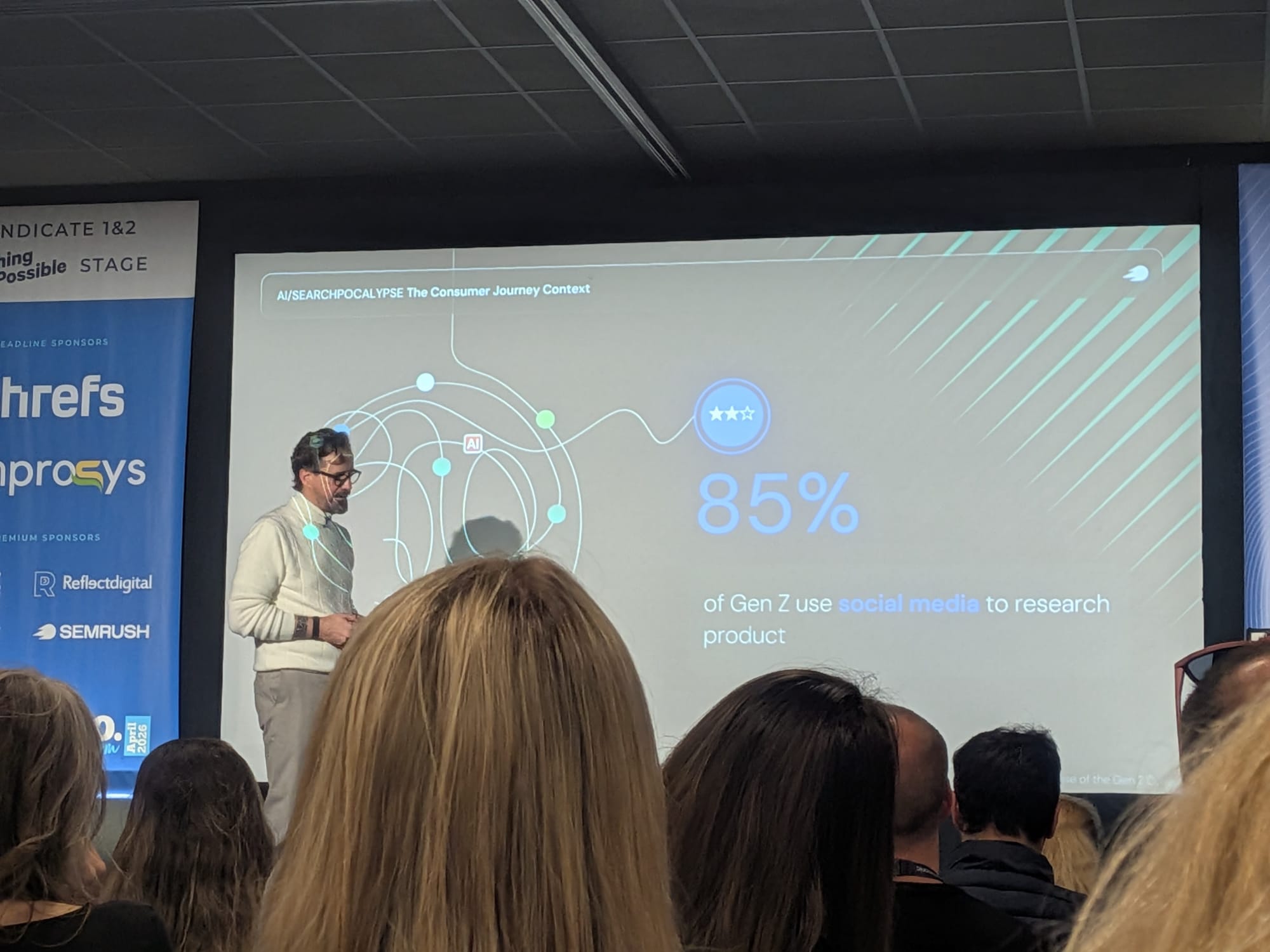
The opening anchor: 90% of consumers conduct online research in their decision-making journey (PYMNTS, Omnichannel Consumer Behaviour). And the most striking sub-figure: 85% of Gen Z use social media to research products before they buy (ICSC, The Rise of the Gen Z Customer). The discovery layer has fragmented across surfaces — TikTok, Reddit, Instagram, YouTube — that don’t pass referral data back to GA4. Most brands have almost zero attribution into this layer, which is one large reason the “missing clicks” haven’t shown up in AI referrals: they’re sitting in social research that GA4 can’t see.
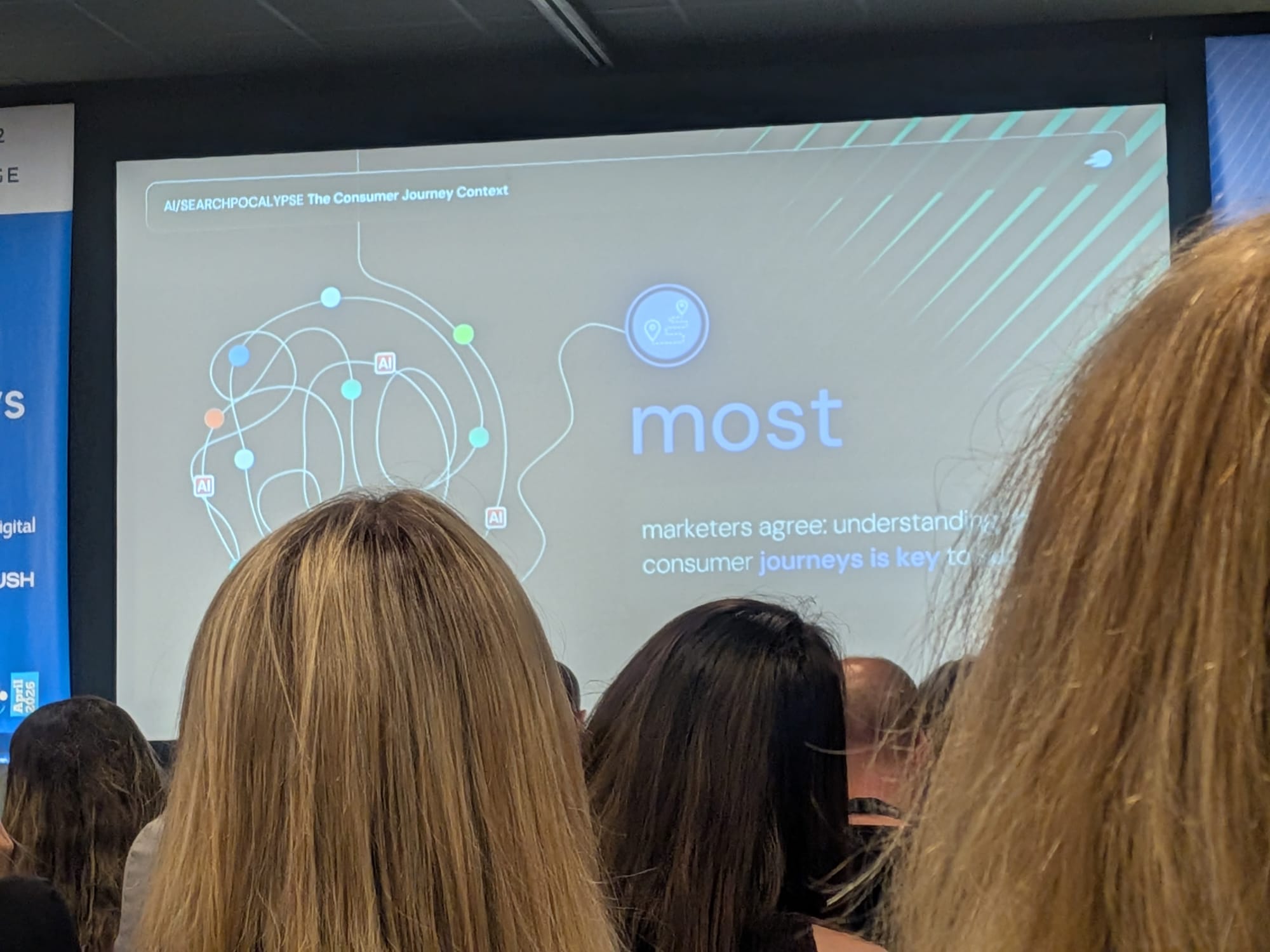
Philip’s landing point before the case studies: most marketers agree understanding consumer journeys is key. The disagreement isn’t about whether journeys matter — it’s about what those journeys now look like, and how much of the journey has become invisible to traditional attribution.
The Semrush Journey Dataset
The data backing the rest of the talk comes from Semrush Journey, which Philip presented as the world’s largest near-time clickstream database:
- 20,000,000,000 (20 billion) monthly click events
- 20,000,000 (20 million) global monthly active users
From that panel:
- 80% of consumer journeys now have an AI/LLM waypoint
- 90% of those AI/LLM-touched journeys also have a search waypoint
Translation: AI has not replaced search. The two function together. Anyone optimising “AI versus search” is asking the wrong question — the right one is how AI and search get used together inside a single customer’s journey.
The Consumer AI Sentiment
Philip pulled in a parallel Semrush AIO Survey (US and EU5, Q4 2025, n=850 across ChatGPT, Gemini, Perplexity, Claude, Copilot, Google AI Mode), targeting adults 18+ who use AI for product research or shopping.
Use Case:
- 40% use AI/LLM when shopping for products or services
- 59% use it primarily for product comparisons
Trust:
- 75% trust AI/LLM recommendations
- Even though 68% confirm using search to verify those recommendations — the “trust but verify” pattern
Influence:
- 79% had their purchase decisions influenced by AI
- More than half were introduced to new products via AI: 53% new purchase, 54% new awareness, 61% new consideration
And critically: AI/LLM use spans every major category — 50%+ in beauty, electronics, and apparel. This is not an early-adopter behaviour confined to tech enthusiasts. It’s mainstream consumer behaviour across the most-shopped retail verticals.
Journey Insights: Three Real Consumer Journeys
The strongest section of the talk was three anonymised real-world journeys observed in the panel, walked through step by step.
Case 1: Sephora — Foundation Purchase (France)
Traveler: Felicia M*, female, 46, Cannes, FR. Affluent, multilingual luxury shopper. POV: Sephora France.
Journey path (compressed):
- -4d 22:34:34 — endemic conversion at calecimprofessional.com (luxury haircare; reinforcing trust in scientific luxury brands)
- -4d 22:28:15 → -4d 22:27:01 — endemic exploration via google.com and littleones.paris (jewelry)
- -4d 14:33:50 — endemic exploration at guerlain.com (shampoo)
- -4d 14:11:53 → -4d 14:10:30 — gateway via sephora.fr, then exploration for Prada Beauty
- -4d 14:09:33 — heuristics on sephora.fr (Prada Reveal foundation)
- -4d 14:07:16 — add-to-cart on sephora.fr
- -3d 19:55:36 → -3d 19:57:51 — ranking via conseilscheveux.fr, FOBO check on my-origines.com (Prada brand page)
- -2d 21:52:15 — heuristics at niche-beauty.com (Chantecaille cushion foundation, cross-checking)
- -0d 18:18:02 → -0d 18:15:56 — canonical review at sephora.fr Dior page, then dior.com (Forever Nude Bronze)
- -0d 16:28:15 — canonical review at prada-beauty.com
- -0d 00:06:22 — add to cart at sephora.fr (Prada Reveal MW45)
- 0d 00:00:00 — conversion via PayPal
- 0d 00:15:11 — nesting at idyl.com (jewelry — luxury self-care blurs categories)
- 0d 00:50:04 → 0d 00:52:27 — buyer’s remorse: opens Sephora cancellation FAQ, then contact form. The grace period has expired
- 0d 00:53:13 → 0d 01:14:30 — validation loop: google.com → chatgpt.com (“prada foundation difference between mn40 and mw40”, gpt-4o) → tiktok.com (“fond de teint prada mn40”) → google.com again → kuwait.ounass.com (Middle Eastern retailer for shade reference)
Outcome: she validates that MW45 is correct, doesn’t return, doesn’t repurchase. Sephora wins.
Lessons:
- Foundation purchase is a complex job-to-be-done, not commodity replacement
- The cart is a dangerous moment: FOBO (fear of better options) diverts even during checkout
- Post-purchase validation is critical and routes through surfaces (ChatGPT, TikTok, Middle Eastern retailers) that Sephora has zero visibility into
- Nesting: the journey doesn’t end at conversion. After buying foundation, Felicia drifts into jewelry shopping — same identity-driven self-care motivation
Case 2: Wegovy — Weight-Loss Drug (United States)
Traveler: Skyler R*, male, 32, Monona, Wisconsin. POV: Wegovy / Novo Nordisk. A man struggling with obesity is finally adding GLP-1 to what Semrush labelled his “Weight-Loss Stack”. Extensively consults UGC video stories on Reddit, TikTok, and YouTube — not because of gossip but because he doesn’t trust the brand’s polished marketing.
Journey path (compressed):
- -12d 21:32:10 — food trigger at pizzapit.weborder.net (the emotional trigger that starts the transformation)
- -12d 21:10:14 — health check on uhc.com (insurance portal login)
- -8d 16:41:39 → -6d 20:25:30 — amazon.com (BP machine with XXL cuff) → bing.com (Fit Nation Slimline treadmill replacement parts) — health stack assembly
- -5d 20:40:48 — habit revisit at pizzahut.com
- -05d 20:00:50 — before/after research on youtube.com (glp-1 weight loss before and after men)
- -3d 21:40:30 → -3d 20:17:15 → -3d 18:16:44 — msn.com food content → bing.com (Hims for men) → heuristics at hims.com (10-minute page session on Hims GLP-1 compounded semaglutide intake form)
- -3d 08:05:38 — bing.com (Hims for men cost)
- -1d 06:19 — affiliate ranking at bestweightlossmeds.io (Zepbound)
- -0d 01:06:19 → -0d 01:04:40 → -0d 01:00:34 — youtube.com (how to inject Wegovy) → youtube.com (tirzepatide vs semaglutide side effects) → reddit.fr (dry eyes side effects)
- -0d 00:57:46 — savings check at wegovy.com (coverage and savings page)
- -0d 00:44:29 → -0d 00:35:59 — youtube.com (how to inject Wegovy) → bing.com (zepbound coverage savings)
- -0d 00:17:40 — youtube.com (how to give yourself a Wegovy shot — the needle-phobia step)
- -0d 00:15:16 → -0d 00:13:54 — goodrx.com (GLP-1 insurance coverage) → reddit.fr (telehealth options)
- -0d 00:07:23 — FOBO check on perplexity.ai (“how much is ozempic through me”)
- 0d 00:00:00 — conversion at
bsp.novocare.com/wegovy/s/registration/results?condition=obesity&product=wegovy(Wegovy enrolment via Novo Nordisk’s care portal, filtered for obesity + Wegovy) - +0d 05:08:58 → +3d 02:35:46 → +3d 02:40:34 — post-conversion nesting: pizzahut.com no-order, ro.com (weight-loss quiz), hims.com (GLP range overview)
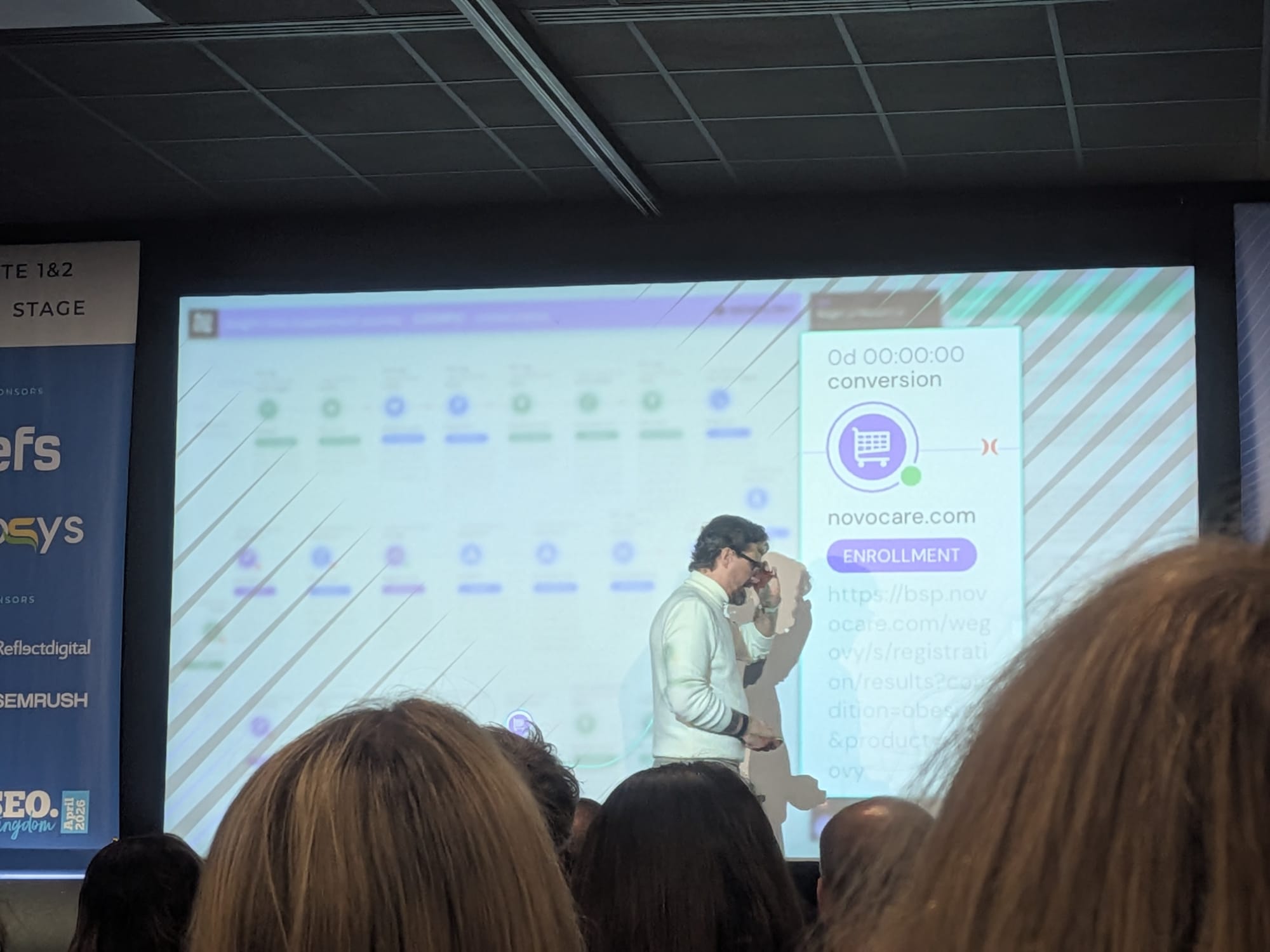
bsp.novocare.com/wegovy/s/registration/results?condition=obesity&product=wegovy — Novo Nordisk’s official enrolment surface. Even when the brand doesn’t sell direct, the manufacturer’s canonical page is the trust checkpoint.Lessons:
- Transformation Intenders trust authentic UGC video stories (YouTube, Reddit, TikTok) more than the brand’s polished marketing
- Efficacy is assumed — differentiation happens on side-effects and ease-of-use heuristics, not on whether the drug works
- FOBO at the cost/savings/telehealth-prescription step is where intenders get diverted: a search for “Wegovy savings” surfaces “Ozempic savings” front and centre
- The brand’s canonical page (novocare.com — Novo Nordisk’s enrolment portal) functions as the trust-verification step. If you don’t sell direct, you still need that authoritative page. Consumers visit brand sites even if the brand is not selling direct
Case 3: Samsung — 77-inch OLED TV (United States)
Traveler: Marcel G*, male, 37, Houston, TX. POV: Samsung DTC. Destination: Samsung OLED S90D, 77-inch 4K. Heavy AI use across multiple LLMs and elaborate post-purchase nesting behaviour.
Journey path:
- -1 07:48:59 — first exposure on reddit.com (“did I just buy the best OLED”)
- -1 07:03:12 — google.com search for “best OLED TVs”
- -1 06:42:07 — add-to-cart and checkout intent at samsung.com (77-class OLED S90D page) — but doesn’t finalise
- -1 06:36:14 — heuristics on perplexity: AI query “samsung 77 class 4k oled s90d”. Perplexity returns a structured response that builds a three-criterion decision framework (picture quality / refresh rate / brightness), evaluates the TV against it, and ranks it
- -1 06:33:02 — heuristics on chatGPT: query “What is the difference between QN77S90DAFXZA vs QN77S90FAFXZA” (he’s checking model variants)
- -1 06:10:21 — canonical visit on samsung.com (77 inch class OLED S90D)
- -0d 00:16:51 → -0d 00:15:16 → -0d 00:15:09 — FOBO loop: samsung.com again → target.com (size 70-79 filtered Samsung 77) → target.com search
- 0d 00:00:00 — payment win at samsung.com (/us/web/express/order-confirm/)
- +0d 00:12:33 → +0d 01:01:57 → +0d 11:43:01 → +0d 15:11:39 — heavy nesting: philips-hue.com (Hue Play HDMI Sync Box 8K), wayfair.com (sideboard TV stand), homedepot.com (decorative wall paneling), then perplexity.ai again (“what is the best wall mount for…”)
The AI Drift moment — the most important part of the case. When Marcel queried perplexity, the AI’s three-point evaluation gave the Samsung 77-inch OLED S90D fail (x) marks on brightness. Third-party measurement actually puts that Samsung at 1000–1300 nits, which is significantly higher than the LG C4 77 OLED competitor (which Perplexity rated as a pass). The AI’s assessment was wrong — and yet that incorrect representation almost cost Samsung the sale. Philip’s term: AI drift. As these AI-mediated journeys become “very common”, brands need to monitor and correct for it.
Lessons:
- AI engines now perform structured reasoning in a single step: building a heuristics framework, filling it in, and ranking — work that previously required human research
- “Trust but verify” routes through AI and community sources (Reddit), and the two can contradict
- AI drift is a real risk vector for brands. The AI’s “polished verdict” feels authoritative, even when factually wrong
- Nesting is real and large: post-purchase, Marcel drives traffic and intent across multiple unrelated retailers, all anchored on the original purchase
Journey Insights: The Synthesis
Philip pulled the three journeys together into three columns of insight.
Complexity:
- Journeys are complex jobs-to-be-done, not singular point purchases
- FOBO diverts consumers, even during the checkout process
- Journeys don’t end with conversion — nesting expands the journey to additional products and services
Trust:
- Consumer trust in user-generated content is higher than for polished marketing messaging
- Consumers visit brand sites even if the brand is not selling direct
Influence:
- Waypoints influence decision-making independently of a direct referral — “your tracking is dead, search lives”
- AI/LLM shortcuts decision-making in a new way — it is not just another exposure point or frequency increment; it actively shapes the heuristics framework
- AI/LLM and search work together, not against each other
SEO Never Dies — Neither Does Clickbait
Philip closed with one chart and one provocation. The chart was Google / Alphabet’s market capitalisation from 1998 ($0, Google founded) through to 2026 ($3.676 trillion at BrightonSEO). Each major search/SEO update — PageRank, social media rise, Panda, RankBrain, BERT, ChatGPT, GEO/AEO — sits on the line, and the line keeps going up.
His point: every prophecy that the death of search has come true has been wrong. The platform has absorbed disruptions and grown. What is genuinely happening now is that AI/LLM has permanently changed consumer behaviour, and that change is breaking last-click attribution methods and legacy search-and-traffic KPIs. The channel isn’t dying; the way we measure it has stopped working.
His prescription: a holistic view of the journey re-enables outcome attribution to AI/LLM and search. Semrush Journey is built for that view; download a sample journey pack at semr.info/journey.
Personal Takeaways
This is my third BrightonSEO (Brighton 2025, San Diego 2025, Brighton 2026), and Philip’s session sat with the strongest of the day for me — alongside Ryan Law’s preceding talk and the Day 1 standout from Tom Capper. The combination of large-N panel data (20 billion events monthly is the kind of dataset that makes industry conversations data-driven rather than vibes-driven) and three meticulously documented customer journeys made it both rigorous and memorable.
A few specific things I’m taking home:
- The 80/90 coexistence statistic is the most useful number from the session. 80% of consumer journeys touch AI; 90% of those also touch search. This kills the false binary that dominates current SEO industry discussion. Anyone planning their 2026 strategy as “AI vs search” is mis-framing the problem from the start.
- The 23% / 3% / 1% trio resolves the “where did the clicks go” question better than anything I’ve seen. Zero-clicks are up 4 points YoY to 23%. But AI is only 3% of all queries and 1% of referral traffic. The missing clicks aren’t all in AI. A large share are in the social-platform research surfaces brands have almost no attribution into — Philip’s 85% Gen Z social research stat anchors that.
- The “AI drift” concept from the Samsung case is the one I’ll be quoting most. Perplexity giving the Samsung OLED S90D a brightness fail when the actual nits rating is 1000–1300 — that’s a real risk for any brand whose specs become flattened or misrepresented in AI evaluations. The polished verdict-style output of AI engines makes their mistakes feel more authoritative than the same mistake on a forum thread. Brands need an “AI drift monitoring” discipline now.
- The “canonical B2C page” idea is one I’ve been weak on. Even when a brand sells indirectly, the manufacturer page (novocare.com in the Wegovy case) still functions as the trust-verification step. That has direct implications for international SEO work I do — Japanese brands selling into the UK through retailers still need their canonical UK landing page to exist, in English, with credible specs, even if it doesn’t drive direct conversions.
- The three case studies are templates for client research. I will be running my own version of these step-by-step journey reconstructions for A-Digital Works clients — even without Semrush’s panel access, customer interviews and session-recording data can produce a similar narrative artefact. The Wegovy YouTube needle-phobia step and the Sephora post-purchase TikTok shade-validation loop are exactly the kind of insights that never show up in a keyword research deck but are decisive at the moment of conversion.
- The closing chart — Google’s market cap from $0 to $3.676T across the supposedly-fatal SEO updates — is a useful piece of rhetorical inoculation. Every year the industry decides SEO has died, and every year Google’s market cap is higher than the last. The channel doesn’t die. The measurement layer does.
Across the BrightonSEOs I’ve attended over the past year, “the consumer journey has restructured” has been a recurring drumbeat — different speakers, different framings, broadly the same argument. Philip’s contribution wasn’t introducing the thesis; it was giving the thesis large-N empirical backing and three forensic journey reconstructions to prove it. That matters more than another conceptual framework.
Related Resources
- Official talk page: AI/Searchpocalypse — The surprising interplay of AI and Search in the modern consumer Journey (BrightonSEO)
- Speaker profile: Philip Armstrong (BrightonSEO)
- Philip J Armstrong on LinkedIn
- Semrush — the brand-visibility and behavioural-panel platform Philip leads insights at
- semr.info/journey — download a sample Semrush Journey pack
- Ryan Law’s session report — the preceding talk in the same Understanding AI Behaviour track; provides the “how AI search engines work” mechanical layer that Philip’s “what consumers do on top” empirical layer sits on
About the Author
Ayaka Uchida (打田彩夏) — Founder & CEO of A-Digital Works Ltd. Founder of Nihon GO! World (Fitzrovia, London and Manchester). 10+ years in international business development across Japan, Singapore, US, and UK. BrightonSEO attendee 3 times (April 2025 Brighton, September 2025 San Diego, April 2026 Brighton — scholarship recipient). Aoyama Gakuin University, Faculty of Law. Fluent in Japanese and English; studying Spanish, French, and German.
Connect: a-digitalworks.com | LinkedIn
About A-Digital Works
A-Digital Works Ltd is a London-based Japan–UK SEO and EN↔JA localisation consultancy supporting UK, EU, and US companies entering the Japanese market. Services span keyword research in Japanese, content localisation, technical SEO, and market entry strategy. Flagship case study: Descartes Systems Group (Canadian logistics technology) — full Japanese-market SEO programme covering 物流システム, EDIシステム, and 配車システム.
This report covers Philip J Armstrong’s session “AI/Searchpocalypse — The surprising interplay of AI and Search in the modern consumer Journey” on the Anything is Possible stage of BrightonSEO Brighton on Friday 1 May 2026.
