

TL;DR
- AI levels everything towards the average — making brilliant slightly less brilliant, and terrible slightly better. The opportunity for marketers is to be deliberately not average
- Keyword research is dead as a starting point — start with buyer personas, themes, topics, and formats; bring keywords in at step 5, working backwards
- 60% of Google searches now end without a click; share of organic results in centre-stage SERP real estate dropped from 58.5% in January 2024 to 44.3% in January 2026 (STAT data)
- Stories are reportedly 22x more memorable than facts — Matt openly admits the citation behind that stat is shaky, but the underlying truth holds. The 2009 Significant Objects experiment turned $128.74 of thrift-store trinkets into $3,612.51 by adding fictional stories to them
- Your jobs aren’t going anywhere — but only if you lean into AI tools and step up. The people who don’t will be in trouble in two or three years
About the Session
Track: Content Creation
Date: Thursday 30 April 2026, 02:00 PM
Venue: Auditorium 1, Brighton Centre, Kings Road, Brighton and Hove, BN1 2GR, United Kingdom
About the Speaker
Matt Beswick — Aira | Founder
Matt co-founded the UK SEO agency Aira in 2014 with Paddy Moogan, and has been working in search since around 2007. He’s currently stepped back to one day a week at Aira while also working on Blush Digital with his wife Nicola. He recently returned to coding after an eight-year break — driven, he says, by AI tools that make him significantly more efficient. His talk closed the Content Creation track on Day 1 in Auditorium 1.
The Opening Provocation: AI Tends Towards the Average
Matt opened with the question every agency owner is hearing right now: why bother training people when we can just lean on AI to do the mid-level work?
His answer: AI tends towards the average. It makes the brilliant slightly less brilliant, and the terrible slightly better. It compresses outputs towards the middle of the distribution.
“You — everybody here — you are not average. You think, you feel, and you care. You are not average.”
That framing carried through the whole session. The thesis: the way to win in an AI-dominated content landscape isn’t to compete on AI’s terms (volume, optimisation, scale). It’s to lean harder into the things AI can’t do — taste, originality, story, emotion, and the credibility that comes from caring about your audience.
The Behavioural Shift
Matt referenced Elizabeth Reid (VP and Head of Search at Google), who has publicly described the behavioural shift Google is observing: where people go to ask questions is fragmenting fast. Gemini, Perplexity, ChatGPT, Claude, Meta, TikTok, YouTube — all are now legitimate starting points for the buyer journey.
Combined with what Matt called the “world of overwhelm” — doom-scrolling, attention competition, efficiency obsession — the result is a buying journey that no longer looks like the clean, linear funnel we’ve been optimising for.
The Messy Middle (and Why GA4 Can’t See It)
Matt drew his own version of how he actually buys things. A pair of trainers sitting in his basket for six months. Tabs reopened. An advert seen. A Reddit thread skimmed. A YouTube video watched. None of which, on its own, triggers the purchase.
What finally triggers it? A friend on the phone says, “Those trainers, they’re awesome, aren’t they?”
“You cannot measure this. GA4, attribution — total rubbish. Because we, as people, we’re not logical. We are emotional. We’re chaotic.”
The strategic question: how do you market to illogical, emotional, chaotic animals?
Matt’s answer came via a quote he attributed to Jono Alderson:
“It’s not enough to be the best. You have to be undeniable. And that doesn’t start with visibility. It starts with being remembered.”
And what gets remembered? Things with meaning. Things told as stories.
The Story That Sells Trinkets for 28x Their Cost
Matt walked through the Significant Objects experiment from 2009. Two researchers, Joshua Glenn and Rob Walker, bought thrift-store trinkets for a total of $128.74. They partnered with professional writers, who wrote short fictional backstories for each item. The trinkets — paired with their stories — were then sold on eBay for a total of $3,612.51.
Same objects. Same physical value. The difference was the story.
Matt’s takeaway for SEOs: the industry has trained us to write for algorithms. The algorithms now reward content written for humans. Why? Because Google’s revenue model depends on people staying engaged, and people stay engaged when they find content that means something to them.
A black background with Comic Sans saying “BUY OUR TRAINERS” doesn’t sell trainers. An emotional brand story does.
The Big Statement: Keyword Research Is Dead
Matt then made his headline claim — and waited, slightly disappointed, for the boos that didn’t come.
“Keyword research is dead — as a starting point.“
The qualifier matters. Keywords aren’t useless. But starting with keywords is.
His supporting data:
- 60% of Google searches end without a click (2024 figure — Matt’s wager: that number is significantly higher now)
- SERP share for organic results in centre-stage real estate above the fold has dropped steadily over two years: 58.5% (Jan 2024) → 56.5% (Jul 2024) → 56.7% (Jan 2025) → 46.4% (Jul 2025) → 44.3% (Jan 2026) — Matt sourced the data from STAT (Tom Capper’s company), tying directly back to Tom’s morning session
- The “Great Decoupling” Tom Capper had presented earlier that morning — impressions and AI Overview appearances rising, but clicks decoupling from impressions in a sharp split
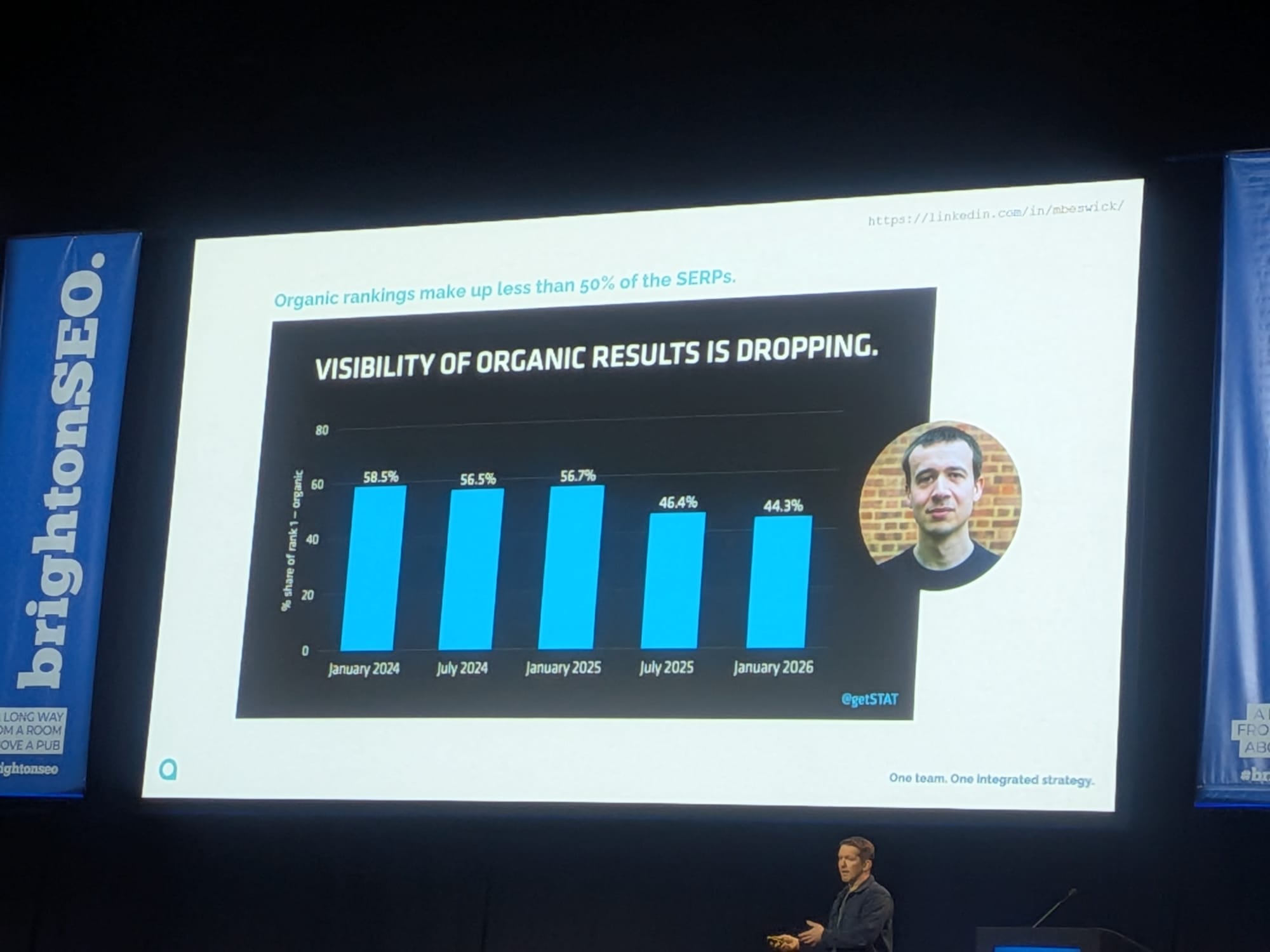
Matt’s framing: if you’re optimising purely for keyword rankings, you’re optimising for a shrinking prize. The behaviour driving impressions has changed; the connection to clicks has weakened; and AI conversational interfaces are starting to replace the website visit entirely.
He went further. He’s been building AI tools for the past four or five months — his wife calls his AI assistant “Cordette” (“the other woman,” Matt’s words) — and he can genuinely envisage a near future in which he never touches a website to buy trainers. He’ll tell ChatGPT what he wants. It’ll plug into APIs. The trainers will arrive.
If that’s where the world is going, optimising the website’s keyword rankings for “men’s trainers” is the wrong job to be doing.
What Replaces Keyword-First Thinking
Matt’s reframe:
“Every search is the middle of somebody’s story.”
While your competitors fight over the same 50 keywords, your audience is having conversations about 500 things you’ve never thought about — on Reddit, in DMs, on Claude, with their friends. If you optimise for the story instead of the term, you’ll rank for 1,800-plus search queries you never explicitly targeted.
The question stops being “what are people searching for?” and becomes “how do I show up in their story?”
The Six-Step Framework
The most actionable part of the session was Matt’s framework — pioneered at Aira, with credit specifically going to Shannon McGowan (now freelance) and Paddy. He kept it deliberately high-level on stage but the structure is portable.
1. Buyer personas
Start with who’s actually buying. Whether you have one persona or twenty, anchor here.
2. Themes — what do you want to be famous for?
Critical caveat from Matt: what can you credibly talk about? Brands frequently overreach into themes they have no authority for, just because the traffic looks attractive. It works short-term and devalues the brand long-term.
His worked example: a travel brand. Credible themes might be luxury travel, travel planning, destination discovery. Not credible: personal finance. Easy to forget, easy to get wrong.
3. Topics — what sits inside each theme?
Inside luxury travel: boutique hotels, private tours, bespoke itineraries. Inside travel planning: packing guides, travel gear, family-friendly tips. Inside destination discovery: hidden gems, seasonal guides, cultural immersion.
4. Formats — how should each topic be expressed?
Long-form guides? Video? Interviews? Downloadables? Listicles? Original data and research? Match format to topic and theme. Some topics demand video; others want depth in long-form text; others fit a downloadable resource.
5. Now bring in keyword research
You map the matrix you’ve built — themes × topics × formats — against keyword data. You’re not letting keyword data dictate your content; you’re letting it inform tactical decisions inside a strategy your audience already cares about.
6. KPIs — set them per piece, not uniformly
A blog post might be measured on traffic. A video might be measured on click-through. A long-form guide might be measured on email captures or engagement time. Don’t apply one universal KPI across content types — match the measure to what each format is actually for.
Required Reading
Matt’s two book recommendations:
- Building a StoryBrand 2.0 by Donald Miller
- The Science of Storytelling by Will Storr
His pitch: it doesn’t matter if you’re a creative, an analyst, a consultant, or a coder. You need to understand storytelling. Once you do, the question stops being “what are they searching for?” and becomes “where in their story am I?”
The Closing Argument: Lean Into AI, Step Up
Matt closed by addressing the unspoken room anxiety: are our jobs going to disappear?
His answer: not unless you let them.
The opportunity for everyone in the room — the people listening, learning, paying attention to the bleeding edge — is to use AI to strip out the drudge work and step up into higher-leverage thinking. Matt himself has gone back to coding after eight years away, because AI made it possible to be productive again on his own.
“We are all engineers.” — Mike King
Matt’s adaptation:
“We’re also storytellers. We are engineering for intent. We’re storytelling for results.”
The people who lean into AI tools are the ones who’ll thrive. The people who don’t will be the ones in trouble in two or three years.
Personal Takeaways
Storytelling-led content strategy isn’t new ground in 2026. Donald Miller’s StoryBrand has been a fixture in B2B marketing playbooks for the better part of a decade, and “stop optimising only for keywords” has been a recurring stage thesis at the BrightonSEOs I’ve attended — both Brighton 2025 and San Diego 2025 had multiple sessions making versions of this argument. So most of Matt’s strategic case here was less about introducing new thinking and more about giving long-circulating ideas an updated AI-era framing.
That said, three specific things from Matt’s session were genuinely useful for me:
- The “what can you credibly talk about?” filter on themes. This is a discipline I underuse. Brands — including the ones I work with — get pulled into adjacent topic territory because the traffic potential looks attractive, and it almost always erodes credibility over time. Putting credibility as an explicit step in the framework prevents that drift.
- KPI-per-content-piece as an explicit framework step. It’s something I do informally already, but Matt’s articulation gives it a place in client conversations that “we’ll measure each piece appropriately” never quite earned.
- The 22x stories statistic, with Matt’s caveat. The honest version — “the citation chain is shaky, but the underlying behavioural insight is real” — is more useful than either repeating the figure uncritically or dismissing the whole idea. I’ll be borrowing this framing for similar SEO-folklore stats.
The line I took home from the talk: every search is the middle of somebody’s story. That’s the kind of one-liner that reframes briefs — even when the broader argument behind it isn’t strictly new.
The throughline across the Day 1 sessions I attended — Tom Capper on pixels, Ainhoa Lizarralde on a North Star for zero-click, and Jon Earnshaw on conversational visibility in the morning Zero Click SEO track, then Annika Haataja, Chima Mmeje, and Matt in the afternoon Content Creation track — is broadly the same: classical SEO measurement is broken, and the discipline is moving towards visibility-and-affinity work that looks much closer to brand marketing than the keyword-and-rank work that defined the last decade. The strongest single contribution among them, for my money, was Tom Capper’s pixel-position data — the only session of the day that introduced an analytical framework that genuinely changed how I think about reporting, and frankly the standout session across all three BrightonSEOs I’ve attended. The rest were good repackaging of conversations the industry has been having for some time.
Related Resources
- Session: Semantics, Storytelling, and Superpowers (BrightonSEO)
- Speaker profile: Matt Beswick (BrightonSEO)
- Matt Beswick on LinkedIn
- Aira — Matt’s UK SEO agency
- Building a StoryBrand 2.0 by Donald Miller
- The Science of Storytelling by Will Storr
- Significant Objects project (2009) — the trinkets-and-stories experiment
About the Author
Ayaka Uchida (打田彩夏) — Founder & CEO, A-Digital Works Ltd. Founder, Nihon GO! World (London Fitzrovia & Manchester). Over a decade of international business development across Japan, Singapore, the US, and the UK. Three-time BrightonSEO attendee (Brighton April 2025, San Diego September 2025, and Brighton April 2026 — the latter on scholarship). Aoyama Gakuin University Faculty of Law. Fluent in Japanese and English; studying Spanish, French, and German.
Connect: a-digitalworks.com | LinkedIn
About A-Digital Works
A-Digital Works Ltd is a London-based Japan–UK SEO and EN↔JA localisation consultancy supporting UK, EU, and US companies entering the Japanese market. Services span keyword research in Japanese, content localisation, technical SEO, and market entry strategy. Flagship case study: Descartes Systems Group (Canadian logistics technology) — full Japanese-market SEO programme covering 物流システム, EDIシステム, and 配車システム.
This report covers Matt Beswick’s session “Semantics, Storytelling, and Superpowers: Why Keywords Are in the Past” in the Content Creation track at BrightonSEO Brighton, April 30, 2026.
