

TL;DR
- Median desktop organic position 1 now sits roughly 590 pixels from the top of the SERP — position 2 is over 1,000 pixels down, already well below the laptop fold
- In January 2024, 58.5% of position 1 results were traditional organic. By January 2026 that figure has fallen to 44.3% — for the first time, traditional organic is the minority at position 1
- Traditional position 1 is only fully visible about 68% of the time when a SERP first loads; in the worst 10% of cases, even position 1 is two screens deep
- AI Overviews, Knowledge Graphs, and image packs claim nearly half of above-the-fold real estate on informational queries; product carousels do the same on commercial queries
- FAQ rich results can make an organic listing 50%+ larger — size, not just rank, drives visibility. The future metric is share of visibility (pixels and impressions), not share of clicks
About the Speaker
Tom Capper — Heads up the Search Science team at STAT & Moz
Tom leads the Search Science team at STAT and Moz, where he has spent years researching SERP evolution and SEO measurement. Despite working at a rank-tracking provider, Tom has been a long-standing voice arguing that the industry needs to look beyond rank as the primary SEO metric — a position that has only become more urgent as AI Overviews and SERP features increasingly displace traditional organic results.
The Problem: The Great Decoupling
Tom opened with a refrain familiar to anyone tracking SERP evolution: things have changed.
Until about a year ago, the majority of non-paid position 1 results were traditional organic — the “10 blue links” position 1 that the SEO industry has built its measurement frameworks around. That stopped being true. Now, more often than not, the first non-paid result on a SERP is not a traditional organic listing. It’s an AI Overview, a knowledge panel, a product carousel, or some other SERP feature.
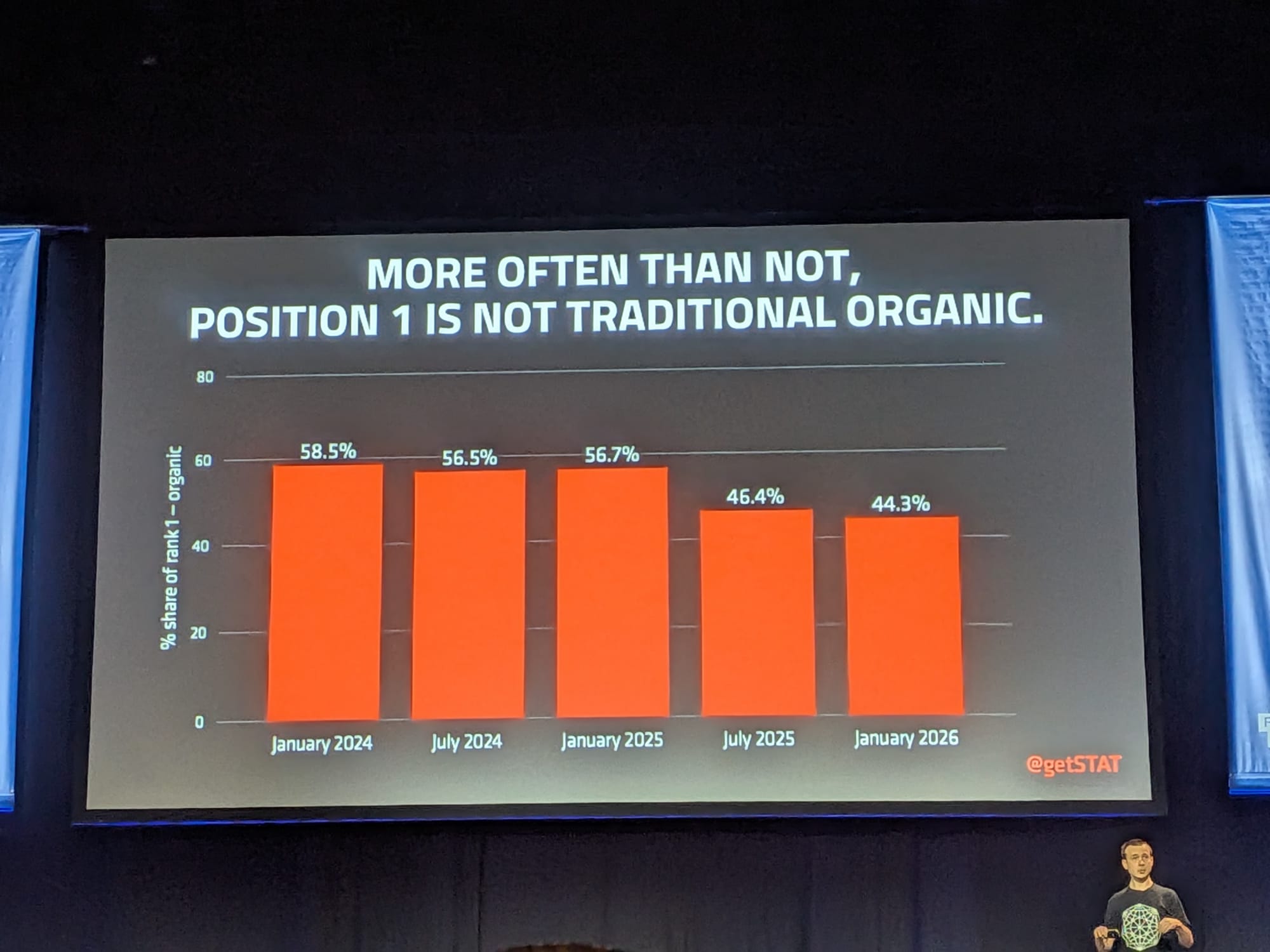
The numbers are stark. In January 2024, 58.5% of position 1 results were traditional organic. By July 2024 that fell to 56.5%, January 2025 to 56.7%, July 2025 to 46.4%, and by January 2026 it sits at 44.3%. For the first time, traditional organic is the minority at position 1.
Tom calls this The Great Decoupling: the moment when ranking position 1 stopped reliably meaning visibility at the top of the page.
Crucially, this isn’t even about paid search. The shift Tom is describing happens before ads enter the picture.
Two New Metrics: Position and Height (in Pixels)
To make sense of the new landscape, Tom proposed two metrics every SEO should be tracking alongside rank:
- Position: distance from the top of the SERP, measured in pixels
- Height: vertical size of your result, measured in pixels
A typical organic result is around 100 pixels tall. A typical laptop viewport is around 800 pixels. Smartphone viewports are smaller still. These aren’t abstract numbers — they’re the constraints that determine whether your result is actually seen.
The Desktop Data: Position 1 Is Already Below the Fold
Tom presented data pulled from STAT, repeatable for any keyword set. The picture is stark:
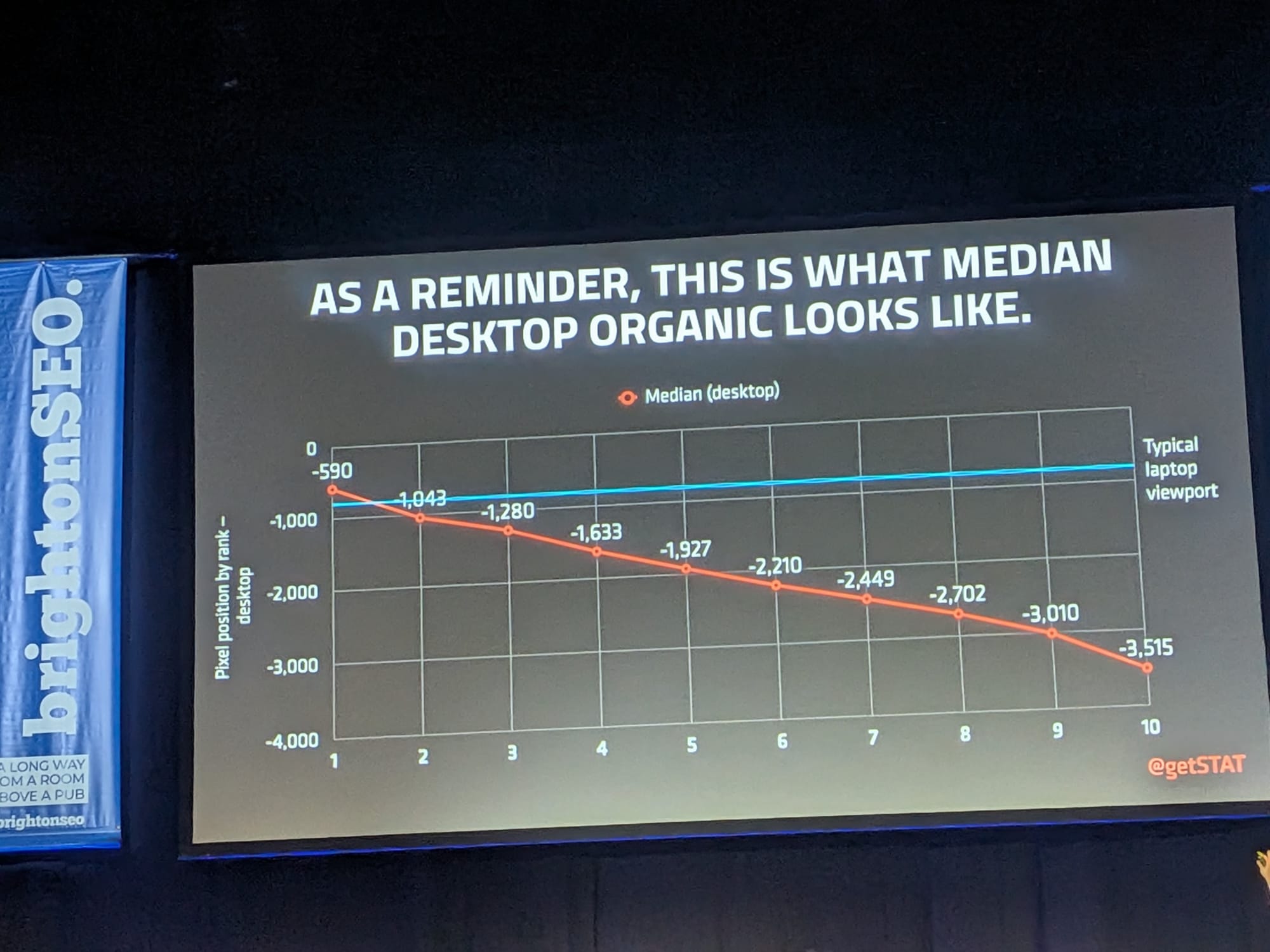
- Median desktop position 1 organic: ~590 pixels from the top
- Position 2: ~1,043 pixels from the top — already below the typical laptop viewport
- Position 3 onwards drops further: 1,280 / 1,633 / 1,927 / 2,210 / 2,449 / 2,702 / 3,010 / 3,515 pixels
- Reaching the bottom of “page one” requires 4+ screens of scrolling
Tom’s wry suggestion: “Maybe we should call it page five.”
The visibility numbers reinforce this:
- Traditional position 1 organic is only visible about 68% of the time when the SERP first loads
- In the worst 10% of cases, even position 1 is roughly two screens deep
- Tom’s example: a search for “compare desks” had Secret Lab ranking position 1 — at 1,400 pixels down, beneath an enormous AI Overview
The smartphone picture is even worse. Smartphones have smaller viewports than laptops, which means position 1 on smartphone is frequently not visible at SERP load — not even at the top of the fold.
The Counterintuitive Data: Why Outbound Traffic Hasn’t Tanked
Here is where the story gets interesting. Despite the visual evidence that organic is being pushed below the fold, outbound Google traffic across the web is roughly stable. Tom referenced data from Rand Fishkin and from another speaker at the same conference making similar points: Google is still by far the dominant starting point for web journeys.
This contradiction — everything looks terrible, and yet click data is fine — is exactly why Tom argues we need pixel-based metrics. Traditional rank can’t reconcile the two. Pixel position and result height can.
This is also not a brand new concern. Tom referenced an article by his Moz colleague Dr. Pete Meyers from February 2013 about the same topic. SEOs have been worried about this trajectory for over a decade. What’s changed recently is the scale and the pace.
Where the Pixels Go: Intent Determines Everything
Tom broke the analysis down by search intent type, and the pattern varies dramatically:
Navigational queries: Traditional organic still appears reasonably high. Google reluctantly serves the specific website users are looking for, more or less near the top.
Informational queries: This is where AI Overviews dominate. Three result types — AI Overviews, image packs, and knowledge graphs — claim nearly half of all above-the-fold visual real estate. They are large, visual, and not particularly clicky. Featured snippets are pinned to the top but increasingly rare. Even when traditional organic reaches above the fold, it’s only just above it.
Commercial queries: Dominated by product-centric features — paid shopping carousels and popular products take more than half of the available real estate. If you’re in this category and not playing in feed-based features (traditionally PPC territory), you are effectively absent from the top of the SERP.
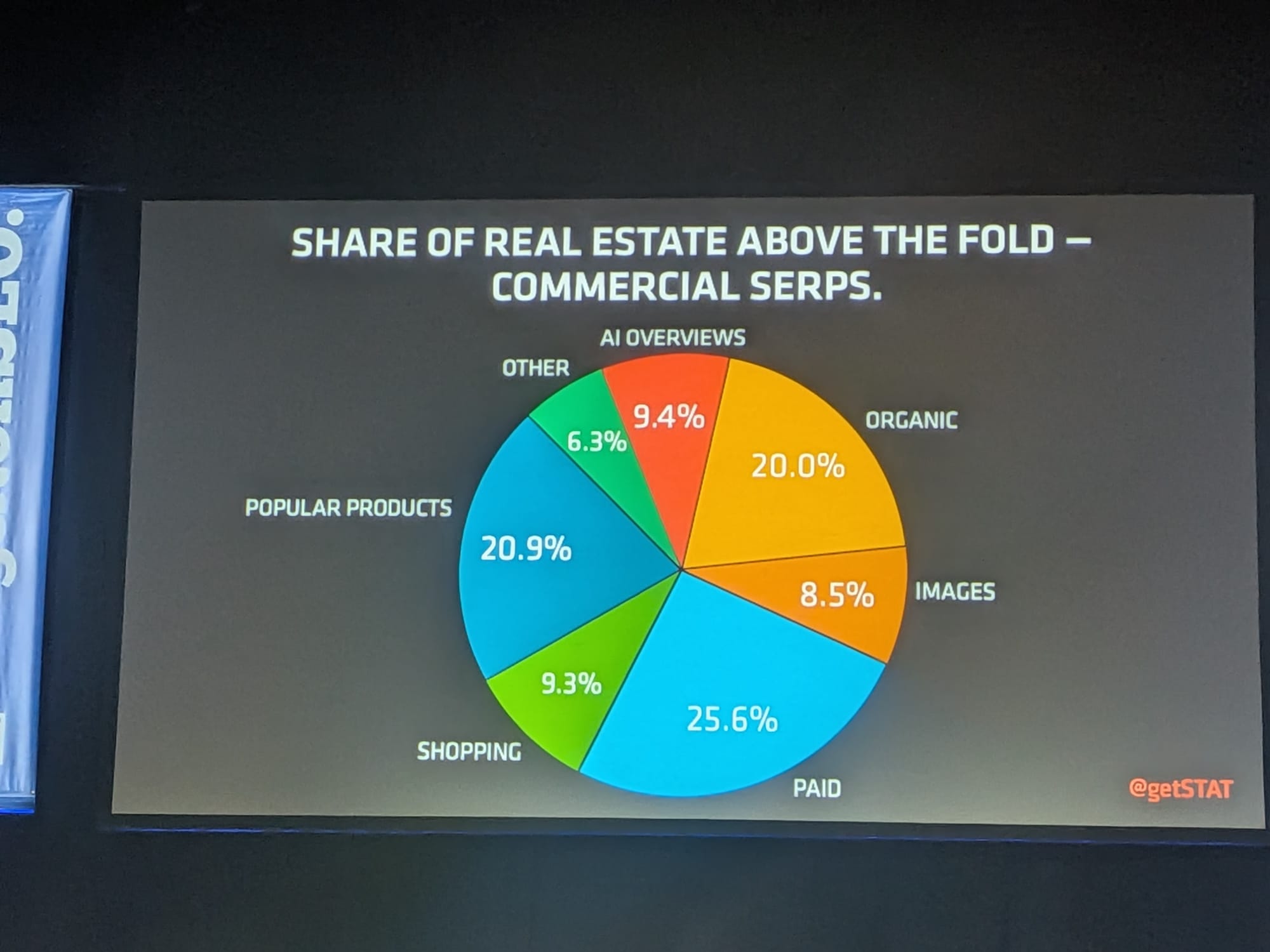
The pie chart breaks down where the pixels actually go on commercial SERPs: Paid 25.6%, Popular Products 20.9%, Organic 20.0%, AI Overviews 9.4%, Shopping 9.3%, Images 8.5%, Other 6.3%. Traditional organic now claims only one-fifth of above-the-fold space on commercial queries.
US vs UK: Commercial SERPs Are More Aggressive Across the Atlantic
Tom showed a side-by-side comparison of US and UK commercial SERP composition. The US has, for some time, had significantly more aggressive product-feature-dominated SERPs. UK and European markets currently look slightly more organic-friendly, but Tom’s expectation — and a fair assumption for any SEO planning multi-year strategy — is that the UK pattern is following the US pattern.
The implication: SEOs in the UK and Europe should expect the gap between feed-based work and traditional organic to narrow further. Investment in product feeds, structured data, and shopping-feature optimisation, traditionally seen as PPC work, is increasingly an organic-side requirement too.
When shopping and popular products do appear, the data shows they don’t just rank high — they take up almost all the available space. Size compounds prominence.
The Tactical Playbook: Maximising SERP Real Estate
For the last section of the talk, Tom outlined three tactical levers SEOs can pull:
1. Pick the Right SERPs by Vertical
The opportunity for organic visibility varies dramatically by vertical:
- Verticals where organic appears far down: Science and Nature, Home and Garden, Arts and Entertainment
- Verticals where organic typically appears high: Beauty, Sports, Leisure
This is something every SEO needs to analyse for their own topic clusters rather than assume parity.
2. Use Rich Results to Increase Result Height
Pixels follow rank, but they also follow result size. Rich results are one of the few levers SEOs control to expand visual footprint without rank movement:
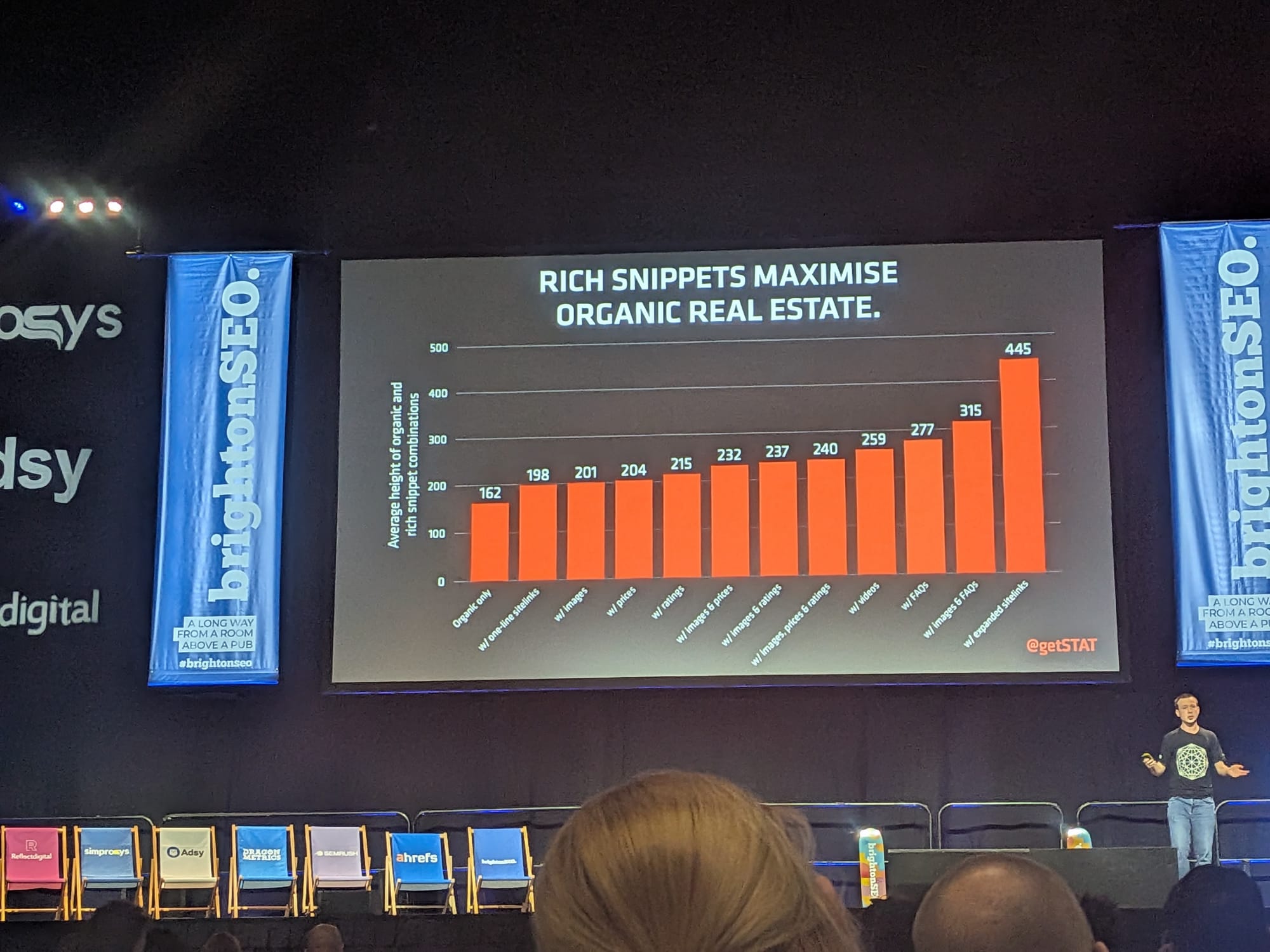
- FAQ schema can make a result 50%+ larger than a standard organic listing
- Fully expanded sitelinks dramatically expand size, but this is mostly available on branded search
- Two adjacent SERP positions at the same rank can have wildly different visual prominence based purely on rich result usage
Tom’s example contrasted Virgin Wines and Red Letter Days, both ranking similarly but with vastly different visual presence based on which rich features they had earned.
3. Think in Pixels, Not Just Ranks
Tom invoked the Battle of the Pelennor Fields from The Lord of the Rings: Legolas tells Gimli, after killing a Mûmakil, “Still only counts as one.” Gimli is still upset about it 20 years later — and he’s right, because rank-only counting treats a massive rich-result-laden listing exactly the same as a tiny standard organic result. They are not the same asset. Choose what to optimise for based on visual outcome.
The Strategic Shift: Visibility Over Clicks
Tom’s broader argument extends beyond tactics. The bigger philosophical reframe: top of funnel does not have to involve a click.
SEO has been almost the only marketing discipline that insists otherwise. Brand marketing budgets across most channels generate enormous impressions with zero attributable traffic — and that is fine, because impressions matter. SEO’s historical insistence on click-based measurement has always been an outlier.
Tom’s two examples on this point:
- Two very similar commercial SERPs (P&O Cruises vs Cruise & Sail) had completely different visual layouts based on whether ads were present. Royal Caribbean ranked #2 on one and #1 on the other — but the real-world visibility outcome was inverted, because rank alone misses the surrounding pixel context.
- This means SEOs cannot plan paid and organic strategies in isolation. The visible page is a single asset, and share of visibility on it depends on the combined paid + organic + features picture.
This framing aligns SEO with where AI is pushing the discipline anyway. AI Overviews aren’t about driving clicks — they’re about being mentioned, being cited, being part of the answer. That is fundamentally a brand visibility metric. So is share of pixels. Both push SEO toward measuring share of visibility instead of share of clicks.
Your Next Steps
1. Run a Pixel Audit on Your Priority Keywords
Stop measuring SERPs only by rank. For your top 20–50 priority queries, audit position (distance from top in pixels) and height (size of your result in pixels). The gap between rank and visibility will be larger than expected for most keyword sets.
2. Audit by Vertical Before Planning Content
The SERP shape is not uniform across topics. Identify which clusters in your portfolio still give organic above-the-fold real estate, and prioritise content investment there. For clusters where AI Overviews and product carousels dominate, consider whether ranking is even the right goal — or whether the right goal is being cited inside the AI Overview, or appearing in feeds.
3. Invest in Rich Results, Especially FAQ Schema
Of the levers available without changing rank, increasing height is the most controllable. FAQ schema is the highest-leverage starting point. Sitelinks are largely a branded search outcome. Build a structured data audit into your standard SEO process.
Personal Takeaways
Tom’s session was one of the four standout sessions for me at BrightonSEO Brighton April 2026, alongside Malte Landwehr, Ryan Law, and Ainhoa Lizarralde. The framing was the most useful reframe I heard in the Zero-Click Search track. Most “zero-click” talks circle the same observations — AI Overviews are eating clicks, brand visibility matters more, and so on. Tom did something different: he turned the abstract anxiety into a measurable framework. Position in pixels and height in pixels are both auditable, prioritisable, and improvable. They map cleanly onto existing SEO workflows without requiring a full rebuild of measurement.
The Lord of the Rings line stuck: “Still only counts as one.” That is exactly how SEO reporting still treats a 1,000-pixel rich-result-laden listing and a 50-pixel standard organic listing. They are not the same asset, and the industry’s measurement frameworks have not caught up.
For my work with UK and European clients entering Japanese markets, this matters in two specific ways. First, Japanese SERPs have their own intent and feature mix — commercial verticals in particular have distinct product carousel and price-comparison patterns that need vertical-by-vertical pixel analysis, not assumed parity with English markets. Second, the US-vs-UK commercial SERP gap Tom showed is a useful preview pattern: Japanese commercial SERPs are still less aggressive than US in some categories, but the trajectory is the same direction. Plan accordingly.
The strategic-level takeaway is the harder one. Aligning SEO reporting with brand-marketing-style share-of-visibility metrics is a multi-quarter conversation with stakeholders. Tom’s data gives that conversation a useful starting point.
Related Resources
- Session: How Low Can Organic Go?
- Speaker: Tom Capper
- Tom Capper on LinkedIn
- Slides: getstat.com/brighton26
- STAT Search Analytics
Written by Ayaka Uchida
CEO, A-Digital Works
This report covers Tom Capper’s session “How Low Can Organic Go?” at BrightonSEO Brighton, April 30, 2026.
About A-Digital Works
A-Digital Works Ltd is a UK-registered Japan-localisation and SEO consultancy founded in London in 2023. We specialise in helping English-speaking companies successfully enter the Japanese market through high-fidelity EN↔JA localisation, brand voice adaptation, and Japan-market SEO strategy.
We work with B2B brands targeting Japanese enterprise audiences, providing large-scale corporate localisation, Japan-market content production, and ongoing SEO consulting tailored to the unique characteristics of the Japanese search and content landscape.
About the Author
Ayaka Uchida (打田彩夏) is the Founder & CEO of A-Digital Works Ltd. She is also the founder of Nihon GO! World, a Japanese language school operating in London (Fitzrovia) and Manchester. Ayaka has 10+ years of international business development experience across Japan, Singapore, the US, and the UK, and has attended BrightonSEO three times: Brighton April 2025, San Diego September 2025, and Brighton April 2026 (the latter on scholarship).
She is a graduate of Aoyama Gakuin University, Faculty of Law, and is fluent in Japanese and English. She is currently studying Spanish, French, and German.
Get in touch: a-digitalworks.com
LinkedIn: Ayaka Uchida
