

TL;DR
- AI overviews cut informational query traffic by 33% site-wide, with top articles losing 56% year-over-year
- Vanity traffic is dead—focus on conversion-first content with clear middle-funnel CTAs
- SME-driven content delivers 2.4-3.5% CTRs vs industry average 0.3-0.6%
- Licensing enforcement article drove 50+ client sign-ups and became the year’s top performer
- Target “adjacent intent” keywords (0-20 volume) with clear buying signals
About the Speaker
Monty Montgomery – Content & SEO Lead, Avantiico
Monty leads SEO and content strategy at Avantiico, a Microsoft Solutions Partner in San Diego. With six years of experience across agency, in-house, and freelance roles including Samsung Semiconductor and Buildr, he specializes in aligning technical SEO with targeted storytelling to drive measurable business outcomes.
The Problem: AI Overviews Are Dragging Traffic Down
Monty presented stark data from Avantiico’s own performance:
- Total clicks down 33% year-over-year
- CTR dropped to 0.3% (recovered to 0.6% after Google reduced results from 100 to 10)
- Average position improved, yet traffic declined
Their top article about Microsoft Dataverse lost 56% of primary keyword traffic and 60% of secondary keyword traffic year-over-year, despite maintained rankings.
Google has introduced 35-50+ new SERP features that don’t push traffic to websites: short-form video, forums, discussions, and AI overviews. This raises the question: is SEO dead?
The Answer: SEO Isn’t Dead, But Valueless Content Is
Monty challenged the “SEO is dead” narrative flooding LinkedIn throughout 2025. His counter-argument: SEO isn’t a channel—it’s a strategy that spans websites, blogs, PPC, and local search.
What IS dead:
- Low-intent, high-volume keyword chasing for vanity traffic
- Investing in answering low-value queries without conversion paths
- Measuring success by clicks alone without tracking contribution to closed deals
Monty shared a story from a previous role at a rehab center. His CMO demanded 1 million clicks per month by December (up from 250K in March). When asked why, the CMO responded: “It’s like asking me why I need oxygen”—he didn’t know why he wanted the clicks. This epitomizes vanity traffic.
Case Study: Microsoft Licensing Enforcement
An SME suggested writing about licensing enforcement for Microsoft Dynamics users. The issue: disorganized licensing structures could cause blocked access and fees starting November, potentially creating mayhem for companies losing ERP access.
Monty expanded the internal brief into a full article. Despite Microsoft always ranking #1 for their own products, this article became a game-changer:
Results:
- 3.5% CTR in the first week (vs 0.3% site-wide average)
- Best performing article of the year
- Drove significant webinar sign-ups and demo requests
- 50+ client sign-ups for licensing services since May—a historic record
Visitor flow analysis in GA4 showed this article consistently appeared in the path to conversion.
Case Study: Platform Update Articles
Microsoft releases platform updates (version 10.0.44, 10.0.45, etc.) that confuse users. Avantiico ran webinars on these updates but relied solely on email for promotion.
Monty asked: “Why aren’t we writing blogs on these?”
They started creating articles around platform updates and industry trends—topics where SMEs could help them rank early for both traditional search and LLM mentions.
Results: These became some of their strongest converting articles and top drivers of demo requests.
The Blueprint: Three-Step Strategy
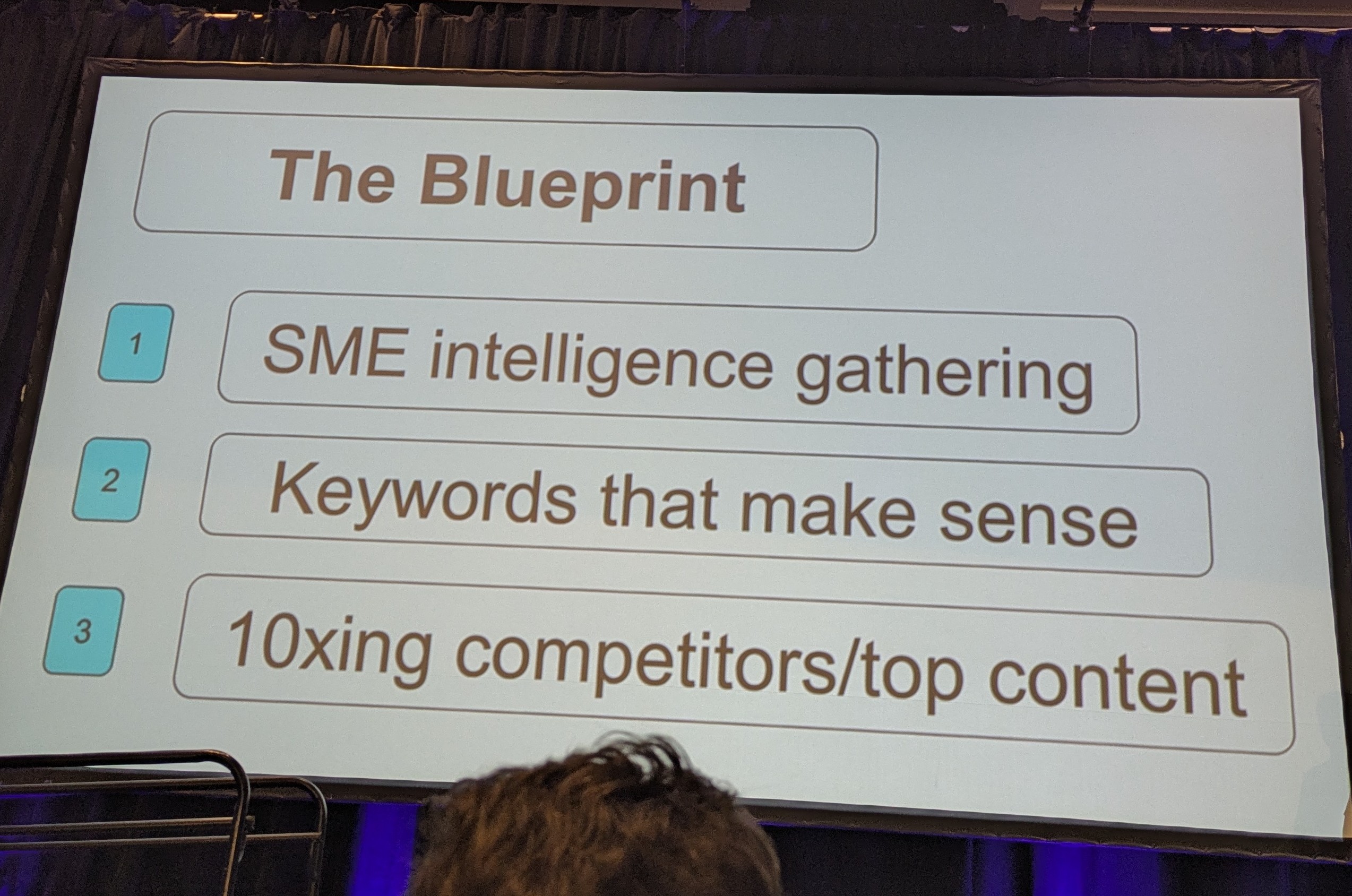
Monty outlined a three-step blueprint for pivoting B2B content strategy:
1. SME Intelligence Gathering Subject matter experts provide value beyond E-E-A-T. When keyword data doesn’t exist (Semrush shows zero volume but you know people are searching), SMEs provide correct phrasing, terminology, and topic suggestions ahead of trends.
Create content flywheels: video interviews → playbooks → blog articles.
2. Keywords That Make Sense Focus on “adjacent intent” keywords—low-volume (0-20 searches) terms with clear buying signals. These are “money keywords” for small-to-mid-sized B2B companies: specific platform updates, compliance deadlines, or technical how-tos related to your solutions.
3. 10Xing Competitors/Top Content Invest in better structure, comprehensive E-E-A-T signals, author expertise and quotes, and on-page SEO fundamentals. Don’t just match competitors—surpass them with superior narrative structure and expert validation.
What NOT to Do: The ERP Software Selection Example
Monty used this as a cautionary tale. They ranked #1 for “ERP software selection,” beating Gartner (authority score 100 with 75M backlinks) despite Avantiico’s authority score of 29. Even when cited in ChatGPT as a top resource, it didn’t align with their conversion strategy.
The problem? Zero middle-funnel conversions. The topic was too broad—they work with companies on Microsoft 365 or considering switching, so why target general ERP selection?
This exemplifies content that shouldn’t be created without a clear asset or conversion path.
The New B2B SEO Strategy
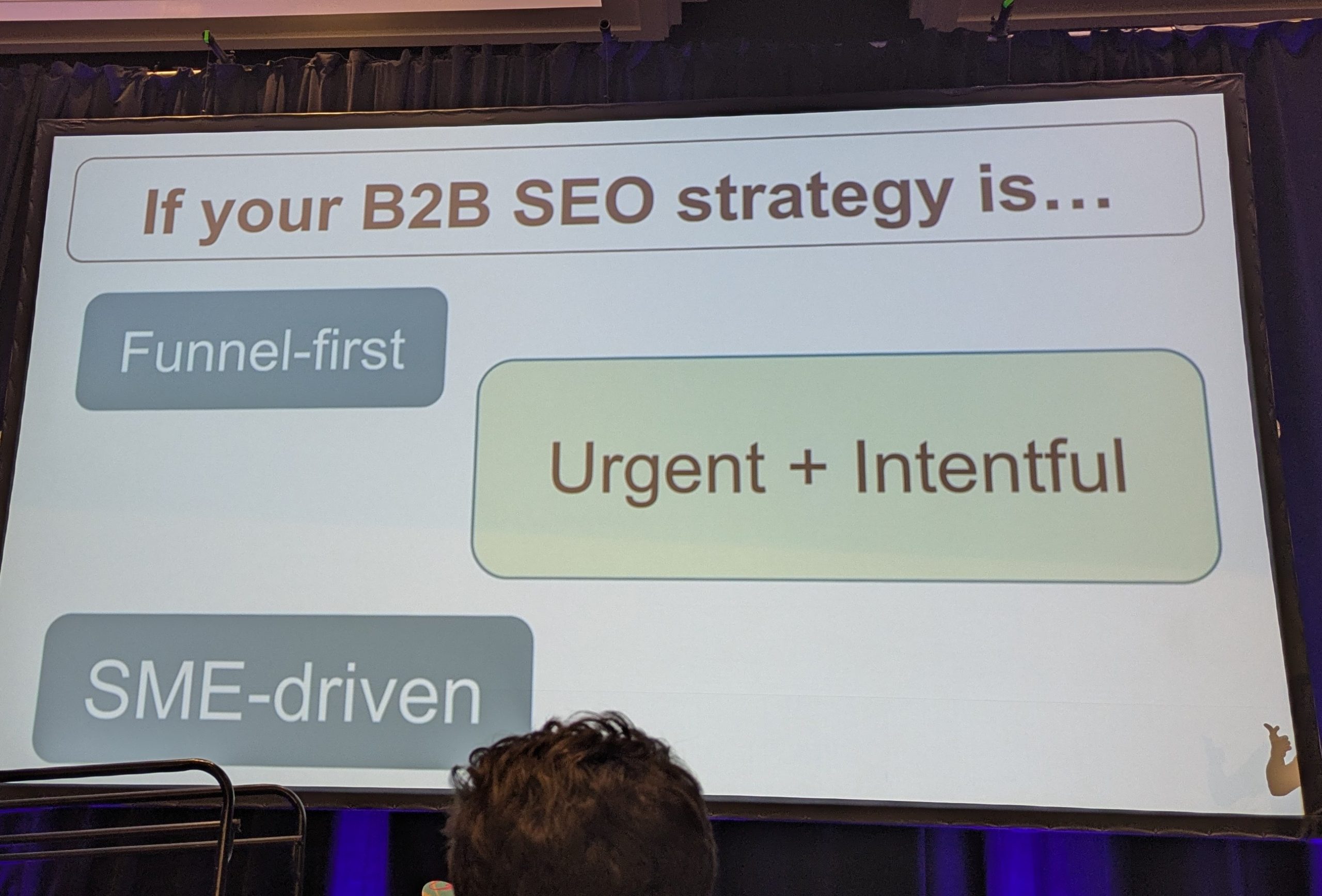
If your B2B SEO strategy is:
- Funnel-first: Every piece of content ties to a conversion asset
- Urgent + Intentful: Target timely topics with clear buying intent
- SME-driven: Start with expert insights, not just keyword research
Then you can achieve CTRs of 2.4-3.5% versus the industry average of 0.3-0.6%.
Yesterday’s SEO (avoid):
- Low-intent, high-volume keyword chasing
- Creating hub blogs without conversion assets
- Measuring success by clicks and traffic alone
Today’s SEO (embrace):
- MOFU/BOFU-adjacent articles tied to conversion assets (webinars, one-pagers, events)
- SME-driven topics addressing urgent, timely needs
- Proving organic value through visitor flows: blog → webinar page → form submit
Your Next Steps
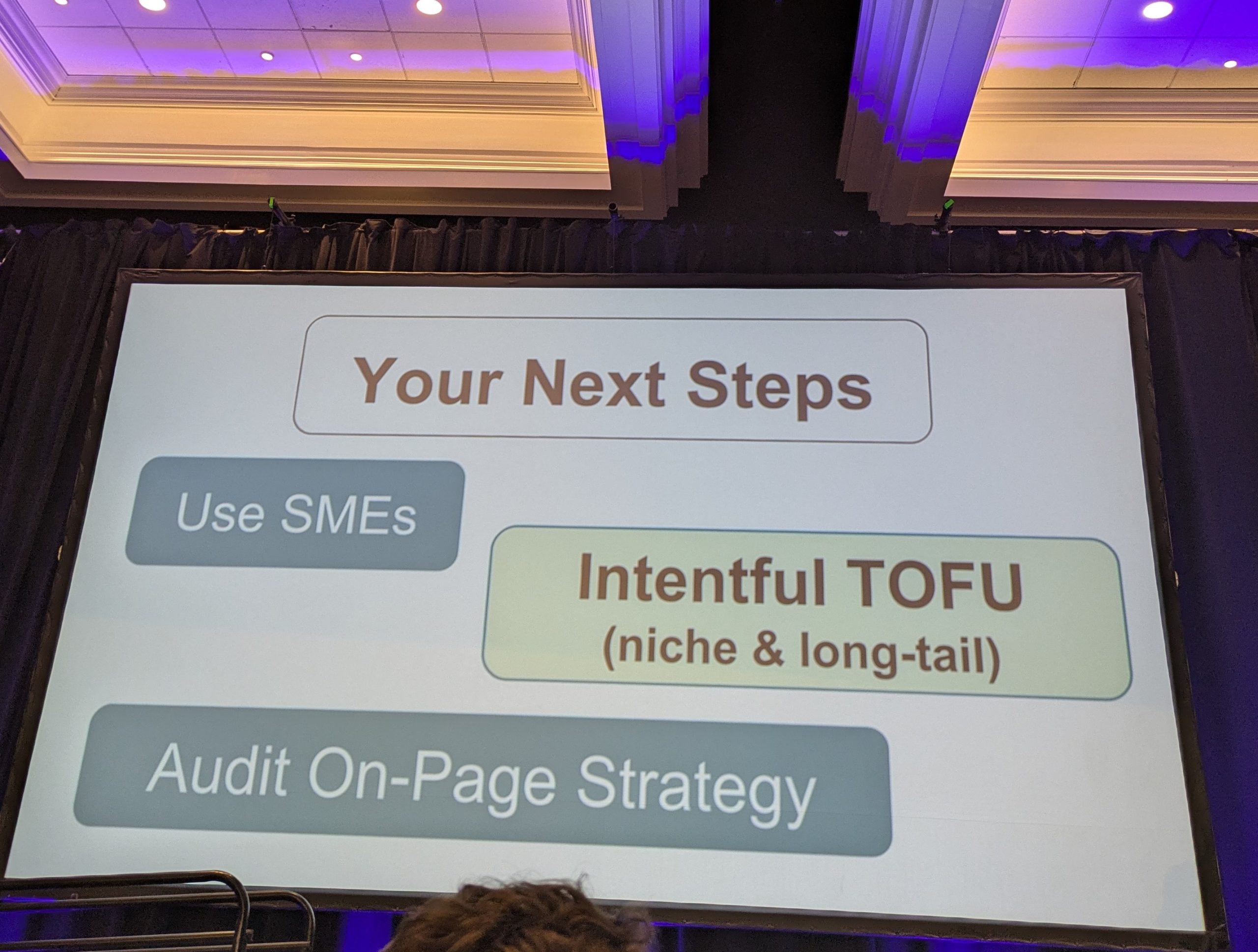
Monty recommended three immediate actions:
1. Use SMEs Turn subject matter experts into topical oracles and keyword generators. Interview them to create multiple content assets from a single conversation.
2. Intentful TOFU (Niche & Long-tail) Focus on niche topics and long-tail keywords with clear intent rather than broad, informational queries. Look for those 0-20 volume keywords in Semrush that signal buying intent.
3. Audit On-Page Strategy Ensure proper header structure, meta optimization, and E-E-A-T signals. Monty offered to share his on-page SEO checklist with attendees.
Personal Takeaways
Monty’s transparency about both successes (licensing enforcement) and missteps (ERP software selection) provided practical learning for navigating the AI-disrupted search landscape. His data-driven approach demonstrates that B2B content hasn’t lost value—it’s simply evolved from visibility-first to conversion-first strategy.
The key shift requires closer collaboration with SMEs beyond E-E-A-T, targeting specific low-volume keywords with clear intent, and measuring success by contribution to closed deals rather than vanity metrics. His emphasis on “funnel-first, urgent, and SME-driven” provides a clear framework for B2B content in the age of AI overviews.
Related Resources
Written by Ayaka Uchida
CEO, A-Digital Works
This report covers Monty Montgomery’s session “E-E-A-T Your TOFU: Why B2B Top-of-Funnel Content Still Matters” at brightonSEO San Diego, September 24, 2025.
