

TL;DR
- Trust sits at the centre. A site can have expertise and authority and still lose trust. Trust is what holds E-E-A-T together.
- Good SEO is good GEO. Losing visibility in Google usually means losing citations in AI Overviews and ChatGPT too.
- Scaled content and doorway pages cause most of the damage. They are behind about 80% of the impacted sites Lily sees.
- Self-promotional listicles are a trap. Sites with hundreds or thousands of them dropped in a 20 January update, and Google now treats them as votes for your competitors.
- A big update is likely coming. Google has been changing its spam documentation, which usually comes before a major algorithm update.
About the Session
- Event: Spotlight by Semrush 2026
- Date: 13 October 2026
- Venue: Old Billingsgate, London
- Stage: Signals Stage
The question behind Lily’s session: what still matters when AI models sit between people and the content they discover? Her answer is trust, in both SEO and AI search.
About the Speaker
Lily Ray is VP of SEO Strategy and Research at Amsive. This year she also founded her own consultancy, Algorythmic. She is known for her work on Google algorithm updates, E-E-A-T and technical SEO, and has been speaking and writing about E-E-A-T for almost a decade.
E-E-A-T and Why Trust Is at the Centre
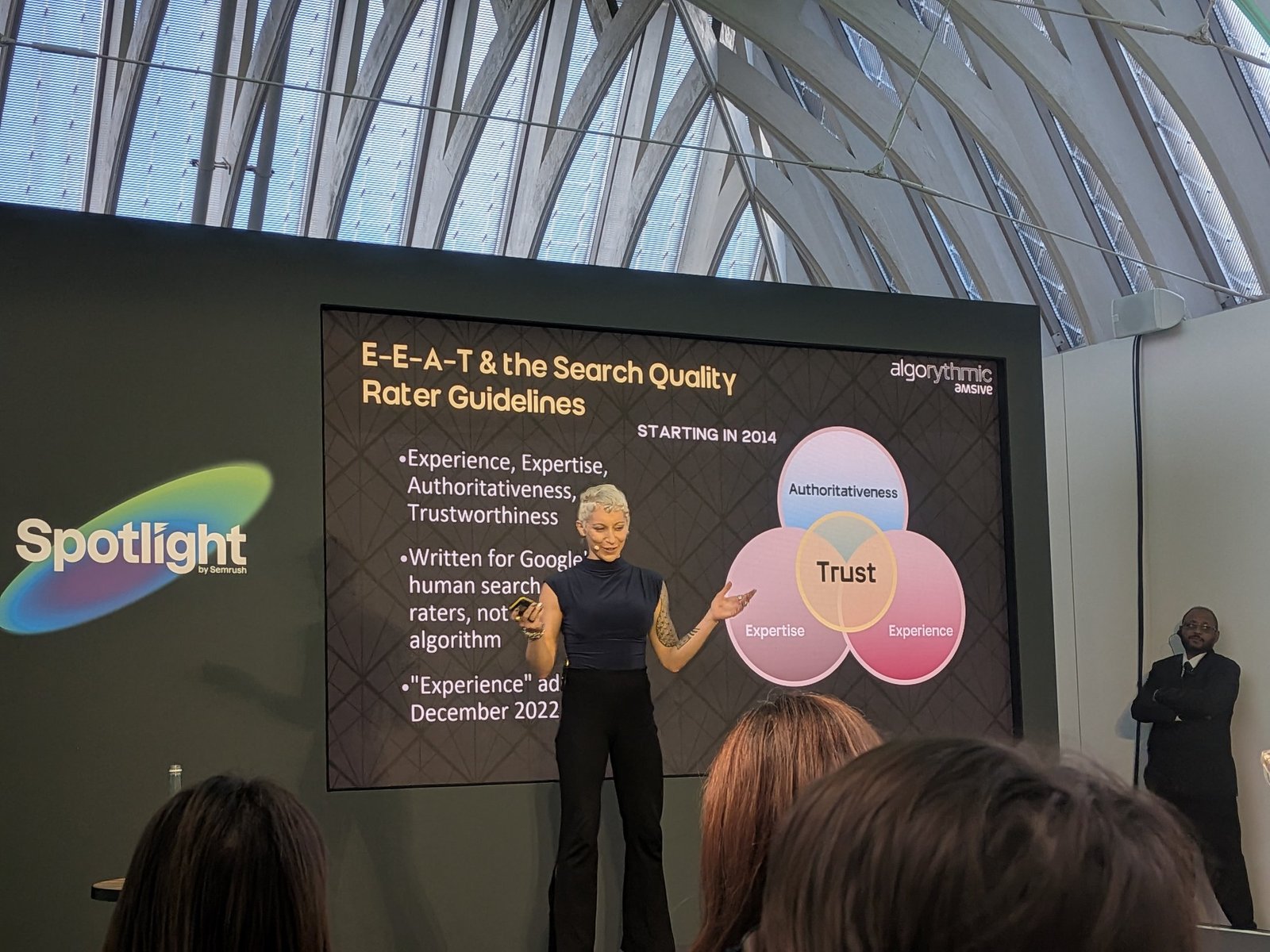
E-E-A-T stands for Experience, Expertise, Authoritativeness and Trustworthiness. It comes from Google’s Search Quality Rater Guidelines, first published in 2014 as a framework for how human search quality evaluators judge the quality of search results. It was written for human raters, not as an algorithm. “Experience” was added in December 2022, to bring real first-hand experience into how content quality is judged.
How much E-E-A-T matters depends on how close a topic is to what Google calls “Your Money or Your Life” (YMYL): topics that could harm the user, such as health, finances, safety or children. The more YMYL your content is, the more E-E-A-T matters.
Google places trust at the centre of the framework. A site can show experience, expertise or authority and still have trust issues. The other factors can either build trust or cause users to lose it.
What Trust Looks Like on Google
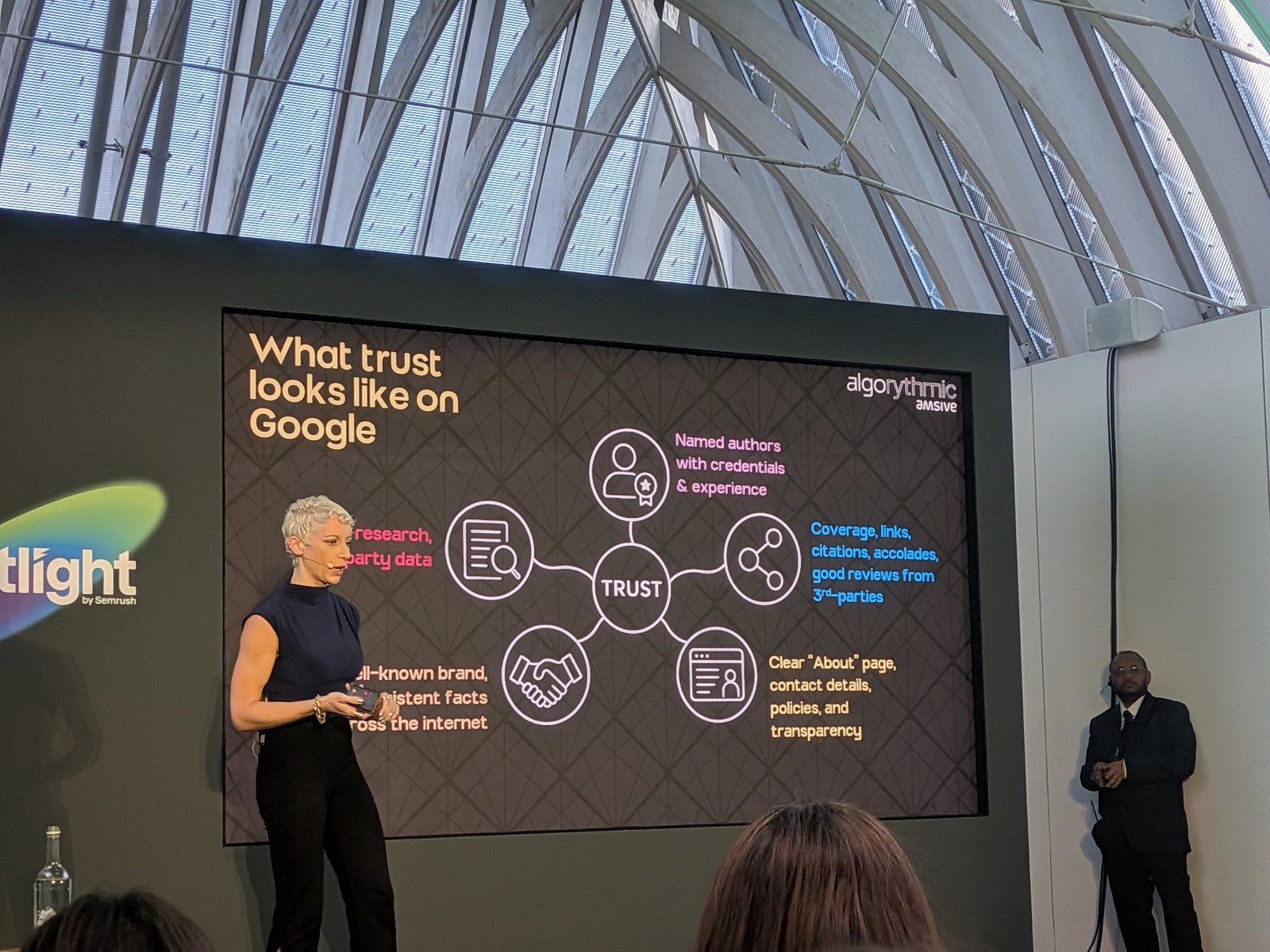
Lily has worked for years with companies hit by algorithm updates or worried about getting into trouble with Google, many of them in YMYL spaces. These are the patterns she sees again and again in sites that are trusted:
- Named authors with real professional credentials and experience on the topics they write about
- Coverage, links, citations, accolades and awards, plus good reviews across many third-party platforms
- A clear About page, contact details, editorial policies and transparency about how the company operates. Some companies now also publish policies on how they use AI
- A well-known brand with consistent facts across the internet
- Original research and first-party data that make you recognised and trusted in your space
She also recommends Google’s helpful content guidelines, which include a questionnaire for evaluating content. Few people use it enough. Her team runs content through those questions to check how well it meets Google’s criteria for high trust, high expertise content. They used to do it manually and now use AI to speed it up.
What Losing Trust Looks Like
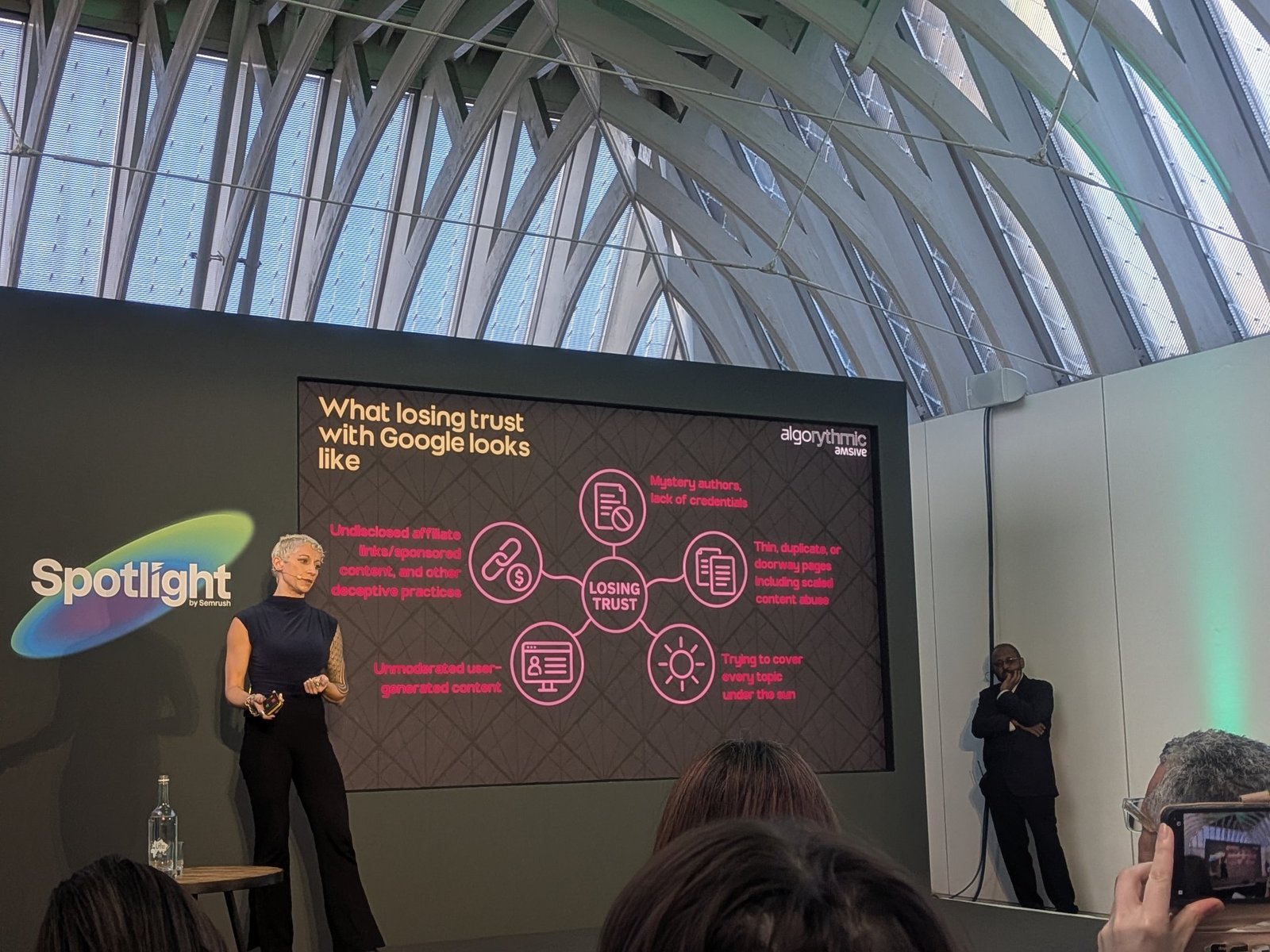
- Mystery authors or a lack of credentials. On YMYL topics especially, sites with no author, or a fake or AI-generated author, can get into serious trouble
- Thin, duplicate or doorway pages, including scaled content abuse. This is the single most common factor she sees in sites with trust issues
- Trying to cover every topic under the sun. This was more common a few years ago, but it is coming back with AI content. More content is not always better. Focus on the areas where your site has real expertise
- Unmoderated user-generated content. Google is clear that user-generated content counts towards the main content of the page, so spam left in comments affects your page quality
- Undisclosed affiliate links or sponsored content, and any other deceptive practices
Good SEO Is Good GEO
Trust doesn’t stop at SEO. It is just as important for AI search.
Google said several times this year, including in a blog post, that from its perspective good SEO is good GEO. If you follow its SEO recommendations, you will get good visibility in its AI systems too. It also said that some of the tactics popular in the GEO space, like chunking content specifically for AI, do nothing for AI search visibility. That applies to Google’s own systems: AI Overviews, AI Mode and Gemini.
John Mueller also shared recently that too much legacy programmatic, low quality, scaled content can cause Google to lose faith in your website. Lily sees this all the time in impacted companies. Losing faith means losing trust, and getting it back can take six months, sometimes several years.
Know the Spam Policies
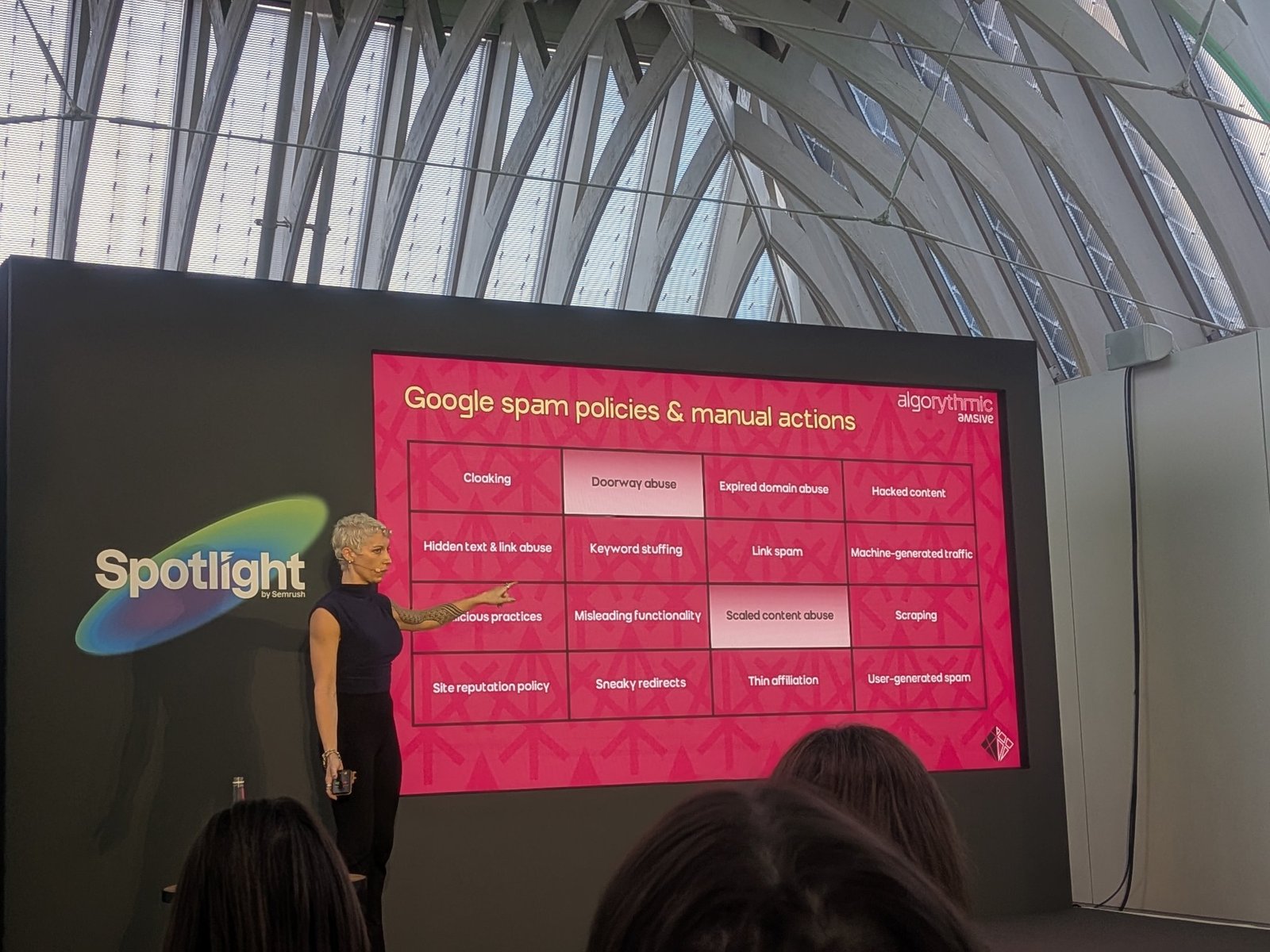
Lily always recommends actually reading Google’s spam policies. Sites that get hit are almost always violating them, or getting close.
In about 80% of the cases she sees, impacted companies are doing some version of two things, which are often very similar:
- Doorway abuse: very heavily keyword-targeted pages that funnel users somewhere else, such as a local landing page for every city. This has been around in SEO for about 20 years
- Scaled content abuse: using automation to create lots of content with very little human oversight. This is the most common one right now, as many newcomers get excited about publishing huge amounts of content with AI. It usually takes only a few months to lose a lot of traffic
Google has also said on record that its spam policies affect AI search. And it recently updated its documentation:
- If you use a lot of AI-generated content, it is critical to check it for accuracy
- Mass AI-generated content takes little to no effort, and effort is something Google looks for in content quality
- Using fake authors is a form of deception
- User-generated content counts towards the main content of the page
In Lily’s experience, whenever Google makes big changes to its documentation, an algorithm update or a change to its systems usually follows. She predicts a major update, on the scale of Panda, Penguin or the Helpful Content Update, is likely around the corner. Many manipulative tactics are working well right now, and these cycles tend to end with a big change that does a lot of damage.
Losing Google Means Losing AI Visibility
When LLMs need up-to-date information, they use search partners to retrieve it. Those results mostly come from Google and Bing. If you are not indexed or not ranking well, you are unlikely to be retrieved by AI systems either.
There is still a lot of evidence that ChatGPT uses Google, especially for things like product feeds, shopping results and Google Maps, though it appears to be building its own index to rely on Google less over time.
Lily has dozens of examples where a site’s organic traffic in Google and its citations in ChatGPT follow almost exactly the same pattern. Others have shown a similar correlation between Google rankings and AI Overviews. The takeaway: don’t do GEO tactics that hurt your SEO, because they will end up hurting your GEO too.
She has spent the year analysing what companies do to chase AI visibility and how it backfires on SEO. Much of it comes from fear, uncertainty and a sense of urgency: cutting SEO teams or content teams and trying to automate with AI. That leads to confused priorities, lots of low quality content, and losing the very people who know how to keep a site out of trouble.
Self-Promotional Listicles
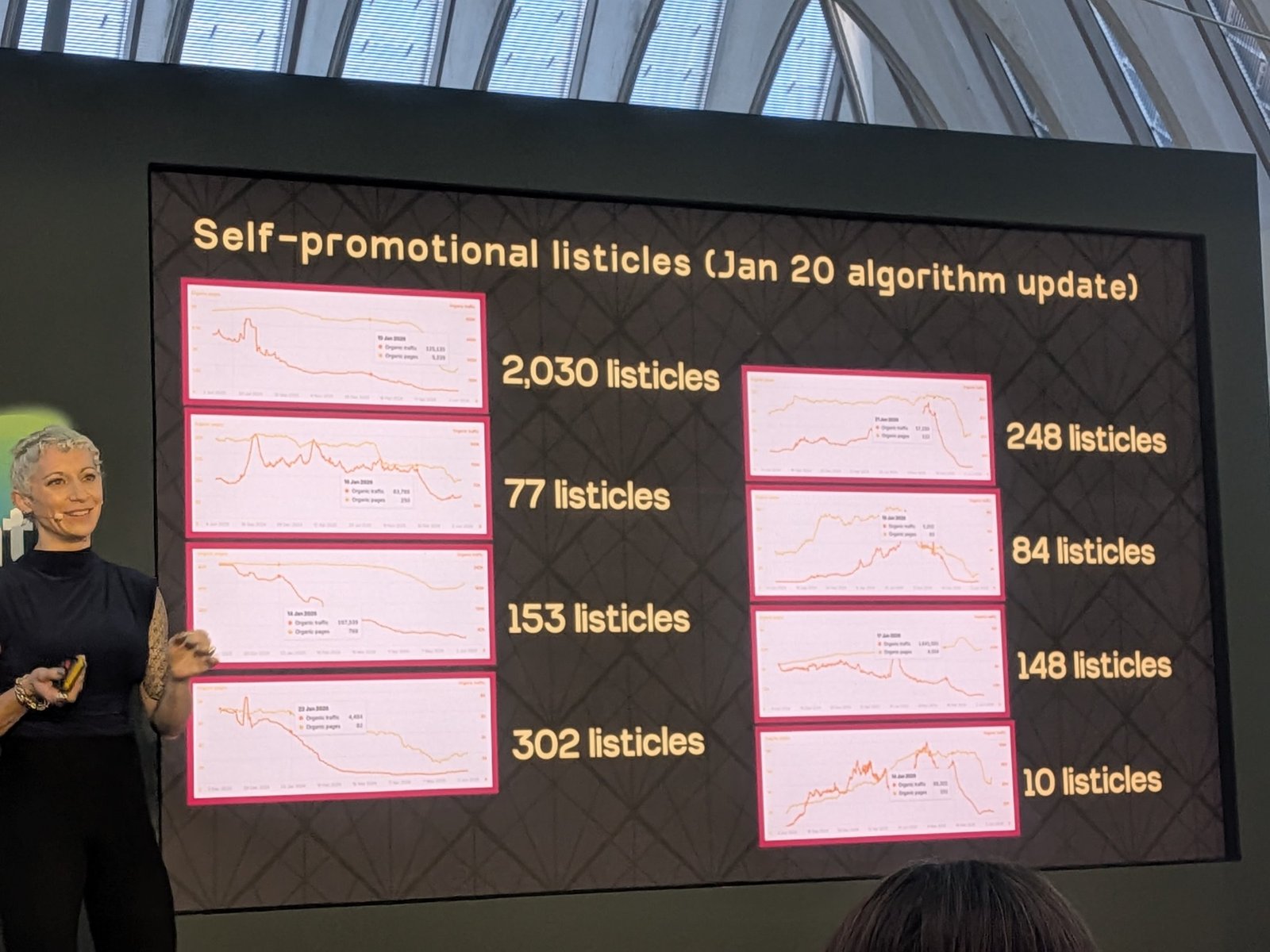
Self-promotional listicles are articles on your own site asking who is the best in your space, with your company at number one and your competitors below. Lily says this has arguably been the most effective tactic for influencing AI search.
But many of the companies that came to her after being hit by updates had scaled them, sometimes into the hundreds or thousands. All of them dropped on 20 January, in an unconfirmed Google update. Her slide showed sites with 10, 77, 84, 148, 153, 248, 302 and even 2,030 listicles. Some were hit even harder in later updates. Once you lose trust with Google, it is very hard to get it back.
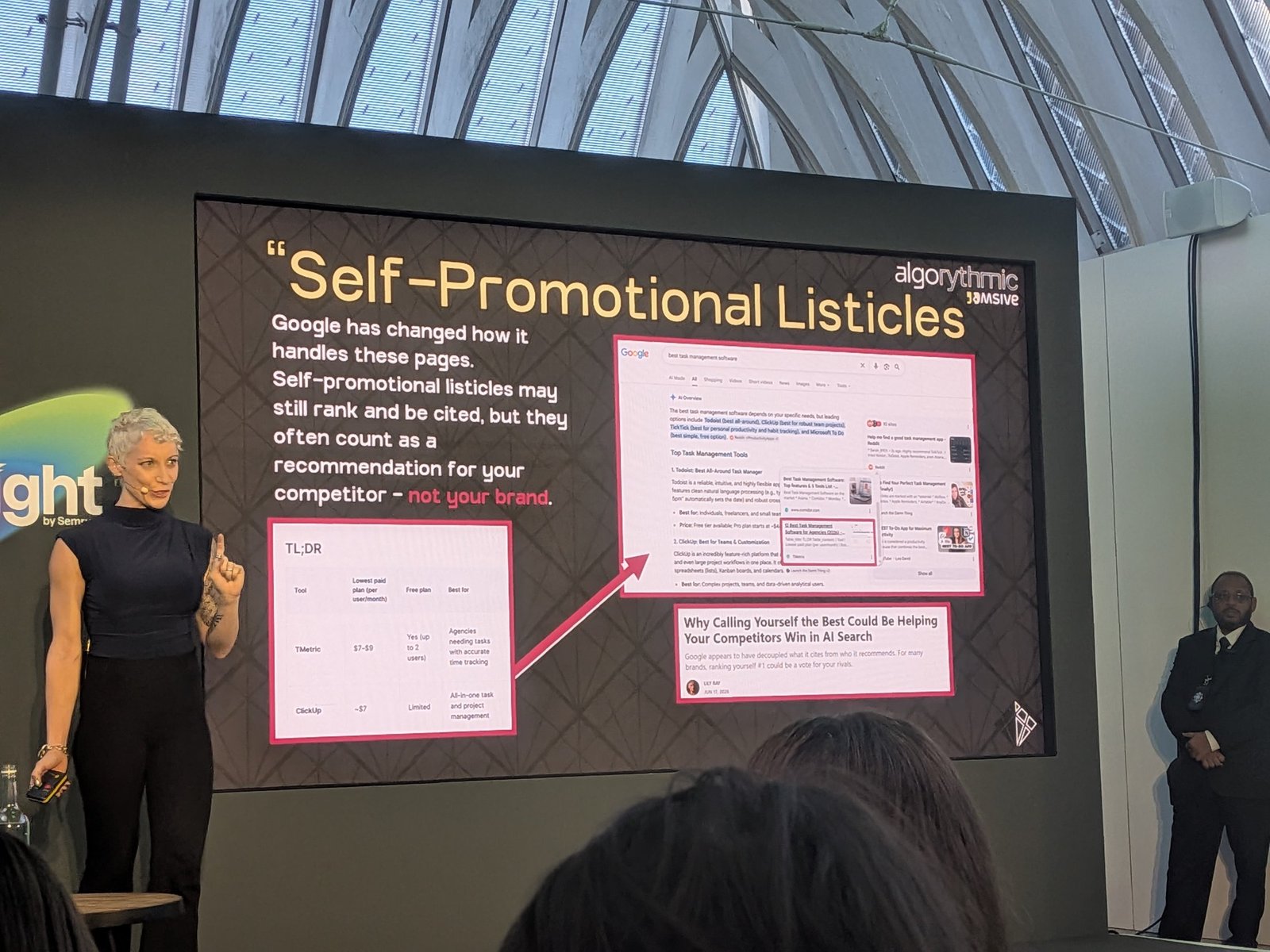
Google has also quietly changed how it handles these pages. It may still use your listicle as a source for AI citations, but it counts it as a vote for your competitors, while removing your name from the recommendations. Lily wrote about this in her article “Why Calling Yourself the Best Could Be Helping Your Competitors Win in AI Search”.
So if you only track citations, you might think the tactic is working. Look at whether you are actually recommended in the answer.
Scaled AI Content and Manual Actions
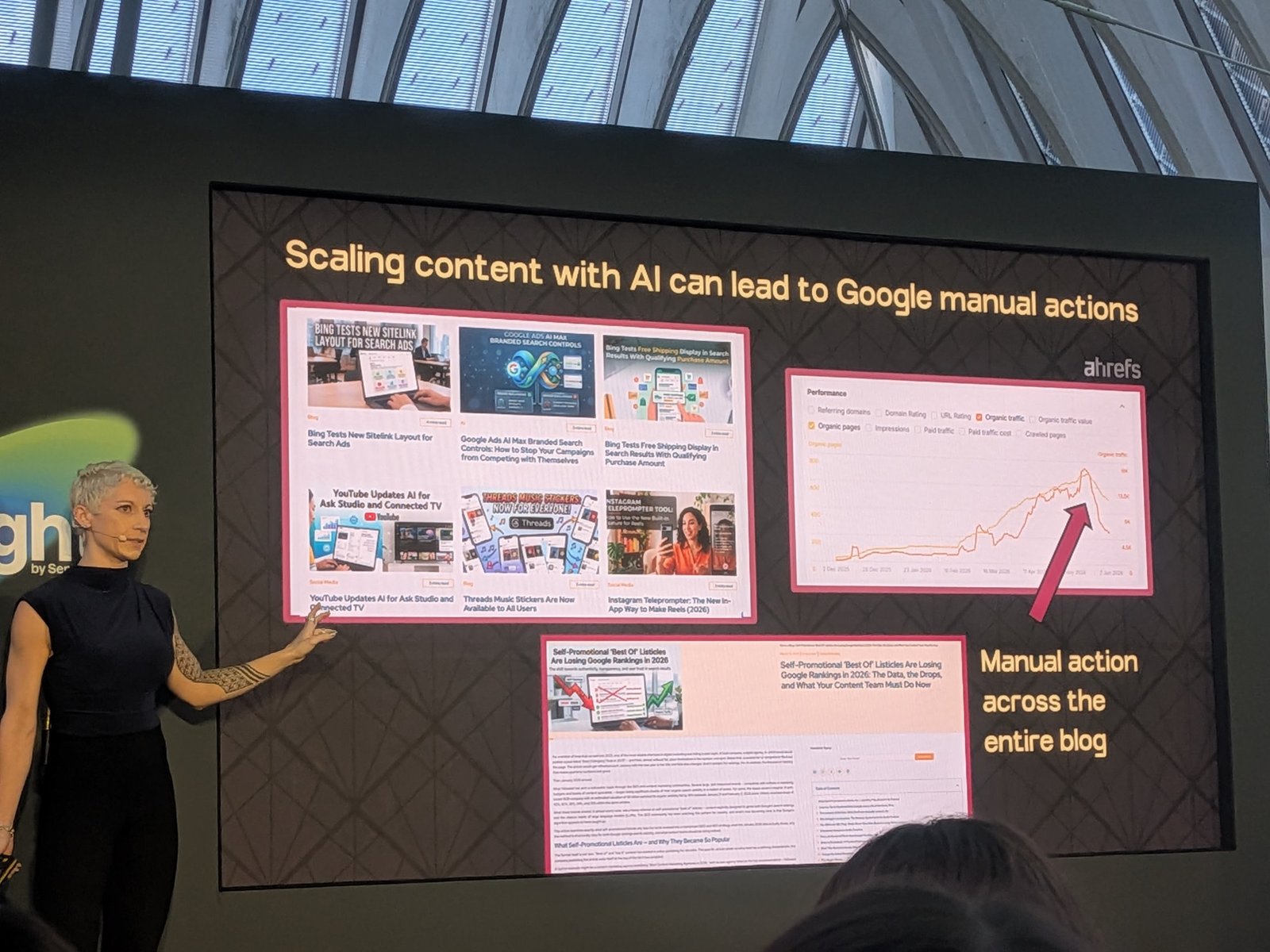
The majority of companies that come to Lily have had some issue with scaled content, even when there was some level of human review. Sites often see success for two, three or four months. Then, once Google has enough data, their visibility drops, often far below where it started.
Some vendors that scale AI content publish case studies celebrating early wins. Look at what happens 12 months later.
One example was a company scaling AI-generated content and images very quickly. It received a manual action, a penalty, on its entire blog, which was removed from Google search. Its AI Overview citations and ChatGPT citations dropped at the same time. You don’t just lose Google traffic. You lose AI citations too.
Commodity Content and the Next Frontier
Lily also sees problems with excessive “commodity content”: generic “what is”, “why” and “how does it work” pages that are easy to produce, easy for AI to answer on its own, and add no original information. One impacted company had almost 2,000 articles starting with “How to”. Google spots patterns like that easily.
She sees two areas as the next frontier for demotion:
- Excessive comparison and alternative pages, such as “brand vs brand” or “brand alternatives”, always recommending your own brand
- Inauthentic mentions, such as reciprocal listicle schemes where brands agree to list each other. She expects Google to treat these like link schemes, possibly with an update similar to Penguin
Bing has its own spam policies too, many of them the same as Google’s. Lily shared an example of a site penalised by Google that was still ranking well in Bing and cited in ChatGPT. A few weeks later, it was gone from Bing as well.
How LLMs Decide What to Trust
The newer AI companies don’t have the public policies Google has built over 20 years, so be careful where you get your information from. But you can observe their fan-out queries and reasoning. Lily uses Fan Out Fox and a reasoning plugin, two free Chrome extensions that show which background searches ChatGPT runs, how it reasons, and which URLs it retrieves and cites.
- Be in the training data. When she asked ChatGPT for the best experts in SEO and AI search, it added specific names directly to its fan-out queries. You want to be one of the people or brands the model already associates with your topic
- Models search trusted sites directly. Newer ChatGPT models run more fan-out queries using the site: operator, limiting searches to domains they already trust
- Sensitive topics stay with official sources. For questions about benefits for disabled veterans, ChatGPT searched only government websites
- Fewer listicle-style searches. After a recent ChatGPT model update, words like “reviews”, “best”, “top” and “vs” appeared less often in fan-out queries, while words like “pricing” and “official” appeared more. Listicles and comparison pages were cited less, while official brand pages, press pages and product specifications were cited more
She also suggests using Search Console to find likely fan-out queries in your own data, checking which URLs are retrieved but not cited, and reading the model’s reasoning where it is shown. ChatGPT’s reasoning includes lines like avoiding treating an unsupported title as objective, or looking for independent recognition or awards.
Some LLMs, including Claude and Grok, have started adding disclaimers warning that a category contains a lot of self-promotional content. And one AI company had published new guidelines just days before the talk, which Lily described as the first time an LLM provider has said outright that it won’t use manipulated or spammy content.
Her closing warning: a big Google algorithm update, and big changes to AI models, are probably on the horizon. Be careful.
What Not to Do
- Don’t publish content under fake or anonymous authors
- Don’t scale content with AI without real human oversight
- Don’t create doorway pages, such as a landing page for every city
- Don’t publish self-promotional listicles, especially at scale
- Don’t use GEO tactics that could hurt your SEO
- Don’t judge success by citations alone
- Don’t cut the people who know how to keep your site out of trouble
Next Steps
- Read Google’s spam policies. Check your site for doorway and scaled content patterns.
- Run your content through Google’s helpful content questionnaire. Prioritise YMYL pages.
- Put named, credentialed authors on your content. Add a clear About page, contact details and editorial policies.
- Audit your listicles and comparison pages. Remove or rework the ones that rank yourself first.
- Track recommendations, not just citations. Check whether AI actually recommends you.
- Install Fan Out Fox. See what ChatGPT searches for and what it decides to cite.
Personal Takeaways
Expectations are always high for Lily, and she still manages to exceed them every time. As expected from Lily. Some of this, like the point about self-promotional listicles, is something we can use ourselves.
Related Resources
- Spotlight 2026 agenda
- The AI Visibility Index panel report: why AI answers differ by model, market and category
- Marcus Tober’s session report: Semrush data on mentions, citations and original data
- Nikhil Lai’s session report: Forrester on why off-site authority drives AI visibility
Written by Ayaka Uchida
CEO, A-Digital Works
This report covers Lily Ray’s session on trust signals at Spotlight by Semrush 2026, 13 October 2026.
