

TL;DR
- Local search has moved from rankings to recommendations. The question used to be “can my location rank?” Now it’s “can AI understand, trust, and recommend the right location for this need?”
- AI decides in four stages: found, scored, trusted, and recommended. Content that fails an early gate never reaches the later ones.
- Consistency matters more than ever. AI grounds its answers in evidence from every source, so conflicting information across channels undermines trust.
- Build a knowledge layer, not just listings. One governed source of truth per location, published in structured formats, makes AI retrieval faster and more accurate.
- Milestone’s case study: +27% AI traffic after publishing an entity map, with new endpoints discovered by nine AI ecosystems in under ten days.
About the Speaker
Benu Aggarwal is the President and Founder of Milestone Inc., a digital experience and search platform company that works with multi-location enterprise brands. She has worked in search for nearly 20 years.
Much of the talk drew on Milestone’s own frameworks and platform, so it had a product perspective, but the underlying model of how AI evaluates local businesses is useful regardless of which tools you use.
The Problem: Scaling Trust Across Thousands of Locations
Benu opened by asking who in the room was tired of hearing about ChatGPT strategy. Her point was that the challenge for enterprise brands isn’t AI in the abstract. It’s making AI work reliably across thousands of locations.
She asked the room to picture 7,000 locations. How do you give AI accurate, real-time context for every one of them, and give customers a consistent experience between them? Doing that manually is next to impossible.
How Local Search Evolved
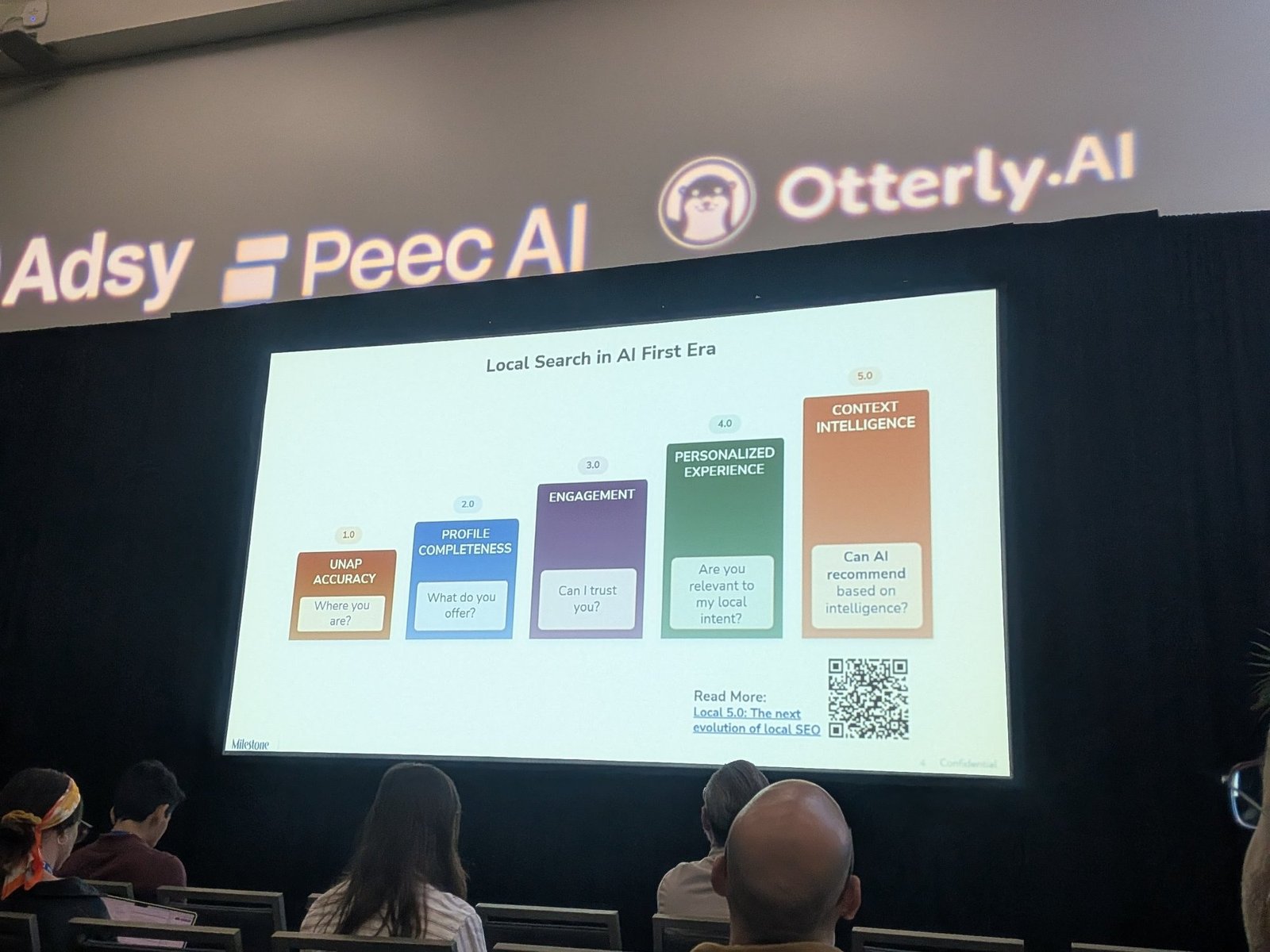
Benu described local search as five stages, each answering a different customer question:
- Local 1.0, UNAP accuracy (URL, name, address, and phone): Where are you?
- Local 2.0, Profile completeness: What do you offer?
- Local 3.0, Engagement: Can I trust you?
- Local 4.0, Personalized experience: Are you relevant to my local intent?
- Local 5.0, Context intelligence: Can AI recommend you based on intelligence?
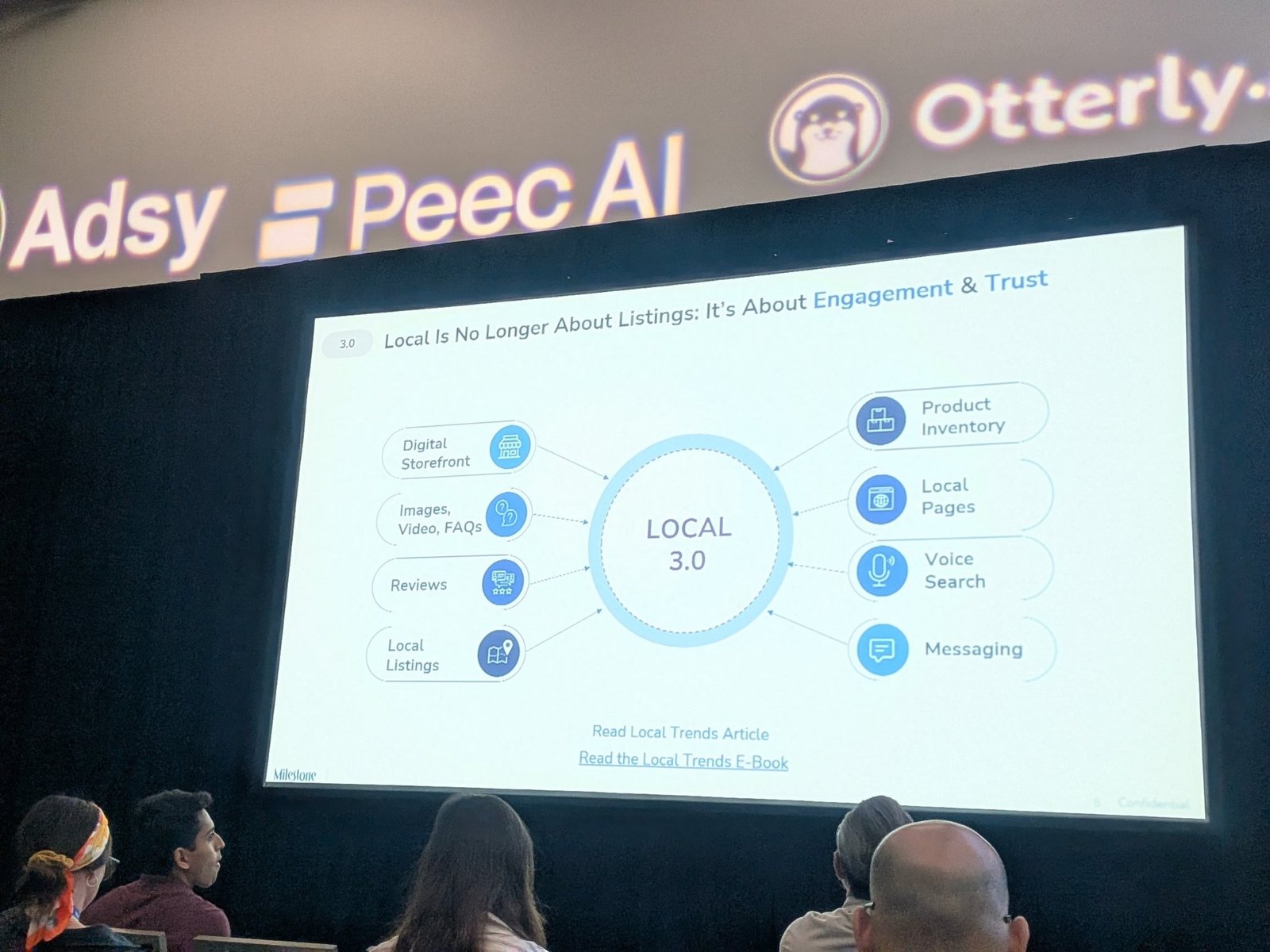
By Local 3.0, listings alone were no longer enough. Engagement and trust came from a much wider set of assets: digital storefronts, images, video and FAQs, reviews, local pages, product inventory, voice search, and messaging.
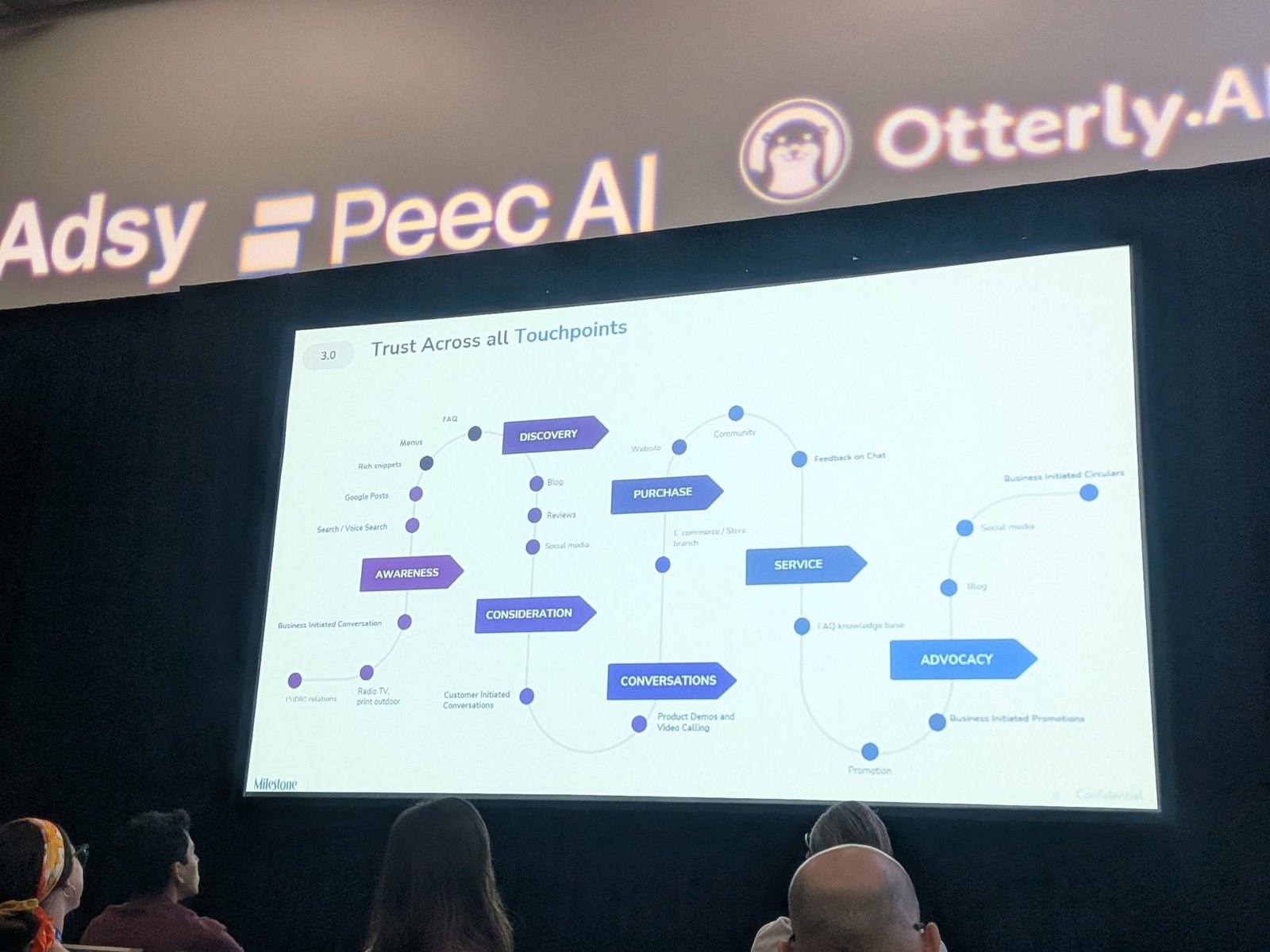
And trust had to be consistent across every stage of the customer journey, from awareness and discovery through consideration, conversations, purchase, service, and advocacy. If the information differs between your listing, your website, and your social channels, customers and AI both lose confidence.
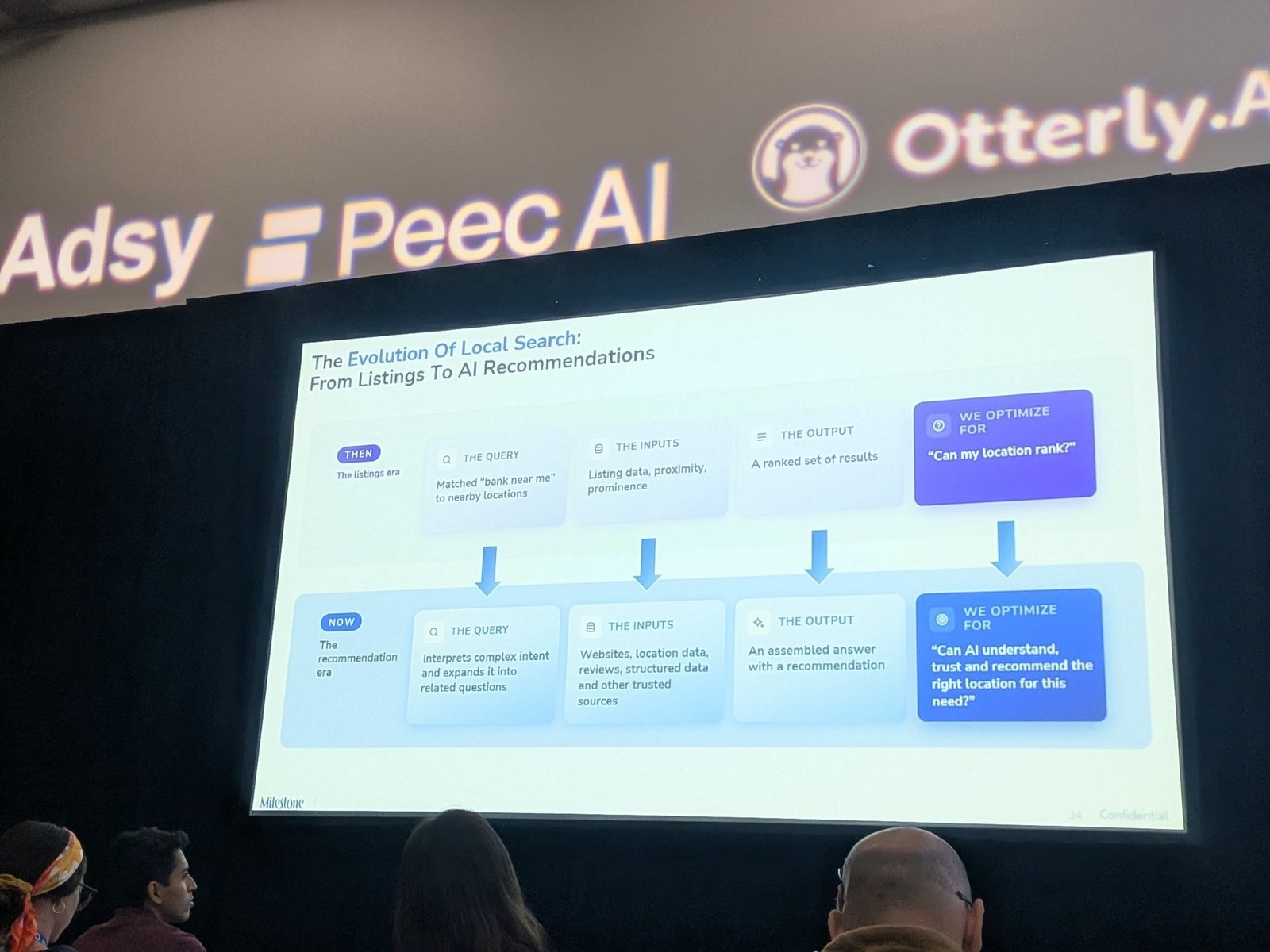
The shift to AI changes every part of the process:
| The listings era | The recommendation era | |
|---|---|---|
| The query | Matched “bank near me” to nearby locations | Interprets complex intent and expands it into related questions |
| The inputs | Listing data, proximity, and prominence | Websites, location data, reviews, structured data, and other trusted sources |
| The output | A ranked set of results | An assembled answer with a recommendation |
| We optimize for | “Can my location rank?” | “Can AI understand, trust, and recommend the right location for this need?” |
The biggest difference, Benu said, is grounding. AI looks for evidence across all your sources before it answers. That makes consistency even more critical than before.
The Solution: Four Stages of AI Recommendation
Benu broke down how AI engines decide which business is found, scored, trusted, and recommended.
Stage 1: Found
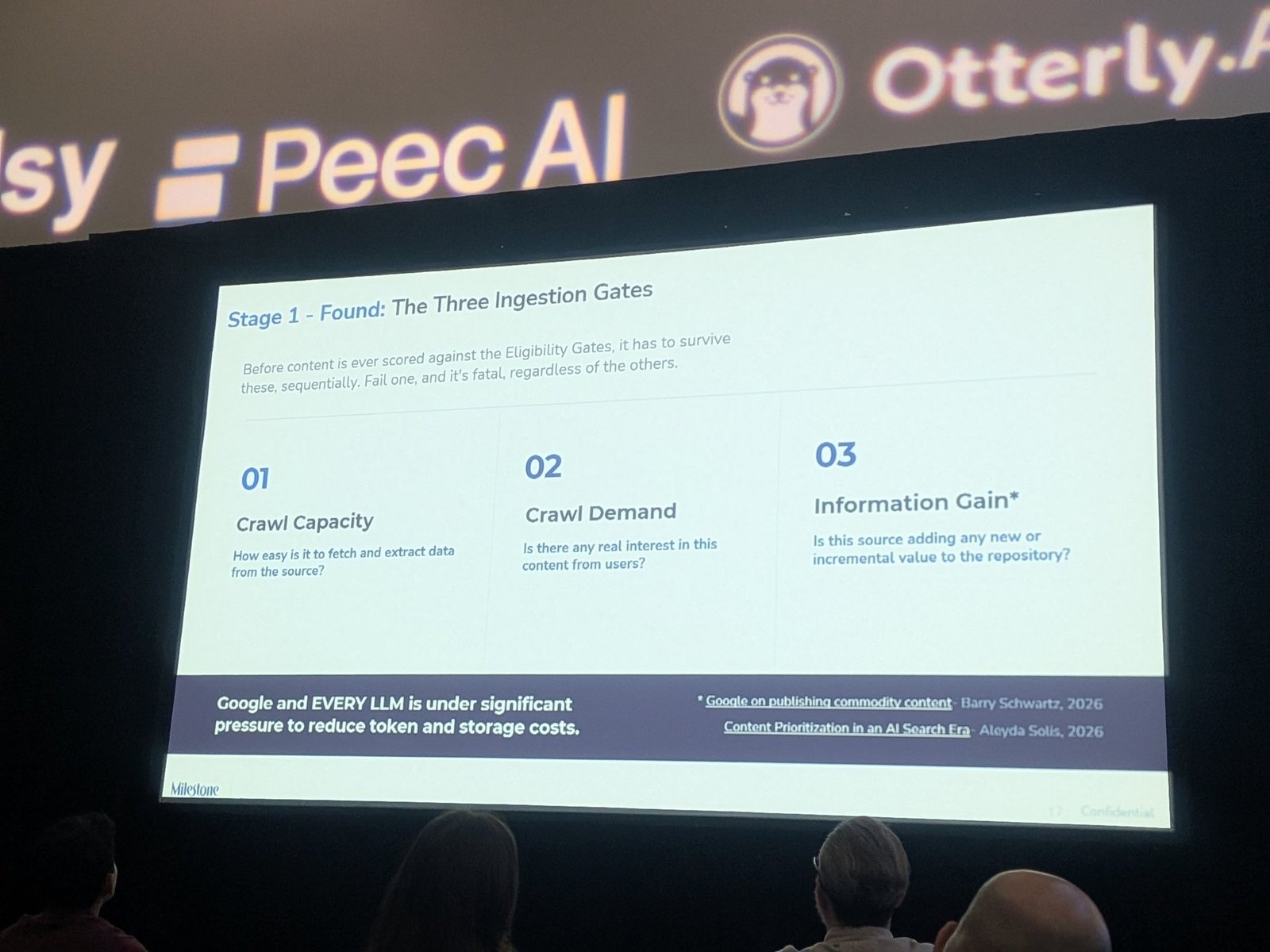
Before content is ever evaluated, it has to pass three gates in sequence. Failing any one is fatal, regardless of the others:
- Crawl capacity: How easy is it to fetch and extract data from the source?
- Crawl demand: Is there real interest in this content from users?
- Information gain: Does this source add new or incremental value?
The underlying pressure, according to her slide, is that Google and every LLM are under significant pressure to reduce token and storage costs. If your content repeats what already exists, there is little reason for AI to collect it. She referenced recent writing by Barry Schwartz on commodity content and Aleyda Solis on content prioritization in AI search.
Stage 2: Scored
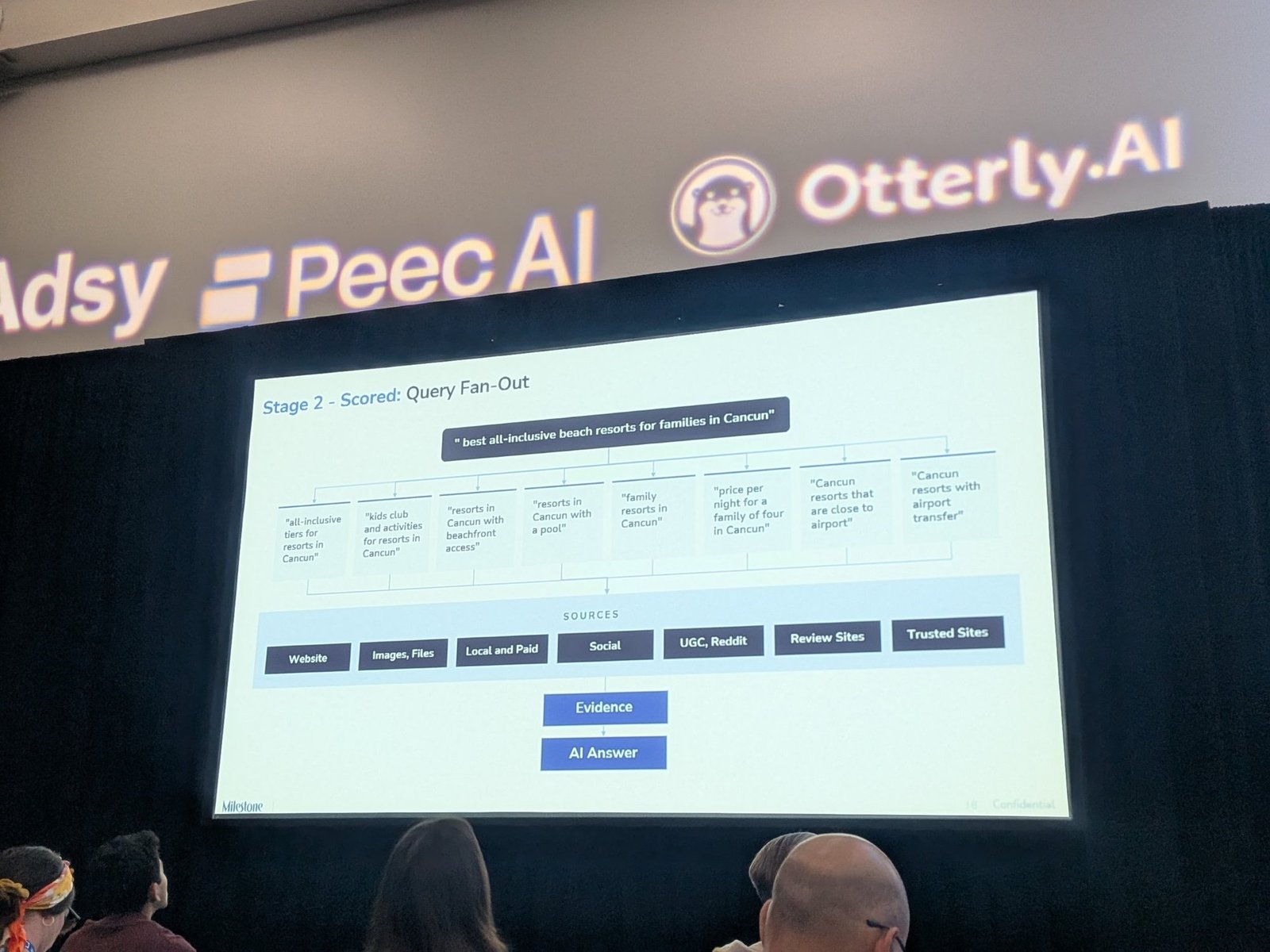
AI then expands a single query into many related questions. Benu’s example started with “best all-inclusive beach resorts for families in Cancun,” which fans out into questions about all-inclusive tiers, kids’ clubs, beachfront access, pools, family resorts, price per night for a family of four, proximity to the airport, and airport transfers.
To answer those, AI draws on websites, images and files, local and paid listings, social media, user-generated content such as Reddit, review sites, and other trusted sites. That evidence becomes the AI answer.
Stage 3: Trusted
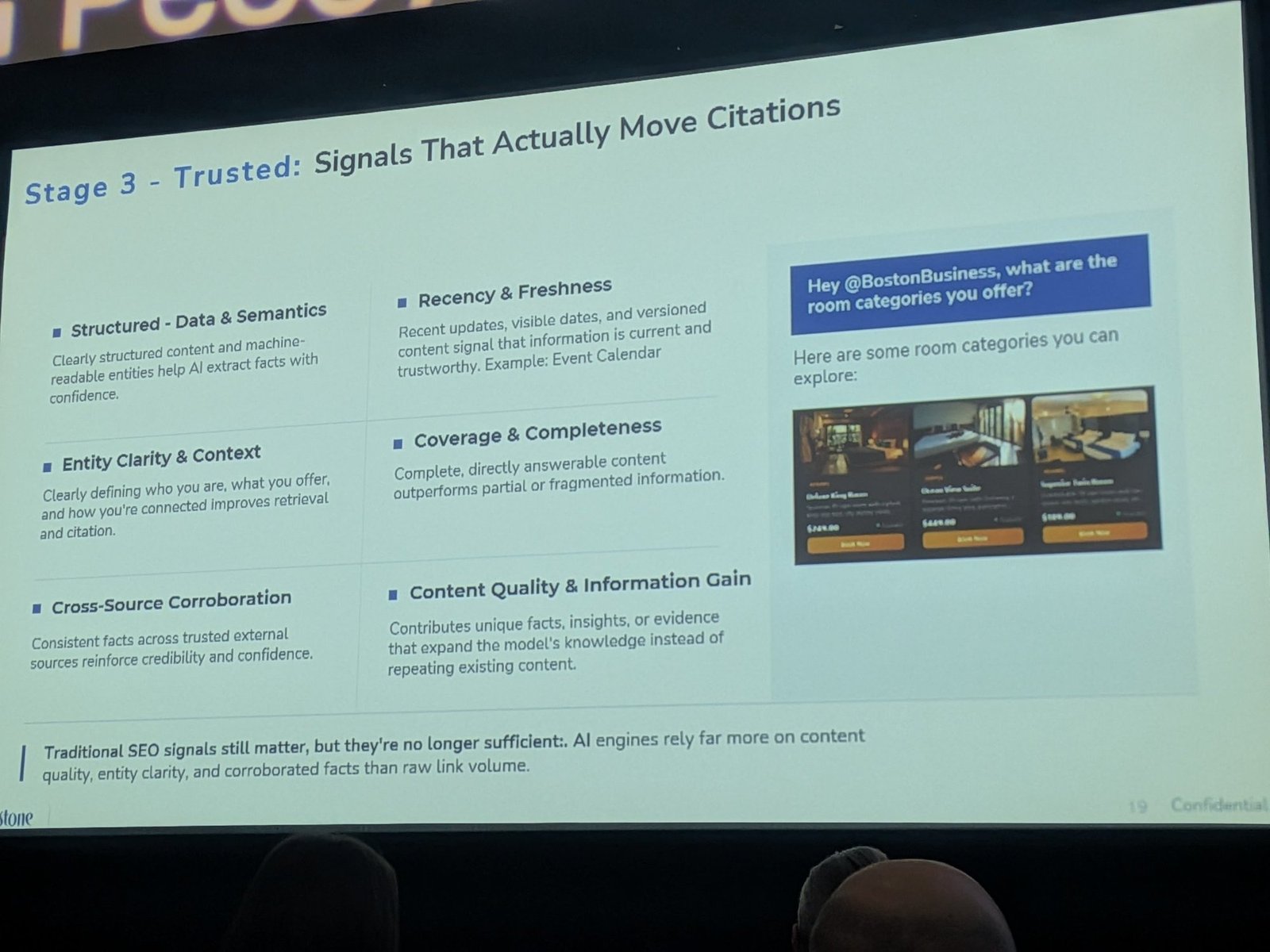
Six signals move citations:
- Structured data and semantics: Clearly structured content and machine-readable entities help AI extract facts with confidence.
- Recency and freshness: Recent updates, visible dates, and versioned content signal that information is current. An event calendar is a good example.
- Entity clarity and context: Clearly defining who you are, what you offer, and how you’re connected improves retrieval and citation.
- Coverage and completeness: Complete, directly answerable content outperforms partial or fragmented information.
- Cross-source corroboration: Consistent facts across trusted external sources reinforce credibility.
- Content quality and information gain: Unique facts, insights, or evidence expand the model’s knowledge instead of repeating existing content.
Her summary: traditional SEO signals still matter, but they’re no longer sufficient. AI relies far more on content quality, entity clarity, and corroborated facts than on raw link volume.
Stage 4: Recommended
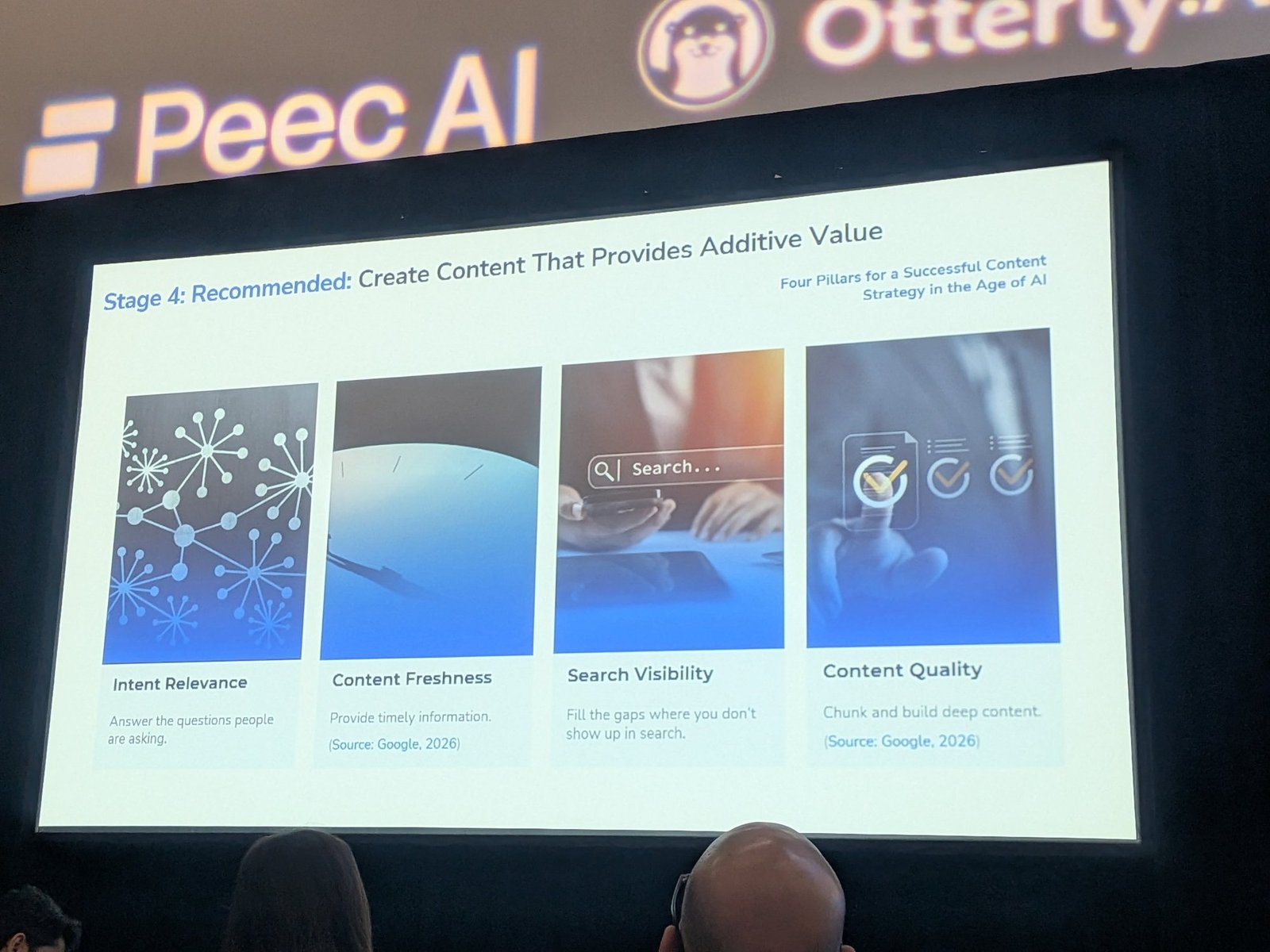
Finally, recommendation depends on four content pillars:
- Intent relevance: Answer the questions people are actually asking.
- Content freshness: Provide timely information.
- Search visibility: Fill the gaps where you don’t show up in search.
- Content quality: Break content into clear sections and build depth.
The Blueprint: Build a Knowledge Layer
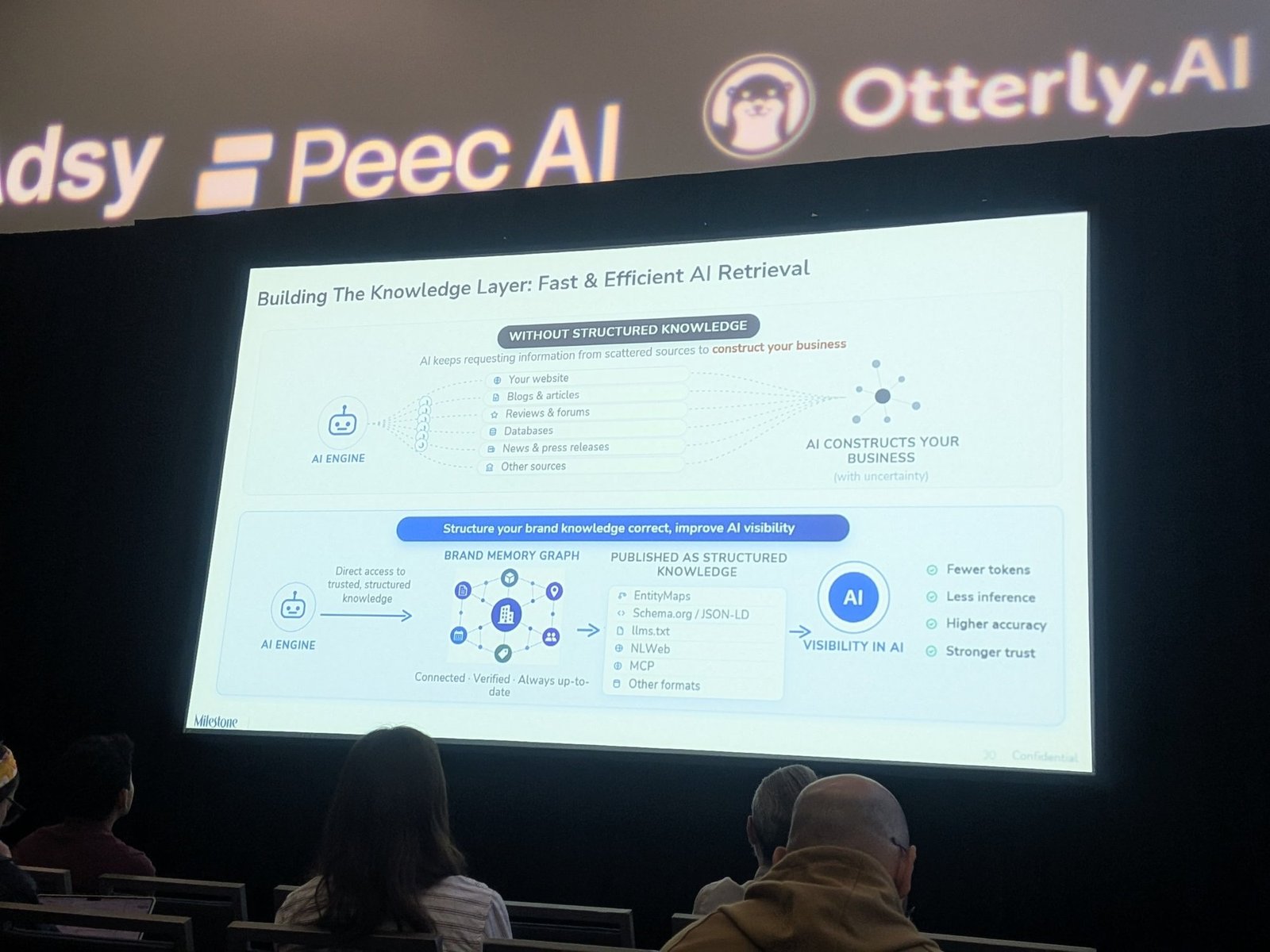
Benu’s central recommendation was to stop relying on scattered information.
Without structured knowledge, AI keeps requesting information from your website, blogs, reviews and forums, databases, news and press releases, and other sources, then constructs a picture of your business with uncertainty.
With structured knowledge, AI has direct access to a brand memory graph that is connected, verified, and always up to date. That knowledge is published in machine-readable formats such as entity maps, Schema.org and JSON-LD, llms.txt, NLWeb, and MCP. The result: fewer tokens, less inference, higher accuracy, and stronger trust.
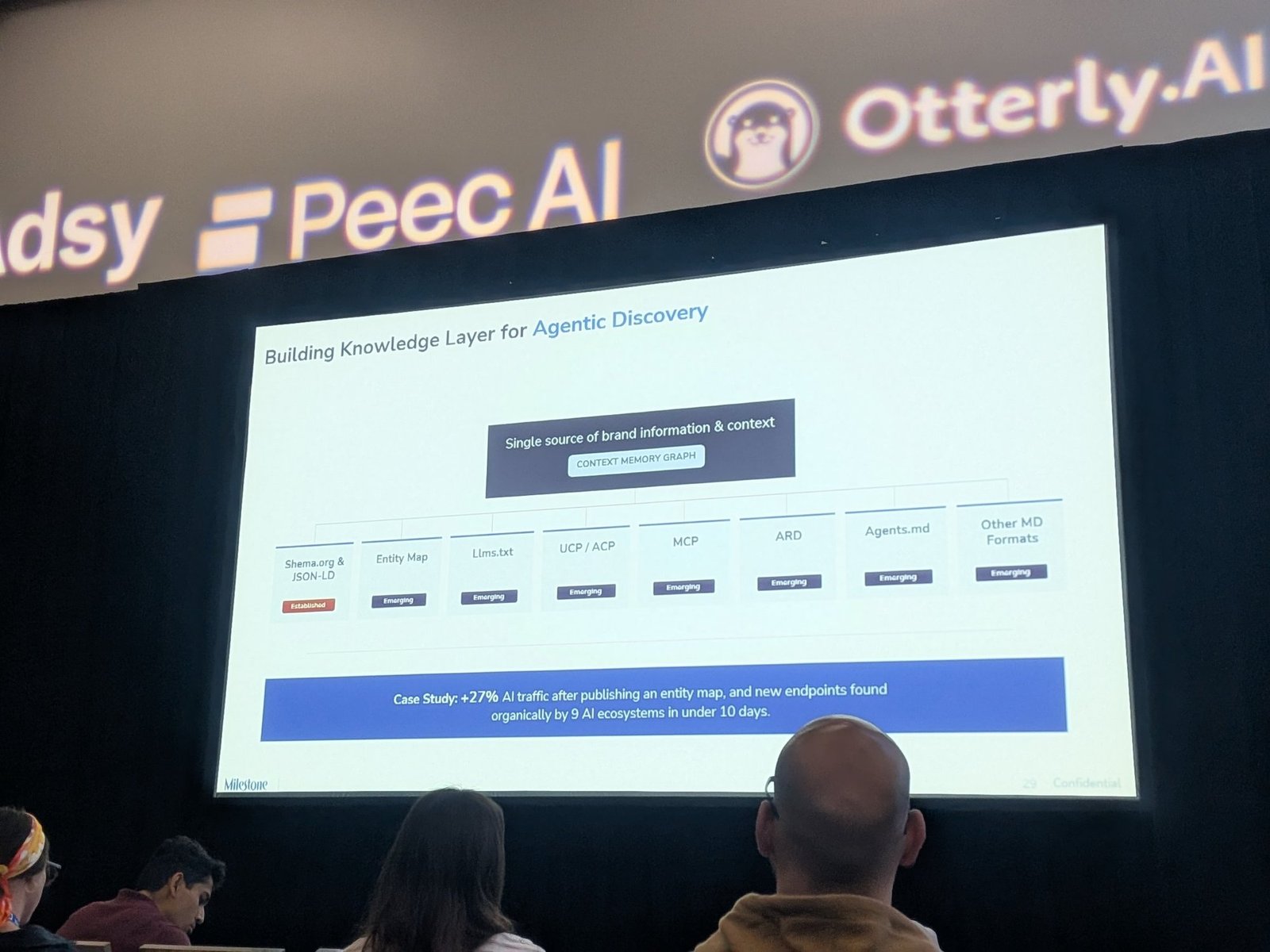
She positioned this as preparation for agentic discovery, where AI agents act on behalf of customers. A single source of brand information and context feeds multiple formats. Schema.org and JSON-LD are established, while entity maps, llms.txt, UCP and ACP, MCP, ARD, Agents.md, and other Markdown formats are still emerging.
The case study on this slide: +27% AI traffic after publishing an entity map, with new endpoints found organically by nine AI ecosystems in under ten days.
What Local 5.0 Looks Like
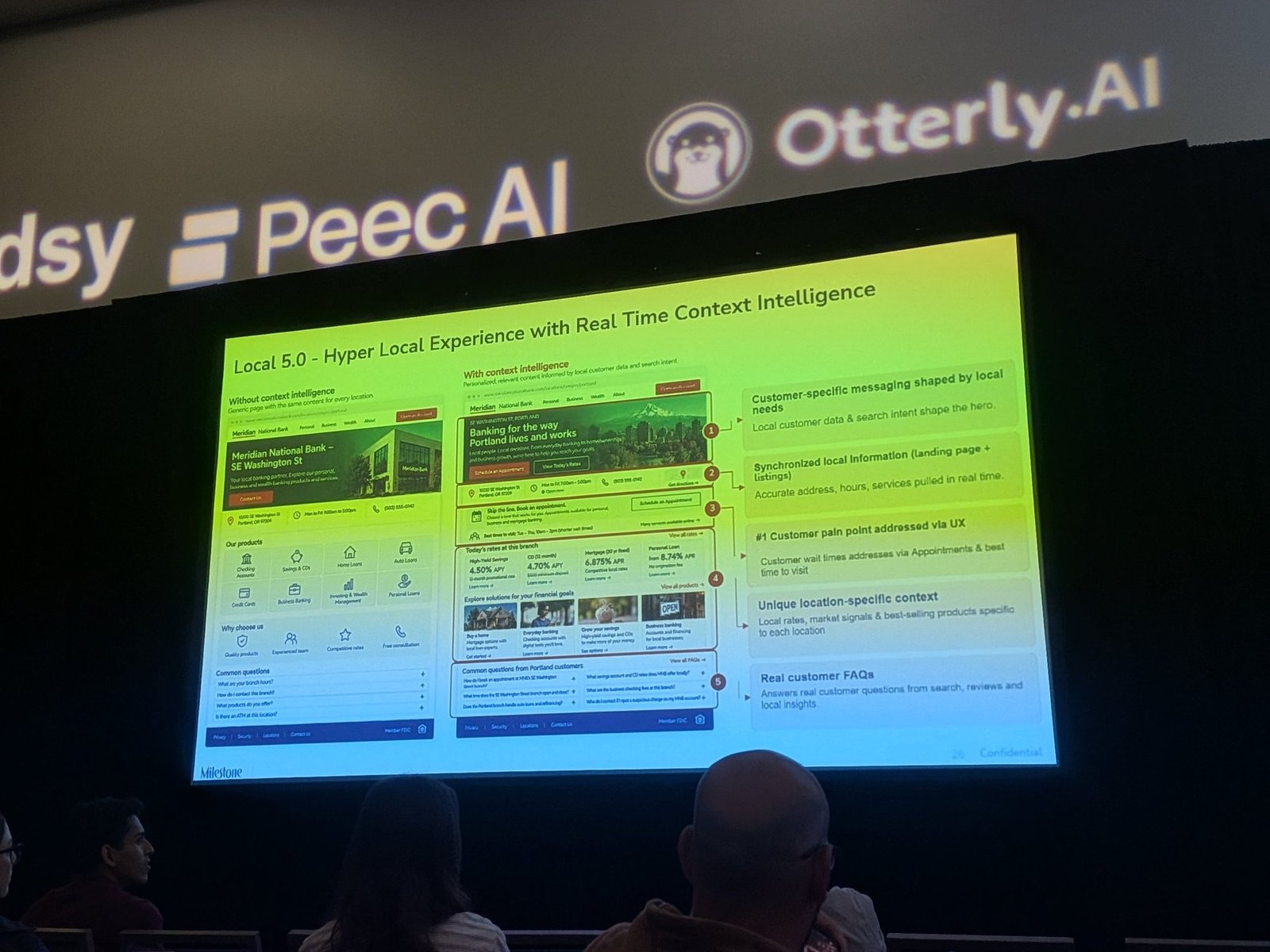
Benu showed a side-by-side example for a fictional bank branch in Portland. Without context intelligence, every branch page carries the same generic content. With it, the page includes:
- Customer-specific messaging shaped by local needs, using local customer data and search intent.
- Synchronized local information, with accurate addresses, hours, and services pulled in real time across the landing page and listings.
- The top customer pain point addressed through the experience, such as reducing wait times with appointment booking and the best times to visit.
- Unique location-specific context, such as local rates, market signals, and best-selling products at that branch.
- Real customer FAQs, answering questions drawn from search, reviews, and local insights.
She also described using the same knowledge to show different information for different locations, including local sentiment and real-time details, so each branch is represented accurately.
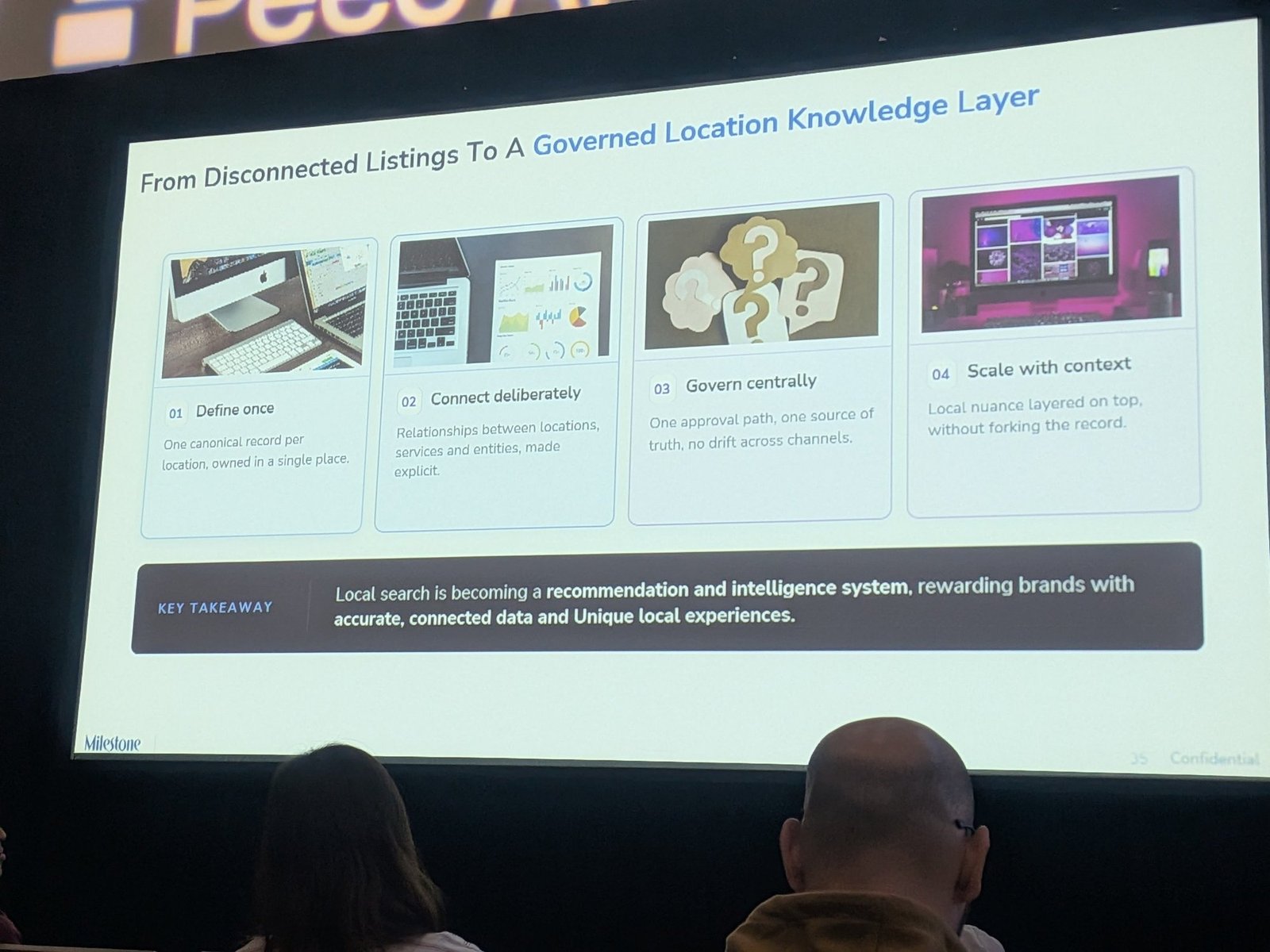
Her four-step model for getting there:
- Define once: One canonical record per location, owned in a single place.
- Connect deliberately: Make relationships between locations, services, and entities explicit.
- Govern centrally: One approval path, one source of truth, and no drift across channels.
- Scale with context: Layer local nuance on top without creating separate versions of the record.
The key takeaway on the slide: local search is becoming a recommendation and intelligence system, rewarding brands with accurate, connected data and unique local experiences.
What Not to Do
- Don’t treat local SEO as listings management. Listings are only one input among many.
- Don’t let location information drift between channels. Inconsistent hours, addresses, or services weaken AI’s confidence.
- Don’t publish generic location pages. Content with no information gain may never pass the ingestion gates.
- Don’t rely on links alone for trust. Entity clarity, corroboration, and content quality carry more weight in AI answers.
- Don’t create separate records for local variations. Layer local detail on one canonical record.
Next Steps
- Audit consistency across channels. Compare addresses, hours, and services for each location across your website, listings, and social profiles.
- Create one canonical record per location. Decide where it lives and who approves changes.
- Map the fan-out for your key queries. Write down the related questions AI would ask for your most important local searches.
- Add unique local content. Give each location page real information gain, such as local FAQs, services, or events.
- Implement structured data. Start with Schema.org and JSON-LD before experimenting with emerging formats.
- Measure before and after. Track AI traffic and citations when you publish structured knowledge.
Personal Takeaways
This talk was clearly shaped by Milestone’s platform and enterprise clients, and the case study figures come from Milestone itself. But the four-stage model of found, scored, trusted, and recommended is one of the clearest explanations I’ve seen of why local businesses appear, or don’t, in AI answers.
What I’m taking away:
- Consistency problems scale down, too. Benu talked about 7,000 locations, but even a business with two locations, like the language school I run in London and Manchester, can end up with outdated addresses or hours after a move. “Define once, govern centrally” applies at any size.
- Information gain is the local SEO gap. Most location pages are nearly identical. The Portland bank example showed how much more useful, and more citable, a page becomes with genuinely local detail.
- The emerging formats deserve healthy skepticism. Benu listed llms.txt and Markdown-based formats as part of the knowledge layer. Thomas Peham’s experiments later the same morning found no measurable impact from Markdown. Structured data like Schema.org is well established; the newer formats are worth testing rather than assuming.
- For Japanese brands opening locations in the UK or US, the “canonical record” idea is especially relevant, since location data often gets maintained separately by headquarters, local teams, and agencies.
Related Resources
- Session: The Future of SEO, brightonSEO San Diego 2026
- Speaker: Benu Aggarwal
- Purvi Sharma’s session report: the previous session in the same block
- Thomas Peham’s session report: the next session, with experiment data on schema, Markdown, and other on-page tactics
Written by Ayaka Uchida
CEO, A-Digital Works
This report covers Benu Aggarwal’s session “Local Search in an AI-First Era: What Enterprise Brands Must Rethink in 2026” at brightonSEO San Diego, September 16, 2026.
