

TL;DR
- ChatGPT ads are a real channel, and still unsolved. Performance has improved quickly since launch, but most advertisers try, fail, and stop. The winners are the ones who keep testing.
- Click-through rates are twice as high in Asia and Latin America. Japan sits at 1.42% and Brazil at 1.67%, compared with 0.66% in the US and 0.69% in the UK.
- Ads work best early in the conversation, but conversations keep going. 47% of ads appear within the first two turns, and 75% of conversations continue after the ad.
- Software dominates. Nine of the top ten advertisers by share of impressions sell software.
- Five rules for testing. Write targeting as prose, use creative as a filter, isolate each test, benchmark against non-branded search, and judge success on lead quality.
About the Speaker
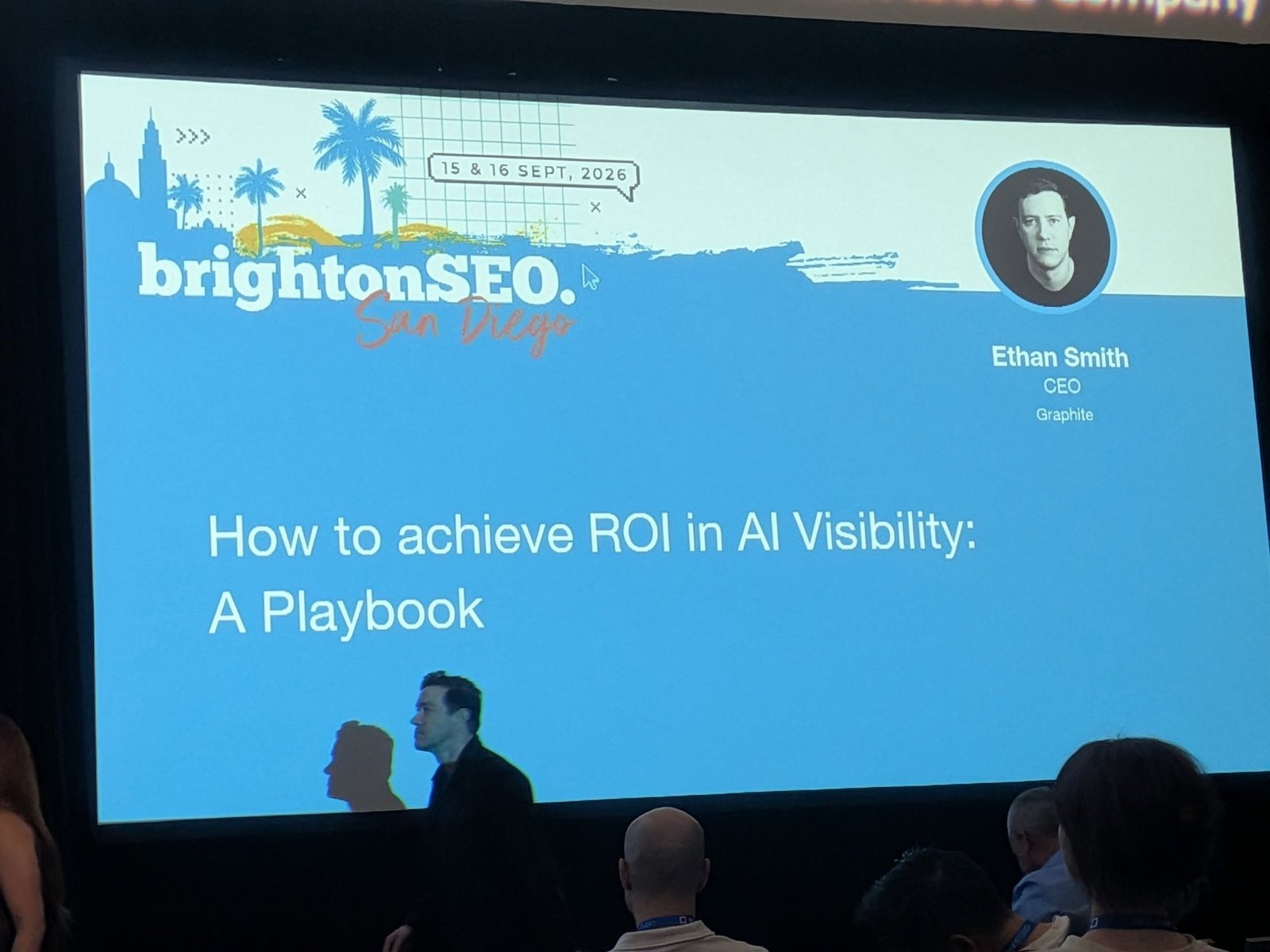
Ethan Smith is the CEO of Graphite, a research-driven growth agency whose clients include Webflow, Adobe, and Upwork. He is also an adjunct professor at IE Business School and teaches SEO and AEO at Reforge. He has become one of the most-cited voices on answer engine optimization over the past year.
He was upfront that he doesn’t have most of the answers, and that Graphite’s approach is to find them through original research.
A note on the session content: the published abstract describes a broader framework combining content, authority, brand, and performance marketing for AEO. On the day, the talk focused almost entirely on ChatGPT ads, drawing on Similarweb data and Graphite’s own testing. This report covers what was presented.
The Problem: A New Channel Nobody Has Figured Out
Ethan’s framing built on Baruch Toledano’s session just before: AI ads are a new channel, growing fast, with a lot still unknown. The pattern he sees in the data is simple. Many companies try, fail, and stop. The ones that continue to test, iterate, and configure are doing well.
That distinction runs through the whole talk. ChatGPT ads don’t reward the autopilot approach that many paid search teams are used to.
Who Sees the Ads
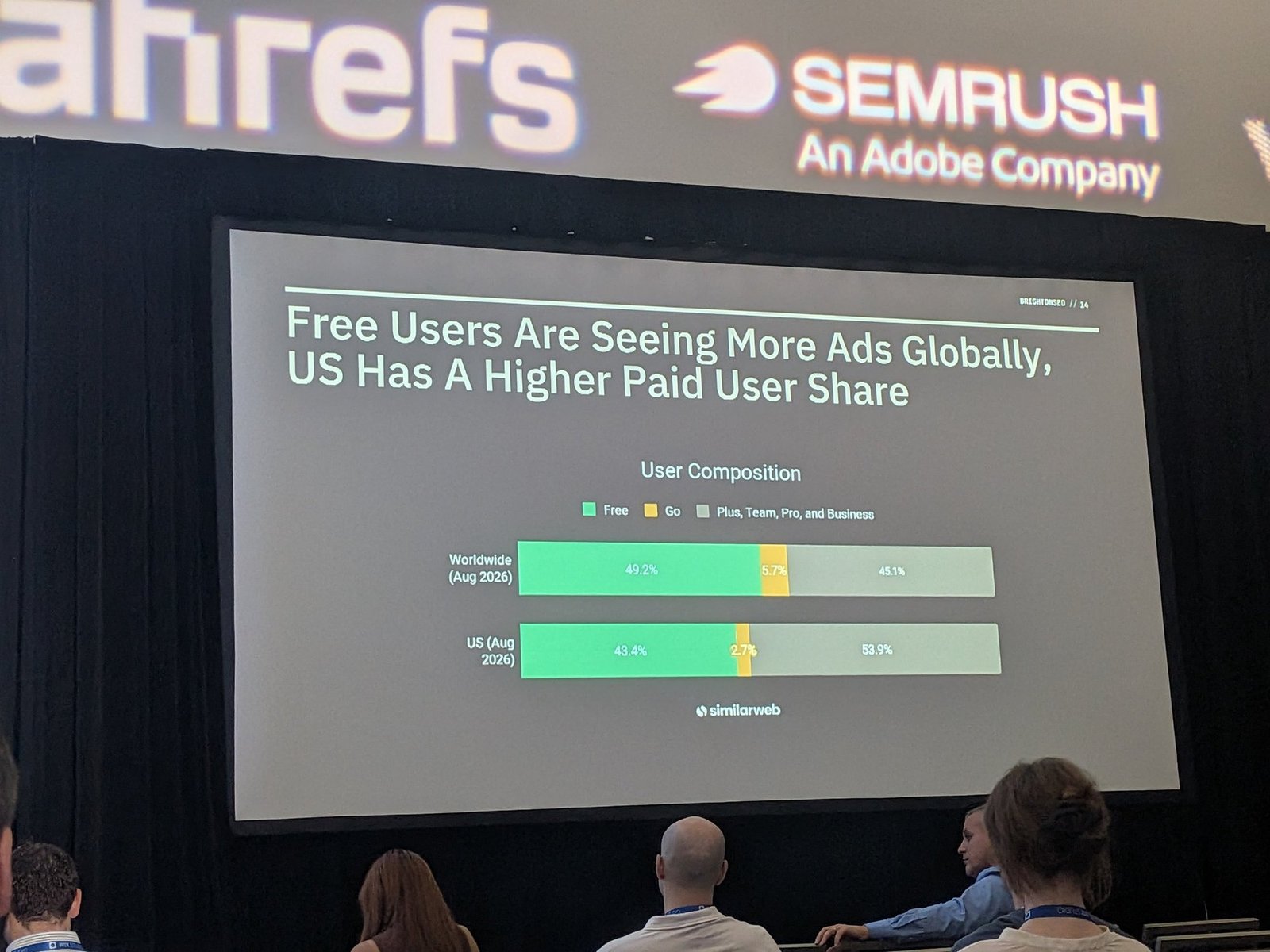
Ads reach the lower-priced tiers, so the user mix matters. In August 2026:
| Tier | Worldwide | US |
|---|---|---|
| Free | 49.2% | 43.4% |
| Go | 5.7% | 2.7% |
| Plus, Team, Pro, and Business | 45.1% | 53.9% |
The US has a higher share of paid users, which means free users outside the US make up a larger part of the ad audience. Ethan noted that markets beyond the US, particularly in Asia and Latin America, are growing quickly, and that many advertisers aren’t testing there yet.
Performance Is Improving, and Varies by Market
Early in the ad platform’s life, targeting and ad placement were imperfect. That is changing quickly. By Ethan’s account, click-through rates roughly doubled over three to four months between spring and summer.
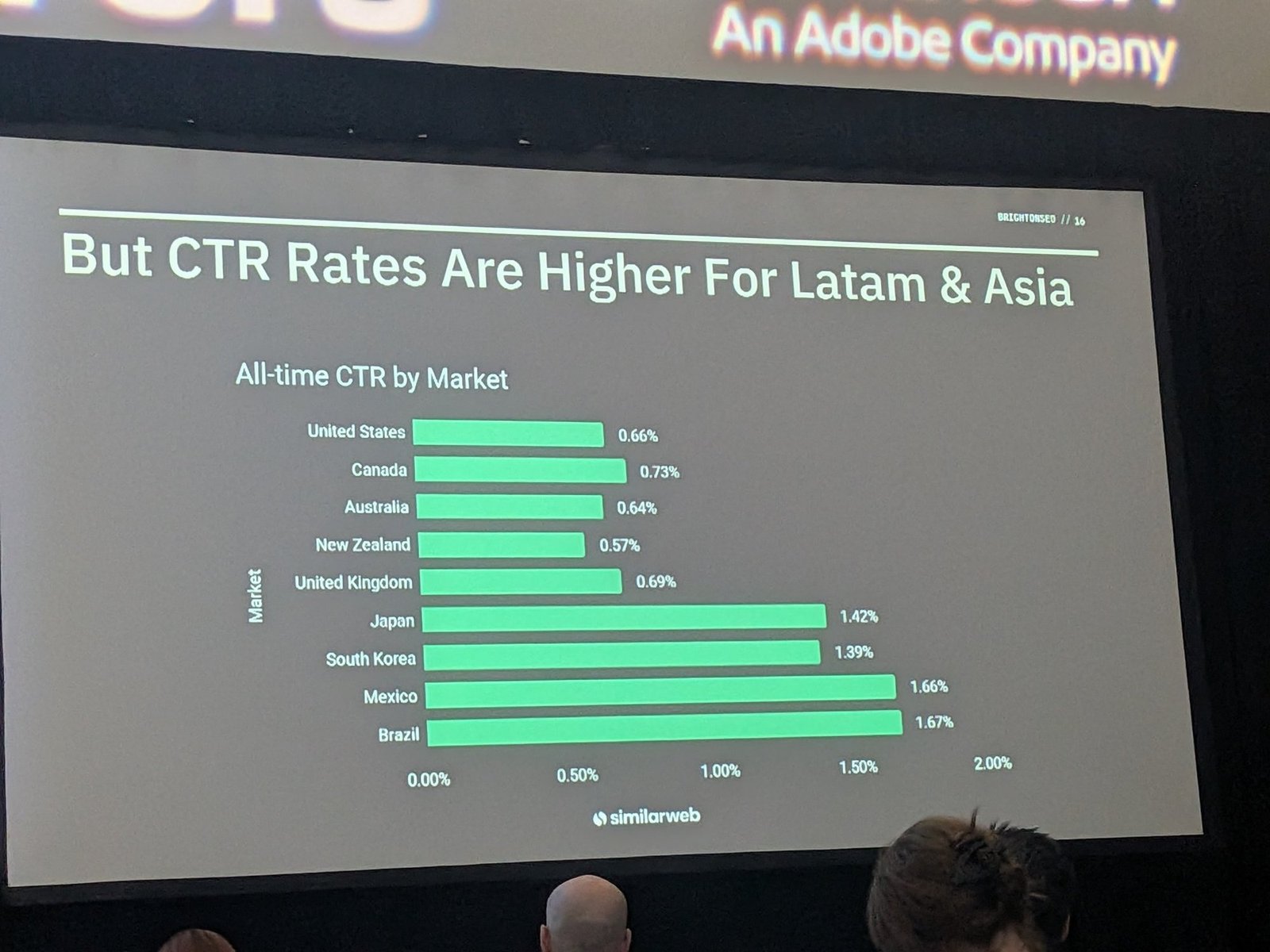
The market differences were the most striking data in the session:
- United States: 0.66%
- Canada: 0.73%
- Australia: 0.64%
- New Zealand: 0.57%
- United Kingdom: 0.69%
- Japan: 1.42%
- South Korea: 1.39%
- Mexico: 1.66%
- Brazil: 1.67%
Click-through rates in Japan, South Korea, Mexico, and Brazil are roughly double those in English-speaking markets.
How Ads Behave Inside Conversations
Ethan explained why ChatGPT ads can’t be treated like search ads. A search is usually three or four words, and once you get an answer, you’re done. A chat is a series of turns: you ask, it answers, it may ask you something back, and you follow up.
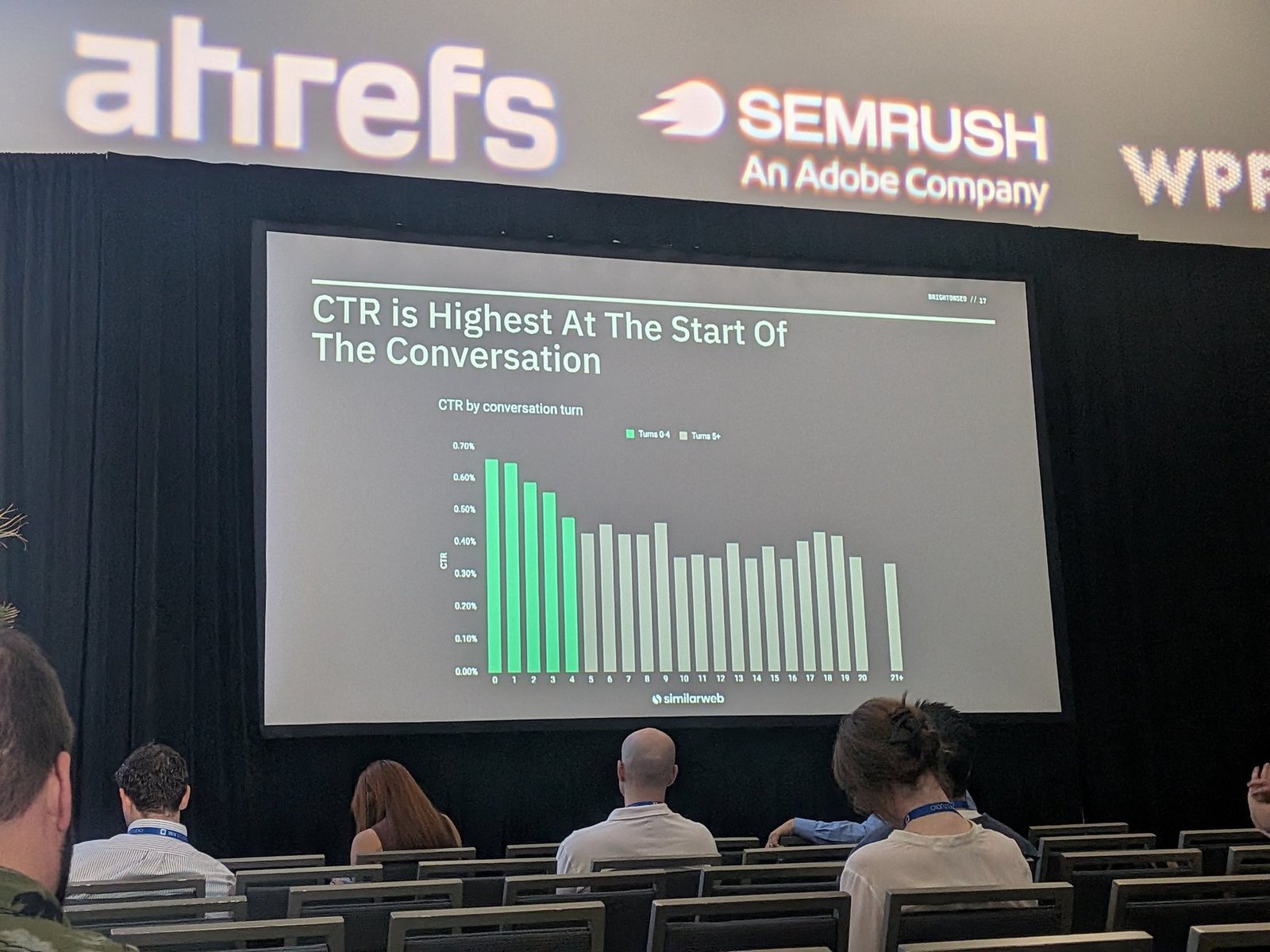
Click-through rate is highest at the very start of a conversation, at around 0.65%, and declines over the first four turns before leveling off at roughly 0.35% to 0.45%.
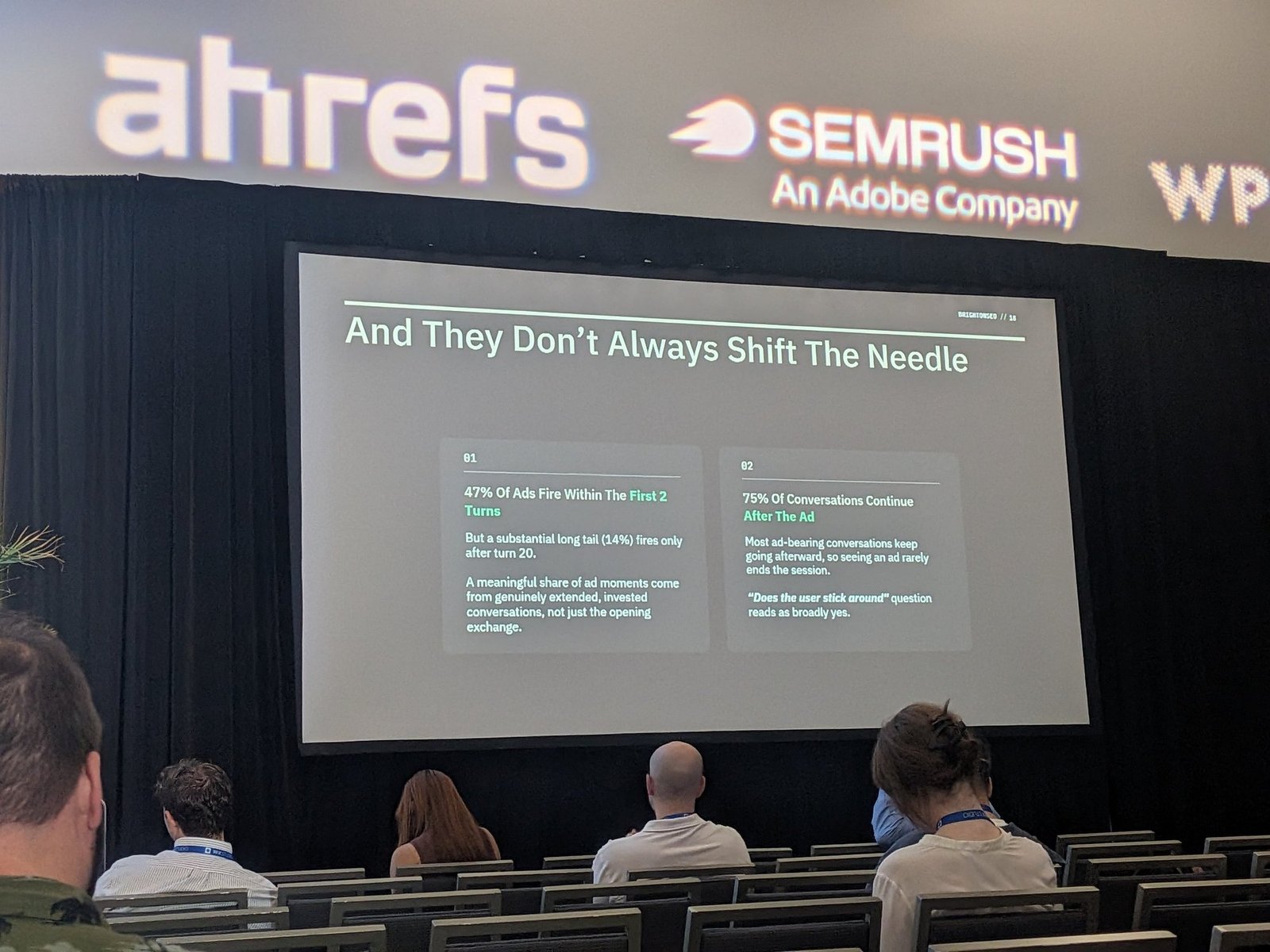
Two findings complicate the picture:
- 47% of ads appear within the first two turns. But a substantial long tail, 14%, appears only after turn 20. A meaningful share of ad moments come from long, invested conversations.
- 75% of conversations continue after the ad. Seeing an ad rarely ends the session.
That makes measurement harder. Ads show up in long, messy conversations where the user drifts in and out, not at a single moment of intent.
Who’s Advertising, and What Works
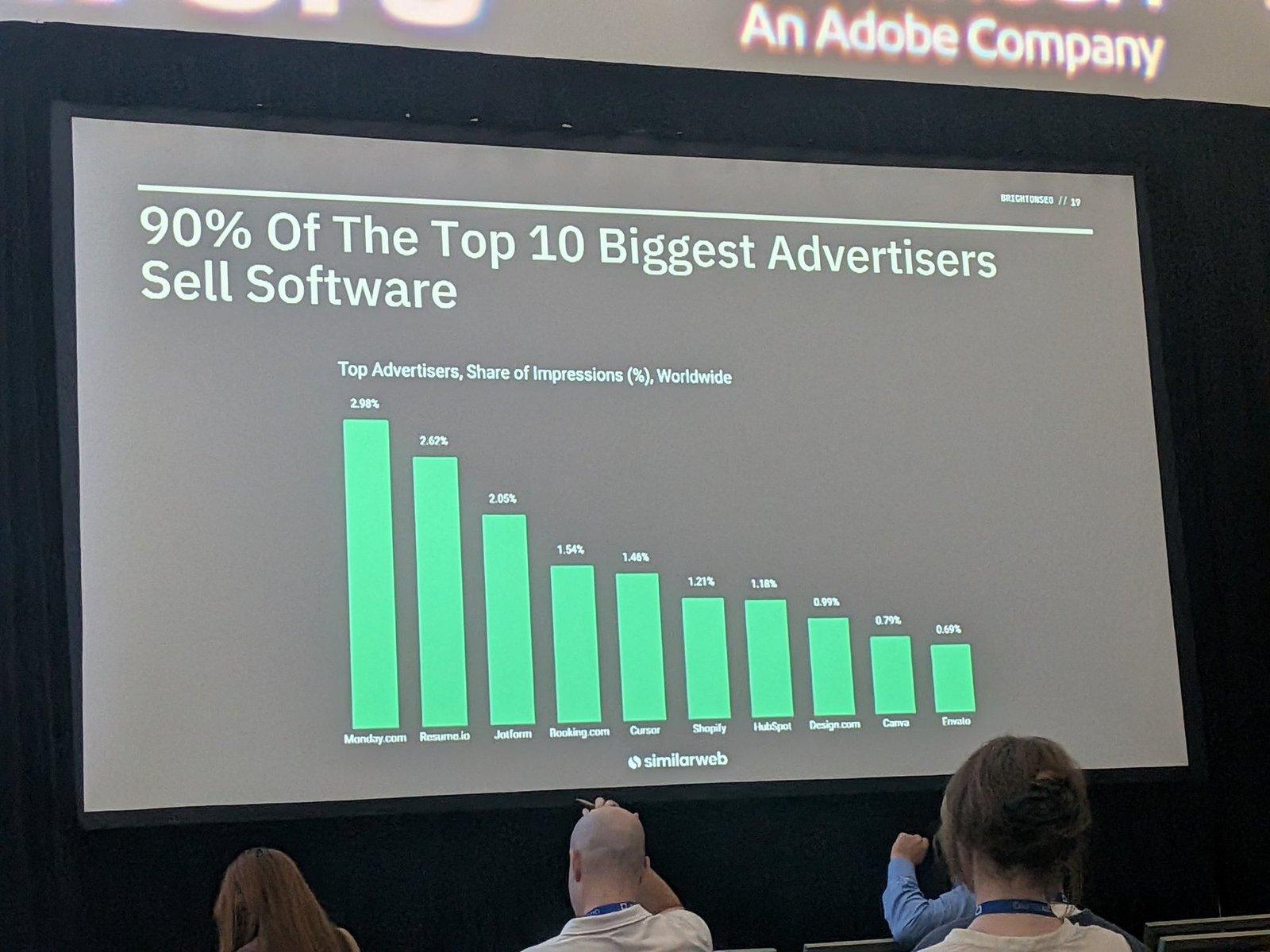
The top ten advertisers by share of impressions worldwide: Monday.com (2.98%), Resume.io (2.62%), Jotform (2.05%), Booking.com (1.54%), Cursor (1.46%), Shopify (1.21%), HubSpot (1.18%), Design.com (0.99%), Canva (0.79%), and Envato (0.69%). Nine of the ten sell software.
The list also changes a lot. Comparing the top ten from earlier in the year with today, only two advertisers remain. Many companies start, stop, and come back, which Ethan read as a sign that setting up ChatGPT ads to perform well is genuinely hard.
Advertisers who have stayed consistently for a long period are worth studying, since consistency suggests something is working. Their creative follows a clear pattern:
- A use-case or action headline. For example, Monday.com’s “plan, track, manage” style messages.
- Or a feature headline. For example, Cursor promoting an AI code editor, or Envato promoting AI audio and graphics tools.
- Plus an image of the feature in use.
Commerce is also growing. Ethan showed a prompt asking for help setting up an online store, where the answer was followed by a Shopify ad with a clear action to start a store.
Don’t Copy Your Search Ads
The advertisers doing best are not lifting their search ads and moving them over. They write net-new copy for the channel.
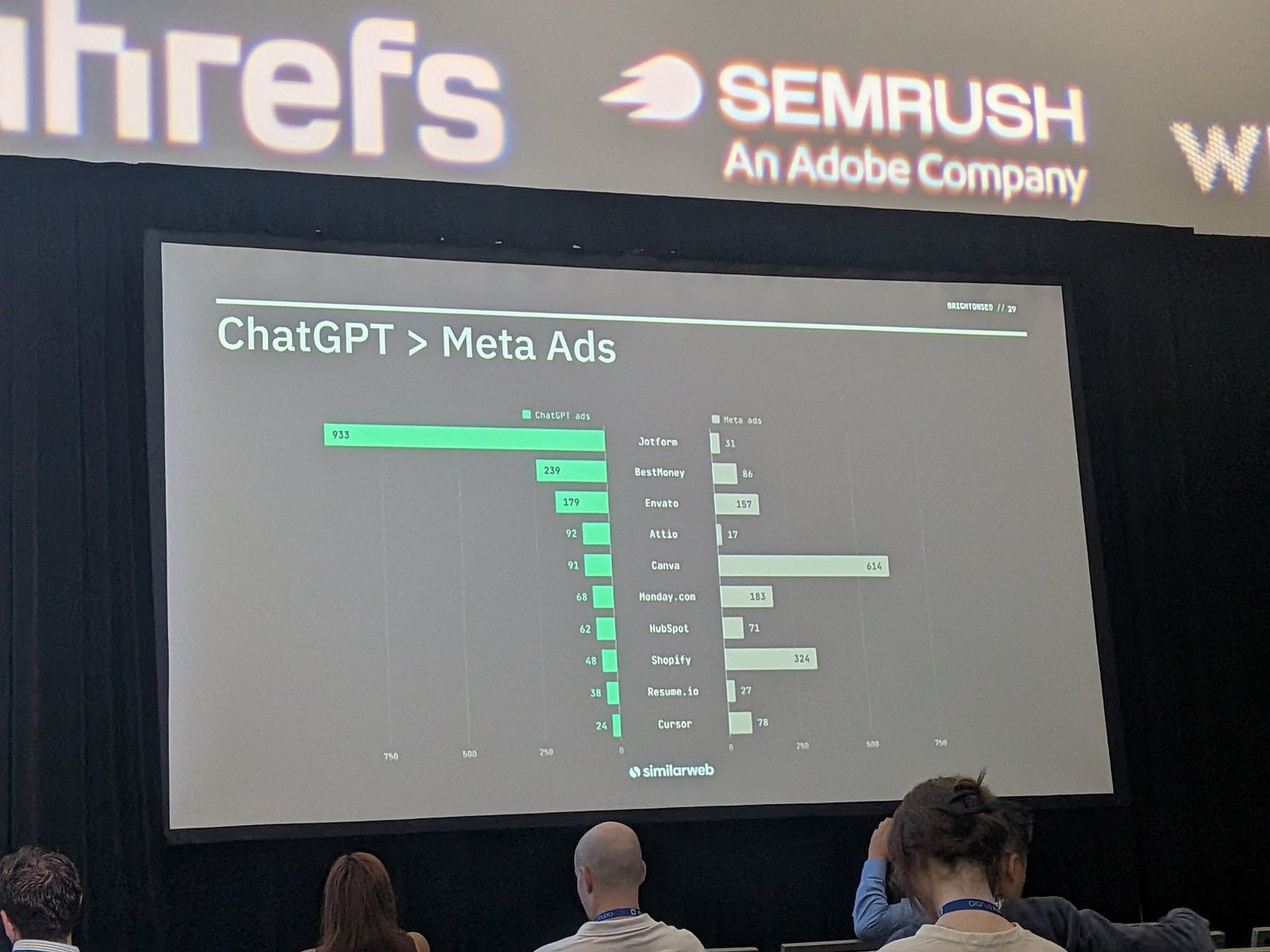
They also test far more variants. Jotform ran 933 ChatGPT ad variants compared with 31 on Meta. BestMoney ran 239 compared with 86, and Attio 92 compared with 17. Not every advertiser leans this way: Canva and Shopify still run far more variants on Meta. But the consistent ChatGPT advertisers are clearly testing heavily, which makes sense for a channel where conversations are long-tail and highly personalized.
Case Study: Graphite’s Own Test
Ethan walked through a test Graphite ran, with total spend of around $13,000.
Setup. Three campaigns, each with a single topic, a single language, and a single landing page. They avoided mixing topics in one campaign so the data would stay clean.
Cost. Cost per click was much lower than on search, about one-sixth, by his figures.
Active management. They didn’t set it and leave it. As data came in, they kept adjusting targeting. At first, the ideal customer profile wasn’t quite right, and lead quality suffered. Adjusting the targeting description improved who the ads reached.
Attribution. This was hard. Graphite asks every inbound lead how they heard about the company. When someone says they found Graphite through AI, they follow up by asking which AI tool it was and what prompt they used. It’s imperfect, but it gives real people’s answers and a picture of the prompts that lead to them.
The Blueprint: 5 Rules for ChatGPT Ads
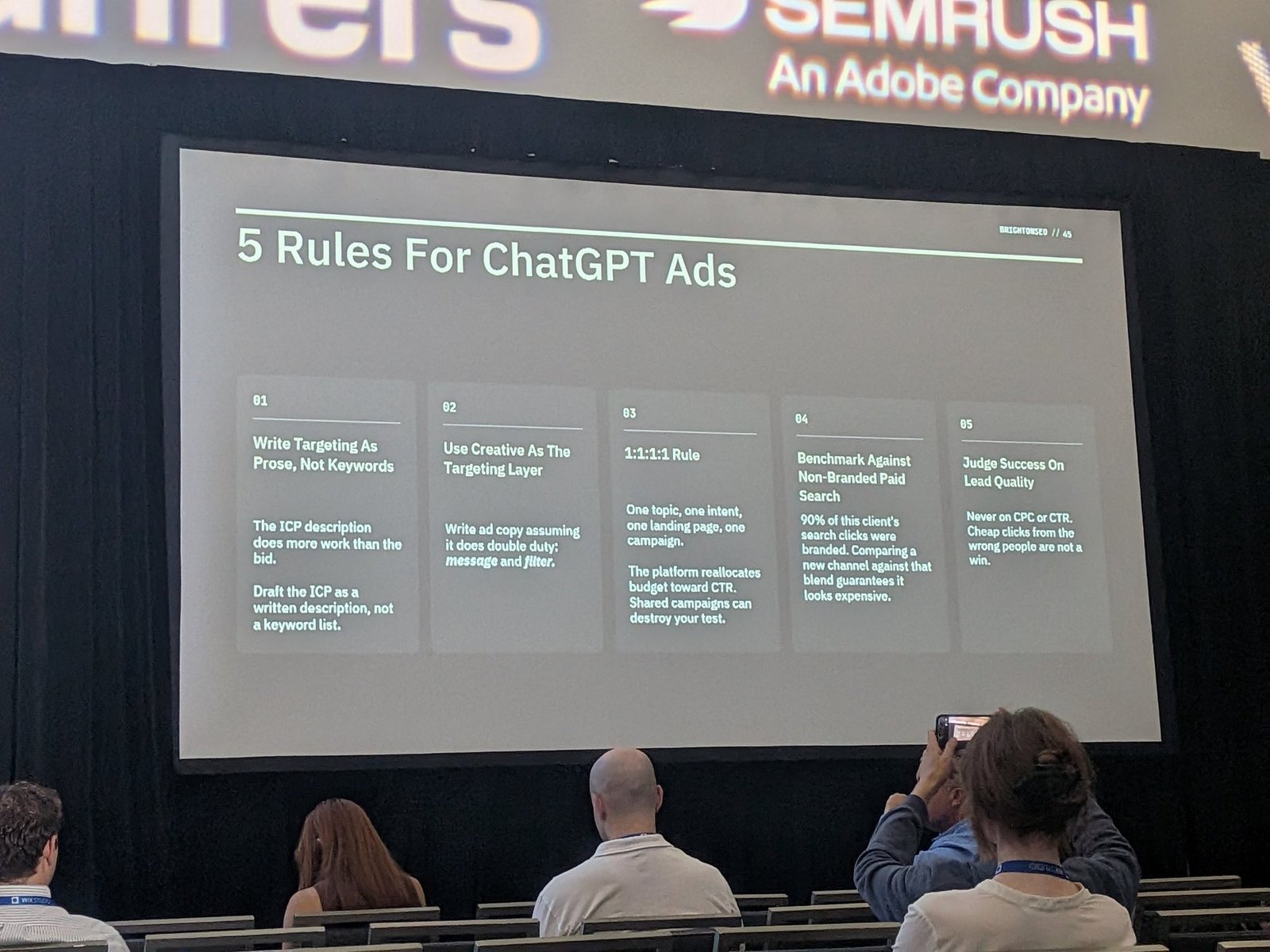
- Write targeting as prose, not keywords. The ideal customer profile description does more work than the bid. Draft it as a written description, not a keyword list.
- Use creative as the targeting layer. Write ad copy assuming it does double duty: it delivers the message and filters out the wrong audience.
- Follow the 1:1:1:1 rule. One topic, one intent, one landing page, one campaign. The platform reallocates budget toward click-through rate, so shared campaigns can ruin your test.
- Benchmark against non-branded paid search. For one client, 90% of search clicks were branded. Comparing a new channel against that blend guarantees it will look expensive.
- Judge success on lead quality. Never on CPC or CTR. Cheap clicks from the wrong people are not a win.
What Not to Do
- Don’t put ChatGPT ads on autopilot. Targeting and placement are still imperfect, and active configuration makes the difference.
- Don’t reuse search ad copy. The consistent winners write new copy for the channel.
- Don’t test several topics in one campaign. Budget will flow toward whatever gets clicks, not what you’re trying to learn.
- Don’t let your ads show to people already searching for your brand. You end up paying for users you would have reached anyway.
- Don’t compare against blended search performance. Branded search makes any new channel look bad.
- Don’t give up after one poor run. The data shows how many advertisers stop too early.
Next Steps
- Write your ideal customer profile as a paragraph. Describe who you want to reach in plain language before building any campaign.
- Pick one topic for a first test. Build one campaign with one intent and one dedicated landing page.
- Set a non-branded search benchmark. Pull your non-branded paid search cost per lead to compare against.
- Add two questions to your lead forms. Ask how people heard about you and, if AI, which tool and what prompt.
- Consider markets beyond the US and UK. If you sell into Japan, South Korea, or Latin America, test there.
- Review weekly. Adjust targeting and creative based on lead quality, not clicks.
Personal Takeaways
I didn’t expect a session titled “A Playbook” for AI visibility to be almost entirely about ads, and some attendees may have been surprised. But it turned out to be one of the most practical talks of the morning, precisely because it was specific.
What stood out for me:
- Japan’s click-through rate is the headline for my work. At 1.42%, it’s more than double the US and UK. For brands entering Japan, and for Japanese companies thinking about AI channels at home, that’s a strong reason to test early while competition is still low.
- “Benchmark against non-branded search” is advice that applies well beyond ChatGPT. Blended search numbers hide how much of paid search is simply capturing existing demand. I’ve seen that problem in client reporting many times.
- The lead form questions are worth copying immediately. Asking which AI tool and which prompt costs nothing, and it creates a first-party record of AI influence that analytics can’t provide.
- This connects directly to Baruch Toledano’s argument. He said the model will choose what it chooses, so don’t ignore ads. Ethan showed how to actually run them.
A caveat: the data covers a young ad platform that is changing month to month, so today’s benchmarks may not hold for long. The rules for testing, though, will likely last longer than the numbers.
Related Resources
- Session: AI & Search Behavior, brightonSEO San Diego 2026
- Speaker: Ethan Smith
- Graphite
- Baruch Toledano’s session report: the previous session, on measuring AI’s downstream impact and why AI ads matter
Written by Ayaka Uchida
CEO, A-Digital Works
This report covers Ethan Smith’s session “How to Achieve ROI in AI Visibility: A Playbook” at brightonSEO San Diego, September 16, 2026.
