

TL;DR
- The crisis is real and immediate. Adidas’s CIO told Wendi 42% of their referral traffic is now coming from LLMs. Brand marketers need to change their strategy yesterday, not next quarter
- 69% of Google searches end without a click. McKinsey research suggests consumers are doing AI research first and then going into physical stores — meaning the “missing clicks” are converting in physical retail, just not where the SEO dashboard can see it
- Wendi’s reframe: in location-based retail, brand-level AI visibility and location-level AI visibility behave differently. Brand-level uses traditional query fan-out. Location-level requires a different model that incorporates the user’s location, their LLM memory, and the type of query (branded vs unbranded, objective vs subjective)
- Yext’s research finding: MapQuest is now the #1 indexing site for ChatGPT in location-based retail. Highly structured data, highly available, LLMs hoover it up. Almost nobody is monitoring this
- Claude weights review-response cadence as a citation factor — speed of reply matters, not just review volume. ~5.5% of total ranking weight, but the immediacy is what moves the needle
- Wendi’s biggest tactical win across luxury retail clients (Dolce & Gabbana, Valentino, Max Mara): scaling AI citation pages — high-intent product, location, and category pages built off structured data. One luxury client’s brand page went from <200K impressions to ~2M
About the Session
Track: Retail
Date: Friday 1 May 2026, 09:30 AM
Venue: Skyline, Brighton Centre, Kings Road, Brighton and Hove, BN1 2GR, United Kingdom
About the Speaker
Wendi Sturgis — EVP, International Sales, Yext
Wendi brings 25+ years of executive experience across global technology and marketing organisations. She has held senior leadership roles at Oracle, Gartner, Yahoo!, and most recently served as CEO of Cleverbridge before rejoining Yext — a company she helped found — in October 2025 as EVP / SVP International Sales, responsible for strategy and growth outside North America. Wendi is a five-time public-company board member, currently serving on the boards of Sabre and the Georgia Tech Foundation; she is a Georgia Tech graduate, a former Columbia Business School adjunct professor, and recently completed MIT’s AI/ML Intensive programme. Her Day 2 morning session sat in the Skyline Stage retail track alongside Malte Landwehr’s “How ChatGPT Shops” research — and the two sessions reinforced each other meaningfully throughout.
The Crisis Framing
Wendi opened by surveying the room: have people seen click-through rates dropping and CPCs going up? Almost every hand in the room.
The headline anecdote, delivered as a warning shot: a friend of hers — the CIO of Adidas — told her recently that 42% of their referral traffic is now coming from LLMs.
“Adidas is one of the biggest retailers in Europe. You have to change your strategy yesterday because the paradigm has changed.”
Other data points she anchored:
- 69% of Google searches end without a click
- Searches per user are decreasing across most brands Yext works with
- CPCs are rising 5–8% as the available SERP space narrows and the auction gets more competitive
Most strikingly, Wendi referenced new McKinsey research she’d seen the night before: consumers are doing their AI research first and then going into physical stores to convert. The “missing clicks” haven’t disappeared — they’ve been redirected. They’re just no longer visible to GA4 because they end as a footstep through the door rather than an attribution-tagged session.
For retail and location-based businesses, this is both bad news (online attribution looks worse) and good news (the journey still ends at your point of sale, you just need a different way to measure influence).
European Adoption Catching Up Fast
Wendi flagged a behavioural shift that’s happening faster in Europe than most brands assume.
“Microsoft says German users are using ChatGPT and the other LLMs more than American consumers. That’s a different moment for Europe — and as an American, I can point that out.”
Seven years ago, when Wendi was helping Yext expand into Switzerland, the response from local clients was that nobody would search online for wealth advisors. That assumption held for a few years. It doesn’t hold now. AI adoption in Europe is at parity with or ahead of US adoption in several markets — Germany, Finland, Italy, France particularly.
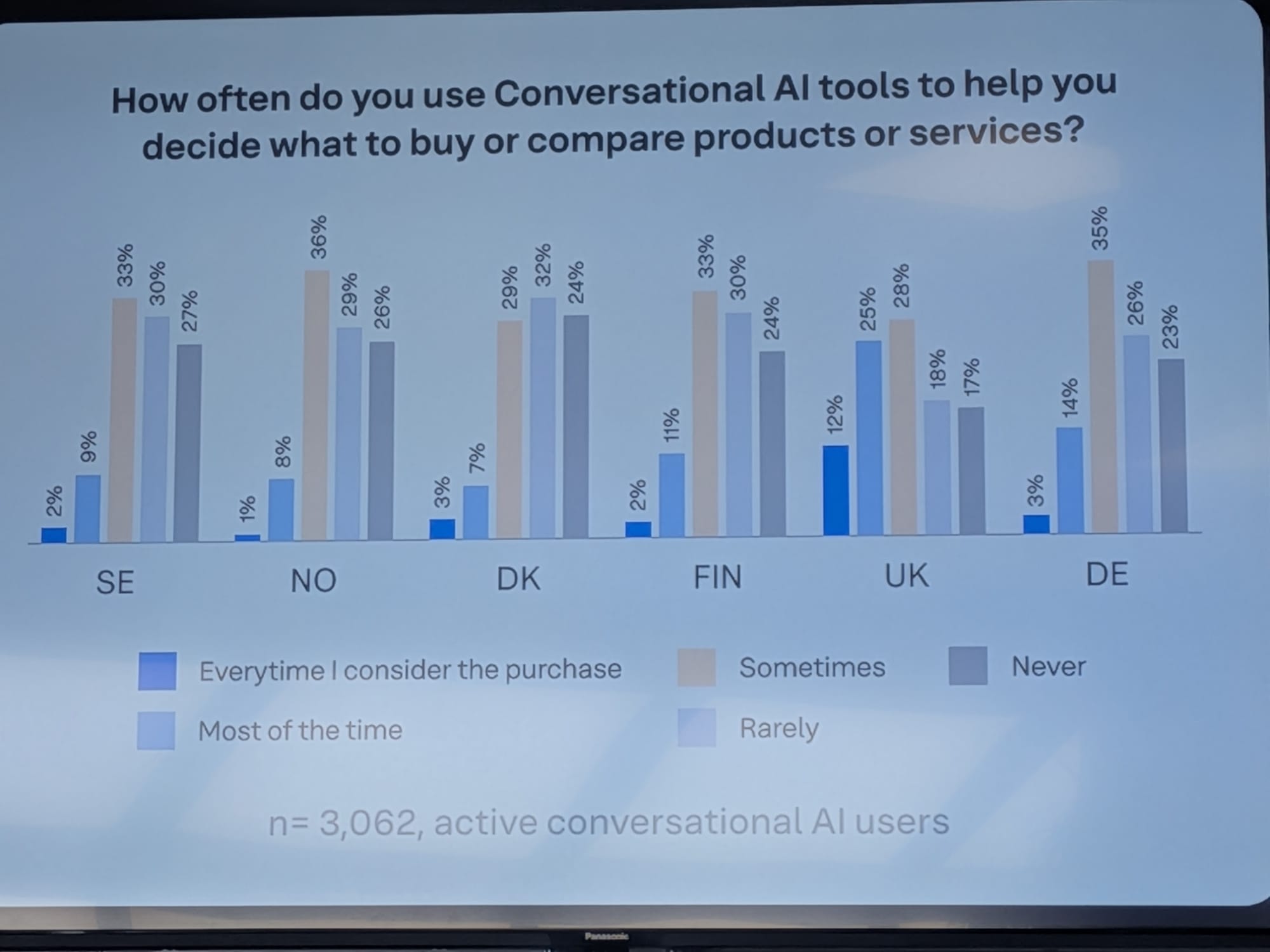
The strategic implication for European brands: don’t assume you have time. The behavioural change has already happened in your market.
Brand-Level vs Location-Level AI Visibility
The most analytically distinctive part of the session was Wendi’s framing of how AI engines treat brand-level visibility differently from location-level visibility.
Brand-level visibility — the territory most AI visibility tools (Profound, Ahrefs Brand Radar, Semrush AI Toolkit) focus on. Built around query fan-out, brand citation tracking, share of voice in responses across 4–6 LLMs. The standard prompt patterns:
![Slide from Wendi Sturgis's BrightonSEO 2026 session showing the standard brand-level prompt patterns AI visibility tools track: Where is [brand] located, What are [brand]'s main products, What makes [brand] unique, What discounts does [brand] offer, What are the reviews for [brand] — all feeding into 'Collect Citations'](https://a-digitalworks.com/wp-content/uploads/2026/05/WhatsApp-Image-2026-05-11-at-09.31.17-2.jpeg)
Location-level visibility — different ground entirely. AI engines incorporate:
- The user’s actual location (GPS-determined, similar to Google Maps’ implicit location signal)
- The LLM interface and memory state (a Florida-based user gets different responses to the same prompt than a London-based one)
- The query type — Yext categorises as branded vs unbranded × objective vs subjective
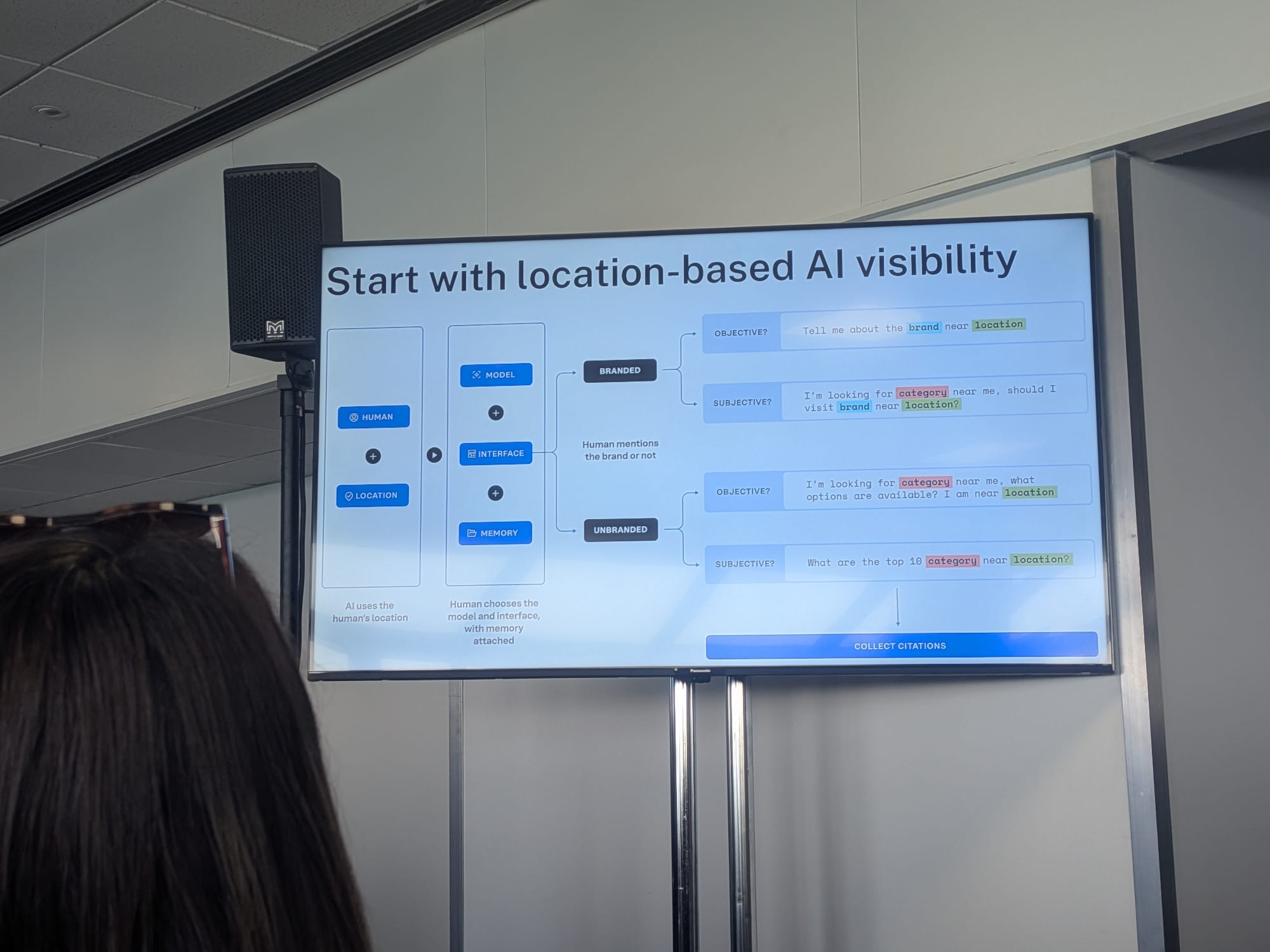
Yext acquired a company called Scout about a year and a half ago, specifically to get to this granularity. The platform analyses citations at the individual physical location level, then rolls up to city, state, country.
The strategic point: most “AI visibility” reporting today is brand-level only, which means location businesses are flying blind on the surface where conversions actually happen.
What’s Indexed vs What’s Cited
Wendi cross-referenced findings from earlier in the day (specifically Malte Landwehr’s research on ChatGPT shopping running on Google) and added Yext’s own complementary data.
Before the indexing rankings, an important hierarchy: how much control brands actually have over the channels AI engines pull from.
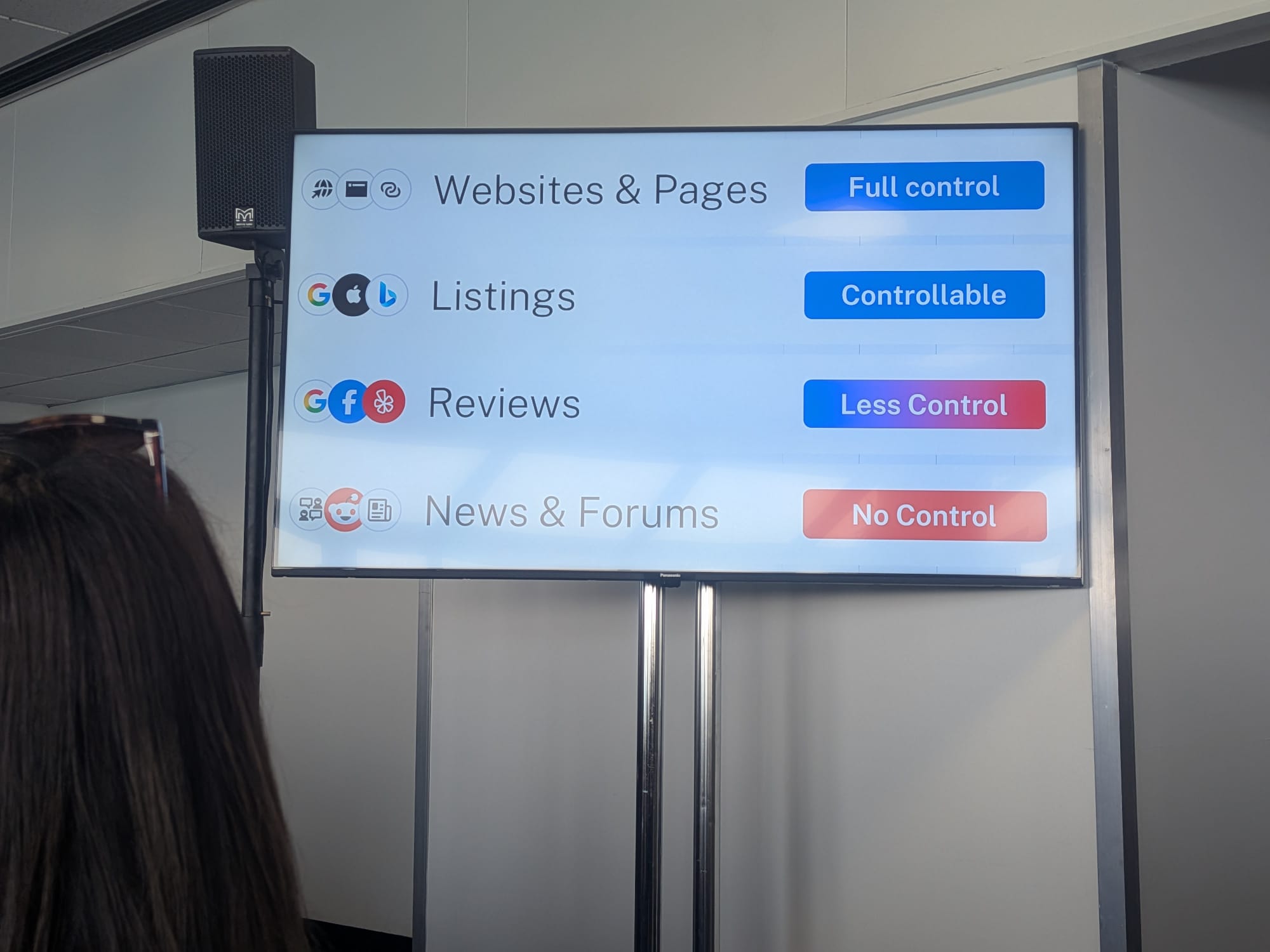
Heavily indexed by LLMs in location queries:
- Brand websites (especially store locator pages and individual store pages with rich schema)
- Listings (highly structured location data — perfect for LLM ingestion)
- Reviews
- Maps platforms
Surprising finding: in Wendi’s words, MapQuest is the #1 indexing source for ChatGPT in location-based retail queries. “Has anyone used MapQuest in the past year?” — zero hands went up in the audience. But ChatGPT is hoovering up MapQuest data because it’s highly structured, highly available, easy to index. Almost no SEO team is monitoring or optimising MapQuest presence as part of their AI visibility strategy.
Lower indexing impact for location businesses:
- Reddit and forum citations (significant for brand-level discussions, much weaker signal for “where should I eat near me?” type queries)
- Editorials in non-local publications
The asymmetry between brand-level and location-level matters for strategy. The Reddit-heavy advice that dominated Day 1 of the conference — and that Jon Earnshaw and Pablo López both anchored their sessions around — applies more strongly to brand-level AI visibility than to location-level AI visibility.
The Knowledge Graph Imperative
Wendi spent useful time on Yext’s Knowledge Graph — what she called “my favourite part of our technology” — and the underlying argument that LLMs require structured, consistent, entity-related data to index correctly.
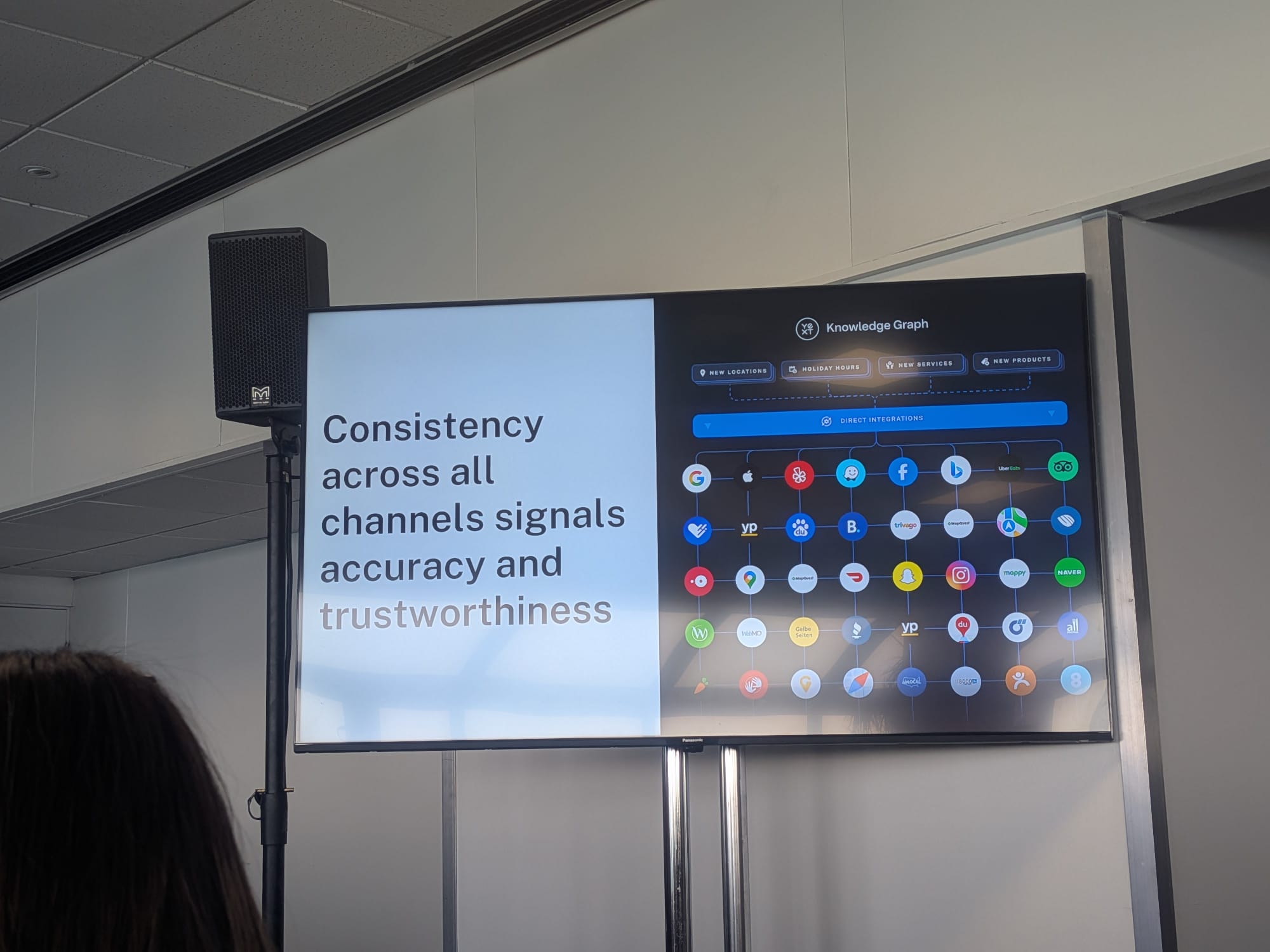
Her scale example: Lloyd’s Bank has 275,000 data elements in Yext’s Knowledge Graph — across eight lines of business, each with multiple products and locations, all entity-related to each other.
The technical argument behind the pitch: LLMs operate on vector databases (Wendi noted she completed MIT’s AI/ML Intensive programme specifically to understand the technology behind her industry). Vector retrieval is fundamentally about semantic consistency. If the same brand appears with five different addresses, three different opening hours, and inconsistent service descriptions across the web, the LLM cannot build a coherent vector for that entity.
Wendi’s three-tier data taxonomy for trust-building:
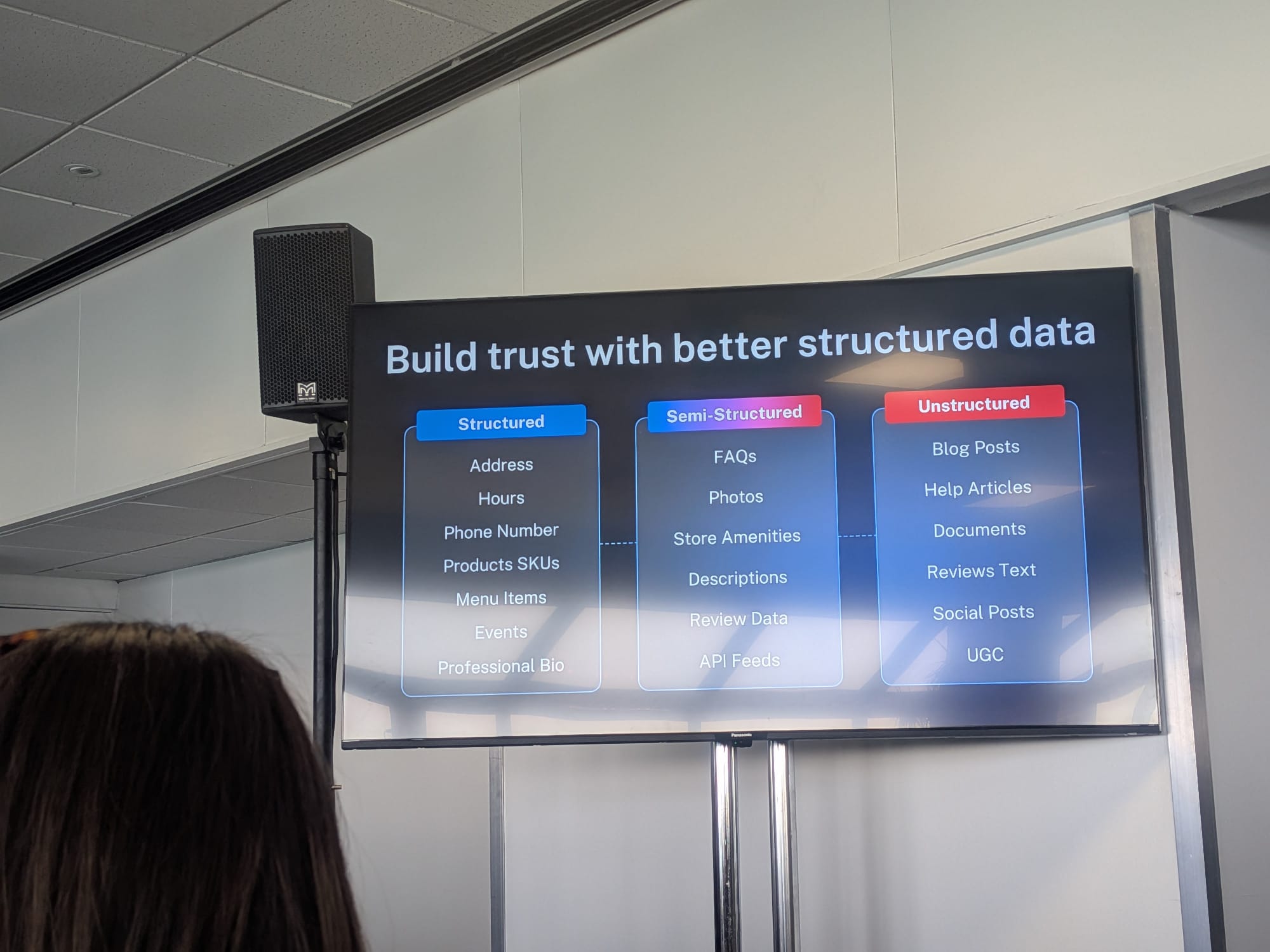
Practical implication: structured data hygiene now has direct citation consequences, not just SEO consequences. The CMS you use to manage your data needs to function as a true entity database, not just a content management layer.
Reviews: Smaller Weight Than You Think, More Important Than You Realise
Wendi’s review data complemented Sam Davis’s later session (also from Yext) but with operational specificity:
- Reviews are roughly 5.5% of ranking weight — much smaller than most assume
- But two factors disproportionately affect citation outcomes:
- Immediacy of response — replying within 90 seconds correlates with a 0.1 ranking lift
- Content of the response — using the keywords and intentional phrasing you want to rank for, in the response itself, has measurable impact
- 4.5 stars is the tipping point for higher click-through rate
Yext’s product uses AI to handle 85–90% of review responses automatically, flagging only those with sensitive content or very negative sentiment for human review. The reasoning: scale + speed beat hand-crafted replies for the citation outcome metrics that matter.
This is one of the cleaner, more replicable tactical insights from the conference. Most local SEO teams treat review responses as a customer-service activity. Treating it as an AI citation factor — with response cadence and keyword content as deliberate variables — is a workflow change small enough to implement immediately.
Specsavers: A Cohesive Strategy in Action
Wendi’s case study client of choice — Specsavers — was ill on the day and couldn’t be there in person, but Wendi walked through their results across the four LLMs Yext monitors (Perplexity, Claude, ChatGPT, Gemini):
- 25% increase in listings clicks after the new strategy was implemented
- 85% average mention rate across AI responses
- 1.5 average rank in AI mentions (where ranked = appears in the citation list)
The strategic ingredients: search optimisation feeding listings management feeding reviews response cadence — operating as a single workflow rather than as siloed tactics.
“That’s where all of us — and our clients — want to be.”
AI Citation Pages: The Biggest Single Hack
The most actionable tactical takeaway of the session.
Wendi’s term: “AI citation pages” — high-intent pages structured around products, services, locations, capabilities, FAQs, generated programmatically from a brand’s structured data and pushed live alongside the core website.
The strategic logic: most brand websites have a core marketing site that’s deliberately curated. AI engines need much higher data density and much broader entity coverage than a curated marketing site provides. The solution isn’t to bloat the marketing site — it’s to build a parallel surface (subdomain, dedicated pages) that exists primarily to be indexed by AI.
Yext’s Italian and French luxury clients — Dolce & Gabbana, Valentino, Max Mara — all use this strategy. Wendi described one Italian luxury client whose brand page went from less than 200K impressions to roughly 2M impressions after the AI citation page strategy was implemented. The Google search impression gain on the intent pages was 172%.
For a postal service client of Yext’s, the strategy resulted in dominating the entire right rail of ChatGPT for relevant queries. That’s the kind of share-of-voice outcome that brand marketers historically only achieved through paid placement.
The structural advantages:
- Pages are not listicles, not editorials — higher quality
- Live on a subdomain or dedicated path of the brand’s main domain (so trust signals carry over)
- Index well in Google as a side effect — two-for-one outcome
- No upper limit on scale: small businesses with one location have built 800 intent pages per location
3 Moves You Can Make Monday Morning
Wendi closed with an explicit, executable framework — the kind of close that BrightonSEO sessions usually skip in favour of grand strategic claims.
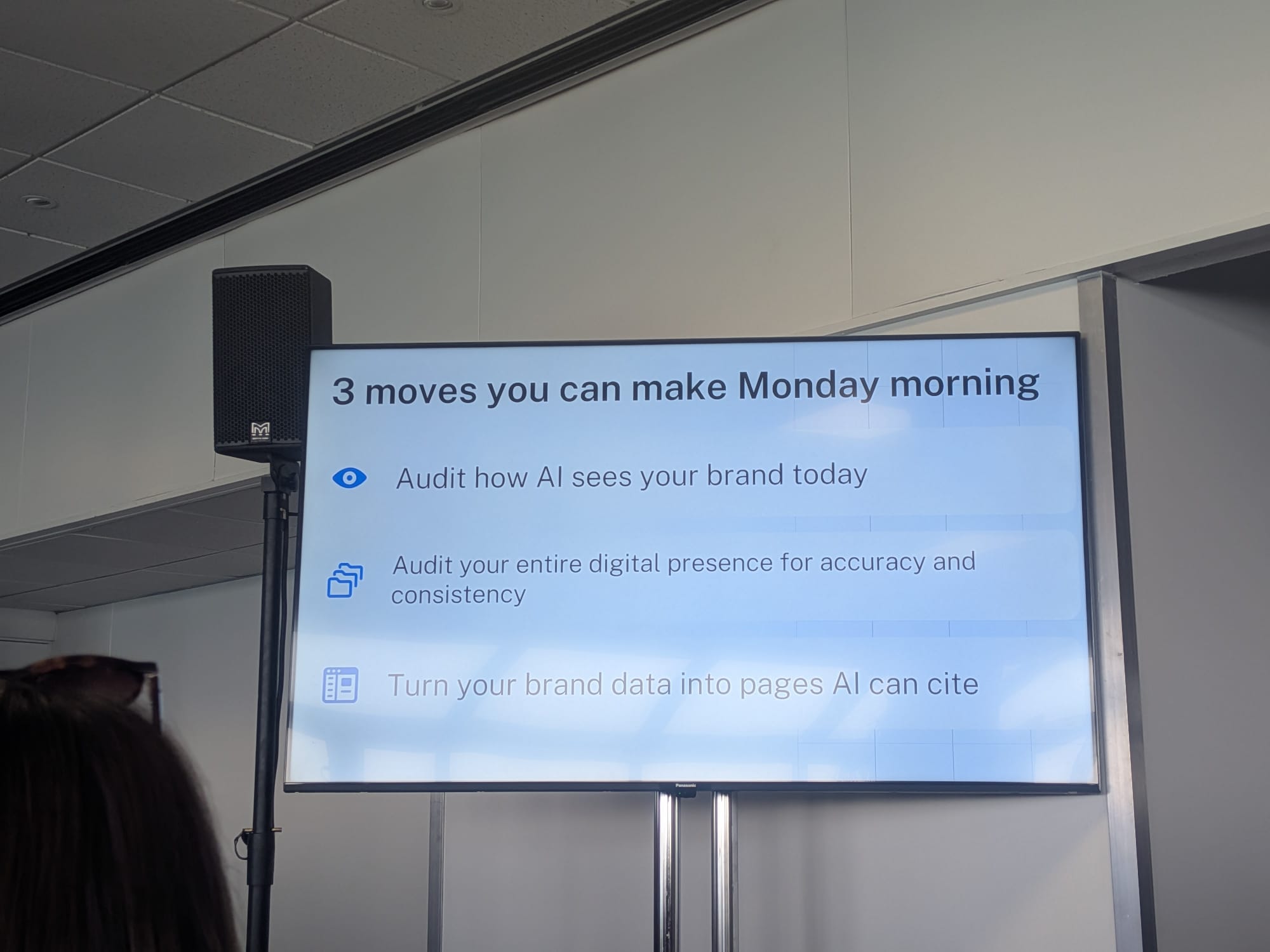
- Audit how AI sees your brand today. Run the standard prompt patterns across the four major LLMs at brand level and at location level. Most brands have never done the location-level audit.
- Audit your entire digital presence for accuracy and consistency. Address, hours, phone, services, descriptions across every platform — including the ones you’ve forgotten about (MapQuest, Apple Maps, Bing Places, Naver, regional directories).
- Turn your brand data into pages AI can cite. The AI citation pages strategy — even at smaller scale than Lloyd’s Bank or Dolce & Gabbana, this is the single highest-leverage move available.
Personal Takeaways
This is my third BrightonSEO (Brighton 2025, San Diego 2025, Brighton 2026), and Wendi’s session was one of the strongest from the senior-leader perspective at the conference. Most BrightonSEO speakers come from the practitioner or research side. Hearing from someone who has run major SaaS organisations, served on multiple public-company boards, and been in marketing since online advertising was a $1B industry produces a different kind of insight — strategic context that practitioner sessions rarely include.
What I’m taking home:
- The Adidas 42% number is the single most useful headline statistic for client conversations. A C-suite executive at a major European retailer disclosing that nearly half their referral traffic is now LLM-driven is the kind of evidence that ends the “do we really need to invest in AI search?” debate at the boardroom level.
- The brand vs location AI visibility distinction is one I’ve been collapsing. Most of my client work for international brands entering the UK or Japanese market involves location signals — physical store presence, regional listings, market-specific reviews. Tracking only brand-level AI mentions has been giving me an incomplete picture. I’ll be auditing the AI visibility tooling I use against the brand-vs-location framing.
- MapQuest as ChatGPT’s #1 location indexing source is the surprise of the session. A platform almost no SEO team I know is actively monitoring is doing meaningful citation work. I’ll be checking client MapQuest profiles and ensuring data hygiene there as a Monday-morning task.
- The AI citation pages strategy is portable but capital-intensive. Building 800 intent pages per location requires either Yext-style structured data infrastructure or significant manual work. For smaller A-Digital Works clients, the question is whether a smaller-scale version (50–100 high-intent pages mapped from existing structured data) is achievable without that infrastructure. Worth piloting.
- The review response cadence + keyword content combination is a small operational change with measurable upside. I can implement that on client engagements within a week without new tooling.
Across the BrightonSEOs I’ve attended, the strongest data-driven sessions have come from large platforms with proprietary panel data (Semrush, Ahrefs, Yext, Moz). Wendi’s session sat with that group. The difference between Wendi and Sam Davis (also Yext, also speaking on Day 2 afternoon) was useful in another way: Wendi spoke as the senior leader who built the strategic frame; Sam spoke as the practitioner who works inside it. Two views of the same dataset, complementary rather than redundant.
Combined with Tom Capper, Ryan Law, Philip Armstrong, Malte Landwehr, and Pete Meyers, Wendi rounds out the small group of speakers from BrightonSEO Brighton 2026 whose research I’ll be pointing clients at when the videos go live.
Related Resources
- Session: Win AI Search in retail with what you already have (BrightonSEO)
- Speaker profile: Wendi Sturgis (BrightonSEO)
- Wendi Sturgis on LinkedIn
- Yext — the brand visibility platform Wendi leads internationally
- Sam Davis’s session report — Day 2 afternoon session from Wendi’s colleague at Yext, useful as a complementary practitioner-view follow-up
About the Author
Ayaka Uchida (打田彩夏) — Founder & CEO, A-Digital Works Ltd. Founder, Nihon GO! World (London Fitzrovia & Manchester). Over a decade of international business development across Japan, Singapore, the US, and the UK. Three-time BrightonSEO attendee (Brighton April 2025, San Diego September 2025, and Brighton April 2026 — the latter on scholarship). Aoyama Gakuin University Faculty of Law. Fluent in Japanese and English; studying Spanish, French, and German.
Connect: a-digitalworks.com | LinkedIn
About A-Digital Works
A-Digital Works Ltd is a London-based Japan–UK SEO and EN↔JA localisation consultancy supporting UK, EU, and US companies entering the Japanese market. Services span keyword research in Japanese, content localisation, technical SEO, and market entry strategy. Flagship case study: Descartes Systems Group (Canadian logistics technology) — full Japanese-market SEO programme covering 物流システム, EDIシステム, and 配車システム.
This report covers Wendi Sturgis’s session “Win AI Search in retail with what you already have” at the Skyline Stage of BrightonSEO Brighton on Friday 1 May 2026.
