

TL;DR
- 47% of people have used AI to conduct a search; 93% of AI-driven searches end without a click — traffic alone has stopped being a complete proxy for SEO value
- AI is “the world’s biggest gossip” — it pulls from YouTube, Reddit, and other third-party sources as much as from your own domain, which means SEO work has to extend beyond on-domain optimisation
- Jack proposed a four-part Search Influence Framework: SERP Visibility, AI Citations & Mentions, Behavioral Signals, Revenue Influence
- The Reach Factor is a single-number metric for stakeholder reporting: total revenue influenced divided by directly attributable revenue
- For Jack’s agency, statistical attribution (causal modelling + regression models) is how they connect upstream visibility work to downstream revenue uplift that GA4 can’t see directly
About the Speaker
Jack Lingard – Head of Search, Anything is Possible
Jack leads search at Anything is Possible, a Manchester-based marketing agency. His talk focused on the measurement problem facing SEO in a zero-click, AI-mediated search environment, and shared the framework his team uses to defend SEO budgets to stakeholders who only want to see GA4 traffic numbers go up.
The Problem: Traffic Alone Can’t Tell the Story Anymore
Jack opened with a measurement crisis: SEO continues to drive real value, but the dominant reporting metric — clicks — increasingly fails to capture it.
Two stats anchored the problem:
- 47% of people have used AI to conduct a search
- 93% of AI searches end without a click to an external site
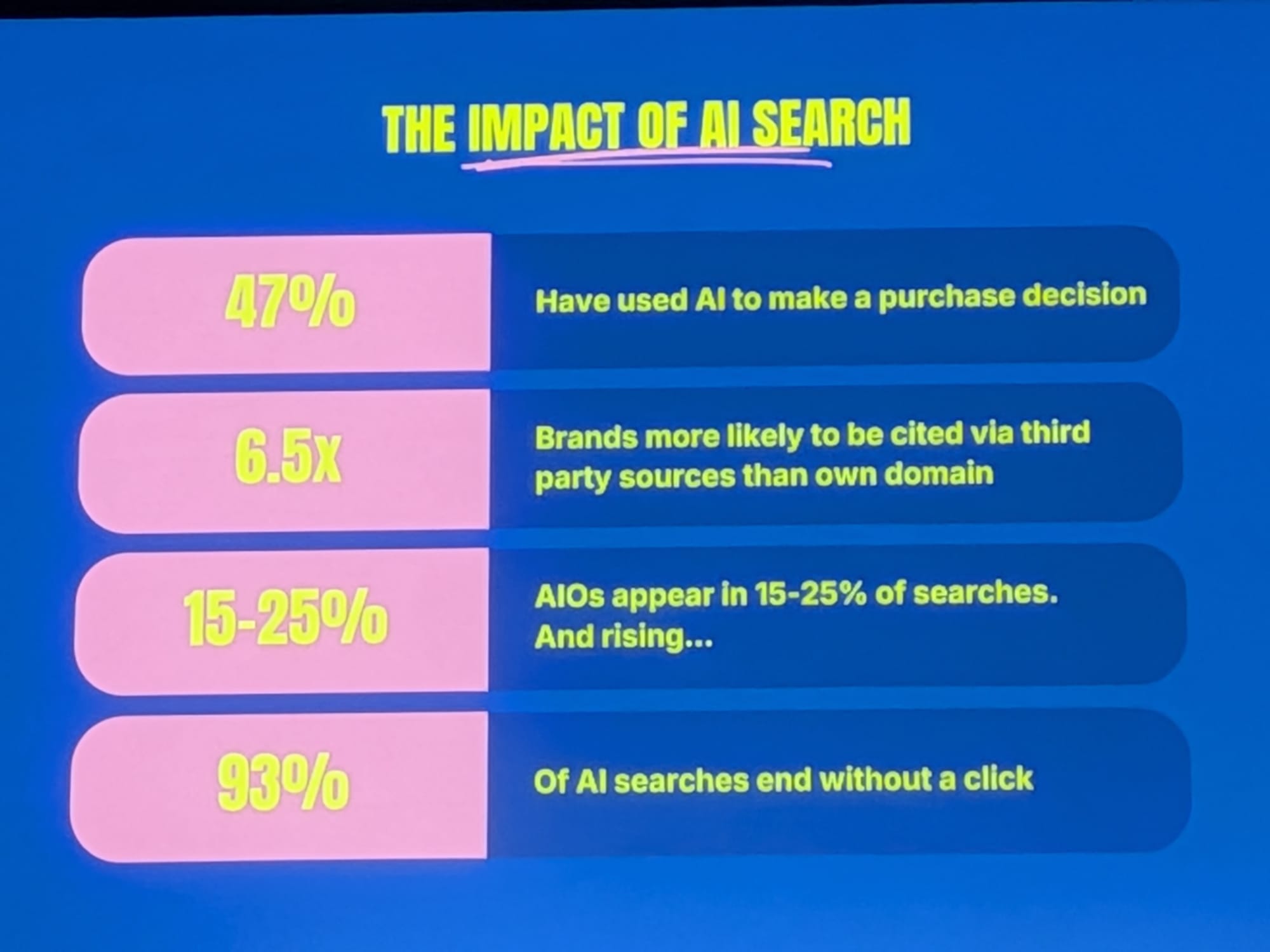
Traffic still matters — Jack was clear that nobody should ditch it as a metric. But if 93% of AI-mediated journeys end inside the AI response, and a growing share of users start their search journey in AI in the first place, then a traffic-only scoreboard misses most of what’s actually happening. Brands are showing up in AI responses, in featured snippets, in Reddit threads, in YouTube clips — none of which routes cleanly through GA4 as “organic search.”
The risk: stakeholders see flat or declining traffic in a quarterly report and conclude SEO isn’t working. The reality is often the opposite — but you have to prove it.
AI as the World’s Biggest Gossip
Jack’s framing for what AI search actually does: it’s the world’s biggest gossip. It aggregates information from across the web — your own domain, yes, but heavily from third-party sources. YouTube is one of the most heavily cited sources by AI engines. Reddit appears prominently in product, comparison, and “best of” responses. A long tail of third-party media fills in the rest.
The strategic implication is significant: you have to be present across these surfaces, not just optimised on your own domain. Brands that appear consistently across third-party sources are meaningfully more likely to be cited by AI engines.
This pushes SEO into territory traditionally owned by PR, content marketing, and brand teams. Which raises the obvious problem: how do you prove the value of work that happens outside your own site, with no GA4 path back to it?
Jack reached for the Oscar Wilde line — “There is only one thing in the world worse than being talked about, and that is not being talked about.” In a zero-click, AI-mediated search world, that’s not just a witty quote. It’s the brief.
The Search Influence Framework
Jack’s answer is a four-pillar framework his team uses for measurement and reporting.
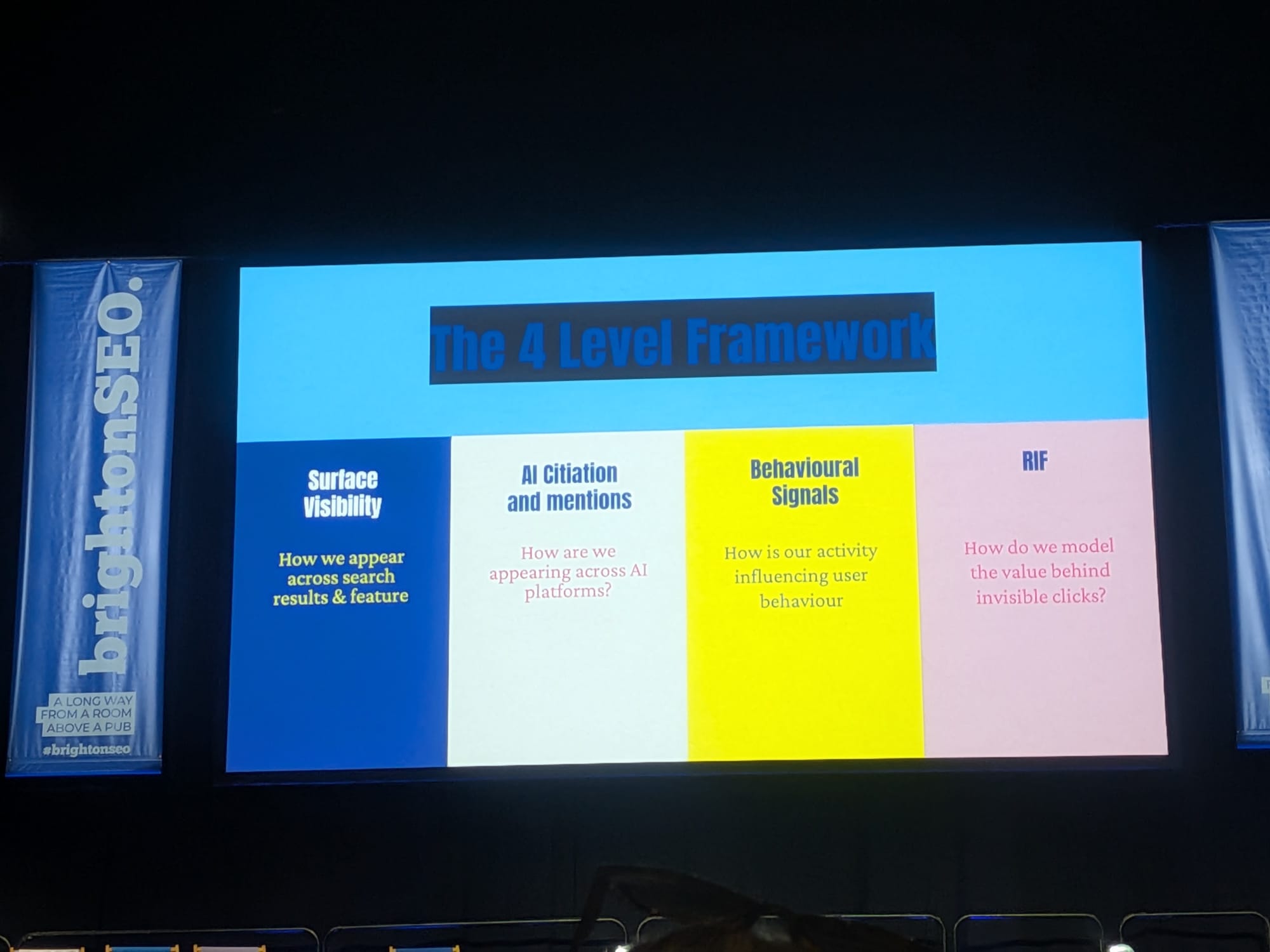
1. SERP Visibility
The familiar territory. Keyword rankings, share of voice on page 1, share of pixel real estate (where applicable), AI Overview appearance and citation rate. Jack noted that being included in an AI Overview, even without a click, increases the likelihood of being seen — and being seen is the precursor to almost everything else.
2. AI Citations & Mentions
Tracked using a growing category of AI visibility tools (Jack referenced his agency’s stack and offered to share specifics one-on-one after the session). The key sub-metrics:
- Topical coverage — what would your client realistically be known for in their industry, and how often are they cited for those topics in AI responses?
- Sentiment — how AI engines describe the brand
- Position within the response — being mentioned at the top of an AI answer versus buried at the bottom
3. Behavioral Signals
This is where SEO meets brand marketing. As visibility increases across AI surfaces and third-party sources, behaviour changes downstream — even when none of those touchpoints directly drives a session. Things to track:
- Direct traffic (GA4)
- Branded search volume
- Returning users
- LLM referral traffic (a newer GA4 dimension)
These are lagging indicators, but over a long enough window they’re more honest than rank reports.
4. Revenue Influence
The metric stakeholders actually care about. Connecting all of the above back to bottom-line numbers — and the heart of Jack’s talk.
Modelled Revenue and the Reach Factor
The most concrete part of Jack’s session was how his team handles attribution for the work that doesn’t show up neatly in GA4.
Two statistical approaches sit behind it:
- Causal modelling
- Regression modelling
(Jack flagged these as heavier topics and offered to talk methodology in detail one-on-one.)
The principle: when you’ve worked on a campaign and you observe that AI mentions have increased, topical coverage is up, and direct or referral traffic has lifted in correlated patterns over time, you can statistically estimate what portion of the revenue uplift can be attributed to the SEO work — even though no single GA4 path traces back to a specific page.
This becomes modelled revenue — traffic and value you’ve influenced but can’t directly attribute.
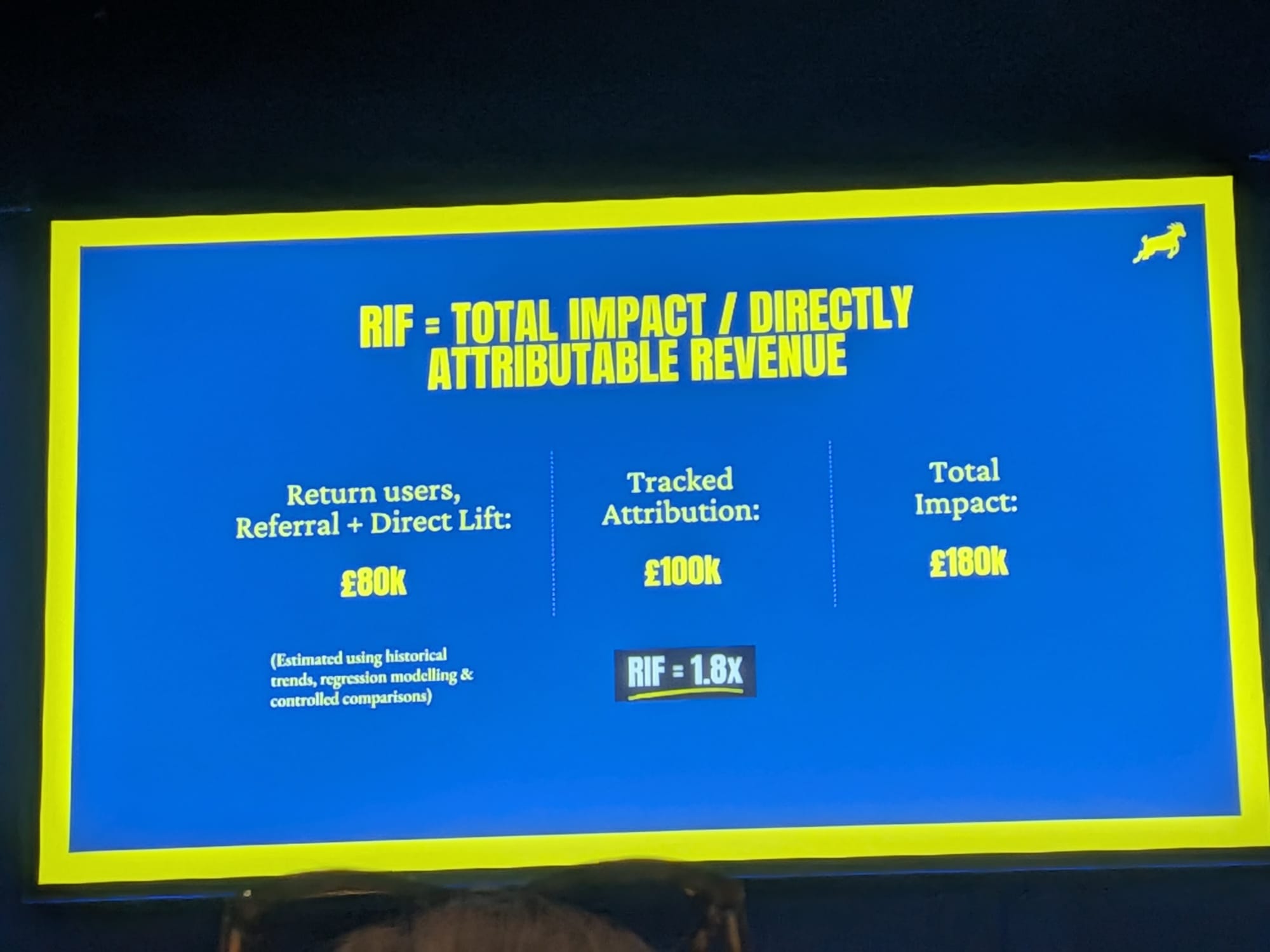
The Reach Factor compresses this into a single, stakeholder-friendly number:
Reach Factor = Total Revenue Influenced ÷ Directly Attributable Revenue
Jack’s example: a campaign with directly attributable revenue plus a measurable lift across other channels (more direct traffic, more brand search, more referral traffic) yielded a Reach Factor of 1.8. In plain language: for every £1 of revenue GA4 attributed directly, another £0.80 of revenue was influenced by the work but invisible to default tracking.
The estimation isn’t perfect — Jack was upfront that the “Total Revenue Influenced” side has to be modelled using historical trends, regression analysis, and controlled comparisons. But a defensible estimate beats a metric that completely ignores invisible influence.
The Closing Argument: Make Yourself Heard, and Make It Count
Jack’s wrap-up was direct: SEO is still a top-of-funnel discipline, and SEO teams have spent too long selling themselves short by reporting only on what they can directly attribute. Brand and PR teams have always operated this way — claiming credit for influence they can’t directly trace, with the methodology to back it up. SEO needs to do the same.
Two action items:
- Track the things outside your own domain — AI citations, brand mentions in third-party sources, share of voice in AI conversations
- Report on those things rigorously — with statistical models, not vibes
Personal Takeaways
Most of the underlying ideas in Jack’s session were familiar. The “AI-search measurement crisis” framing has been a steady drumbeat across the two previous BrightonSEOs I attended — Brighton 2025 and San Diego 2025 both had multiple sessions arguing some version of this thesis — and the call to look beyond direct attribution has been on industry stages since at least 2024. So this wasn’t a session that introduced new strategic territory for me.
What I did find useful was the Reach Factor as a single-number reporting metric. The maths underneath it (causal modelling, regression) isn’t novel either — MMM teams have been doing this in adjacent disciplines for years — but compressing the result into “for every £1 of directly attributed revenue, another £0.80 was influenced” is the kind of phrasing a CFO can engage with. “Improved share of voice in AI Overviews” is not. That packaging alone is worth borrowing.
A few honest practical questions I’m sitting with after the session:
- Which clients actually have enough clean historical data for causal or regression-based attribution to be defensible?
- For clients who don’t, what minimum tracking foundation has to be built before this kind of analysis is even possible?
- How do you present the Reach Factor in a monthly report without overstating the model’s confidence?
The framework is portable. The challenge is doing the underlying analytics work properly — which, as Jack himself noted, is harder than it sounds.
Related Resources
- Session: How to Prove SEO Works When It No Longer Drives Traffic
- Speaker: Jack Lingard
- Jack Lingard on LinkedIn
- Anything is Possible — Jack’s agency
Written by Ayaka Uchida
CEO, A-Digital Works
This report covers Jack Lingard’s session “How to Prove SEO Works When It No Longer Drives Traffic” at BrightonSEO Brighton, April 30, 2026.
About A-Digital Works
A-Digital Works Ltd is a UK-registered Japan-localisation and SEO consultancy founded in London in 2023. We specialise in helping English-speaking companies successfully enter the Japanese market through high-fidelity EN↔JA localisation, brand voice adaptation, and Japan-market SEO strategy.
We work with B2B brands targeting Japanese enterprise audiences, providing large-scale corporate localisation, Japan-market content production, and ongoing SEO consulting tailored to the unique characteristics of the Japanese search and content landscape.
About the Author
Ayaka Uchida (打田彩夏) is the Founder & CEO of A-Digital Works Ltd. She is also the founder of Nihon GO! World, a Japanese language school operating in London (Fitzrovia) and Manchester. Ayaka has 10+ years of international business development experience across Japan, Singapore, the US, and the UK, and has attended BrightonSEO three times: Brighton April 2025, San Diego September 2025, and Brighton April 2026 (the latter on scholarship).
She is a graduate of Aoyama Gakuin University, Faculty of Law, and is fluent in Japanese and English. She is currently studying Spanish, French, and German.
Get in touch: a-digitalworks.com
LinkedIn: Ayaka Uchida
